How to Reduce Failed Delivery Attempts (Couriers’ Biggest Hidden Cost)

How to Reduce Failed Delivery Attempts

How to Reduce Failed Delivery Attempts (Couriers’ Biggest Hidden Cost)

user profile

Bodha Route

July 3, 2026

Table Of Content

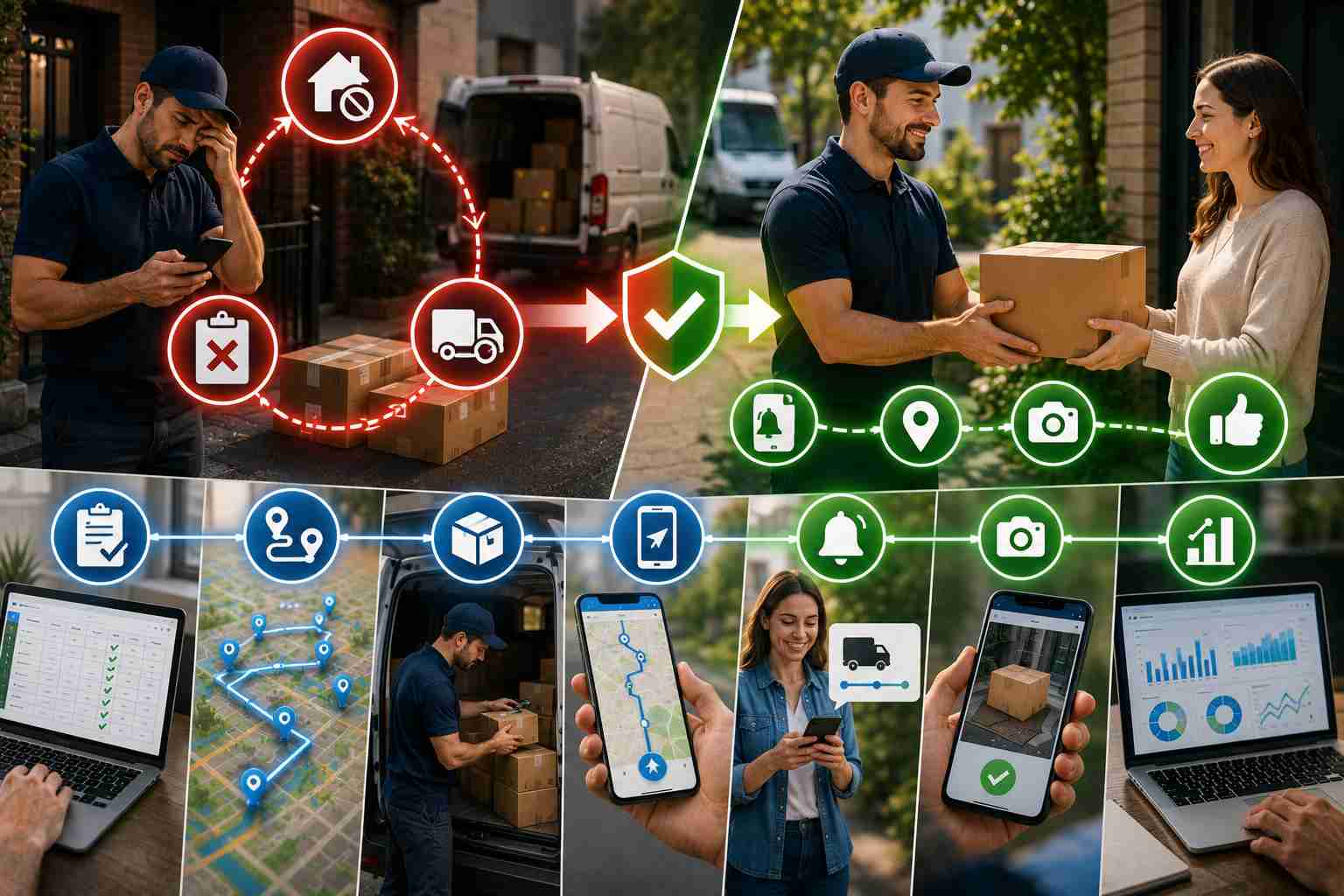
Ask a courier where their money leaks and they will usually point at fuel. Fair enough, you can watch fuel drain at the pump. But there is a bigger leak most operators barely track, because it hides inside “normal” operations: the failed delivery attempt. The parcel that comes back because nobody was home, the address was wrong, or the driver could not get through the gate. Each one feels small. A quick “we will try again tomorrow.” But learn to reduce failed deliveries and you often find more profit there than in any fuel saving, because a failed attempt is not one wasted trip. It is unpaid work you end up doing twice, plus a stack of hidden costs that never show up on a delivery report.


This is the playbook for shrinking that number. First, what a failed attempt truly costs, because the real figure is worse than it looks. Then why deliveries fail. Then the concrete moves that push your first-attempt success rate up where it belongs.

What a failed delivery attempt actually costs

Most couriers log a redelivery and move on, which badly undercounts the damage. Let me total it up properly.

The direct cost of a single failed attempt runs about $17.78 on average once you add the wasted drive, the driver’s time, and the handling. The reattempt then costs two to three times the original delivery, because you are sending a van out a second time for one parcel. And this is not rare. Somewhere between 5 and 15 percent of deliveries fail on the first go, depending on the area and the type of drop, so on a busy round it is a steady, daily tax.

Now the costs that never make it onto a report. Every failed stop burns ten to fifteen minutes of a driver’s day, time that should have gone to a paying drop. The “where is my parcel” calls that follow eat your office hours, and those queries make up close to a fifth of all support tickets across the industry. Then there is the customer. Between a quarter and a third of people will not order again after a delivery falls over on them. You did not just lose a trip. You lost the account and every order behind it.

Stack all of that and the true cost of a failed attempt is usually put at $25 to $40 once you count service time and lost business, not the $17 the redelivery line suggests. Multiply by your failure rate across a year and it is one of the largest, quietest costs in the whole operation. Which is exactly why it is worth attacking properly.

Put it in real numbers

Percentages slide off the brain, so let me make it concrete. Say you run 40 stops a day, five days a week, and 8 percent fail on the first attempt. That is a bit over three failed drops a day, sixteen a week, and somewhere near 800 a year. At a conservative $25 all-in per failure, you are watching roughly $20,000 a year evaporate into redeliveries, wasted fuel, and customers who never come back. And that is a modest failure rate on a small operation. Now flip it. Cut that failure rate from 8 percent to 4 and you have handed yourself back around $10,000 a year, most of it without driving a single extra mile. That is the prize sitting inside this one number, and it is why it deserves more attention than the fuel gauge.

Why deliveries fail in the first place

You cannot fix what you have not named. Nearly every failed attempt traces back to one of five causes, and once you see them, the playbook writes itself.

The recipient is not home. The classic, especially on signature-required parcels. An empty house and the whole trip is wasted. The address is wrong or vague. A missing flat number, a mistyped postcode, two similar street names in the same town. Address errors alone drive up to 45 percent of failed deliveries, and as many as one in five orders arrives with an address that is off in some way. Access problems. A gate code that lived in an email instead of on the stop, a broken buzzer, a business that shut at four. No safe place, so a “leave it somewhere” instruction turns into a carded return. And bad timing, where the driver arrives during the exact window the customer asked them to avoid.

Notice something. Almost none of these are really about driving. They are about information and communication. The right details on the stop, the right order of stops, and a heads-up to the customer knock out most of them before the van even arrives. That is good news, because it means most failed deliveries are preventable without hiring anyone or buying a bigger fleet.

Where your failures are actually hiding

Not every stop fails at the same rate, and knowing which ones fail helps you aim the fixes instead of spraying effort everywhere. Residential deliveries fail far more often than business ones, because homes sit empty during the day while offices are staffed. Signature-required parcels fail more than leave-safe ones, for obvious reasons. First-time customers fail more than regulars, because you do not yet have their access notes or their habits. And certain addresses, the gated estate, the apartment block with the broken buzzer, the office with strict reception hours, will fail again and again until you capture what makes them awkward.

So treat failures as data, not bad luck. If you tag why each one failed, even roughly, patterns surface within a fortnight. Maybe one estate accounts for a fifth of your misses. Maybe your afternoon residential runs fail twice as often as your morning business drops. Once you can see it, you can fix it, by resequencing those stops into a better time slot, adding the missing note, or nudging the customer to name a safe place. Guesswork keeps you parked at the industry-average failure rate. Paying attention is how you beat it.

The playbook to reduce failed delivery attempts

Here is the practical part. Seven moves, each aimed at one of those causes, and each one something a courier of any size can put in place.


1. Validate addresses before the van leaves

Since bad data causes up to 45 percent of failures, this is the highest-return five minutes in your day. Clean and check addresses on import, not on the doorstep. Catch the missing flat number at the desk, when fixing it costs nothing, rather than at the kerb, when it costs a whole trip. Pulling stops in cleanly from a spreadsheet or order system, rather than retyping them, removes a big chunk of the typos too.


2. Use time windows and sequence around them

A parcel that turns up when the customer asked you not to come is a failed attempt you scheduled yourself. Capture the window, and let your routing respect it, so the “before noon” jobs land in the morning leg and nothing gets driven into a known dead zone. This is where good parcel delivery route planning quietly prevents failures rather than just saving fuel.


3. Send accurate ETAs and arrival notifications

This is the single most effective fix for “nobody was home,” and it is worth more than any other item on this list. When a customer gets a text saying the driver is 20 minutes out, they stay in, or they reply to reschedule before you waste the trip. Automatic delivery notifications turn a blind drop into an expected one. They also cut the “where is my parcel” calls, so you win twice.


4. Carry access notes to the driver

Every gate code, buzzer number, and “ring twice, leave with the neighbour” instruction needs to travel with the stop to the driver’s phone, not sit in an email nobody opens on the road. A locked gate the driver cannot get through is a failed delivery that a single line of text would have prevented.


5. Offer a safe place or backup instruction

Give customers a way to say “leave it behind the bin” or “with the shop next door” up front. A pre-agreed safe place converts a lot of would-be failures into clean first-time drops, and it is exactly the kind of small touch that makes a courier feel reliable.


6. Capture proof of delivery on every drop

Proof of delivery does not stop a failure by itself, but it closes the loophole that failures create. When a delivery is disputed, a photo, signature, and GPS stamp settle it in seconds. Proof of delivery protects you from the chargebacks and “it never arrived” claims that often follow a messy delivery, and it is what larger clients expect before they hand you a contract.


7. Track, re-optimize, and review the failures

Some misses will still happen, so handle them well. Real-time tracking lets you spot a problem mid-round and re-slot a redelivery cleanly rather than letting it pile up. And crucially, review your failures weekly. If the same street, the same building, or the same time slot keeps failing, that is a pattern with a fixable root cause, not bad luck. Route analytics help you see it.

Set a target and measure it

What gets measured gets fixed. Most operations run a first-attempt success rate somewhere around 80 percent without really tracking it. Put the moves above in place, and you can realistically push past 92 percent, with the best operations targeting 95 and up. Start by simply logging your current first-attempt rate for a couple of weeks. The maths is easy: take the deliveries that succeeded on the first try, divide by the total you attempted, and there is your number. Then watch how it moves as you add each fix. Notifications alone usually shift it within days, because the nobody-home misses fall fastest. Once you can see the number, the improvements become obvious, and every point you add is money that stops leaking, week after week. This ties directly into the wider last-mile workflow for small courier teams, where reducing failures is one of the biggest wins available.

How Bodha helps you reduce failed deliveries

Bodha lines up against every cause of a failed attempt. As a parcel delivery route planner it validates and imports your stops so bad addresses get caught early, sequences around time windows so nothing arrives at the wrong hour, and carries access notes to the driver’s phone. Automatic ETAs and notifications keep customers in and cut the misses, proof of delivery ends disputes, and real-time tracking plus reporting help you catch and fix the patterns.

You can start for free, too. If you only need up to 20 stops per route, you can optimize unlimited routes for free in the Bodha Drive app, which is enough to tighten a single round and start cutting misses. For the full anti-failure kit, meaning notifications, proof of delivery, tracking, and multi-driver dispatch, paid plans start at $29 a month. The pricing page has the tiers.

For the bigger picture on cutting cost and fuel alongside failures, read our guide to parcel delivery route optimization, and if you are still using a maps app for the round, see why Google Maps runs out of road for couriers.

Stop paying for the same delivery twice

A failed attempt is unpaid work you do twice, and most of them are preventable with clean data, accurate ETAs, and access notes that reach the driver. Bodha’s courier route planner puts all of that in one place, and you can start free.

Start your free 7-day trial (no card needed) or book a quick demo.

Frequently asked questions

A failed delivery attempt is any trip where the driver reaches the address but cannot complete the drop, usually because the recipient is not home, the address is wrong, there is no safe place, or the driver cannot get access. It triggers a redelivery, which is why each one costs you twice.

The direct cost averages around $17.78 per attempt once you count the wasted trip and handling, and the reattempt runs two to three times the original delivery. Adding customer service time and lost repeat business, the true cost is usually put at $25 to $40 per failure, which adds up fast across a year.

Bad or incomplete address data is the leading cause, behind up to 45 percent of failed deliveries, followed by the recipient not being home and access problems like missing gate codes. Because these are largely information problems, they are highly preventable.

Validate addresses before dispatch, sequence around time windows, send accurate ETAs and arrival notifications, carry access notes to the driver, offer a safe-place option, capture proof of delivery, and review your failure patterns to fix root causes. Together these commonly lift first-attempt success past 92 percent.

Yes, they are the single most effective fix for the "nobody was home" failure, which is one of the most common. An accurate ETA text means the customer either stays in or reschedules before you waste the trip, and it also reduces the volume of status calls to your office.

You can make a real dent for free. The Bodha Drive app optimizes up to 20 stops per route across unlimited routes at no cost, which helps you sequence around time windows on a single round. For the notifications, proof of delivery, and tracking that prevent most failures at scale, you move to a paid plan from $29 a month.

One Workflow, Every Van

Optimize 20 stops per route on unlimited routes, free. Import, optimize, and prove every drop in one workflow.

Subscribe to Our Blog

    Related blogs

    How to Plan Delivery Routes: A Practical Guide for Operators

    How to Plan Delivery Routes: A Practical Guide for Operators

    Back Table Of Content Something every experienced dispatcher knows: the difference between a good day and a chaotic…

    Reduce Delivery Costs: 10 Proven Strategies That Actually Work

    Reduce Delivery Costs: 10 Proven Strategies That Actually Work

    Back Table Of Content Last-mile delivery is the most expensive part of the logistics chain. It accounts for…

    What Is Route Optimization? (And Why Your Delivery Business Can’t Afford to Ignore It)

    What Is Route Optimization? (And Why Your Delivery Business Can’t…

    Back Table Of Content Picture this: it’s 7am, you’ve got 60 deliveries to get out, two drivers called…

    Last-Mile Delivery: A Practical Workflow for Small Courier Teams

    A Practical Workflow for Small Courier Teams

    Last-Mile Delivery: A Practical Workflow for Small Courier Teams

    user profile

    Bodha Route

    July 3, 2026

    Table Of Content

    Everyone in logistics loves talking about the last mile, usually while making it sound like a problem only a warehouse full of engineers could ever crack. For a small courier team, that framing is worse than useless. You do not have a data science department. You have three vans, a phone that will not stop buzzing, and a promise to a customer that their parcel lands today. Here is the reassuring part: last-mile delivery, at your size, is not really a technology problem. It is a workflow problem. Build one repeatable rhythm and run it every single day, from the first import in the morning to the last proof of delivery at night, and the scary part goes quiet.


    So this is that workflow, start to finish. No jargon, no enterprise fluff. Just the shift the way a small courier team actually runs it, and where a bit of software quietly takes the pain out of the parts that used to hurt.

    Why the last mile is where small teams win or lose

    Before the how, a quick word on why this matters more for you than for the big carriers. The last mile is the most expensive stretch of the entire delivery journey, soaking up around 53 percent of total shipping cost, up from 41 percent back in 2018. It is also the only part the customer ever sees. Nobody thanks you for a smooth line-haul across three states. They remember whether the parcel showed up when you said it would.

    For a small team, that cuts both ways. You will never beat a national carrier on price or scale. But you can absolutely beat them on the thing that actually wins local contracts: reliability the customer can feel. The neighbourhood courier who texts an accurate ETA, turns up in the window, and sends a photo of the parcel on the porch looks more professional than the giant who dumps it at the wrong door and vanishes.

    There is a revenue angle here too, not just a cost one. A customer who gets a smooth, well-communicated delivery is far more likely to order again and to tell the sender you did a good job, which is exactly how local couriers win repeat contracts. A messy last mile does the reverse. One misdelivered parcel and the client quietly starts shopping for your replacement. So the last mile is not only your biggest cost, it is your biggest piece of marketing. Every clean drop is a quiet advert for the next contract.

    That edge does not come from spending more. It comes from running a tighter shift. Which brings us to the workflow.

    The small courier team's last-mile workflow

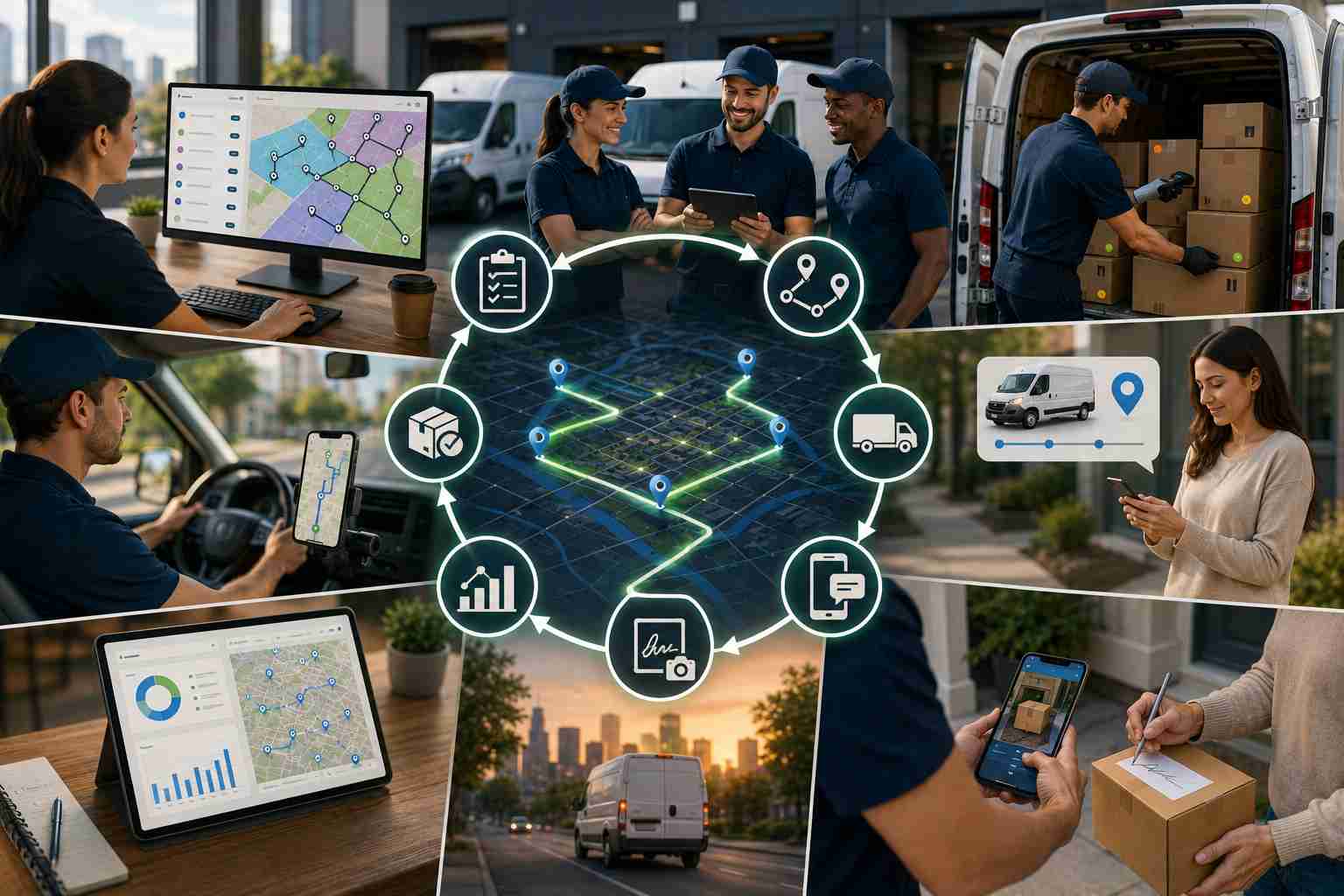
    Think of the day in three acts. Before the wheels turn, while they are turning, and after they stop. Nail all three and you have a last-mile route planning routine that holds up whether you are running two vans or ten.


    1. The night before, or first thing: gather and import

    Everything downstream depends on getting the day’s stops in cleanly. Pull every order into one list: the deliveries, the pickups, the same-day jobs that came in overnight. The fastest way to do this is to import the whole lot from a spreadsheet or straight from your order system, rather than typing addresses one at a time while the clock ticks.

    This is also the moment to catch bad data. A wrong postcode or a missing flat number is a failed delivery in waiting, and it is a lot cheaper to fix at a desk than to discover on a doorstep. Clean the list now, and the rest of the day gets easier.


    2. Build and optimize the routes

    Now turn that list into routes. This is where a small team either saves an hour or loses one. Group stops by area so each driver gets a tight patch, sequence them for the shortest sensible run around traffic and time windows, and split the work so nobody finishes at lunchtime while someone else is out until eight.

    Doing this by hand works for a dozen well-clustered stops. Past thirty it falls apart, because the number of possible orderings explodes and no human is finding the best one on a spreadsheet. Optimized routing typically saves 20 to 40 percent of drive time against booking order, which for a small team is the difference between three vans and needing a fourth. If you want the mechanics of this step, our guide on how to plan a courier route with multiple stops breaks it down.


    3. Load the vans in the right order

    Small teams skip this step and pay for it all day. If parcels go into the van in a random pile, the driver is digging at every stop, adding a minute here and there that stacks up to an hour by evening. A vehicle loading plan tells each driver where every parcel sits and has them load in reverse delivery order, so the first drop is right by the door and comes out first. It is unglamorous and it saves more time than almost anything else on this list.


    4. On the road: status, notes, and navigation

    Once the vans roll, the office needs to know what is happening without ringing every driver. Each stop should reach the driver’s phone through a driver mobile app with navigation, the parcel details, and the access notes (gate codes, buzzer numbers, “leave with reception”). As they work, drivers mark each stop done or failed with a tap, so you can see the round progressing in real time rather than guessing.

    Keep the nav familiar, too. A good workflow does not force drivers into a strange navigation app. It optimizes the order, then hands each leg off to Google Maps or Waze, which the driver already knows cold.


    5. Keep the customer in the loop

    This is the step that separates a small team that feels professional from one that feels chaotic, and it costs you nothing once it is set up. Automatic ETAs and arrival notifications tell the customer when to expect the driver, which is the single most effective way to make sure someone is actually home. Fewer failed drops, fewer “where is my parcel” calls landing on your one office phone. Meanwhile real-time tracking means when a client rings to ask where their delivery is, you can answer in five seconds without interrupting the driver.


    6. Handle the curveballs

    No shift goes to plan. A customer reschedules. A pickup runs late. A same-day job lands at 2pm and needs slotting in. The whole point of a good workflow is that these are shrugs, not crises. A route that re-optimizes on the fly lets you drop the new stop into the nearest gap and re-sequence the rest, instead of rebuilding the day from scratch at the kerb. If a delivery fails, the driver logs why, and it flows back to the office to sort a redelivery cleanly.


    7. Proof of delivery at every drop

    Every completed stop should end with proof of delivery: a photo, a signature, a GPS-stamped record. For a small team chasing bigger clients, this is not optional. It ends “I never got it” disputes in seconds, and it is exactly the kind of professionalism that wins you the next contract. Capturing it should be one tap for the driver, not a form.


    8. End of day: reconcile and review

    When the vans are back, close the loop. Check that every stop is accounted for, sort any failed deliveries for tomorrow, and glance at the numbers. Route analytics show you which routes ran long, where drivers doubled back, and how your stops-per-hour is trending. Five minutes here is how next week’s routes get tighter. Small teams that skip the review keep repeating the same detour for months without ever noticing.

    The tools a small team actually needs (and the ones you can ignore)

    Here is where a lot of small operators go wrong. They either try to run the whole thing on a spreadsheet and a maps app, or they get talked into a heavy enterprise platform built for a fleet of 200 and priced accordingly. Neither fits.

    What a small courier team genuinely needs is fairly short: multi-stop route optimization, a driver app with proof of delivery, customer notifications, and simple reporting. What you can happily ignore for now is the enterprise stuff, the deep API integrations, the warehouse management modules, the per-seat licensing that assumes a call centre. Match the tool to your size. If you are weighing options, our comparison of route planner apps for couriers is built around exactly this decision.

    Common last-mile mistakes small teams make

    A few traps show up again and again in small operations:

    Planning in booking order, which quietly wastes miles all day. Overloading the reliable driver while a newer one sits idle. Leaving access notes in emails instead of on the stop, so the driver gets locked out. Never sending the customer an ETA, then wondering why so many people are not home. And never looking at the end-of-day numbers, so the same mistakes repeat on a loop. None of these are dramatic. That is precisely why they survive for months and cost real money.

    How the workflow scales as you add vans

    The best thing about getting this rhythm right early is that it does not break when you grow. With one or two vans you might run the whole thing from a phone and a laptop, and that is fine. At three to five vans, the dispatcher side starts to matter, because now you are balancing work across drivers, watching a live map, and answering client questions while the vans are out. The steps do not change. The tooling steps up, from a solo planner to a proper dispatch view. That is the moment a single shared system stops being a nice-to-have and becomes the thing holding the operation together, because knowledge stuck in one driver’s head does not scale to five. Build the habit now, while it is simple, and growth becomes a matter of adding drivers to a system that already works, rather than reinventing your whole day every time you buy a van.

    How Bodha runs this workflow for you

    Everything above is one connected workflow in Bodha, which is built for exactly this kind of operation. You import the day, the courier route planner optimizes and splits routes across your drivers in seconds, the loading plan sorts the van, drivers get navigation and proof of delivery on their phones, customers get automatic ETAs, and you watch the whole shift on a live map. At the end of the day the numbers are waiting for you. For a team running multiple vans, Bodha Fleet ties the dispatcher side together.

    On cost, you can start without spending a thing. If a driver only needs up to 20 stops per route, they can optimize unlimited routes for free in the Bodha Drive app, which is a genuine way to test the workflow before you commit. When you want the full team setup, meaning multi-driver dispatch, proof of delivery, tracking, and reporting, paid plans start at $29 a month. The pricing page has the detail.

    Two related reads worth your time: our guide to parcel delivery route optimization digs into cutting fuel and failed drops, and the focused playbook on how to reduce failed delivery attempts covers the single biggest hidden cost in this whole workflow.

    Run a tighter last mile from tomorrow

    You do not need enterprise software to run a professional last mile. You need one repeatable workflow and a tool that carries it from import to proof of delivery. Bodha’s courier route planner does exactly that, and you can start free.

    Start your free 7-day trial (no card needed) or book a quick demo and run tomorrow’s shift through it.

    Frequently asked questions

    Last-mile delivery is the final step of getting a parcel from a local depot or pickup point to the customer's door. For a small courier team it is the whole job, and because it is the most expensive and most visible part of delivery, running it as a tight, repeatable workflow is where a small operation competes with the big carriers.

    It runs in three acts: before the shift you import and clean the day's stops and optimize the routes, during the shift drivers navigate, capture status and proof of delivery, and customers get ETAs, and after the shift you reconcile and review the numbers. Each step feeds the next, so nothing falls through the cracks.

    Once you are past about thirty stops a day or running more than one van, yes. Manual planning stops finding efficient routes at that scale, and optimization typically saves 20 to 40 percent of drive time. You can start free with a 20-stop planner and only pay when you need multi-driver dispatch and proof of delivery.

    On reliability the customer can feel, not on price or scale. Accurate ETAs, tight routes, on-time drops, and proof of delivery make a small team look more professional than a giant that misdelivers and disappears. That local trust is what wins and keeps contracts.

    The last mile, which accounts for around 53 percent of total shipping cost. That is why tightening the last-mile workflow, rather than the long-haul legs, gives a small courier operation the biggest return on its effort.

    Yes. Start with the free Bodha Drive app, which optimizes up to 20 stops per route across unlimited routes at no cost. It lets you see your real drive times and cost per drop first, so your rate card is built on numbers, and you only move to a paid plan when you want reporting, proof of delivery, or multi-driver dispatch.

    One Workflow, Every Van

    Optimize 20 stops per route on unlimited routes, free. Import, optimize, and prove every drop in one workflow.

    Subscribe to Our Blog

      Related blogs

      How to Plan Delivery Routes: A Practical Guide for Operators

      How to Plan Delivery Routes: A Practical Guide for Operators

      Back Table Of Content Something every experienced dispatcher knows: the difference between a good day and a chaotic…

      Reduce Delivery Costs: 10 Proven Strategies That Actually Work

      Reduce Delivery Costs: 10 Proven Strategies That Actually Work

      Back Table Of Content Last-mile delivery is the most expensive part of the logistics chain. It accounts for…

      What Is Route Optimization? (And Why Your Delivery Business Can’t Afford to Ignore It)

      What Is Route Optimization? (And Why Your Delivery Business Can’t…

      Back Table Of Content Picture this: it’s 7am, you’ve got 60 deliveries to get out, two drivers called…

      How Much Should a Courier Charge? Pricing Your Delivery Service

      How Much Should a Courier Charge

      How Much Should a Courier Charge? Pricing Your Delivery Service

      user profile

      Bodha Route

      July 3, 2026

      Table Of Content

      Get your pricing right and you have solved the hardest problem in the courier business, because price is where the profit lives or quietly dies. Set it too low and you are basically a charity that moves parcels, working hard to cover your own fuel. Set it too high without the service to back it up and clients drift to the next van. So when someone asks how much to charge for courier delivery, the real answer is not a magic number and it is definitely not “whatever the courier down the road charges.” It comes from three things: knowing your own costs, picking the pricing model that fits the work, and then protecting that margin once the wheels start turning. Let me walk through all three.


      If the last piece looked at courier pay from the driver’s seat, this is the same coin flipped to the owner’s side. Here is how to land on a rate that actually makes money in 2026.

      The three ways couriers charge

      Most courier pricing boils down to three models, and plenty of operators blend them. Each one suits a different kind of job, so it helps to know when to reach for which.

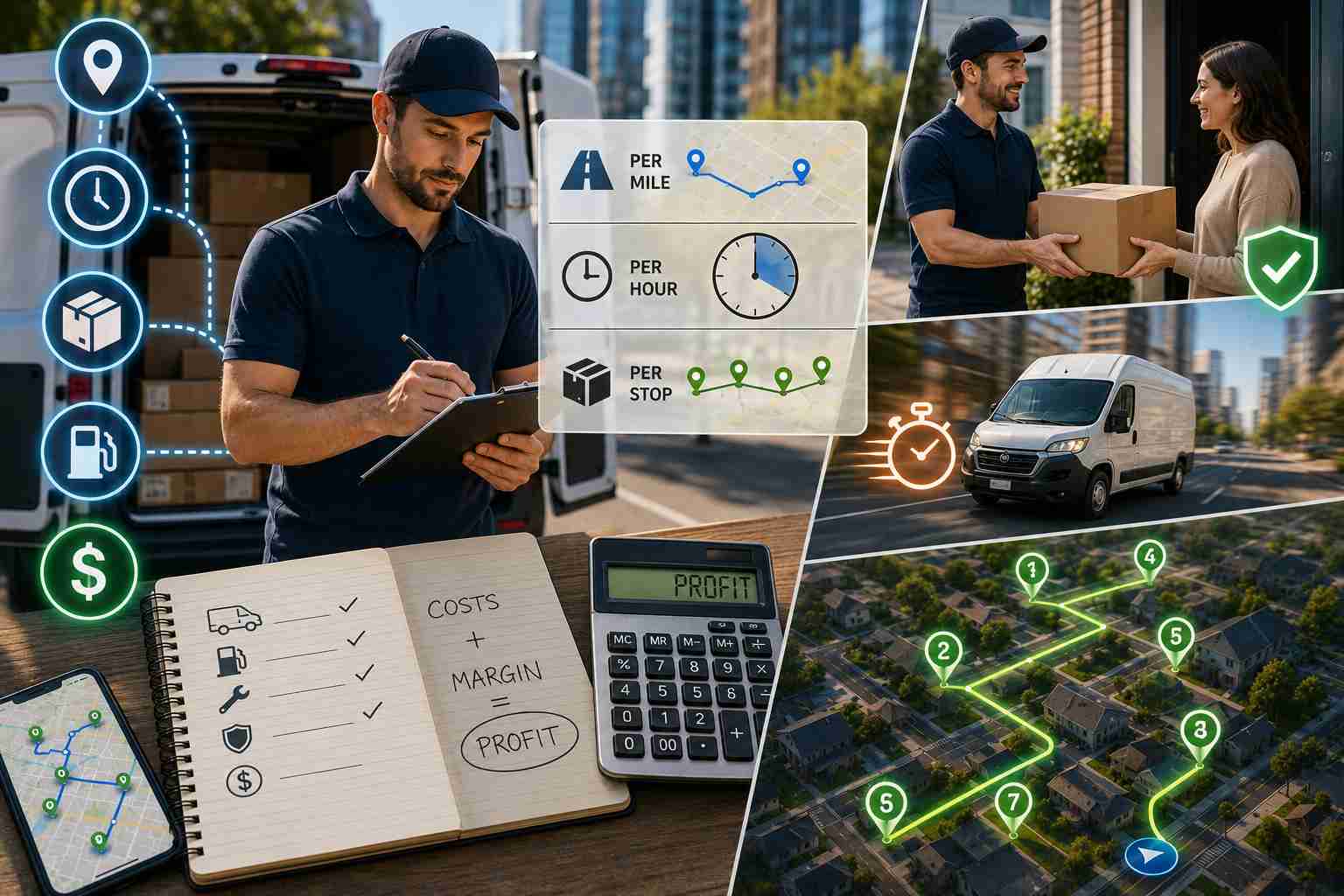
      Per mile is the distance model. You charge for the miles driven, it scales cleanly with the job, and it suits longer runs where distance is the main cost. Typical rates land around $1 to $3 a mile, often near $1.50 for a car and $2.00 or more for a van, with dense cities like New York running higher, into the $2 to $5 range. One number worth tattooing somewhere: the IRS 2026 business mileage rate is 72.5 cents a mile. That is roughly what it costs just to run the vehicle. Charge anywhere near it and you are covering the van and nothing else, not your time, not a penny of profit.

      Per hour is the time model. You bill for hours rather than miles, which suits jobs heavy on loading, waiting, or setup, where the distance is short but the effort is not. A common figure is around $45 an hour, which works out to about 75 cents a minute, so a half-hour job bills near $22.50. Local courier rates often sit in the $45 to $65 an hour band depending on the vehicle and the market. The upside is fair pay for slow, fiddly work. The downside is a hard daily ceiling, since there are only so many hours in a shift.

      Per stop is the multi-drop model, and it is the natural fit for dense courier rounds and recurring routes. You charge a set fee per drop, which rewards you for efficiency, because the more stops you pack into a run, the more you earn on the same miles. Medical and recurring contract routes often price this way. The catch, and it is a big one, is that a per-stop rate only works if you can actually fit enough stops into the run to cover the driving between them. More on that shortly, because it is where routing and pricing collide.

      There is no single right model. Long, variable-distance work leans per mile. Slow, wait-heavy work leans per hour. Dense multi-drop and recurring work leans per stop. Most couriers end up quoting per job, using whichever model gives the fairest number for that particular route.

      The surcharges you should not skip

      Your base rate is only half the invoice. Experienced couriers protect their margin with surcharges for the stuff that genuinely costs extra, and leaving these off is one of the quietest ways to bleed money. The usual suspects:

      Urgency. Same-day, rush, and sub-one-hour dispatch carry a premium, often 20 to 60 percent over standard. If someone needs it there in an hour, that convenience is worth paying for. After-hours, weekends, and holidays. Usually a flat after-hours fee, somewhere around $25 to $75, or a weekend surcharge of 10 to 25 percent. Waiting time. If the pickup is not ready and your driver is stood around, bill for it. The industry norm is roughly $1 to $2 a minute after a short grace period. Oversize or heavy items. A bigger vehicle or an overweight parcel costs more to carry, so a handling fee is fair, for example a per-pound charge over 50 pounds. And fuel. A fuel surcharge, commonly 5 to 15 percent, lets you ride out price swings without rewriting your whole rate card every month.

      For context on where the totals land: same-day courier jobs frequently run anywhere from $25 to $300 or more once distance, vehicle, and surcharges stack up. Specialised work sits higher still. Standard medical routes often run $30 to $45 for a short same-day drop, while STAT medical deliveries can hit $90 to $160 or more, because the timing is not negotiable.

      A simple way to set your first rate

      Ranges are handy for a sanity check, but your real number has to come from your own costs, not a blog’s averages. The framework is not complicated:

      Cost per mile, or per delivery, equals your fixed costs plus your variable costs, divided by the total miles or deliveries you actually do, and then you add your profit margin on top.

      Fixed costs are the ones that do not care how far you drive: insurance, licensing, your phone, and the vehicle itself, which averages well over $11,000 a year to own and run. Variable costs move with the work: fuel, maintenance, tyres, depreciation. Add them up, divide by the miles or deliveries you genuinely complete in a period, and you have your break-even. Then add the margin you want. If that final number lands wildly above or below the local market, do not just shrug and change the price. Go back and look at your costs or your efficiency first, because one of them is telling you something.

      And here is the warning that comes up from experienced couriers more than any other: do not win work by being the cheapest. Undercutting either signals “low quality” to clients or eats a margin you never properly worked out. Plenty of successful couriers deliberately price 15 to 25 percent above the market floor and back it up with reliability, tracking, and proof of delivery. People will pay for certainty. They will not pay for a stranger with a car and no proof anything arrived.

      Pricing multi-drop runs so they actually pay

      Multi-drop work is where couriers make or lose the real money, because one badly built run can wipe out the margin on every stop inside it. The trick is to price the route, not just the individual drops. A per-stop rate looks great on paper, but it only holds up if you can fit enough stops into the run to cover the miles between them. Pack a route with backtracking and your true cost per drop climbs, even though the number on the invoice never moved. This is the exact point where route efficiency stops being an “operations thing” and becomes a pricing thing. Your per-stop rate is only as profitable as your routing lets it be.

      Route efficiency is just margin protection

      Here is the link most pricing guides skip entirely. Once you have set a good rate, efficiency is what lets you keep the profit that is supposed to be in it. Every dead mile, every failed delivery, every hour a driver spends crossing town for a stop they drove past earlier eats straight into the margin you priced for. Failed attempts are the worst of the lot, because a redelivery is unpaid work you swallow twice.

      A courier delivery route planner protects your pricing from the operational side. Tighter routes drop your cost per stop. Accurate ETAs cut the failed attempts. And clear reporting means you finally know your real cost per delivery instead of guessing, which is the thing that lets you price with a straight face and hold your rate when a client pushes back.

      How Bodha helps you price and hold your margin

      You cannot price well if you do not know your true cost per drop, and most couriers are guessing at it. Bodha’s route analytics show stops per route, distance, and time per driver, so your pricing sits on real numbers rather than a hunch. The routing itself keeps that cost per drop down by cutting dead miles, and proof of delivery protects you from the disputes and chargebacks that eat margin after the fact. Running a team? Bodha Fleet puts planning, tracking, and reporting in one place.

      You can also start without spending anything, which is handy when you are still working out your rates. If you only need up to 20 stops per route, you can optimize unlimited routes for free in the Bodha Drive app, enough to see your real drive times before you commit to a price list. When you want the full feature set, meaning dispatch, proof of delivery, and reporting, paid plans start at $29 a month. The pricing page lays out the tiers.

      If you are still setting up, our guide on starting a courier business covers the whole launch, and the companion post on how much courier drivers make shows the earnings side of the same equation, which is worth reading alongside this one.

      Price with confidence, then protect it

      A rate is only profitable if your routes are efficient enough to keep it that way. Bodha’s route planner for couriers cuts your cost per drop and hands you the numbers to price from, and you can start for free.

      Start free for 7 days (no card needed) or book a quick demo.

      Frequently asked questions

      Most couriers charge between $1 and $3 per mile, often around $1.50 for a car and $2.00 or more for a van, with dense cities running higher. Use the IRS business mileage rate as a cost floor and add your time and profit on top, because charging near the mileage rate alone covers the vehicle and nothing else.

      It depends on the work. Per mile suits longer, variable-distance jobs. Per hour suits slow, wait-heavy jobs. Per stop suits dense multi-drop and recurring routes because it rewards efficiency. Many couriers use whichever gives the fairest number for a given route, and quote per job rather than sticking rigidly to one model.

      Add your fixed costs, meaning insurance, licensing, and the vehicle, to your variable costs, meaning fuel, maintenance, and depreciation, then divide by the miles or deliveries you actually complete and add your profit margin. That gives you a rate grounded in your real costs rather than a guess or a competitor's number.

      The common ones cover urgency such as rush and same-day, after-hours and weekend work, waiting time at roughly $1 to $2 a minute, oversize or heavy items, and fuel at around 5 to 15 percent. Leaving these off the invoice is one of the most common ways couriers quietly lose the margin they thought they had.

      It protects your margin. Tighter routes lower your real cost per drop, which is exactly what makes a per-stop rate profitable, and fewer failed deliveries mean less unpaid rework. Route reporting also tells you your true cost per delivery, so you can price accurately instead of hoping.

      Yes. Start with the free Bodha Drive app, which optimizes up to 20 stops per route across unlimited routes at no cost. It lets you see your real drive times and cost per drop first, so your rate card is built on numbers, and you only move to a paid plan when you want reporting, proof of delivery, or multi-driver dispatch.

      Know Your Cost Per Drop

      Optimize 20 stops per route on unlimited routes, free. Lower your cost per drop and know your real numbers.

      Subscribe to Our Blog

        Related blogs

        How to Plan Delivery Routes: A Practical Guide for Operators

        How to Plan Delivery Routes: A Practical Guide for Operators

        Back Table Of Content Something every experienced dispatcher knows: the difference between a good day and a chaotic…

        Reduce Delivery Costs: 10 Proven Strategies That Actually Work

        Reduce Delivery Costs: 10 Proven Strategies That Actually Work

        Back Table Of Content Last-mile delivery is the most expensive part of the logistics chain. It accounts for…

        What Is Route Optimization? (And Why Your Delivery Business Can’t Afford to Ignore It)

        What Is Route Optimization? (And Why Your Delivery Business Can’t…

        Back Table Of Content Picture this: it’s 7am, you’ve got 60 deliveries to get out, two drivers called…

        How Much Do Courier Drivers Make || And How to Earn More Per Shift

        How Much Do Courier Drivers Make

        How Much Do Courier Drivers Make || And How to Earn More Per Shift

        user profile

        Bodha Route

        July 3, 2026

        Table Of Content

        If you are asking how much do courier drivers make, here is the short version: most employed courier drivers in the United States take home somewhere between $18 and $25 an hour, which lands around $38,000 to $53,000 a year, and the strong ones push past $60,000. Useful to know. But that short version hides the part that actually matters, because courier pay is oddly elastic. Two drivers working the same streets, for the same kind of money on paper, can finish the year thousands of dollars apart. A big slice of that gap is not luck or seniority. It is how well they run the shift.

        So I will give you the real numbers first, employed and self-employed, and then spend most of this on the bit the salary sites skip: how to earn more per shift without simply staying out later.

        How much do courier drivers make in 2026?

        Pay swings a lot depending on how you are hired, where you drive, and what you carry. Here is the honest spread rather than one tidy figure.

        Employed courier drivers sit in the middle of the range. Pull together the salary aggregators and job-board data and the US average lands somewhere around $38,000 to $51,000 a year, or roughly $18 to $25 an hour. The middle band, the 25th to 75th percentile, runs about $33,000 to $60,000, and the top tenth report $60,000 to $75,000. That is a wide spread, and the width itself is the lesson: experience, city, and the exact role move this number around far more than the job title suggests.

        Self-employed and contract couriers are where the ceiling lifts, and where the floor gets wobbly. Independent courier drivers report averages a touch above $40,000, but that number is almost meaningless on its own, because as an owner-driver you keep more of every delivery and you also carry every cost. A busy operator with steady contracts clears well above the employed average. A quiet fortnight bites in a way a salaried driver never feels. Higher upside, more risk. That is the trade.

        Medical and specialised work pays a premium, and for good reason. Carrying lab samples, prescriptions, or STAT medical runs demands reliability and a bit of compliance, so it earns more than shifting general parcels. Standard employed medical courier roles sit in the mid-$30,000s, but the specialised, time-critical end runs higher.

        A quick word for UK readers, since the numbers are structured differently. Employed couriers there usually land somewhere in the £22,000 to £30,000 range, while self-employed owner-drivers tend to think in day rates instead, often aiming for £150 to £300 a day depending on the vehicle and the work.

        Treat all of these as reference points, not promises. They drift with fuel prices, local demand, and how the work is structured. If one exact figure matters to you, go and check current local data for your own patch before you bank on it.

        Employed, self-employed, or gig: which pays best?

        People new to the trade tend to fixate on the hourly rate and miss that the pay model shapes almost everything.

        An employed, hourly job is the steady option. You know what lands in your account, holiday and sick cover usually come with it, and a slow week is the company’s problem, not yours. The catch is the ceiling: you cannot really out-earn the rate, no matter how sharp you get.

        Self-employment flips that. Every efficiency you find, every extra drop you fit in, every dead mile you cut lands in your pocket instead of the company’s. The ceiling is high. But you are also buying your own fuel, insurance, and van, and there is no one to cover a quiet spell. This is the model where “earn more per shift” stops being a nice idea and becomes the difference between a good month and a scary one.

        Gig and app-based work sits somewhere in between, and it is the most variable of the lot. Pay per drop can look decent in a busy hour and dreadful in a dead one, and you are largely at the mercy of the platform’s demand. Plenty of couriers stack a couple of platforms, or use gig work to fill gaps around contract runs.


        There is no single “best.” But if your income is tied to output in any way, the rest of this guide is where your raise actually comes from.

        Where the fuel quietly disappears

        The other leak is distance, and it is bigger than most owners think. The last mile now soaks up around 53 percent of total shipping cost, up from 41 percent back in 2018. It is the single most expensive stretch of the whole journey, and parcel work makes it worse because the drops are dense and the temptation to just run them in the order they landed in the system is strong.

        Here is what that looks like on the road. A driver hits a street, delivers three roads over, doubles back for a parcel they drove past twenty minutes ago, then loops round again because two stops on the same close got split across the list. None of it feels dramatic. It is a couple of wasted minutes here, half a mile there. Stack it across 80 or 100 drops and you have paid for a chunk of a tank you did not need to burn, plus the wear and the hour that pushes the driver into overtime. Route density, which is just a fancy way of saying more stops per mile you actually drive, is the single biggest lever on cost per drop. And tighter sequencing is where density comes from.

        How to earn more per shift

        Here is the part the salary pages leave out. When your pay is tied to output, whether that is per delivery, per stop, or your own margin, earning more is mostly about fitting more paid drops into the same hours. A few levers do the heavy lifting.

        The first is simply completing more drops in the same time. Couriers average somewhere around 30 to 50 stops a day, and the order you drive them in decides how many you can physically fit before the shift ends. Optimized sequencing usually saves 20 to 40 percent of drive time against running stops in the order they came in. That reclaimed time is not a longer lunch. It is more billable drops. Say you normally clear 25 stops and smarter routing lets you slot in five more. That is a 20 percent bump on a per-drop income, for the exact same day.

        The second is killing dead miles. Every mile you drive that does not end at a paid door is fuel and time you are giving away, and as an owner-driver you are paying for it out of your own margin. Cut the backtracking and you are not earning more per drop, but you are keeping more of what you earn, which comes to the same thing at the bank.

        The third is refusing to lose time to failed deliveries. A failed attempt is unpaid work twice over, the wasted trip now and the redelivery later. Accurate arrival times and clear access notes keep first-attempt rates high, which quietly protects your effective hourly rate.

        The fourth is moving toward better-paid work. Here is the knock-on effect people miss. When tighter routing frees up an hour a day, you suddenly have room for the premium jobs, the medical run, the same-day rush, the priority contract, that you had to turn down when your day was full of backtracking. Efficiency does not just save time. It buys you the capacity to chase higher-value drops.


        Notice the thread running through all four. Your take-home is capped less by the rate on each drop than by how many good drops you can complete cleanly in a day. Routing is the lever on that, which is why a tool that plans your round is really an earnings tool wearing an operations badge.

        The maths, in plain numbers

        Let me make it concrete, because percentages are easy to nod along to and ignore. Say you are self-employed, averaging 30 drops a day at $6 net per drop. That is $180 a day. Now tighten the round so six more drops fit in the same hours. You are at 36 drops, $216, without working a minute longer. Over a five-day week that is roughly $180 more. Over a working year it is thousands, all from driving the same stops in a smarter order. Push the drop count or the rate up and the gap only widens. This is exactly why route efficiency is a pay conversation, not just an ops one, and why the drivers who treat it seriously pull ahead of the ones who wing it.

        Mistakes that quietly cost couriers money

        A few habits show up again and again in drivers who feel busy but never seem to earn more.

        Running stops in booking order. It feels efficient because you are always moving, but you are moving in a bad sequence, and the wasted miles do not announce themselves. Ignoring the notes. A gate code skimmed instead of read is a wasted trip later. Chasing volume over value, packing the day with cheap drops when a couple of premium jobs would pay more for less driving. And never looking at the numbers, so the same daily detour repeats for months because nobody ever added it up.

        None of these are dramatic on any given day. That is exactly why they persist, and why fixing them adds up.

        How Bodha helps you earn more

        For a solo courier, Bodha Drive takes your list of stops and sequences them into the shortest sensible run in seconds, then hands off to Google Maps or Waze for the actual driving. Fewer dead miles, more drops per shift, more in the account. And the starting cost is nothing: if you only need up to 20 stops per route, you can optimize unlimited routes for free in the Bodha Drive app, which covers a lot of solo rounds on its own. When you want the full kit, dispatch across drivers plus proof of delivery and tracking, paid plans start at $29 a month.

        Run a team? The full route planner for couriers adds multi-driver dispatch and route analytics, so you can see exactly where the time and miles are going and squeeze more paid drops out of every shift. The pricing page has the tiers.

        Thinking bigger than one van? Our guide on starting a courier business covers turning driving into an operation, the companion piece on how much to charge for courier delivery is the pricing side of the same coin, and the walkthrough on how to plan a courier route with multiple stops is the practical how-to.

        Fit more paid drops into every shift

        More drops per shift is more take-home, and it comes from routing, not from staying out later. Bodha’s courier route planner sequences your stops in seconds so you cover fewer miles and finish more deliveries, and you can start for free.


        Start free for 7 days (no card needed) or book a quick demo.

        Frequently asked questions

        Employed courier drivers in the US typically earn around $18 to $25 an hour, with the average sitting near $20 to $22 depending on which source you trust. Pay rises with experience, with location, and with specialised work like medical courier delivery, which pays a premium over general parcels.

        They can, because they keep more of each delivery, but the income is less stable and they carry their own costs for fuel, insurance, and the van. A busy owner-driver with steady contracts often out-earns an hourly employee, while a slow stretch hits far harder with no company to absorb it.

        Specialised and time-critical work generally pays best. Medical, legal, and same-day or STAT courier services command higher rates than general parcel delivery because they demand reliability, compliance, and speed, and fewer drivers are set up to do them well.

        Fit more paid drops into the same shift by optimizing your route. Efficient sequencing commonly saves 20 to 40 percent of drive time, which turns straight into more completed deliveries. Cutting dead miles and reducing failed attempts protects that gain instead of leaking it back out.

        It varies a lot by area and delivery type, but many couriers handle somewhere between 30 and 50 stops a day. Dense urban rounds sit at the top of that range, spread-out rural routes lower, and route optimization raises how many you can actually complete cleanly in the hours you have.

        No. You can start free with the Bodha Drive app, which optimizes up to 20 stops per route across unlimited routes at no cost. That is enough for most solo rounds to see the time savings, and you only move to a paid plan when you want proof of delivery, tracking, or multi-driver dispatch.

        Pay figures here are general 2026 reference ranges and vary by employer, location, and market. This is not financial advice; check current local data before making decisions based on it.

        Earn More Per Shift

        Optimize 20 stops per route on unlimited routes, free. Fit more paid drops into the same shift.

        Subscribe to Our Blog

          Related blogs

          How to Plan Delivery Routes: A Practical Guide for Operators

          How to Plan Delivery Routes: A Practical Guide for Operators

          Back Table Of Content Something every experienced dispatcher knows: the difference between a good day and a chaotic…

          Reduce Delivery Costs: 10 Proven Strategies That Actually Work

          Reduce Delivery Costs: 10 Proven Strategies That Actually Work

          Back Table Of Content Last-mile delivery is the most expensive part of the logistics chain. It accounts for…

          What Is Route Optimization? (And Why Your Delivery Business Can’t Afford to Ignore It)

          What Is Route Optimization? (And Why Your Delivery Business Can’t…

          Back Table Of Content Picture this: it’s 7am, you’ve got 60 deliveries to get out, two drivers called…

          Parcel Delivery Route Optimization: Cut Failed Deliveries and Fuel

          Cut Failed Deliveries and Fuel

          Parcel Delivery Route Optimization: Cut Failed Deliveries and Fuel

          user profile

          Bodha Route

          July 3, 2026

          Table Of Content

          Ask a parcel courier what really eats their profit and you tend to get two answers, usually in a tired voice. Fuel. And failed deliveries. The parcels that come back because nobody was in. The miles that pile up because the round got planned in a rush. What almost nobody says out loud is that those two problems are the same problem wearing different clothes. Both trace back to how the route was built. That is the whole case for parcel delivery route optimization. Fix the sequencing, clean up the addresses, and give the customer a heads-up, and you watch the failed drops and the wasted fuel drop together, off one fix.

          So let me keep this practical. First, what those two costs actually are in 2026, with real numbers. Then the levers that move them, and how a decent parcel delivery route planner pulls all of them at once.

          What a failed delivery really costs you

          Most operators file a failed delivery under “send it again tomorrow” and move on. That is the mistake, because the second trip is the cheap part.

          Count everything and a single failed attempt runs about $17.78 on average. That is the wasted drive, the driver’s time, the handling, the parcel going back to the depot. Then the reattempt usually costs two to three times the original delivery. And this is not some rare edge case you can ignore. Somewhere between 5 and 15 percent of parcel deliveries fail on the first go, depending on the area and the type of drop. On a busy round, that is a tax you pay every single day.

          Now the part that never shows up on a delivery report. Every failed stop burns ten to fifteen minutes of a driver’s day, time that could have gone to a paying drop. The “where’s my parcel” calls that follow eat your office hours, and those queries make up close to a fifth of all support tickets across the industry. Worst of all is the customer. Somewhere between a quarter and a third of people will not order again after a delivery falls over on them. You did not lose a trip. You lost the relationship, and every order that would have come with it.


          Here is the frustrating bit. Most of this is preventable, and the biggest culprit is dull as dishwater: bad address data. Wrong or incomplete addresses cause up to 45 percent of failed deliveries, and as many as one in five orders turns up with an address that is off in some way. Which means the fix starts long before the driver turns the key.

          Why parcels fail in the first place

          If you want to cut failures, it helps to know the handful of ways a parcel actually dies on the round. In my experience talking to couriers, they are nearly always one of these five.

          Nobody is home. The classic. A signature-required parcel and an empty house, and the whole trip is wasted. Wrong or vague address. The flat number is missing, the street has three similar names, the postcode is a digit off. Access problems. A gate code that lived in an email instead of on the stop, a buzzer that does not work, a business that shut at four. No safe place, so a leave-safe instruction turns into a “carded and returned.” And timing, where the driver arrives during the one two-hour window the customer asked them to avoid.


          Notice how few of those are really about driving. They are about information and communication, which is exactly why routing software helps more than people expect. The right details on the stop, the right order of stops, and a text to the customer knock out most of these before they happen.

          Where the fuel quietly disappears

          The other leak is distance, and it is bigger than most owners think. The last mile now soaks up around 53 percent of total shipping cost, up from 41 percent back in 2018. It is the single most expensive stretch of the whole journey, and parcel work makes it worse because the drops are dense and the temptation to just run them in the order they landed in the system is strong.

          Here is what that looks like on the road. A driver hits a street, delivers three roads over, doubles back for a parcel they drove past twenty minutes ago, then loops round again because two stops on the same close got split across the list. None of it feels dramatic. It is a couple of wasted minutes here, half a mile there. Stack it across 80 or 100 drops and you have paid for a chunk of a tank you did not need to burn, plus the wear and the hour that pushes the driver into overtime. Route density, which is just a fancy way of saying more stops per mile you actually drive, is the single biggest lever on cost per drop. And tighter sequencing is where density comes from.

          How parcel delivery route optimization fixes both

          This is the good part, and it is why the two problems are worth solving together. The same pass that trims your dead miles also strips out the causes of failed drops. A solid parcel delivery route optimization routine really comes down to five moves.

          Clean the addresses first. Since bad data drives up to 45 percent of failures, validating and de-duplicating your stops on import is the highest-return five minutes in the whole day. Catch the dodgy address at the depot, not when the driver is sat outside a house that does not exist.

          Cluster tight, then sequence. Group stops by area so a driver clears a patch in one sweep, then order them for the shortest sensible run. This is the move that kills backtracking and fuel, and it is exactly the kind of sequencing a human stops doing well somewhere north of thirty stops.

          Respect the windows. A fast route that blows through a “before noon” promise is a slow route the moment you add the redelivery. Window-aware sequencing keeps first-attempt rates up without wrecking the day’s efficiency.

          Re-optimize when things change. A same-day add-on or a customer who reschedules should slot into the nearest gap on an existing route, not blow up the plan. When the round can flex, a surprise at 2pm is a shrug, not a scramble.

          Close the loop with the customer. Accurate arrival times and a proactive text are the single most effective fix for “nobody was home.” Put real-time updates, tight sequencing, and clear driver guidance together and first-attempt rates climb past 92 percent, against an industry average nearer 80. The best operations push for 95 and up.

          Do those five and both numbers move at once. AI-driven route optimization tends to cut delivery time by around a quarter and fuel by around a fifth versus planning by hand, while lifting first-attempt success at the same time. One pass, two wins. That is rare in logistics, so it is worth grabbing.

          A quick self-audit

          Want a fast read on your own operation? Run down this list and count the “no” answers.

          • Are addresses validated before dispatch, or are drivers finding the errors on the road?
          • Are stops grouped by density, or planned in the order the orders arrived?
          • Does every stop reach the driver with its time window and access notes attached?
          • Can you drop a new stop into a live route without rebuilding the whole thing?
          • Do customers get an accurate ETA and an arrival heads-up?
          • Is every drop backed by proof of delivery, so a dispute ends in seconds?

          Every “no” on that list is a failed delivery or a wasted mile waiting to happen. Most operators find three or four, and each one is money.

          What it looks like when it clicks

          Picture two versions of the same round. In the first, the driver gets a printed list in booking order, no windows, no notes. They spend the morning doubling back, guessing gate codes, and phoning the office. Three parcels come back. Dispatch spends the afternoon fielding “where is it” calls.

          In the second, the round comes in optimized. Stops are clustered, sequenced, and carry their access notes. The customer got a text with a two-hour window. The driver clears each street once, and the two people who were not home had already replied to reschedule. Zero returns, an hour off the clock, and a quiet office. Same drivers, same parcels, same city. The only thing that changed was how the route was built. That gap, repeated five days a week, is the whole return on getting routing right.

          How Bodha handles parcel routing

          Bodha was built for exactly this. As a parcel delivery route planner it validates and imports your stops, sequences hundreds of drops across your drivers in seconds around traffic and time windows, and re-optimizes on the fly when the day shifts under you. You can pull stops straight from a spreadsheet or your order system so the bad addresses get caught early instead of on a doorstep.

          On the failed-delivery side, automatic ETAs and customer texts cut the “nobody home” misses, real-time tracking lets you answer a client without ringing the driver, and proof of delivery with photo, signature, and GPS stamp ends the disputes on the spot. Running several vans? Bodha Fleet puts the lot on one dispatcher screen.

          Cost-wise, you can start without spending anything. If you only need up to 20 stops per route, you can optimize unlimited routes for free in the Bodha Drive app, which is plenty for a solo parcel round to prove the idea. When you want the full kit, meaning multi-driver dispatch, proof of delivery, tracking, and the rest, paid plans start at $29 a month. The pricing page lays out the tiers.

          Want the day-to-day method behind the sequencing? Our guide on how to plan a courier route with multiple stops walks it through. Still choosing a tool? We put the options side by side in our roundup of route planner apps for couriers. And if you are trying to stretch a maps app across a parcel round, read why Google Maps runs out of road for couriers before you commit to that.

          Cut failed drops and fuel on your next round

          You do not need a bigger fleet to fix failed deliveries and dead miles. You need tighter routes, clean data, and customers who know when to expect you. Bodha’s courier delivery route planner brings parcel optimization, proof of delivery, tracking, and customer ETAs into one place built for parcel work, and you can try it free.

          Start your free 7-day trial (no card needed) or book a quick demo and run a real round through it.

          Frequently asked questions

          It is the work of putting a set of parcel drops in the most efficient order while respecting time windows, vehicle capacity, and traffic. Done well it cuts the miles a driver covers, and because it keeps deliveries on time with accurate ETAs, it also lowers the rate of failed first attempts. The same pass helps both fuel and reliability.

          The direct cost of a failed attempt is around $17.78 once you count the wasted trip and handling, and the reattempt often runs two to three times the original delivery cost. Add customer service time and lost repeat business and the true figure is usually put at $25 to $40 per failure.

          Bad address data is the leading cause, behind up to 45 percent of failures, followed by the recipient not being home and access problems like missing gate codes. Because those are largely preventable, address validation, accurate ETAs, and clear access notes remove most failed attempts before they happen.

          Yes. Tighter sequencing and higher route density mean fewer miles for the same deliveries. AI-driven route optimization usually trims fuel use by about a fifth and delivery time by about a quarter compared with planning by hand, and the savings compound across a full week of rounds.

          Proof of delivery does not stop a failure by itself, but it settles disputes instantly and protects you when someone claims a parcel never arrived. Paired with accurate ETAs and notifications, which do prevent misses, it closes the loop on the whole delivery and keeps chargebacks down.

          Use the free Bodha Drive app for a single round. It optimizes up to 20 stops per route across unlimited routes at no cost, which is enough to see the fuel and time savings for yourself before you move up to a paid plan for proof of delivery, tracking, and multi-driver dispatch.

          Fewer Failed Drops

          Optimize 20 stops per route on unlimited routes, free. Tighter routes, fewer misses, less wasted fuel.

          Subscribe to Our Blog

            Related blogs

            How to Plan Delivery Routes: A Practical Guide for Operators

            How to Plan Delivery Routes: A Practical Guide for Operators

            Back Table Of Content Something every experienced dispatcher knows: the difference between a good day and a chaotic…

            Reduce Delivery Costs: 10 Proven Strategies That Actually Work

            Reduce Delivery Costs: 10 Proven Strategies That Actually Work

            Back Table Of Content Last-mile delivery is the most expensive part of the logistics chain. It accounts for…

            What Is Route Optimization? (And Why Your Delivery Business Can’t Afford to Ignore It)

            What Is Route Optimization? (And Why Your Delivery Business Can’t…

            Back Table Of Content Picture this: it’s 7am, you’ve got 60 deliveries to get out, two drivers called…

            Google Maps vs a Courier Route Planner: Why 10 Stops Isn’t Enough

            Google Maps vs a Courier Route Planner

            Google Maps vs a Courier Route Planner: Why 10 Stops Isn’t Enough

            user profile

            Bodha Route

            July 3, 2026

            Table Of Content

            For years the courier morning has looked the same in thousands of depots. A spreadsheet of addresses on one screen, Google Maps open in another tab, and a driver squinting at both, trying to guess a sensible order before they set off. It works, right up until it doesn’t. Start typing stops into a Google Maps courier route and you hit the wall fast, because the app stops you at ten, and it will not put them in a smart order for you either. For a courier running 30, 50, sometimes 100 drops a day, ten stops is not a route. It is barely the first street.

            Let me be clear before we go further: this is not a Google Maps takedown. It is a brilliant navigation app, and couriers should keep using it. The point is that navigation and route planning are two different jobs, and Google Maps only nails one of them. Here is exactly where the line sits, and the dead-simple setup that lets you keep the app you love while fixing the part it cannot do.

            What Google Maps is genuinely great at

            Credit where it is due, because plenty of couriers live in this app for good reason and I am not about to pretend otherwise.


            For turn-by-turn driving, Google Maps is hard to beat. The real-time traffic and rerouting are excellent, the ETAs are accurate, and the map data is about as complete as it gets anywhere on earth. Drivers already know the interface inside out, so there is zero training and zero grumbling about a new tool. It handles the actual business of getting from one door to the next better than almost anything, and it costs nothing. None of that is in question. If your whole day is a handful of stops, Google Maps on its own is fine, which is exactly why so many couriers start there and never think twice.

            Where Google Maps runs out of road

            The trouble starts the moment the operation gets serious. A Google Maps courier route runs into a set of hard limits that a growing courier simply cannot design around. Let me go through them, because each one shows up as a real cost on a real day.

            The ten-stop cap is the headline. Google Maps lets you add up to ten stops on a route, full stop. A proper courier round is several times that, so you end up chopping the day into chunks of ten and stitching them together by hand, which is its own little time sink every morning.

            No route optimization is the quieter, bigger problem. Even inside those ten stops, Google Maps drives them in the order you typed them. It does not work out the best sequence. So you are still the one guessing the order, and every guess that is slightly off is a bit of backtracking and a bit of fuel you did not need to spend. People fixate on the stop cap and miss this one, and this one costs more.

            No mid-route re-planning. Dispatch calls at 2pm with an urgent pickup, and Google Maps has no way to fold it into your existing round and re-sequence the rest. You rebuild the plan in your head at the kerb, which is exactly when you are least able to.

            No proof of delivery. There is nowhere to snap a photo, grab a signature, or stamp a time. So when a customer insists the parcel never arrived, you have nothing but your word.

            No live tracking or customer heads-up. You cannot see where your drivers are, and customers get no automatic “arriving soon” message, which means more “where is my parcel” calls landing on whoever answers the phone.

            No multi-driver dispatch. Google Maps plans one route for one phone. It has no idea your team exists, so there is no way to balance the work across drivers or push routes out from an office.

            And no manifest import. You type or paste stops one at a time. There is no clean way to drop in a spreadsheet or pull from your order system, which at volume is soul-destroying.

            None of these are flaws, exactly. They are just jobs the app was never built to do. Google Maps is a navigation tool. Courier work needs a planning tool sitting behind it.

            The maths: why ten is nowhere near enough

            Put a number on it and the gap gets obvious. Couriers commonly run somewhere between 30 and 50 stops a day, and dense city rounds go higher. Optimized sequencing typically saves 20 to 40 percent of drive time versus handling stops in the order they came in. On a Google Maps courier route you get neither the capacity nor the optimization, so you are handing back that time, and the fuel that rides along with it, every single day. For a courier paid by the drop, that is lost income sitting on the table. For one paying for their own fuel, it is a straight cost you chose not to cut.

            When Google Maps actually is enough

            Let me be fair, because the honest answer is not “always upgrade.” If you are a hobby courier or just starting out with fewer than ten stops a day, Google Maps alone genuinely does the job, and paying for software would be silly. The trouble is that couriers grow out of that window fast, usually within weeks of landing a real contract, and the ten-stop wall shows up right as things get busy.

            There is a middle path that a lot of couriers miss, though. You do not have to jump from “free Google Maps” straight to “paid platform.” A free planner that lifts the stop cap and adds optimization is the natural next step. The Bodha Drive app does exactly that: if you only need up to 20 stops per route, you can optimize unlimited routes for free, then open each leg in Google Maps or Waze to drive it. That covers the exact gap between “Google Maps is fine” and “I need a full dispatch platform,” at no cost. When you do outgrow it, meaning you want proof of delivery, live tracking, and multi-driver dispatch, paid plans start at $29 a month.

            The best-of-both-worlds workflow

            Here is the setup couriers actually like, because it does not ask you to give up the nav app you trust. Use each tool for the job it is best at.

            Plan and optimize in a dedicated courier route planner. Import the whole day, let it sequence every stop in the best order around traffic and time windows, and split the work across drivers if you have a team. Then, for the driving, hand each leg off to Google Maps or Waze for turn-by-turn. The planner solves the ordering and the capacity. Google Maps solves the road. Your driver still sees the familiar blue line on the screen, and you stop losing an hour a day to a ten-stop wall and a guessed order.


            That handoff is the whole trick, and it is worth saying plainly: a good route planner for courier delivery does not try to replace the navigation drivers already like. It does the heavy planning Google Maps cannot, then opens each stop in the maps app of their choice. Nobody has to learn a new way to drive.

            Google Maps vs a courier route planner, side by side

            The takeaway is not “stop using Google Maps.” It is “stop using Google Maps for the job it was never built to do.”

            How Bodha fits with Google Maps

            Bodha is built for exactly this workflow. As a solo courier, Bodha Drive takes your full list of stops, optimizes the order in seconds, and then opens each leg in Google Maps, Waze, or Apple Maps so you navigate with the app you already know. And as covered above, it is free for up to 20 stops per route on unlimited routes, so you can get off the ten-stop wall without spending a thing.

            For teams, the full courier route planner adds multi-driver dispatch, a driver mobile app, proof of delivery, and real-time tracking, all while still handing navigation off to the maps apps drivers trust. Paid plans start at $29 a month, and the pricing page has the detail.

            Hitting the same wall on other tools? Our MapQuest alternative guide covers that app’s version of the ceiling. For the day-to-day method, read how to plan a courier route with multiple stops, and if you are weighing your options, we compare the best route planner apps for couriers. To see how a better sequence cuts failed drops and fuel, our guide to parcel delivery route optimization has the numbers.

            Get past the 10-stop wall

            Keep Google Maps for navigation. Add a planner for everything it cannot do. Bodha optimizes your whole round in seconds, then hands off to the maps app your drivers already use, and you can start free for up to 20 stops per route.

            Start free for 7 days (no card needed) or book a quick demo.

            Frequently asked questions

            Google Maps lets you add up to ten stops on a single route. For couriers running dozens of drops a day, that means splitting the day into several routes and planning the order by hand, which is exactly the job a dedicated route planner takes off your plate.

            No. Google Maps navigates your stops in the order you enter them and does not reorder them for efficiency. A courier route planner works out the most efficient sequence automatically, which is what cuts the drive time and the fuel that a manual order quietly wastes.

            Yes, and most couriers do. You plan and optimize the route in the planner, then open each leg in Google Maps or Waze for turn-by-turn navigation. You get proper multi-stop planning and keep the nav app your drivers already trust, so there is nothing new to learn on the road.

            It handles navigation well but was never built for delivery operations. It caps you at ten stops, does not optimize the order, and has no proof of delivery, no live tracking, no customer notifications, and no multi-driver dispatch, all of which a working courier operation needs once it is past a handful of drops a day.

            A free route planner that lifts the stop cap and adds optimization. The Bodha Drive app optimizes up to 20 stops per route across unlimited routes for free, then hands off to Google Maps or Waze to drive, which covers the gap between a handful of stops and a full dispatch platform without any cost.

            Once you are past ten or so stops a day, the time and fuel it saves usually cover the cost several times over. You can start free with the 20-stop Bodha Drive app and only move to a paid plan, from $29 a month, when you want proof of delivery, tracking, or multi-driver dispatch.

            Beat the 10-Stop Limit

            Optimize 20 stops per route on unlimited routes, free. Then navigate with Google Maps or Waze.

            Subscribe to Our Blog

              Related blogs

              How to Plan Delivery Routes: A Practical Guide for Operators

              How to Plan Delivery Routes: A Practical Guide for Operators

              Back Table Of Content Something every experienced dispatcher knows: the difference between a good day and a chaotic…

              Reduce Delivery Costs: 10 Proven Strategies That Actually Work

              Reduce Delivery Costs: 10 Proven Strategies That Actually Work

              Back Table Of Content Last-mile delivery is the most expensive part of the logistics chain. It accounts for…

              What Is Route Optimization? (And Why Your Delivery Business Can’t Afford to Ignore It)

              What Is Route Optimization? (And Why Your Delivery Business Can’t…

              Back Table Of Content Picture this: it’s 7am, you’ve got 60 deliveries to get out, two drivers called…

              Best Route Planner Apps for Couriers in 2026

              Best Route Planner Apps for Couriers in 2026

              Best Route Planner Apps for Couriers in 2026

              user profile

              Bodha Route

              July 3, 2026

              Table Of Content

              Search for the best route planner for couriers and you get a wall of “top 10” lists that mostly rank the same generic delivery apps. The trouble is that courier work has needs a general delivery app does not: pickups and deliveries on one run, dense multi-drop routes, proof of delivery that stands up to disputes, and dispatch across several drivers at once. A courier route planner app has to handle all of that, not just find a fast path between two points.


              So this comparison judges each tool on what actually matters to a courier operation, and it is straight about where each one wins and where it falls short, including ours. Prices change often, so treat the figures as a starting point and check current pricing before you commit. We have grouped things by what kind of courier you are at the end, because the right answer for a solo driver is rarely the right answer for a growing fleet.

              What to look for in a courier route planner app

              Before the comparison, here is the checklist worth scoring each tool against. A strong option for couriers should cover most of these, and the ones it skips tell you who it is really built for.

              • Multi-stop optimization at real volume. Sequencing a hundred or more stops cleanly, not just a dozen. This is the whole point, and weak optimization quietly costs you fuel every day.
              • Pickups and deliveries on the same route. Couriers rarely deliver only, so the tool has to handle collections before their matching drops.
              • Multi-driver dispatch. So a dispatcher can plan and assign routes across a whole team from one screen, not app-by-app.
              • Proof of delivery. Photo, signature, and a timestamp to settle “I never got it” disputes in seconds.
              • Real-time tracking and customer ETAs. To cut the flood of “where is my parcel” calls that eat your office time.
              • Manifest or spreadsheet import. So nobody retypes addresses every morning.
              • Offline capability. Because parcels get delivered in basements, lifts, and rural dead zones.
              • Parcel scanning. To match the right package to the right stop and kill mis-deliveries.
              • Van loading guidance. A newer capability that tells drivers where each parcel sits and has them load in reverse delivery order. Few tools offer it, but on dense routes it saves real time by ending the digging at every stop.
              • A pricing model that scales. Per stop, per driver, or a flat tier, each behaves very differently as you grow.

              Very few apps do all of this well. The gaps are exactly where the differences below show up.

              Best route planner apps for couriers: quick comparison

              Bodha

              Bodha is built specifically for courier and parcel operations, which is why it leads this list for small and mid-sized fleets. It optimizes hundreds of pickups and deliveries across multiple drivers in seconds, and it bundles the pieces couriers usually have to buy separately: proof of delivery with offline capture, real-time tracking with customer ETAs, in-app parcel scanning, and spreadsheet import. Pricing starts around $29 a month with a 7-day free trial and no card required, and it scales to unlimited stops on higher tiers. You can see the tiers on the pricing plans page.

              Where it wins: it is one of the few tools that combines multi-driver dispatch, proof of delivery, notifications, and scanning at a price a small courier can afford, with predictable tiers rather than per-stop charges that balloon at volume. It also does something most rivals do not: a vehicle loading plan that guides drivers to load the van in reverse delivery order and pins where each parcel sits, which saves minutes at every stop on a dense route. Solo drivers are covered too, and this is where a lot of couriers start. If you only need up to 20 stops per route but want unlimited route optimization, that is completely free in the Bodha Drive app, so a single driver can plan and optimize their whole day at no cost, then open each leg in Google Maps or Waze. When you want the full feature set, meaning multi-driver dispatch, proof of delivery, real-time tracking, and the vehicle loading plan, you step up to a paid plan from $29 a month. You can see everything on the courier route planner page.

              Circuit (and Spoke Dispatch)

              Circuit is one of the most recognised names among individual drivers, and for good reason: the driver app is polished, and features like voice and scan stop entry are handy on a busy run. Its free tier caps at about ten stops, and the individual Premium plan (around $20 a month) lifts that to roughly 500. For teams, the company splits off into Spoke Dispatch, which uses stop-based pricing starting near $100 to $125 a month and climbing as your stop volume grows.

              Where it wins: a genuinely good driver experience and solid support for combined pickups and deliveries. Where to watch: the stop-based team pricing can climb quickly at high volume, and some reviewers note the optimization occasionally misses nearby stops, which is worth testing on your own data before you commit.

              RoadWarrior

              RoadWarrior is a favourite with solo courier drivers, largely because it can import manifests directly from carriers like FedEx, UPS, OnTrac, and Amazon, which is a real time-saver if that is your work. Flex, the team version, runs about $49 a month for one user plus roughly $20 per additional driver.

              Where it wins: manifest upload and a low entry point for solo drivers. Where it falls short for couriers: proof of delivery is a paid add-on, and there are no automated customer notifications at all, which is a notable gap for any courier trying to cut status calls. It suits independent drivers more than a growing dispatch operation, and most teams outgrow it.

              OptimoRoute

              OptimoRoute is the strongest option here for complex routing. If you run multi-day schedules, recurring routes, driver skill matching, or tight vehicle capacity constraints, it handles those well, and it uses per-driver pricing starting around $35 a driver each month.

              Where it wins: depth of routing logic for operations with real constraints. Where to watch for couriers: proof of delivery sits on the pricier Pro plan, its “Live ETA” is not a true live map location for dispatchers, and it does not include barcode scanning. Powerful, but more planning engine than all-in-one courier platform, so pair it with expectations that match.

              Route4Me

              Route4Me is highly customizable and aimed at larger, more established operations that want to configure a lot and bolt on modules. As of 2026 its pricing is no longer public, so you contact sales, and historically it started high, in the several-hundred-dollars-a-month range, with add-ons for things like customer notifications.

              Where it wins: flexibility and breadth for bigger fleets with specific, unusual needs. Where to watch: cost and complexity, and the fact that features couriers consider essential often arrive as paid add-ons rather than being included in the base price.

              Upper

              Upper is a capable middle-ground option, offering multi-stop optimization, proof of delivery, notifications, and API access without an enterprise commitment. Pricing generally starts around $49 a month for up to 500 addresses and rises with stop volume toward roughly $125 a month at 1,000 stops.

              Where it wins: a reasonable all-round feature set with API access at a mid-market price. Where to watch: reviewers often describe it as solid rather than standout, so it is worth trialing against one or two others on your own delivery data before you decide.

              A few others worth knowing

              Beyond the six above, a handful of tools come up in courier circles. There are courier-specific niche planners such as courierrouteplanner.com aimed squarely at last-mile parcel work. Onfleet is strong for on-demand and same-day courier operations but sits at the pricier, enterprise end. Routific is well regarded for clean optimization for small and mid-sized teams, and SmartRoutes is a full delivery-management platform. None are wrong choices; they simply weight features and price differently, so shortlist by what your operation actually needs rather than by brand recognition.

              Solo driver or dispatch team? Match the app to how you run

              The single biggest factor in picking a courier route planner is whether you drive alone or dispatch others, because the two need almost opposite things.

              If you are a solo owner-driver, you want speed and simplicity: import your stops, optimize, navigate, capture proof, done. You do not need a dispatcher dashboard or driver-management tools, and paying for them is waste. A focused single-driver tool like Bodha Drive, or a low-cost individual plan from Circuit, fits this well.

              If you dispatch a team, the priorities flip. Now you need to plan across several drivers at once, balance the workload, watch everyone on a live map, and prove deliveries to clients who expect it. That is where Bodha Fleet and the team tiers of Spoke, OptimoRoute, or Route4Me belong. Buying a solo app and trying to stretch it across a team, or buying a fleet platform for one driver, is how people end up paying for the wrong thing.

              Understanding the pricing models

              Pricing looks confusing across these tools because they charge in three different ways, and each rewards a different kind of operation.

              • Per stop. You pay based on how many stops you plan (Spoke Dispatch works this way). Predictable at low volume, but it can climb fast once you are running thousands of drops a month.
              • Per driver. A flat fee for each driver seat (OptimoRoute, RoadWarrior additions). Simple if your driver count is steady, but you pay for capacity even in quiet weeks.
              • Flat tiers. A set monthly price for a band of usage (Bodha’s plans). Easiest to budget around, especially if your volume moves week to week.

              When you compare, do it at your real volume and driver count, not at the headline starting price. A cheap entry plan that meters you per stop can end up costing more than a flat tier once you scale.

              How to choose the right one for your operation

              Match the tool to how you run, not to the longest feature list.

              • Solo owner-driver: a low-cost individual plan or a manifest-friendly app may be all you need day to day.
              • Small courier fleet that dispatches drivers: you want multi-driver routing, proof of delivery, and notifications included rather than bolted on, which is where an all-in-one route planner built for courier delivery like Bodha fits.
              • Operation with complex constraints (multi-day, recurring, capacity, skills): OptimoRoute earns its place.
              • Large enterprise wanting deep customization: Route4Me is worth a look, budget allowing.

              Whatever you shortlist, run a real day of your own stops through the free trial before you pay. A tool that looks great in a demo can still produce messy routes on your actual delivery patterns, and the trial is where you find out.


              If you are earlier in the journey, our guide on starting a courier business covers the full setup, and once you have picked a tool, here is how to plan a courier route with multiple stops day to day.

              See how Bodha handles your courier routes

              The best way to judge any courier route planner is on your own delivery data, not a demo dataset. Bodha brings multi-driver dispatch, proof of delivery, real-time tracking, parcel scanning, and a vehicle loading plan together in one courier route planner built for parcel work.

              Start a free 7-day trial (no card required) or book a demo and run a real day of stops through it.

              Frequently asked questions

              There is no single winner for everyone. For small and mid-sized courier fleets that need multi-driver dispatch, proof of delivery, tracking, and scanning in one affordable tool, Bodha is a strong all-in-one. Solo drivers may prefer a cheaper individual plan like Circuit, while operations with complex multi-day routing may favour OptimoRoute. Match the tool to how you operate.

              The better ones do, and it matters because couriers routinely mix collections and drops on the same run. Tools like Bodha and Spoke are built around combined pickup and delivery workflows. Always confirm this before buying, since some general delivery apps assume delivery-only routes.

              It varies, so read the fine print. Bodha includes proof of delivery, while RoadWarrior charges for it as an add-on and OptimoRoute gates it behind its higher Pro plan. For a professional courier operation, proof of delivery should be treated as essential, not optional.

              Free tiers are fine for testing or for a driver handling a handful of stops, but they usually cap stops low (Circuit's free tier is around ten) and leave out multi-driver dispatch, proof of delivery, and notifications. A working courier operation almost always outgrows the free tier quickly.

              Entry pricing commonly ranges from around $20 to $50 a month for individual or small-team plans, rising with stop volume or driver count. Some tools charge per stop, others per driver, and a few (like Route4Me) quote only on request. Compare on total cost at your real volume, not just the headline starting price.
              Built for Couriers

              Optimize 20 stops per route on unlimited routes, free. Multi-driver, proof of delivery, and van loading built in.

              Subscribe to Our Blog

                Related blogs

                How to Plan Delivery Routes: A Practical Guide for Operators

                How to Plan Delivery Routes: A Practical Guide for Operators

                Back Table Of Content Something every experienced dispatcher knows: the difference between a good day and a chaotic…

                Reduce Delivery Costs: 10 Proven Strategies That Actually Work

                Reduce Delivery Costs: 10 Proven Strategies That Actually Work

                Back Table Of Content Last-mile delivery is the most expensive part of the logistics chain. It accounts for…

                What Is Route Optimization? (And Why Your Delivery Business Can’t Afford to Ignore It)

                What Is Route Optimization? (And Why Your Delivery Business Can’t…

                Back Table Of Content Picture this: it’s 7am, you’ve got 60 deliveries to get out, two drivers called…

                How to Start a Courier Business in 2026

                How to Start a Courier Business in 2026

                How to Start a Courier Business in 2026

                user profile

                Bodha Route

                July 2, 2026

                Table Of Content

                If you have been thinking about how to start a courier business, 2026 is a reasonable time to do it. Online orders keep climbing, big carriers keep outsourcing the last leg of delivery, and local businesses still need someone reliable to move documents, samples, and parcels across town today, not in three days. The US courier and local delivery market was worth close to $180 billion in 2025 and has grown year on year, and the global express and courier market sits well north of $430 billion. Demand is not the problem. Standing out and running a tight operation is.

                This guide takes you from idea to first delivery: picking a niche, setting up legally, sorting insurance and vehicles, choosing your software, pricing the work, and landing your first clients. There is a startup checklist at the end you can work straight through.

                Is a courier business actually worth starting in 2026?

                A few things make couriers an attractive small business to launch.

                The barrier to entry is low. You can start with one vehicle you already own and scale as contracts come in, without a storefront or heavy inventory. The work is fairly recession-resistant, because documents, lab samples, and purchased goods still need to move whether the economy is up or down. And profitability is mostly in your control, because it tracks closely with efficiency. Tighter routes and more drops per hour feed straight into your margin.

                The catch is competition. This is a crowded field, from national names down to the driver who started last month. The operators who last pick a lane, deliver reliably, and keep their cost per drop under control. That is the whole game.

                How to start a courier business, step by step

                Step 1: Choose your niche and delivery model

                The biggest early mistake is trying to deliver anything for anyone. Narrow it down. Your niche shapes your vehicle, your insurance, your pricing, and your pitch, so choosing it early saves you from buying the wrong van or the wrong cover.

                Common courier niches include:

                • Same-day and on-demand local delivery for retailers and offices that need speed and will pay for it
                • Medical courier work, moving lab samples, prescriptions, and specimens, which pays more and rewards reliability, though it comes with extra compliance
                • Legal courier work, handling time-sensitive court filings and documents where a missed deadline is a serious problem for the client
                • E-commerce last-mile, subcontracting the final delivery leg for online sellers or larger carriers, which gives you volume from day one
                • B2B parcel and pallet runs between local businesses on regular, predictable schedules that are easy to route and bill

                Then decide your model: owner-operator driving the van yourself, or a small fleet where you dispatch other drivers. Most people start as an owner-operator to keep costs down and learn the work from the inside, then add drivers once the volume is steady. Both are valid. Just be honest about which one you are building, because the numbers, the software, and the daily routine all differ a lot between the two.


                Step 2: Write a lean business plan

                You do not need a fifty-page document. You need clarity on a few things: who your customers are, what you will charge, what it costs you to run a single delivery, and how many deliveries you need each week to break even. Add a short competitor scan, meaning who already serves your area, what they charge, and where they are weak, and a simple cash forecast for the first six to twelve months.

                That runway matters, because most courier businesses spend before the invoices start landing. A plan that ignores the gap between “started working” and “got paid” is a plan that runs out of money in month three. Write down the break-even number and keep it somewhere you will see it.


                Step 3: Pick a legal structure and register

                Get this right early, because it affects your taxes and your personal liability.

                In the US, the common options are sole proprietorship, LLC, partnership, or corporation. Many new couriers form an LLC to separate personal assets from the business. You will also want an EIN from the IRS for taxes and for hiring drivers later.

                In the UK, most start as a sole trader, which is simpler but leaves you personally liable for debts, or set up a limited company, which means more admin and reporting but more protection and sometimes a tax advantage. Either way you register with HMRC, and a limited company also registers with Companies House.

                If you are unsure, a short conversation with an accountant usually pays for itself within the first year. This is general guidance, not legal or tax advice, so check the rules for your own location before you file anything.


                Step 4: Sort licences, permits, and compliance

                There is no single national courier licence in the US. What you need depends on your state, city, delivery type, and vehicle class. Expect a general business licence from your county or city, and check whether crossing state lines or your cargo type triggers extra federal or interstate permits. Specialised work adds requirements: medical couriers may need HIPAA awareness and HAZMAT handling depending on what they carry.

                In the UK you do not need a special licence to work as an independent courier. But if you plan to carry dangerous goods such as chemicals or fuel, you will need ADR certification, and carrying goods for hire means the right insurance category, which we come to next.


                Step 5: Get the right insurance

                This is the step new couriers most often underestimate, and the one that protects the whole business. The cover you need depends on your model and cargo, but typically includes:

                • Commercial vehicle insurance, because personal auto cover does not extend to paid delivery work and a claim can be refused if you are underinsured
                • Goods in transit or cargo insurance, to cover the parcels you are carrying if they are lost or damaged
                • Public or general liability, in case you cause damage or injury while working
                • In the UK, hire and reward cover, which is the category for carrying other people’s goods for payment

                Medical and high-value work usually needs higher limits, and some contracts will specify a minimum before they let you quote. Price this properly before you set your rates, because it is a real and recurring line in your cost per delivery, not an afterthought.


                Step 6: Sort your vehicle and equipment

                Match the vehicle to the niche. Documents and small parcels can start in a car. General courier work usually means a cargo van. Refrigerated or specialist work needs the right fit-out. Buying a used van keeps startup costs down, while leasing a newer one spreads the cost and comes with fewer surprises and less downtime. Both are common. Pick based on your cash position and expected mileage, not on what looks best on the driveway.

                Beyond the vehicle, budget for a reliable smartphone, a parcel scanner or a scanning app, basic packaging materials, fuel, and vehicle maintenance. These smaller lines add up faster than people expect.


                Step 7: Build the software stack you will actually need

                This is where a lot of first-time owners lose money without realising it, so it deserves its own step. A modern courier operation runs on a small stack of tools:

                • Route planning and optimization. This is the core. It is what turns a list of addresses into an efficient run and decides how many drops each driver can complete in a shift. Operators who lock in route optimization from day one tend to see meaningfully lower fuel costs, often in the range of 15 to 30 percent, and reach profitability faster than those who wing it with a maps app.
                • Proof of delivery, so every drop has a photo, signature, or GPS-stamped record. This settles disputes and, in plain terms, wins and keeps contracts.
                • Real-time tracking and customer notifications, so clients can see where their parcel is and stop calling you to ask.
                • Order import and reporting, so you are not retyping addresses every morning and you can see where the money and the time actually go.
                • A vehicle loading plan. This is the one most first-time owners have never heard of, and it is a quiet money-saver for parcel work. A vehicle loading plan turns the route into a loading order, tells the driver exactly where each parcel sits in the van (section, level, and side), and has them load in reverse delivery order so the first stop is at the rear door. The payoff is real: no digging through the van at every stop, fewer wrong-parcel grabs that turn into failed deliveries, and any fill-in driver can load and run the van correctly because the plan is not stuck in one person’s head.

                You can buy these as separate tools, but for a small courier operation it is cheaper and simpler to run them in one place. A route planner for couriers like Bodha covers all of it. If you start as a solo owner-driver, Bodha Drive handles fast multi-stop optimization on your phone. When you add drivers, Bodha Fleet brings in multi-driver dispatch, real-time tracking, proof of delivery, a vehicle loading plan that shows drivers where each parcel sits, the ability to import orders from a spreadsheet, and route analytics so you can watch your cost per drop. You can see what each tier includes on the pricing plans page, and if you want to compare options first, we compare courier route planner apps in a separate guide.

                Once you are running, our walkthrough on how to plan a courier route with multiple stops shows the day-to-day method.


                Step 8: Price your service to protect your margin

                Your price has to cover fuel, the vehicle, insurance, your time, and a profit on top. Local courier rates in the US commonly land somewhere around $45 to $65 an hour depending on vehicle, distance, and urgency, while UK owner-drivers often aim for £150 to £300 a day. Those are starting reference points, not rules. The real number comes from working backward from your own costs.

                Most couriers price per mile, per hour, or per stop, with surcharges for urgency, waiting time, or after-hours work. Whatever model you pick, know your cost per delivery cold, because that is what tells you whether a job is worth taking. Pricing deserves its own guide, but even a rough cost model beats guessing.


                Step 9: Land your first clients

                Marketing plan or not, revenue only starts when someone hires you. The fastest early wins for a local courier usually come from direct outreach: walk into nearby pharmacies, print shops, law offices, and medical practices and ask who handles their deliveries now, and what annoys them about it. Niche down where you can, because a medical or legal courier is easier to remember and refer than a general one. Subcontracting for a larger carrier or joining a courier exchange can fill your calendar while you build direct relationships.

                Then keep them. Reliable, on-time, proof-backed delivery is what turns a one-off job into a standing contract, and route efficiency is what lets you keep that promise without burning your margin. Finding and keeping clients is a big topic on its own, and one we will cover separately.

                Scaling from owner-operator to a fleet

                Plenty of couriers are happy staying as a one-van operation, and that is a perfectly good business. But if you want to grow, the jump from driving yourself to dispatching others is the real transition, and it is more about systems than vehicles.

                When you add your second and third driver, the daily planning stops fitting in your head. This is the point where a courier delivery route planner with a proper dispatcher view earns its keep, because you are now balancing work across people, tracking who is where, and proving deliveries to clients who expect it. Later, if you want to put your own brand on the customer-facing tracking and apps, a white-label route platform lets you run the whole operation under your name. Grow into these rather than buying them on day one.


                Common mistakes new courier businesses make
                • Underpricing to win early work. Cheap jobs that lose money are not a foundation, they are a trap. Price for profit from the start.
                • Skimping on insurance. One rejected claim can end a young business. Get the right categories and limits first.
                • Buying too much van too soon. Match the vehicle to real, current volume, not the fleet you hope to have next year.
                • Ignoring efficiency until it hurts. Fuel and dead miles quietly eat margin. Route optimization is not a nice-to-have, it is the margin.
                • Not funding runway. Most failures are cash-flow failures, not idea failures. Fund several months before the invoices land.

                What does it cost to start a courier business?

                Costs vary enormously by niche and scale, so treat these as planning buckets rather than a fixed number. A solo owner-driver using a vehicle they already own can start lean, mostly needing insurance, a scanner or app, software, and marketing. Buying or leasing a dedicated van adds the largest single cost. A small staffed fleet needs far more, because you are funding driver pay, more vehicles, and a few months of payroll runway before contracts convert.

                The principle that holds at any scale: fund a few months of runway, not just the setup. The businesses that fail rarely fail on the idea. They run out of cash before the invoices land.

                Your courier business startup checklist
                • Choose a niche and decide owner-operator or fleet
                • Write a lean business plan with a break-even number
                • Pick a legal structure and register (LLC or sole trader / limited company)
                • Get an EIN (US) and register with HMRC / Companies House (UK)
                • Confirm licences and permits for your area and cargo type
                • Line up commercial vehicle, goods in transit, and liability insurance
                • Buy or lease the right vehicle and fit it out
                • Set up your software: routing, proof of delivery, tracking, notifications, reporting
                • Build your pricing around a known cost per delivery
                • Do direct outreach to local B2B clients and niche targets
                • Fund several months of operating runway, not just startup costs

                Give your courier business the right routing from day one

                The operators who stay profitable are the ones who route efficiently from the very first delivery. Bodha’s route planner for couriers brings multi-stop optimization, proof of delivery, real-time tracking, and a vehicle loading plan into one place, so you can run a tight operation from day one without paying for a stack of separate tools.

                Start your free 7-day trial (no card required) or book a quick demo to see it running on your own delivery stops.

                Frequently asked questions

                It ranges widely. A solo owner-driver using an existing vehicle can start with insurance, a phone, scanning and routing software, and marketing, which is a modest outlay. The largest single cost is usually the van if you buy or lease one, and a staffed fleet needs several months of payroll runway on top. Budget for runway, not just setup.

                In the UK you do not need a special licence to work as an independent courier, though carrying dangerous goods requires ADR certification and you need the right insurance category. In the US there is no single national courier licence; you typically need a local business licence, plus extra permits for interstate work or specialised cargo like medical items. Always check your own state, city, and cargo rules.

                It can be. Profit tracks closely with efficiency, so more drops per hour and lower fuel and dead miles feed straight into margin. Specialised niches such as medical or legal courier work often pay more than general delivery. The operators who struggle are usually the ones who underprice or run inefficient routes.

                There is no single best niche, but specialised lanes tend to be more profitable and less crowded than general parcel work. Medical, legal, and same-day B2B delivery are popular because clients value reliability and will pay for it. Pick a niche you can serve consistently in your area.

                At minimum you want route optimization, proof of delivery, real-time tracking with customer notifications, and a way to import orders without retyping them. Running these in one courier route planner is usually cheaper and simpler for a small operation than stitching together separate tools.
                Route Right From Day One

                Bodha optimizes 20 stops per route on unlimited routes, free, with no ads and no signup.

                Subscribe to Our Blog

                  Related blogs

                  How to Plan Delivery Routes: A Practical Guide for Operators

                  How to Plan Delivery Routes: A Practical Guide for Operators

                  Back Table Of Content Something every experienced dispatcher knows: the difference between a good day and a chaotic…

                  Reduce Delivery Costs: 10 Proven Strategies That Actually Work

                  Reduce Delivery Costs: 10 Proven Strategies That Actually Work

                  Back Table Of Content Last-mile delivery is the most expensive part of the logistics chain. It accounts for…

                  What Is Route Optimization? (And Why Your Delivery Business Can’t Afford to Ignore It)

                  What Is Route Optimization? (And Why Your Delivery Business Can’t…

                  Back Table Of Content Picture this: it’s 7am, you’ve got 60 deliveries to get out, two drivers called…

                  How to Plan a Courier Route With Multiple Stops (Step-by-Step)

                  How to Plan a Courier Route With Multiple Stops

                  How to Plan a Courier Route With Multiple Stops (Step-by-Step)

                  user profile

                  Bodha Route

                  July 2, 2026

                  Table Of Content

                  Ask ten dispatchers how to plan a courier route and you will get ten different answers, most of them involving a spreadsheet, a maps tab, and a fair bit of guesswork. Courier work is its own animal. You are not running one tidy set of drop-offs like a pizza shop. You have pickups and deliveries mixed into the same run, parcels that need scanning, gate codes buried in notes, and a customer who books a same-day collection at 3pm when the van is already halfway across town. This guide walks through how to plan a courier route with multiple stops in a way that survives a real day, not just a neat plan on paper.


                  By the end you will have a repeatable method you can run every morning, whether you are a solo owner-driver clearing your own list or a dispatcher juggling fifteen vans. We will cover what makes courier routes different, the exact steps to build one, the small mistakes that quietly bleed time and fuel, and where software takes over from the spreadsheet.

                  Why planning a courier route is different from other delivery routes

                  Most “plan your delivery route” advice treats every stop as the same: a fixed address you drive to and drop at. Courier routing breaks that assumption in five ways, and if your process ignores them, the route falls apart by mid-morning.

                  Pickups and deliveries share the same run. A parcel courier rarely does deliveries only. You collect from a warehouse or a customer, then deliver somewhere else, sometimes with the collection and the drop on the same route. Logistics people call this a pickup and delivery problem, and it matters because a pickup has to happen before its matching delivery. Sequence them wrong and a driver is holding a parcel they were supposed to collect two stops later, or worse, arriving at a delivery empty-handed.

                  The drops are dense and clustered. Courier runs are high volume. Sixty, a hundred, two hundred stops in a shift is normal, often packed into a few postcodes or ZIP zones. That density is an opportunity. Plan it well and a driver clears a whole street before moving on. Plan it badly and they cross the same neighbourhood four times, burning fuel and daylight on distance that added nothing.

                  New stops land after the van leaves. Same-day and on-demand work means your list is never final. The 4pm urgent collection is the one that blows up a badly built afternoon. A good courier route leaves room to slot in a stop without rebuilding everything from scratch, so one phone call does not undo an hour of planning.

                  Time windows overlap and fight each other. “Before noon,” “after 2pm,” “business hours only,” “not during the school run.” String enough of these together and the constraints start to contradict. Sequencing has to respect them, not just chase the shortest distance, because a fast route that misses three windows is a slow route in disguise once you count the redeliveries.

                  Every stop carries parcel-level detail. Barcodes, package sizes, signature required, leave-safe instructions, gate codes, buzzer numbers, which entrance to use. This detail has to travel with the stop to the driver, or you get failed attempts and a stream of “where do I leave it” calls that pull the driver and the office off task.


                  Keep those five in mind and the steps below make a lot more sense.

                  How to plan a courier route with multiple stops: the step-by-step

                  Step 1: Build one clean stop list

                  Everything starts with the data. Pull every job for the run into a single list before you sequence anything. For each stop you want the full address, whether it is a pickup or a delivery, the time window, the parcel reference or barcode, and any access note such as a gate code, floor number, or “ring twice.”

                  The fastest way to do this at volume is to import your stops from a spreadsheet or straight from your order system, rather than typing addresses one by one. Bad or missing addresses are the single biggest cause of a wrecked route, so validate them now, not when the driver is parked outside a building that does not exist. Five minutes of cleanup here saves an hour of chaos later.


                  Step 2: Group by area, not by the order jobs came in

                  The instinct is to plan stops in the order they were booked. Resist it. Booking order has nothing to do with geography. Instead, group your stops into clusters by neighbourhood, postcode, or ZIP zone. You are trying to give each driver a tight patch they can work through cleanly rather than a scattered list that sends them back and forth across the city.

                  If you run more than one driver, this is also where you split the work. Balance the clusters so no single driver is overloaded while another finishes at lunchtime with nothing left to do. Aim for zones that roughly match how your drivers already picture the map, since a plan that fights their local knowledge tends to get quietly ignored on the road. Even, sensible zones are the foundation everything else sits on.


                  Step 3: Sequence pickups and deliveries together

                  Now order the stops inside each cluster. This is the part manual planning gets wrong most often, because you have to hold two things in your head at once: the shortest sensible path, and the rule that a pickup comes before its matching delivery.

                  Work the run so collections feed naturally into the drops that follow. If you are collecting three parcels from a depot and delivering them across one suburb, the depot pickup obviously leads. Where pickups and deliveries are independent, weave them so the driver is never doubling back for a collection they passed an hour ago. Done right, the route reads like a loop rather than a scribble.


                  Step 4: Layer in the time windows and priorities

                  With a rough sequence in place, force it to respect the promises you made. Slot the “before noon” jobs into the morning leg. Flag priority or express parcels so they are not sitting at the back of the run. When two windows clash, the tighter or higher-value one wins, and the rest of the sequence bends around it.

                  This is exactly where a spreadsheet starts to creak. Every time you move one stop to hit a window, the knock-on effect ripples through the whole list, and you are re-checking the entire thing by eye. Miss one and you find out at 11:58 when the driver is three streets away.


                  Step 5: Account for the real-world limits

                  A route that looks perfect on a map can still fail in the van. Check it against the constraints that actually apply: how much the vehicle can carry, how long the driver’s shift is, service time at each stop (a signature-required medical drop takes longer than a leave-safe parcel), and current traffic. A courier route that ignores load capacity or shift length is a route that ends in unpaid overtime or a second trip back to base to reload. It is also worth checking the vehicle suits the run, because a large van sent down narrow residential streets loses time on every turn.


                  Step 6: Leave room to re-optimize mid-shift

                  Because new stops will land, build the run so it can flex. When that 4pm collection comes in, you want to drop it into the nearest point on an existing route and re-sequence the tail of the day, not tear up the whole plan. The ability to re-optimize on the fly is the difference between absorbing a surprise and being derailed by it. It is also the difference between saying yes to a lucrative last-minute job and turning it away.


                  Step 7: Dispatch with everything the driver needs on one screen

                  The route only pays off if the driver can follow it without ringing you. Each stop should reach their phone with turn-by-turn navigation, the parcel details, and those access notes from Step 1. Let them scan each parcel so the right package is matched to the right stop, which kills a whole category of mis-delivery before it happens. A good driver mobile app puts navigation, notes, and scanning in one place so the driver is not juggling three tools at the kerb.

                  There is one step between planning and driving that is easy to overlook: how the van gets loaded. A vehicle loading plan turns the sequenced route into a loading order, tells the driver where each parcel should sit, and has them load in reverse delivery order so the first stop is at the rear door and comes out first. On a dense run that saves a minute or two of digging at every single stop, which adds up to a lot of daylight over a hundred drops.


                  Step 8: Capture proof, notify customers, then review

                  As drivers work the run, they should capture proof of delivery at each drop: a photo, a signature, a GPS-stamped record. That evidence settles “I never got it” disputes in seconds. Meanwhile, automatic customer ETAs cut down the “where is my parcel” calls that eat your afternoon. And because you can track drivers in real time, you can answer a client’s question without calling the driver at all.


                  At the end of the day, look back. Which stops ran long? Where did drivers double back? Which windows nearly slipped? That five-minute review is how next week’s routes get tighter, and it compounds over a month into real savings.

                  Common courier route planning mistakes to avoid

                  Even experienced operators fall into the same traps. A few worth naming:

                  Planning in booking order. Covered above, but it is worth repeating because it is the most common one. The order jobs arrive in is almost never the order you should drive them.

                  Overloading the “best” driver. Handing your fastest driver the biggest zone feels efficient, until they are still out at 7pm while the newer driver sat idle from four. Balance by workload, not by who you trust most.

                  Ignoring service time. Two routes can have the same mileage but wildly different finish times if one is all quick letterbox drops and the other is full of buzzer-and-wait apartment deliveries. Build the time-at-stop into the plan.

                  Treating access notes as optional. A gate code left in an email instead of on the stop is a failed delivery waiting to happen. If the driver cannot get in, the parcel comes back, and you pay to send it again tomorrow.

                  Planning once and never reviewing. The best routes are refined, not invented. If you never look at what actually happened versus what you planned, you keep repeating the same detour every single week.

                  Planning by hand vs using software

                  You can absolutely plan a courier route by hand, and plenty of small operators do. For a dozen well-clustered stops it is fine. The trouble starts when volume climbs. Manual sequencing does not scale, because every constraint you add (a window, a pickup-before-delivery rule, a driver’s capacity) multiplies the number of possible orderings a human has to weigh. By around thirty stops, no one is finding the best route on a spreadsheet. They are finding a route that is good enough and hoping.

                  A route planner for courier delivery does the sequencing math in seconds and holds all those constraints at once. That is the entire reason the category exists, and it is why operators who adopt it rarely go back to the spreadsheet.

                  How Bodha plans courier routes

                  Bodha was built for this exact workflow. You import a manifest, and the courier delivery route planner sequences hundreds of pickups and deliveries across your whole fleet in under a minute, working around traffic, time windows, and what each driver can carry. When a stop gets added or the traffic shifts, it re-optimizes without you starting over.

                  Which product you use depends on how you operate. If you are a solo owner-driver planning your own day, Bodha Drive gives you fast multi-stop optimization and navigation on the phone. If you dispatch a team, Bodha Fleet adds multi-driver planning, live tracking, and a dispatcher dashboard so you can assign and rebalance work across every van from one screen. Either way, drivers get the route with navigation, parcel scanning, access notes, and proof of delivery built in, customers get automatic ETAs, and you can see the whole run on a live map. It is the eight steps above, minus the spreadsheet gymnastics. You can see the plans on the pricing plans page, and there is a free trial if you want to run a real day of your own stops through it first.

                  If you are still setting up your operation, it is worth reading our guide on starting a courier business, and if you are weighing tools, our rundown of the best route planner apps for couriers compares the main options fairly.

                  Plan your next courier route in seconds

                  You do not need a spreadsheet and three map tabs to build a clean run. Bodha’s courier delivery route planner sequences your pickups and deliveries in seconds, loads the van in the right order, and puts navigation, parcel scanning, and proof of delivery in the driver’s hand.


                  Start your free 7-day trial (no card required) or book a quick demo and run a real day of your own stops through it.

                  Frequently asked questions

                  There is no fixed cap, it depends on stop density, service time per drop, and the driver's shift. Dense urban routes can run well past a hundred stops a day, while spread-out rural runs top out much lower. Software helps because it keeps the sequence efficient as the count climbs, where manual planning gets unreliable somewhere around thirty stops.

                  Group stops by area first, then sequence within each area so that any pickup happens before its matching delivery. Where collections and drops are unrelated, order them for the shortest sensible path without backtracking. The rule that never breaks is that you cannot deliver a parcel you have not collected yet.

                  You can for a handful of stops, but Google Maps caps you at ten and does not optimize the order, handle pickups before deliveries, capture proof, or send customer ETAs. For real courier volume you need a dedicated courier route planner that does the sequencing and carries parcel details to the driver.

                  Slot it into the nearest point on an existing route and re-sequence only the remaining stops, rather than rebuilding the whole day. A planner that re-optimizes on the fly makes this a few seconds of work instead of a scramble.

                  Failed attempts usually come from missed time windows, wrong addresses, or missing access details. Clean data, window-aware sequencing, and access notes carried to the driver remove most of those causes, and proof of delivery documents the ones that still slip through.
                  Ditch the Spreadsheet

                  Bodha sequences your pickups and deliveries and loads the van in order. Free, no ads, no signup.

                  Subscribe to Our Blog

                    Related blogs

                    How to Plan Delivery Routes: A Practical Guide for Operators

                    How to Plan Delivery Routes: A Practical Guide for Operators

                    Back Table Of Content Something every experienced dispatcher knows: the difference between a good day and a chaotic…

                    Reduce Delivery Costs: 10 Proven Strategies That Actually Work

                    Reduce Delivery Costs: 10 Proven Strategies That Actually Work

                    Back Table Of Content Last-mile delivery is the most expensive part of the logistics chain. It accounts for…

                    What Is Route Optimization? (And Why Your Delivery Business Can’t Afford to Ignore It)

                    What Is Route Optimization? (And Why Your Delivery Business Can’t…

                    Back Table Of Content Picture this: it’s 7am, you’ve got 60 deliveries to get out, two drivers called…

                    What Are USPS Carrier Routes: A Practical Guide to Carrier Route Mapping in 2026

                    USPS Carrier Routes

                    What Are USPS Carrier Routes: A Practical Guide to Carrier Route Mapping in 2026

                    user profile

                    Bodha Route

                    June 11, 2026

                    Table Of Content

                    Pull almost any piece of bulk mail out of your box and you’ll spot a short string of letters and numbers printed near the address. Most people never give it a second glance. But that little code decides which carrier handles your address, and it’s a big part of how the USPS reaches more than 160 million addresses a day without the whole thing falling apart.

                    That code points to a carrier route, and the system behind it is called carrier route mapping. This guide breaks down what a carrier route is, the different route types, how to run a carrier route lookup, and how any delivery business can copy the same approach to cut planning time and fuel costs. Bodha does precisely that, and we’ll get to how near the end.

                    What a USPS carrier route actually is

                    In short: a carrier route is the group of addresses one mail carrier covers in a single day. Rather than treating a whole ZIP code as one giant block, the Postal Service splits it into smaller pieces, each small enough for one person to finish on a normal shift.

                    Every route gets a nine-character code. It looks technical, but it reads easily once you know the parts. Here’s 60614C008 broken apart:

                    • 60614 is the ZIP code
                    • C is the route type (a City route, in this case)
                    • 008 is the route number inside that ZIP

                    So 60614C008 simply means City Route 8 in ZIP code 60614. That code is what lets mail get sorted, tracked, and targeted right down to a single neighborhood.

                    A bit of context on scale:

                    • The average ZIP code holds around 8 carrier routes
                    • Dense cities can climb to 14 or 15 routes per ZIP
                    • Rural areas may drop to just 3 or 4
                    • A single route usually covers 300 to 600 deliveries a day

                    The 5 types of USPS carrier routes

                    Carrier routes come in five official types. Most guides only cover the first three, so here’s the full list straight from the USPS Domestic Mail Manual, including the two that rarely get a mention:

                    • City routes (C): dense urban and suburban areas where addresses sit close together. Carriers often drive part of the way and walk the rest to clear apartment blocks and tight streets.
                    • Rural routes (R): wide areas where homes are spread far apart, so carriers stay in their vehicles and rely on roadside mailboxes.
                    • Highway Contract Routes (H): routes run by contractors instead of postal employees, usually in remote spots or for delivery needs that don’t fit the city or rural mold.
                    • Post Office Box Sections (B): clusters of P.O. boxes treated as their own delivery unit.
                    • General Delivery Units (G): a holding service for people without a fixed address, where mail waits at the post office for pickup.

                    City, Rural, and Highway Contract routes do most of the daily heavy lifting, but the B and G prefixes still turn up in route data and are worth recognizing.

                    How the Postal Service plans and updates its routes

                    There’s real logic behind where each of these USPS delivery routes begins and ends. Three things drive it:

                    • Natural boundaries. Routes follow physical lines like main roads, rivers, rail tracks, and city limits, which keeps carriers from crossing awkward barriers mid-shift.
                    • Address density. Tightly packed areas get routes with a small footprint but lots of stops. Spread-out areas cover more ground with fewer stops along the way.
                    • Workload. Each route is sized to fill roughly a full day for one carrier, keeping staffing fair and the schedule steady.

                    Once the boundaries are set, the addresses inside get arranged in a sensible order so nobody doubles back. That ordering is the exact idea good routing software automates today: cut the distance, kill the backtracking.

                    Routes don’t stay frozen, either. New homes get checked against nearby routes and current workloads before they’re assigned, carriers use handheld devices for sequencing and delivery scans, and the Postal Service watches historical volume to brace for busy seasons. The network basically retunes itself over time, which is a lesson any growing delivery operation can borrow.

                    How to look up a carrier route or find a USPS route map

                    Sooner or later, if you’re running mailings or planning deliveries, you’ll want to do a carrier route lookup. There’s no free public tool that spits out an exact route code from a street address, but you’ve got a few solid options:

                    • Start with the ZIP+4. The USPS lookup tool gives you the full ZIP+4 for any address, and the carrier route is tied closely to that extended code.
                    • Run a CASS-certified process. This cleans up your addresses and attaches the carrier route code to every record automatically. Most direct-mail and list-cleaning services offer it.
                    • License boundary data. Since the USPS doesn’t publish a free, address-level route map, commercial vendors build and maintain those boundaries (usually refreshed quarterly) and sell them in formats like SHP, KML, or GeoJSON.
                    • Ask your local post office. For a single address, they can often tell you the route on the spot.

                    Quick tip: Always run your mailing list through CASS certification before a campaign. It scrubs bad addresses, appends the carrier route code, and can qualify you for a lower postage rate, all in one pass.

                    One thing worth clearing up, since it’s the question that comes up most. The Postal Service does keep detailed internal maps showing route boundaries and delivery order, but it doesn’t release a full, address-level carrier route map to the public, mostly for security and privacy reasons. What you can get openly are ZIP code maps and the licensed boundary products from data vendors.

                    So why bother with any of this? A USPS route map and route codes let you:

                    • Target direct mail to every address on a chosen route at a lower postage rate
                    • Plan deliveries around how an area naturally breaks apart
                    • Keep your address data clean so fewer pieces come back undelivered

                    Bringing postal-level routing to your own deliveries

                    Strip away the postal jargon and carrier route mapping is really just one thing: grouping stops into efficient, balanced, repeatable territories. That’s exactly what couriers, food and grocery delivery, pharmacies, retailers, and field-service teams all need to get right.

                    The trouble is doing it by hand. Here’s the difference once software takes over the sequencing:

                    Planning routes manually usually means:

                    • backtracking across town because the stops were never put in order
                    • guessing at delivery windows and missing a few
                    • burning fuel on a route that only looked fine on a map
                    • losing an hour every morning before anyone leaves the depot

                    Letting software handle it looks more like:

                    • a clean, neighborhood-by-neighborhood flow with no doubling back
                    • routes that respect time windows and priorities automatically
                    • 20% to 30% less fuel for the same deliveries
                    • finishing earlier with more stops covered

                    Good software works out the best order for hundreds of stops in seconds while respecting delivery windows, vehicle capacity, and driver schedules. It adjusts to live traffic, lets dispatchers move stops between drivers when the day shifts, and keeps customers in the loop with automatic texts and emails. Connect it to the ecommerce, order management, CRM, and ERP tools you already use, and routing just becomes part of how you work.

                    Where Bodha fits in

                    Bodha takes the routing discipline that makes the Postal Service so efficient and hands it to delivery teams of any size, with flexibility a fixed mail route never needs. It was built by people who came out of logistics operations and got tired of the same routing headaches, so it’s aimed at turning a morning of manual planning into a couple of clicks.

                    You can run it three ways:

                    • Bodha Drive for solo drivers: add stops fast and optimize unlimited stops a day, with turn-by-turn navigation on iOS and Android, plus proof of delivery and reporting built in.
                    • Bodha Fleet for multi-driver teams: the complete platform, with every feature Bodha offers, including route optimization across unlimited drivers and vehicles, live tracking from a dispatcher dashboard, customer notifications, proof of delivery, package scanning, and route analytics.
                    • White Label for businesses that want their own brand on the platform, using Bodha’s API and custom domains.

                    Out of the box you also get AI route optimization that factors in traffic, time windows, and vehicle capacity, drag-and-drop adjustments, real-time GPS tracking with predicted ETAs, automatic SMS and email updates on branded tracking pages, proof-of-delivery capture, a built-in package scanner, route analytics, and bulk address import via Excel, CSV, or API.

                    What teams actually see after switching:

                    • Fuel costs down by as much as 30%
                    • 20 or more extra stops per day
                    • About an hour saved daily
                    • Over $400 in monthly savings, with most teams set up inside an hour

                    Bodha is also SOC 2 certified, GDPR compliant, secured with 256-bit encryption and a 99.9% uptime guarantee, and works across more than 190 countries.

                    If courier or postal delivery is your world specifically, there’s a version built for that exact workflow. Take a look at the Courier and Postal Services route planner, or just try Bodha free for seven days. No credit card needed.

                    Frequently asked questions
                    1. How do I find my USPS carrier route?

                    The easiest way is the free USPS ZIP code lookup tool: enter your address and it returns the ZIP+4, which is tied to your carrier route. For the exact route code, run the address through CASS-certified software or ask your local post office, since they can usually tell you on the spot.


                    2. What does a USPS carrier route code mean?

                    A carrier route code is nine characters that read in three parts. The first five digits are the ZIP code, the next letter is the route type (C for City, R for Rural, H for Highway Contract, B for P.O. Box section, G for General Delivery), and the last three digits are the route number. So 60614C008 is City Route 8 in ZIP 60614.


                    3. Is there a USPS carrier route map I can look at?

                    Not a free, address-level one. The USPS keeps detailed internal maps but doesn’t publish them publicly, mainly for security and privacy reasons. You can view ZIP code maps for free, and commercial data vendors sell full carrier route maps with boundaries drawn along streets.


                    4. How many carrier routes are in a ZIP code?

                    About eight on average. Busy urban ZIP codes can have 14 or 15, while rural ZIPs might have only a few. The full range runs from a single route to more than 60.


                    5. What’s the difference between a ZIP code and a carrier route?

                    A ZIP code is the broad postal area. A carrier route is a smaller slice inside that ZIP, made up of the specific addresses one mail carrier delivers to in a day. One ZIP code usually contains several carrier routes.


                    6. How can a delivery business use carrier routes to plan deliveries?

                    By copying the logic the USPS relies on: group stops by density, put them in a smart order, and keep driver loads balanced. Carrier route mapping software like Bodha does this automatically, sequencing hundreds of stops in seconds so drivers cover fewer miles and fit in more deliveries each day.

                    Ready to route like the Postal Service?

                    Bodha groups your stops into efficient, balanced territories automatically. Plan hundreds of stops in seconds, cut fuel by up to 30%, and fit in 20+ more deliveries a day.

                    Related blogs

                    How to Plan Delivery Routes: A Practical Guide for Operators

                    How to Plan Delivery Routes: A Practical Guide for Operators

                    Back Table Of Content Something every experienced dispatcher knows: the difference between a good day and a chaotic…

                    Reduce Delivery Costs: 10 Proven Strategies That Actually Work

                    Reduce Delivery Costs: 10 Proven Strategies That Actually Work

                    Back Table Of Content Last-mile delivery is the most expensive part of the logistics chain. It accounts for…

                    What Is Route Optimization? (And Why Your Delivery Business Can’t Afford to Ignore It)

                    What Is Route Optimization? (And Why Your Delivery Business Can’t…

                    Back Table Of Content Picture this: it’s 7am, you’ve got 60 deliveries to get out, two drivers called…