What Is Route Optimization? (And Why Your Delivery Business Can’t Afford to Ignore It)

Route Optimization Banner

What Is Route Optimization? (And Why Your Delivery Business Can’t Afford to Ignore It)

user profile

Bodha Route

April 6, 2026

Table Of Content

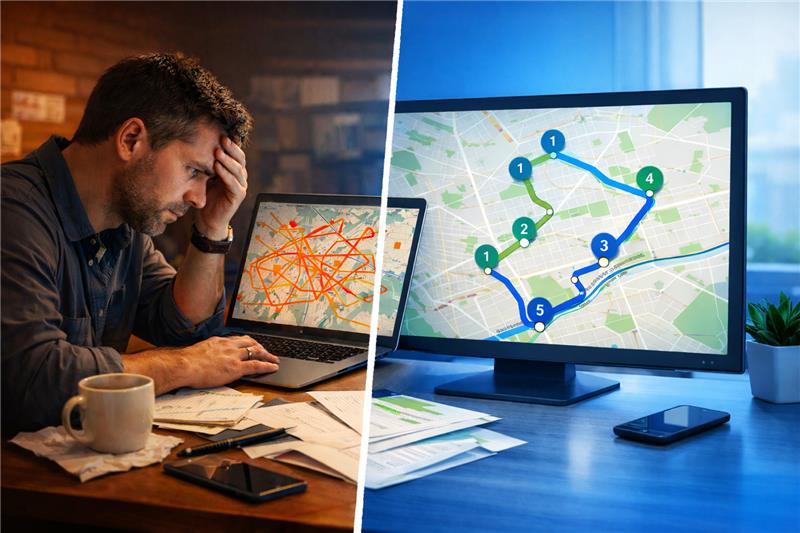
Picture this: it’s 7am, you’ve got 60 deliveries to get out, two drivers called in, and your third driver just texted asking which order to do the stops in. You’re staring at a spreadsheet, coffee going cold, trying to figure out the most logical sequence before the morning rush kicks in.

That is manual route planning. And it’s why route optimization exists.

This guide covers everything you need to know — what route optimization actually is, how it works under the hood, what signs tell you that you need it, and why the difference between optimized and unoptimized routes often comes down to hundreds of dollars a week for a typical delivery operation.

What Is Route Optimization, Really?

At its most basic: route optimization is the process of figuring out the most efficient order and path for a driver to complete a set of deliveries.

That sounds easy. It isn’t.

Even with just 10 stops, there are over 3.6 million possible sequences a driver could follow. Push that to 20 stops and the number of possible combinations becomes, mathematically speaking, astronomically large — we’re talking more combinations than atoms in the observable universe. No human sitting at a desk can work through that. Not even close. Route optimization software solves it in seconds.

The goal isn’t just “shortest distance,” either. A genuinely optimized route accounts for traffic at different times of day, delivery time windows customers are expecting, how much each vehicle can physically carry, when each driver’s shift ends, which stops are highest priority — all of it, simultaneously. That’s the difference between a route that looks good on a map and one that actually works when your driver hits the road at 8am.

Route Optimization vs. Route Planning — They're Not the Same Thing

A lot of people use these terms interchangeably. They shouldn’t.

Route planning is just the act of creating a route. You pick your stops, put them in some order, and off you go. You can do this with Google Maps, a whiteboard, a spreadsheet — whatever works. It gets the job done if you have maybe five stops and no time constraints.

Route optimization is what happens when you apply an algorithm to that planning process. Instead of you deciding the order, the software calculates it — based on distance, time windows, traffic patterns, vehicle capacity, and a dozen other variables you probably aren’t tracking manually.

Here’s the tangible difference: a dispatcher at a grocery delivery company once told us they were manually planning routes for 8 drivers every morning. It took about 90 minutes. When they switched to route optimization software, the same routes were generated in under two minutes — and the routes themselves were around 20% shorter. That 88 minutes of saved planning time doesn’t sound like much until you realize it’s recurring every single morning, forever.

How Route Optimization Software Actually Works

Step by step, here’s what happens when you run a route optimization:

You load your delivery addresses. Either typed in manually, uploaded from a CSV or Excel file, or pulled automatically via API from your order management system. Good software geocodes each address on its own — no need to manually look up coordinates.

You set your constraints. This is the part most people don’t think about until they’ve been burned. Constraints are things like: this customer is only home between 2pm and 4pm. This vehicle can only carry 300kg. This driver starts from a different depot. This stop has to happen before that one because it’s a pickup. You define all of this before the optimization runs.

The algorithm processes everything. The engine runs through the possible combinations — far faster than any human could — and produces a route sequence that respects your constraints while minimizing distance and time. With Bodha, this typically takes a few seconds regardless of how many stops you have.

Routes go straight to drivers’ phones. No printing. No WhatsApp messages. No “I’ll text you the list.” The optimized route appears in the driver app with turn-by-turn navigation, delivery notes, and the full stop manifest.

The system adjusts during the day. This is where modern route optimization software earns its keep. A new order comes in at 11am? Driver stuck in traffic? Stop cancelled? The system reoptimizes the remaining route on the fly and updates the driver automatically.

What Route Optimization Is Actually Worth — The Real Dollar Math

Let’s skip the vague claims and work through what this typically delivers in real numbers. Two scenarios, both common:

Scenario A: 5-driver operation, 40 stops per driver per day

A 20% mileage reduction on a 5-driver fleet typically saves around 25–30 miles per driver per day. At current fuel prices, that’s roughly $12–15 in fuel per driver, per day. Over a working month (22 days), that’s $1,320–$1,650 saved — just in fuel. Against a software cost of $150/month, you’re looking at roughly 9x ROI before you count time savings or increased delivery volume.

Scenario B: 10-driver operation, 60+ stops per driver per day

The math compounds faster at this scale. The same 20% mileage reduction now saves closer to $2,800–$3,500/month in fuel. Add the time savings from eliminated manual planning (typically 60–90 minutes per day across the dispatch team) and the capacity gains from fitting more stops per shift, and the ROI is substantial. Most 10-driver operations running real numbers find payback inside the first 2–3 weeks.

The other thing worth flagging: fuel is the visible saving, but it’s not always the biggest one. Missed delivery windows cost money too — failed first-attempt deliveries cost an average of $15– 25 per package in additional handling and redelivery. If your unoptimized routes are causing even 5–10 missed windows per day, that adds up faster than the fuel bill.

UPS famously illustrated just how deep routing inefficiency runs when they began eliminating left turns from driver routes. Their analysis found that left turns (which require waiting against oncoming traffic) were adding unnecessary idle time and miles across their entire fleet. The routing change — powered by optimization software — now saves them over 10 million gallons of fuel annually. Most delivery businesses aren’t operating at UPS scale, but the principle is exactly the same: small, systematic improvements to how routes are sequenced compound into very large numbers over time.

7 Signs You've Already Outgrown Manual Route Planning

This is the uncomfortable section. Most delivery businesses that need route optimization know something is off — they just haven’t connected the dots to routing as the cause. Here are the clearest warning signs:

Your route planning takes more than 30 minutes per day. If your dispatcher or you personally are spending meaningful time each morning shuffling stops around a map, that time has a cost. A 60-minute daily planning task across a year is 250+ hours of labor that optimization software handles in seconds.

Drivers are regularly running late on time windows. Not occasionally — regularly. If it’s happening a few times a week, your route sequence isn’t respecting delivery constraints properly. Optimization fixes this by building time windows into the route calculation from the start.

Your fuel costs are climbing without obvious explanation. Vehicle costs go up, sure. But if your per-delivery fuel cost keeps rising as you add more stops, inefficient routing is almost certainly a factor. The routes aren’t getting tighter as you scale — they’re getting messier.

Different drivers plan their own routes differently. When each driver handles their own sequence, you lose consistency and control. There’s no way to compare performance, optimize over time, or ensure a new driver isn’t taking a wildly inefficient path on their first week.

Customers are calling to ask where their delivery is. A lot of these calls happen specifically because ETAs are unreliable — which they are when routes aren’t optimized. Proper route optimization gives dispatchers and customers accurate, trackable ETAs that actually hold up.

You can’t easily add a new stop mid-day. If a last-minute order means starting the whole planning process over from scratch, your current system doesn’t scale. Route optimization software inserts new stops into active routes in seconds.

You’re planning routes for one driver at a time. Individually planning routes isn’t just slow — it means you’re not optimizing across your whole fleet. A route optimizer looks at all drivers and all stops simultaneously, balancing workloads and minimizing total fleet mileage rather than just each individual route.

If more than two of these describe your current operation, the cost of staying manual is almost certainly higher than the cost of switching.

Why This Actually Matters (In Numbers)

Beyond the ROI calculation above, route optimization consistently delivers across five areas that affect every delivery business:

Fuel. Inefficient routes are full of unnecessary miles — doubling back, crossing town twice, zigzagging through a neighborhood instead of working through it logically. Most operations see a 20–30% reduction in total mileage after switching to optimization.

Volume. When drivers spend less time driving between stops, they complete more stops per shift. The typical increase is somewhere between 15–25% more deliveries per driver per day — without hiring anyone new or buying another vehicle.

Missed time windows. Route optimization sequences stops around time constraints specifically. Missed windows drop significantly once routes are built around delivery windows rather than treating them as an afterthought.

Customer calls. “Where’s my delivery?” is one of the most expensive calls a delivery business receives — not because it’s complicated to answer, but because of the sheer volume of them. Automated ETAs and live tracking (which only work properly when routes are optimized) cut this call volume dramatically.

Driver turnover. Drivers following a logical, pre-planned route — with no backtracking or confusion about what comes next — are measurably less stressed at the end of a shift. Staff retention improves. It’s a soft benefit, but it’s real and it compounds

The Google Maps Problem

Everyone has Google Maps. It’s free, it works, and drivers already know how to use it. So the obvious question is: why pay for route optimization software?

Here’s the honest answer: Google Maps was built for consumers navigating to one destination. It was not built for delivery operations, and the gap between what it does and what a delivery business actually needs is significant.

Google Maps caps you at 10 waypoints per route. It doesn’t support delivery time windows — you can’t tell it “stop 4 needs to happen between 2pm and 3pm.” It has no concept of vehicle capacity. It doesn’t track your fleet. It can’t send automated notifications to customers. It has no proof of delivery. And if you have more than one driver, you’re back to doing everything manually.

For occasional use — a handful of stops, no time constraints, one driver — Google Maps is perfectly fine. But if you’re running a real delivery operation with multiple drivers, 30+ daily stops per vehicle, and customers who expect to know when their order is arriving, you’ve already outgrown it. You just might not have noticed yet.

Static vs. Dynamic Optimization — Which Do You Need?

There are broadly two modes of route optimization, and which one matters to you depends on how your operation works.

Static optimization means you plan your routes in advance — usually the evening before or early morning. You know all your stops, you run the optimization, and drivers head out with a fixed plan. This works well for scheduled delivery operations: grocery deliveries, pharmacy runs, meal kit distribution, anything where you have a complete order list before drivers leave the depot. Most small and mid-sized operations run this way.

Dynamic optimization is for operations where orders keep coming in throughout the day and need to be added to active routes in real time. Think restaurant delivery, same-day courier services, anything on-demand. The software continuously re-optimizes as new stops are inserted, which is considerably more complex technically.

Most delivery businesses doing scheduled work don’t actually need dynamic optimization — static is fine, and simpler. The important thing is knowing which mode your software supports before you commit.

Industries Where It Makes the Biggest Difference

Route optimization benefits any delivery operation with multiple stops, but some industries see a more dramatic impact than others.

Food delivery businesses feel it first, because route quality directly affects product quality. A poorly optimized food delivery route means food arriving cold. Customers notice immediately, and it hits your reviews before the end of the day.

Pharmaceutical and medical delivery is another area where optimization isn’t optional — it’s a compliance issue. Medications often have strict delivery windows, temperature requirements, and documentation needs. A missed delivery isn’t just a customer service failure; it can have real health consequences.

Courier services running 80–100 stops per driver per day see the biggest raw efficiency gains, because the compounding effect of even small per-stop time savings is enormous at that volume.

Furniture and large-item delivery has a different challenge — long service times at each stop and complex vehicle loading constraints. The optimization has to account for load sequencing (you don’t want the item you need first loaded last), which is something most basic tools don’t handle well.

Where Route Optimization Is Heading in 2026

The technology is moving fast, and it’s worth knowing where the meaningful developments are happening — especially if you’re evaluating software for the long term.

AI-driven dynamic routing is becoming standard rather than premium. Systems now learn from historical delivery data — which driver tends to run faster in which neighborhoods, where traffic reliably backs up on certain days — and factor that into future route calculations automatically. Routes get smarter the longer you use them.

EV fleet optimization is an emerging constraint that wasn’t relevant two years ago. Electric delivery vehicles have range limitations and need charging windows planned into routes. The best optimization platforms now treat charging stops as a routing constraint the same way they treat time windows. If you’re running or planning to run EVs, this is worth asking about explicitly when evaluating software.

Sustainability metrics are becoming something operations teams actually track and report. Reducing CO₂ emissions per delivery is increasingly a business requirement — not just a nice-tohave — and route optimization is the primary lever for hitting those targets. Carbon-per-stop reporting is now a feature category in itself among the better platforms.

What to Actually Look for in Route Optimization Software

If you’re shopping around, here’s what genuinely matters versus what’s marketing noise:

The stop cap matters more than people realize. Some tools limit you to 100 or 200 stops per route. If you’re anywhere near that ceiling today, you’ll hit it as you grow. Look for software that handles 500+ stops without degrading route quality.

Real-time GPS tracking is non-negotiable for any multi-driver operation. Not just a dot on a map — actual status updates as drivers complete stops, arrive at locations, and mark deliveries done.

Proof of delivery shouldn’t be an add-on. Photos, signatures, and delivery notes captured in the driver app and stored automatically should be standard. Disputes with customers are far easier to resolve when you have timestamped photo evidence.

Customer notifications built in — not through a third-party integration you have to configure separately. Automated SMS and email updates with live ETAs reduce inbound support calls dramatically and genuinely improve customer experience.

How fast is the setup? This one is underrated. Some enterprise route optimization platforms take weeks to implement, require IT involvement, and come with a learning curve that means your dispatcher needs three days of training before they can create a route. That’s not practical for most delivery businesses.

How Bodha Handles Route Optimization

Bodha Drive is built for individual drivers and small operations — you can plan up to 500 stops, get your optimized route in seconds, and navigate with turn-by-turn directions straight from the app. Most drivers are creating their first optimized route within 20 minutes of signing up.

For teams with multiple drivers, Bodha Fleet adds a full dispatcher dashboard, real-time GPS tracking across your entire fleet, automated customer notifications, proof of delivery capture, and reporting. The dispatcher plans and dispatches all routes from one screen; drivers receive everything they need on their phones.

Setup takes under an hour for most teams. You bring your delivery addresses (Excel, CSV, or API), and Bodha handles the rest.

Try it free for 7 days — no credit card required →

Questions We Get Asked Often

Route planning is choosing your stops and roughly sequencing them. Route optimization is having software calculate the mathematically best sequence based on distance, time windows, vehicle capacity, and traffic — automatically, in seconds. The results are meaningfully different, especially at higher stop counts.

The travelling salesman problem (TSP) is a classic mathematical puzzle: given a list of cities, what's the shortest route that visits each one exactly once and returns to the start? It's considered one of the hardest problems in computational mathematics because the number of possible routes grows exponentially with each added stop. Route optimization software solves a real-world version of this problem every time it generates a route — which is why the calculations that would take a human hours can happen in seconds with the right algorithms

Often better for small businesses than large ones, proportionally. If a solo dispatcher is spending 90 minutes every morning manually planning routes for a small fleet, route optimization hands them back that time every single day. It compounds.

It varies by platform and fleet size, but most SMB-focused tools fall in the $25–$100 per driver per month range. Bodha is $29.99 per driver per month. For a single driver doing 40+ stops daily, the fuel savings alone typically cover that cost several times over. Most operations see payback within the first two to three weeks.

Seconds, genuinely. Upload your stops, hit optimize, routes are ready.

Last-mile delivery — the final leg from a local depot to the customer's door — is where most delivery costs concentrate. Studies put it at 40–53% of total logistics costs. Last-mile optimization is just route optimization applied to that specific stage, and the efficiency gains tend to be largest there because stop density is highest.
Yes, directly. Fewer miles driven means less fuel burned and lower CO₂ emissions per delivery. Some platforms now include carbon-perstop reporting specifically for businesses tracking sustainability metrics. It's one of those areas where the environmental benefit and the financial benefit point in exactly the same direction.

The Bottom Line

Most delivery businesses don’t fail because they have bad products or bad drivers. They fail because the gap between what they’re spending on the road and what they could be spending — with better routing — is quietly eating their margins.

Route optimization closes that gap. It won’t solve every problem in your operation, but it will almost certainly make your routes shorter, your drivers’ days more manageable, and your fuel bills meaningfully lower. For most businesses, it pays for itself within the first few weeks.

If you’re still sending drivers out with a manually-planned sequence or a Google Maps link, it’s worth spending 20 minutes seeing what optimized routes actually look like for your specific stop count and geography.

Start your free 7-day Bodha trial and run your first optimized route today →

Ready to optimize your delivery routes?

Join 10,000+ businesses already using Bodha’s delivery route planning software to save time and reduce operational costs.

Related blogs

How to Plan Delivery Routes: A Practical Guide for Operators

How to Plan Delivery Routes: A Practical Guide for Operators

Back Table Of Content Something every experienced dispatcher knows: the difference between a good day and a chaotic…

Reduce Delivery Costs: 10 Proven Strategies That Actually Work

Reduce Delivery Costs: 10 Proven Strategies That Actually Work

Back Table Of Content Last-mile delivery is the most expensive part of the logistics chain. It accounts for…

What Is Route Optimization? (And Why Your Delivery Business Can’t Afford to Ignore It)

What Is Route Optimization? (And Why Your Delivery Business Can’t…

Back Table Of Content Picture this: it’s 7am, you’ve got 60 deliveries to get out, two drivers called…

Reduce Delivery Costs: 10 Proven Strategies That Actually Work

reduce delivery costs banner

Reduce Delivery Costs: 10 Proven Strategies That Actually Work

user profile

Bodha Route

April 6, 2026

Table Of Content

Last-mile delivery is the most expensive part of the logistics chain. It accounts for roughly 53% of total shipping costs. Not because the distances are long, but because the density is low, the stops are unpredictable, and the variables that drive cost upward are numerous.

For a delivery business running 10 drivers, getting from average to efficient typically means the difference between $8,000 and $5,500 in monthly operating costs for the same delivery volume. That $2,500 gap is not theoretical. It shows up in fuel bills, driver overtime, failed deliveries, and planning inefficiencies that compound quietly week after week.

This guide covers 10 strategies that actually move that number, with the dollar math behind each one so you can prioritise which to tackle first.

First: Know Your Cost Per Delivery

Before any of the strategies below are worth implementing, you need one number: your cost per delivery.

Most delivery operators know their monthly fuel bill and their payroll. Fewer know what each individual delivery actually costs them. Without this number, you cannot measure improvement, identify your worst-performing routes, or make a credible case for investing in software.

Calculating it is straightforward. Take your total monthly operating costs (fuel, driver wages, vehicle depreciation, insurance, platform costs, any maintenance) and divide by total deliveries completed that month.

For most SMB delivery operations, this number sits somewhere between $4 and $12 per delivery depending on route density, vehicle type, and stop complexity. Industry benchmark for optimised small-fleet operations is $3-5 per delivery. If you’re at $9-12, there is significant room to move.

Track this number monthly. Every strategy below should move it.

Strategy 1: Route Optimisation (With the Real Dollar Math)

Every article about reducing delivery costs mentions route optimisation. Few show what it’s actually worth.

Here is the calculation for a 10-driver fleet doing 50 stops per driver per day:
Poorly planned routes typically add 15-20 unnecessary miles per driver per day compared to optimised routes. At current fuel prices and average delivery vehicle consumption, that’s roughly $7-10 in wasted fuel per driver daily. For 10 drivers over 22 working days: $1,540-$2,200 per month in unnecessary fuel spend.

Add the planning time. Manual planning for 10 routes takes an experienced dispatcher 60-90 minutes per morning. Route optimisation software reduces this to 5-10 minutes. At a dispatcher salary of $20/hour, that’s $260-$390 per month in recovered labour time.

Route optimisation software for a 10-driver fleet costs roughly $300/month. The fuel savings alone cover that. The planning time savings are profit.

The implementation is straightforward with Bodha Fleet: import your stops via spreadsheet or API, set your constraints (time windows, vehicle capacity, driver shift times), optimise, and dispatch routes to drivers’ phones in minutes. Most operations see measurable mileage reduction in the first week.

Strategy 2: Cut Failed First-DeliveryAttempts

Failed deliveries are one of the most expensive and least-discussed cost drivers in last-mile logistics. Each failed first attempt costs an average of $15-25 in additional handling, re-dispatch labour, and vehicle time. If your operation does 200 deliveries per day and 5% fail on first attempt (a conservative estimate), that’s $150-250 per day in pure waste. Over a month: $3,300-$5,500.

The fix is almost entirely about customer communication. Most failed deliveries happen because the customer was not home. Most customers who are not home simply did not receive enough notice, or received it too late.

Automated SMS and email notifications sent when the driver is 30-60 minutes away give customers enough time to get home, ask a neighbour to accept, or communicate alternative instructions. Operations that implement proactive notifications consistently reduce failed delivery rates to 1-2% from industry averages of 5-8%.

The secondary fix is flexible re-delivery options. Customers who can specify a safe place or request a neighbour delivery via a tracking link cause far fewer failed attempts than customers who have no way to communicate instructions in real time.

Both capabilities, automated notifications and customer tracking links, are standard in modern delivery platforms. If yours does not have them, the cost of failed deliveries is likely exceeding the cost of upgrading.

Strategy 3:Increase Delivery Density Per Route

Every delivery route has fixed costs (the driver’s time, the vehicle’s fuel for the journey, the wear on the vehicle) that exist regardless of how many stops are on the route. The more stops you add to a route within a given area, the lower your cost per delivery becomes. This is delivery density, and it’s one of the highest-leverage cost levers available to small and mid-sized fleets.

Three ways to improve it:
Geographic clustering at dispatch. Before you assign stops to routes, sort and group them by neighbourhood or postcode. Stops in the same area belong on the same route. This sounds obvious and is routinely ignored in manual planning because it takes time to do properly. Route optimisation software does it automatically.

Time window management. If customers can pick any delivery window they like, some will pick windows that force drivers to cross town twice. If you offer windows that match your geographic routing (morning deliveries in zone A, afternoon in zone B), customers still get a choice but you get far better route density. Bringg data suggests this approach reduces miles per stop by 15-25%.

Order consolidation. If you have multiple small orders going to the same building or street, combining them into a single delivery run where possible reduces total stop count without reducing delivery volume. B2B deliveries and apartment blocks with multiple customers are obvious candidates.

Strategy 4: Address Driver Behaviour and Fuel Waste

Drivers covering the same routes in similar vehicles can have fuel costs that vary by 15-20% based purely on driving behaviour. Idling engines, harsh acceleration from traffic lights, speeding on short stretches, and unnecessary deviation from planned routes all add fuel cost without adding delivery value.

For a 10-driver operation with a combined monthly fuel bill of $6,000, a 12% reduction from behaviour improvement alone saves $720/month. Over a year, that’s $8,640 recovered without changing a single route.

The practical approach has two components. First, telematics or GPS tracking data (which most route optimisation platforms provide) shows you idling time, route deviation, and average speed patterns per driver. You don’t need expensive dedicated telematics hardware to start seeing this data. Second, simple driver scorecards reviewed weekly in a brief team meeting create awareness that changes behaviour without requiring confrontational management conversations.

The change is typically fastest when drivers understand that the data is there to identify operational issues, not to catch people out. Frame it correctly and most drivers respond well. They generally prefer efficient routes too.

Strategy 5:Improve Vehicle Load Planning and Utilisation

This is the most consistently overlooked cost reduction lever in small fleet operations. If your vehicles are leaving the depot at 60-65% capacity when they could leave at 85-90%, you’re either making more trips than necessary or running more vehicles than your actual delivery volume requires.

Two specific problems to address:
First, load order. Vehicles loaded in the wrong sequence (where the first delivery stop is buried under everything else) force drivers to spend 5-10 minutes at each stop rearranging the load. On a 40-stop route, that’s 3-7 hours of lost productivity per driver per day across your fleet. A loading manifest that maps packages to vehicle position by delivery sequence adds planning time upfront but saves far more on the road.

Second, vehicle-to-route matching. Sending a large van on a 15-stop residential route when a smaller vehicle would do increases fuel cost and makes parking harder. If you have mixed vehicle types in your fleet, matching vehicle size to stop density and package volume is worth the additional planning complexity.

Strategy 6: Manage Time Windows to Shape Route Efficiency

This is an operator-level decision that most businesses never make deliberately, and it’s worth thinking through.

When customers are given completely free choice over delivery time (any time between 8am and 6pm), the resulting stop distribution across your delivery area is essentially random. Routes that could be geographically tight become scattered because two customers in the same street want morning and evening deliveries respectively.

Offering structured windows (morning or afternoon, for example) that align with how you’ve zoned your delivery area lets customers feel they have a choice while dramatically improving your route density. Taking this a step further: offering a slightly reduced delivery fee for the window that fits your routing better incentivises customers to select the option that costs you less, without making them feel constrained.

This requires a shift in how you present delivery options but very little operational change. Operations that manage windows deliberately report 15-25% better route density compared to fully open windows.

Strategy 7: Calculate and Track Cost Per Delivery By Route and Area

Most operators who know their overall cost per delivery don’t know which routes or delivery areas are profitable and which are quietly losing money.

A route that goes 25 miles out of your usual area to serve a handful of customers might have a cost per delivery of $18 when the rest of your fleet is averaging $6. You might be unaware because the overall average hides it.

Breaking down cost per delivery by route, zone, or geographic area reveals which parts of your operation are efficient and which need to change, either through pricing adjustments, route restructuring, or, in some cases, the honest assessment that certain customers are not worth the delivery cost.

Most route management platforms capture the data needed to do this analysis automatically. The time investment is in reviewing it weekly and acting on what you find, not in gathering it.

Strategy 8: Preventive Maintenance to Avoid Unplanned Breakdowns

An unplanned vehicle breakdown mid-route triggers a cascade of costs that rarely show up on a single line in anyone’s budget. The immediate costs: emergency re-dispatch or route redistribution to remaining drivers, driver overtime to cover the additional stops, missed deliveries with potential penalty or re-delivery costs, and any roadside assistance or towing fees.

For a typical delivery operation, a single mid-day breakdown costs $500-1,500 in total when all the downstream effects are counted. A 10-vehicle fleet experiencing even two unplanned breakdowns per month is spending $1,000-3,000 monthly on a problem that a scheduled maintenance calendar largely prevents.

The fix is unglamorous: a simple preventive maintenance schedule with reminders. Oil changes at the right intervals, tyre pressure and tread checks weekly, brake inspections on schedule. Operations that maintain this discipline report breakdown rates 60-70% lower than those that do maintenance reactively.

If you’re managing a fleet without a maintenance log, starting one this week is one of the highestROI changes available to you at zero cost.

Strategy 9: Automate Customer Notifications to Cut Support Call Volume

A dispatcher who spends 2 minutes per call handling “where is my delivery?” enquiries and takes 25 such calls per day is spending nearly an hour of paid time per day answering a question that software can answer automatically.

At $20/hour that’s $400/month in dispatcher labour absorbed by customer queries that add no delivery value. In operations where the dispatcher is the owner, it’s their time, and that’s worth considerably more than $20 per hour.

Automated notifications (a message when the order is out for delivery, a second when the driver is approaching, and a delivery confirmation with proof of delivery photo) eliminate most of these calls before they happen. Operations implementing automated notifications consistently report 60-70% reductions in inbound support calls related to delivery status.

The secondary benefit is customer satisfaction. Customers who receive proactive updates without having to ask are measurably more satisfied with the delivery experience, which drives repeat orders. The cost reduction and the customer experience improvement happen simultaneously.

Strategy 10: Post-Route Analytics Review as a Weekly Practice

The previous nine strategies will reduce your delivery costs. This one keeps them falling over time instead of plateauing.

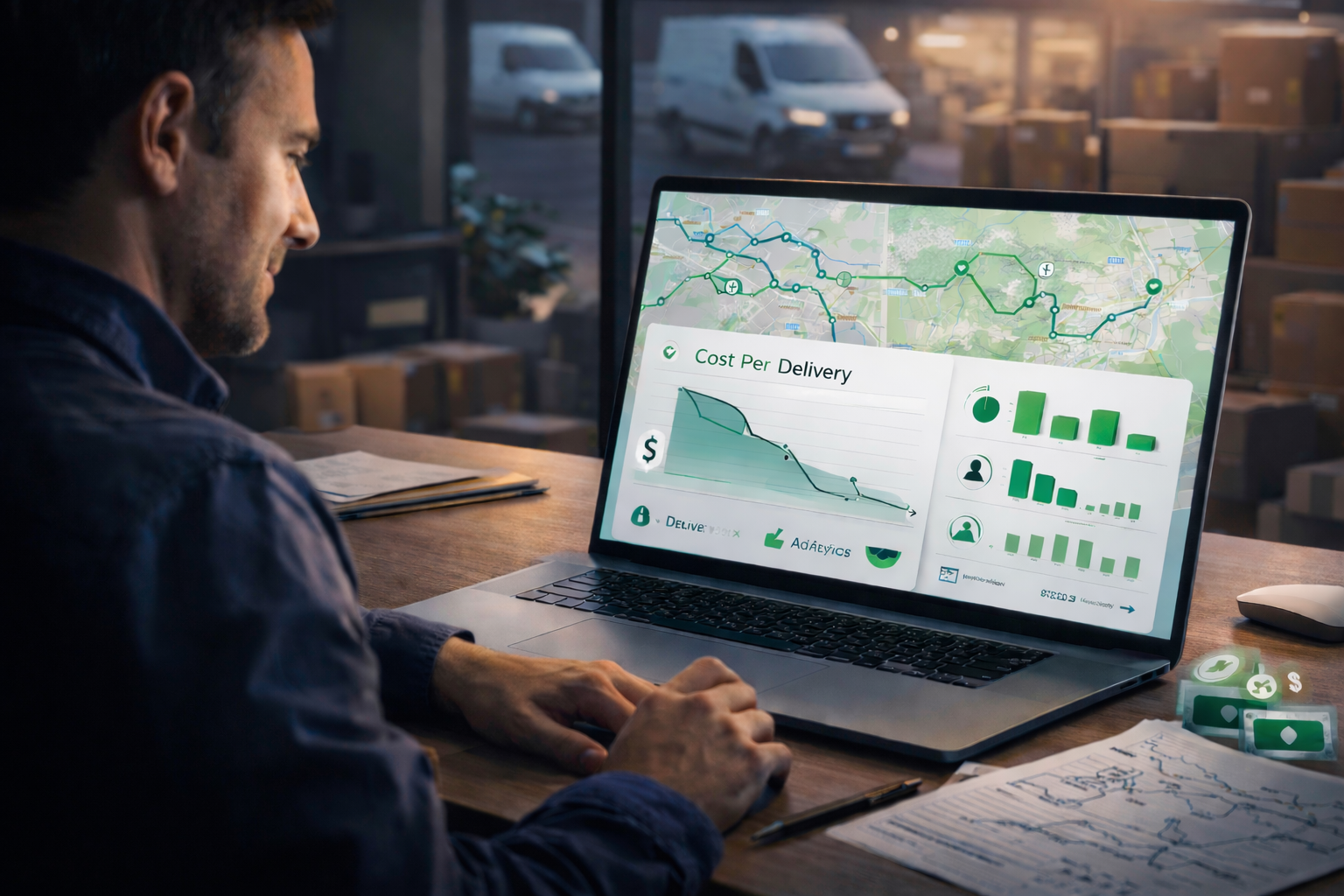
Every week, spending 30 minutes reviewing your route performance data will reveal patterns that are invisible in daily operations. A specific stop that consistently runs 20 minutes over planned service time has something that needs fixing: incorrect address data, an access issue, a customer who’s always difficult to reach. A route that runs 15% over planned mileage every Tuesday has a traffic pattern or deviation problem that can be corrected.

The metrics worth reviewing regularly are: planned vs actual arrival time per stop, planned vs actual total route time, miles driven vs planned miles, failed delivery rate by route and by zone, and cost per delivery by route.

Most modern delivery platforms capture all of this automatically. The operational discipline is not in gathering the data. It’s in actually sitting down with it weekly and feeding what you find back into next week’s planning decisions.

Operations that build this habit consistently reduce their cost per delivery by an additional 5- 10% per year beyond the initial improvement from the strategies above, simply by finding and fixing the recurring leaks.

How These 10 Strategies Stack Up Financially

For a 10-driver operation running 50 stops per driver per day, implementing all 10 strategies realistically looks like this:

Route optimisation: $1,540-$2,200/month in fuel savings Failed delivery reduction: $1,650-$2,750/month recovered (assuming current 5% failure rate drops to 2%)
Delivery density improvement: 15-20% mileage reduction, approximately $900-$1,200/month
Driver behaviour improvement: $500-$800/month in fuel recovered
Preventive maintenance: $500-$1,000/month in avoided breakdown costs
Automated notifications: $400/month in dispatcher labour recovered

Conservatively: $5,490-$7,950 per month in recoverable costs across a 10-driver operation. Against a route optimisation platform cost of $300/month, the return is not close.

Not every operation will realise every saving immediately. But any two or three of these strategies implemented well will move your cost per delivery measurably in the first month.

Where to Start

The sequence matters. Start with the strategies that cost nothing or close to nothing, and use the savings to fund the ones that require investment.

Week one: calculate your current cost per delivery and break it down by route. This takes 30 minutes and everything else depends on it.

Week two: implement a vehicle maintenance log and review driver behaviour data if you have GPS tracking. Both are zero-cost.

Month one: implement automated customer notifications if your platform supports it, and start structuring delivery time windows. Both should reduce failed deliveries and support calls within weeks.

Month two onwards: if you’re still planning routes manually at this point, the cost savings from route optimisation software should now be obvious from the data you’ve been tracking. The investment decision is much easier to make when you know exactly how much you’re spending on inefficiency.

Try Bodha Fleet free for 7 days. Route optimisation, automated notifications, proof of delivery, and full analytics included. No credit card required.

Frequently Asked Questions

Industry benchmark for a well-optimised small fleet is $3-5 per delivery for standard parcel-type drops in moderate-density areas. Operations at $8-12 per delivery typically have significant room to improve through route optimisation and density improvements alone.

For a 10-driver operation, the realistic fuel saving from route optimisation is $1,500-$2,200 per month based on typical 15-20% mileage reduction. Add planning time savings and the total is often $1,800-$2,600 per month, against a platform cost of $200-400/month.

Industry average is 5-8%. Well-run operations using proactive customer notifications get this to 1-2%. The cost difference at scale is significant. For a 200-delivery-per-day operation, dropping from 5% to 2% failure rate saves $90-$150 per day in re-delivery costs.

Take your total monthly operating costs (fuel, driver wages, vehicle depreciation and maintenance, insurance, software) and divide by total deliveries completed. Do this monthly. Track it by route once you have the data infrastructure to do so.

Failed delivery reduction through automated notifications typically shows the fastest ROI because the savings start from day one and require no behaviour change from drivers or significant process change from dispatchers. Route optimisation takes a few days to implement but shows measurable fuel savings in the first week.

Most apply to any scale. Route optimisation, load sequencing, and post-route analytics review are as relevant for a solo courier doing 60 stops daily as for a 20-driver fleet. The dollar amounts scale down, but the percentage improvements are often similar or better for solo operators because there's more room to improve.
Ready to optimize your delivery routes?

Join 10,000+ businesses already using Bodha’s delivery route planning software to save time and reduce operational costs.

Subscribe to Our Blog

    Related blogs

    How to Plan Delivery Routes: A Practical Guide for Operators

    How to Plan Delivery Routes: A Practical Guide for Operators

    Back Table Of Content Something every experienced dispatcher knows: the difference between a good day and a chaotic…

    Reduce Delivery Costs: 10 Proven Strategies That Actually Work

    Reduce Delivery Costs: 10 Proven Strategies That Actually Work

    Back Table Of Content Last-mile delivery is the most expensive part of the logistics chain. It accounts for…

    What Is Route Optimization? (And Why Your Delivery Business Can’t Afford to Ignore It)

    What Is Route Optimization? (And Why Your Delivery Business Can’t…

    Back Table Of Content Picture this: it’s 7am, you’ve got 60 deliveries to get out, two drivers called…

    How to Plan Delivery Routes: A Practical Guide for Operators

    plan delivery route banner

    How to Plan Delivery Routes: A Practical Guide for Operators

    user profile

    Bodha Route

    April 6, 2026

    Table Of Content

    Something every experienced dispatcher knows: the difference between a good day and a chaotic one is almost always decided before 8am. If the routes went out clean, with stops sequenced logically, time windows respected, drivers assigned to areas they know, and load order matching drop sequence, the day runs itself. If the routes were thrown together fast because the morning got away from you, you’ll be fielding calls until 6pm.

    This guide is written for operators who already know what they’re doing and want to do it better. Not a beginner tutorial. A proper playbook for planning routes that hold up in the real world, handling the disruptions that will inevitably happen, and building a system that gets smarter over time.

    One thing you can do right now, before reading any further, that will improve your routes today:
    group your stops by postcode or zip code in a spreadsheet before you do anything else. Sort by postcode, then assign zones to drivers. It takes ten minutes and immediately eliminates the most common source of backtracking in manually planned routes. If you’re already doing that and need more, keep reading.

    What Good Route Planning Actually Involves

    Planning delivery routes sounds like a logistics task. It’s actually a resource allocation problem with time constraints, and that distinction matters for how you approach it.

    You’re not just deciding which road to take. You’re deciding how to distribute a finite set of driver hours across a set of deliveries with different time requirements, priority levels, and geographic positions, while respecting vehicle capacity limits, customer windows, road conditions, and the unpredictable reality that about 10-15% of what you plan for won’t survive first contact with the actual day.

    Good route planning accounts for all of this upfront. Poor route planning accounts for the address and not much else, which is why a lot of routes that look fine on a map turn into a mess by lunchtime.

    Specifically, a well-built route will factor in:

    • How long each stop actually takes, not how long it’s supposed to take in theory.
    • Vehicle load capacity and load sequence (the last stop gets loaded first).
    • Delivery time windows that customers have been promised.
    • Traffic patterns at the actual times your drivers will hit certain roads.
    • Which driver knows which area, because familiarity with local roads is genuinely worth 10-15 minutes per route.
    • Priority stops that need to happen regardless of efficiency.
    • A realistic buffer for the unexpected, because there always is one.

    Routes that skip any of these factors look efficient on paper and create problems on the road.

    The Morning Dispatch Workflow: Step by Step

    This is the section most guides skip. Here’s a realistic sequence from the moment your order list is ready to the moment your drivers leave.

    Step 1: Pull your complete order list and validate addresses

    Before you optimize anything, check the data. Wrong or incomplete addresses are the most common cause of failed deliveries, and catching them at planning time costs nothing. Catching them at delivery time costs the driver’s time, a failed attempt fee, and a frustrated customer.

    A few minutes spent running your address list through geocoding software or even a basic validation pass in your route planner is almost always worth it. Most modern delivery platforms do this automatically when you import stops.

    While you’re at it, flag anything unusual: access restrictions, gate codes needed, commercial addresses with loading bay requirements, customers who are notoriously hard to reach. These notes need to be in the driver’s instructions before they leave, not discovered at the doorstep.

    Step 2: Set your constraints before you touch the sequence

    This is the step that separates experienced operators from less experienced ones. Before you think about which stop comes first, set the parameters that the route has to respect.

    Time windows are the most critical. If customerA is available until 11am and customer B is only available after 2pm, the sequence has to work around that. Any route that doesn’t account for this upfront will hit a wall mid-day.

    Vehicle capacity is next. How many stops can each vehicle handle at full load? What’s the weight or volume limit? If you’re running different vehicle types across your fleet, this gets more complex, and the assignment of drivers to routes needs to match vehicle capability to stop requirements.

    Driver shift times matter more than people think. A route that asks a driver to do 55 stops in a 7-hour shift, accounting for realistic service times, is already overloaded before it starts. Set a realistic ceiling per driver based on your actual average service time per stop, not an optimistic estimate.

    Step 3: Cluster stops geographically before sequencing

    Even if you’re using optimization software, understanding your geographic clusters helps you spot problems the algorithm might not. The basic principle: stops that are close together geographically should generally be close together in the route sequence.

    The main exception is time windows. If two stops are next door to each other but one needs to be done at 9am and the other at 3pm, they obviously can’t be consecutive regardless of geography.

    For manual planners: sort your stops by postcode first, then look at them on a map. Draw rough zones. Assign each zone to a driver. Then within each zone, sequence the stops in a logical geographic flow. A good zone route works through a neighborhood in one direction rather than zigzagging back and forth.

    For software users: let the algorithm do this, but review the output on a map before dispatching. A good route optimization engine won’t produce spaghetti routes, but it’s worth a 90-second visual check to catch anything that looks obviously wrong.

    Step 4: Sort load order to match delivery sequence

    This is the step that consistently gets forgotten and consistently causes problems. Your driver’s last delivery stop should be loaded first, and the first stop should be at the front of the vehicle.

    If your team loads vehicles in the wrong order, drivers spend 5-10 minutes at each stop digging through the load to find the right parcel. Multiply that by 40 stops a day across 8 drivers and you’ve added several hours of productive delivery time to your daily cost.

    For operations with complex mixed loads or multiple product types per stop, a loading manifest that maps packages to vehicle position makes a real difference. It takes time to build initially, but experienced loading teams work much faster with a clear schema.

    Step 5: Assign routes to drivers based on familiarity and shift timing

    Driver-route matching is underrated as a planning decision. A driver who knows a specific area, knows where parking is awkward, knows which apartment buildings have difficult access, and knows the local traffic patterns is measurably faster than an unfamiliar driver on the same route, often by 15-20 minutes on a full day’s run.

    Where possible, keep drivers on familiar zones. It builds efficiency over time and reduces the number of “can’t find the address” calls you get during the day.

    Shift timing matters too. If you have drivers starting at different times, routes need to be structured so early starters aren’t waiting around for the later shift to fill out their routes, and late starters aren’t being given time-sensitive early-morning stops.

    Step 6: Send routes to drivers, not just addresses

    A route pushed to a driver’s phone should contain more than a list of addresses. It should include:
    The planned sequence with estimated arrival times at each stop.
    Any specific instructions per stop (access codes, customer notes, contact numbers).
    Package information so drivers can verify they have the right items before leaving.
    The estimated end time for the route so drivers can plan their day.

    If you’re dispatching manually via text or email, this is harder to do cleanly. If you’re using a platform with a driver app, all of this can go to the driver’s phone automatically.

    The 5 Things That Break a Good Route

    You can plan a solid route and still have it fall apart because of one of these.

    Underestimating service time. Most operations plan for an average service time per stop without accounting for variance. A residential doorstep delivery might take 2 minutes. A delivery to a commercial building with a loading bay, signature requirement, and a lift that’s slow might
    take 20. If your planning assumptions use the first type of timing for a route full of the second type, the schedule collapses before lunchtime.

    The fix: track actual service times by stop type and location, not by averages. Most route management platforms capture dwell time automatically. Use that data.

    Ignoring access restrictions. Low bridges, weight-restricted roads, no-entry zones, pedestrian areas that come into effect at certain hours, construction closures that have been there for six months but somehow never made it into the route notes. Access issues that a driver discovers at the stop cost time and sometimes make the delivery impossible.

    Build a simple running list of known access restrictions in your area. Any time a driver reports a new one, it goes on the list. Feed it into your routing constraints if your software supports it, or note it manually in the stop instructions.

    Planning routes that don’t account for the actual traffic at the actual time. Planning a route at 6am using current traffic conditions doesn’t tell you what the traffic will be like at 11am when the driver reaches that part of the city. Historical traffic patterns by time of day are built into most
    modern route optimization software. If you’re planning manually, you need to know your delivery area’s rush hour patterns and build them into your sequencing decisions.

    Overloading drivers without building in real buffer time. A route with 50 stops and a planned finish time of 3pm that has zero buffer will run to 5pm when two customers aren’t home, one stop has a 15-minute wait, and there’s an accident on the main road. Experienced dispatchers build 10-15% buffer into their route timing. It feels like leaving capacity on the table. What it actually does is stop you getting calls at 4:30pm asking why the driver isn’t there yet.

    Dispatching routes that drivers didn’t have input on. This sounds like a management issue, but it’s a route quality issue. Drivers have local knowledge that doesn’t exist in any database: the customer who always parks across the loading bay, the apartment block where you can never get
    a signal to confirm delivery, the shortcut that saves eight minutes on the way back to the depot. Operations that treat driver feedback as route improvement input consistently produce better routes over time than operations that treat drivers as route-followers

    Handling In-Day Disruptions Without Starting Over

    Every experienced dispatcher has a version of this story: it’s 10:30am, a driver has a breakdown, a major customer has cancelled their order, and three urgent jobs have just come in that weren’t on the morning plan. What happens next determines whether the day is salvageable or a write-off.

    A few principles that actually work:
    Triage by time-sensitivity first. Not all disruptions need an immediate response. A driver running 20 minutes late on a stop that doesn’t have a hard time window is different from a driver running 20 minutes late on a stop with a hard 11am commitment. Deal with the constrained ones
    first.

    Redistribute, don’t rebuild. When a driver goes down, the instinct is to rebuild all the routes from scratch. Usually this is wrong. Identify the 2-3 highest-priority stops from the affected driver’s remaining route, redistribute those to the closest available driver with capacity, and let the rest slide or reschedule. A full route rebuild mid-day causes more disruption than it solves.

    New urgent stops go in at the closest logical point in an existing route, not at the start or end.
    This sounds obvious but a lot of dispatchers default to adding urgent stops to the end of a route when there’s a much more sensible insertion point mid-route that adds less total mileage.
    Communicate downstream before the problem arrives. If you know a delivery is going to be late, customer notification that goes out before the customer is waiting is infinitely better than notification that goes out after they’ve already called you. Most delivery platforms handle this
    automatically. If yours doesn’t, this is the most compelling reason to upgrade.

    Manual Planning vs Software: Where the Real Threshold Is

    For operations doing under 20-25 deliveries per day with one or two drivers, manual planning with a spreadsheet and Google Maps is genuinely workable. It’s not ideal, but the time cost of the planning process is manageable and the optimization gap isn’t enormous at that scale.

    Once you’re at 30-40 deliveries per day, the math changes. Route optimization software typically reduces total mileage by 20-30% compared to manual planning at this volume. Let’s say you have five drivers each doing 40 stops.

    Manual planning for five routes at that volume probably takes an experienced dispatcher 60-90 minutes per morning. Route optimization software does the same job in 2-3 minutes.

    That’s 60+ minutes of dispatcher time saved every single day, or roughly 22 hours per month. At any reasonable salary rate, that’s the software cost covered several times over before you count the fuel savings.

    The fuel math is stark too. A 20% mileage reduction on five drivers doing typical delivery routes is probably 15-20 miles saved per driver per day. At current fuel prices, that’s $7-10 per driver per day, or $35-50 per day for the fleet. Over a 22-day working month that’s $770-$1,100 in unnecessary fuel spend per month for a five-driver operation.

    The real question for most operators isn’t whether to use software. It’s which software, and when to make the switch. The answer to the second part is almost always earlier than it feels.

    Using Driver Feedback to Make Routes Better Over Time

    This is the most consistently overlooked part of route planning, and the operations that do it well have a compounding advantage over ones that don’t.

    Your drivers spend 8 hours a day on the roads you plan. They see things you don’t: the customer who’s never home on Tuesdays, the building that added a new access control system, the backroad shortcut that saves six minutes between two stops you’d never look at on a map. That knowledge is worth capturing.

    The simplest version of a feedback loop is a driver debrief at the end of each day. Five minutes, not a formal meeting. What took longer than expected? Any access issues? Anything on the route that didn’t make sense? Keep a running log.

    The better version is a route debrief system built into your delivery software. Modern platforms track planned time vs actual time at every stop, flag stops where drivers deviate significantly from the planned route, and capture delivery notes that include things like “couldn’t access loading bay, had to park three streets away.” All of that is data you can feed back into your next planning cycle.

    Over time, operations with strong feedback loops build a route knowledge base that makes their routes genuinely better each week. Operations without feedback loops plan the same inefficiencies on repeat.

    How Bodha Fits Into This Workflow

    Bodha Fleet handles the dispatch workflow described in this guide from start to finish: address validation on import, constraint-based optimization that respects time windows and vehicle capacity, automatic load sequencing, driver app with turn-by-turn navigation and delivery instructions, real-time fleet tracking for dispatchers, automated customer notifications, proof of delivery capture, and post-route performance data.

    Most dispatchers get comfortable with the platform within the first couple of routes. The learning curve is short because the workflow maps to how experienced dispatchers already think about planning, not a new system they have to adapt to.

    For solo drivers, Bodha Drive handles individual route planning with the same optimization engine, up to 500 stops per route.

    Try it free for 7 days. No credit card required.

    Frequently Asked Questions

    For a 5-10 driver operation, manual planning typically takes 60-90 minutes. With route optimization software, the same job takes 5-10 minutes. If your planning time consistently exceeds 30 minutes per day, the time saving from software alone almost certainly justifies the cost.

    Depends almost entirely on your average service time per stop. A driver doing doorstep parcel drops can realistically do 80-100 stops in a full shift. A driver making deliveries that require customer sign-off, carrying items indoors, or handling returns might max out at 20-30. Calculate your realistic average service time, subtract a 15% buffer, and divide into available shift hours to get your realistic ceiling.

    Evening before is better for most operations, because it gives drivers time to review their routes before they start. It also means the morning dispatch is confirmation rather than planning, which is much less stressful. The tradeoff is that orders arriving after cut-off need to be inserted manually the next morning. Most delivery platforms handle late additions without requiring a full route rebuild.

    Build re-delivery into your planning rather than treating it as an exception. If you know that a certain stop has a history of missed deliveries, schedule it with a narrow buffer and trigger the customer notification earlier so they have more warning. For operations with high failed-delivery rates, a dedicated second-attempt route run at a different time of day is often more efficient than inserting re-deliveries randomly into existing routes.

    The clearest threshold is around 30-40 deliveries per day total. At that point, the manual planning time and the optimization gap both become expensive enough that the software cost is easily justified by fuel savings and time savings alone.

    Planned vs actual arrival time per stop, dwell time per stop (planned vs actual), failed delivery rate by route and by stop, miles driven per stop, and driver comments on access issues or unusual circumstances. Most route planning platforms capture most of this automatically. The key is actually reviewing it weekly and feeding insights back into the next planning cycle.

    The Takeaway

    Planning delivery routes well is not complicated, but it does require being deliberate about each part of the process. The operations that run efficient, consistent routes do the same things: they set constraints before they sequence, they match load order to delivery sequence, they account for realistic service times, they build in buffer, and they treat driver feedback as a planning input rather than an afterthought.

    The operations that struggle with routes typically skip one or more of those steps because the morning gets busy and the shortcuts seem harmless. They aren’t. They show up as fuel costs, overtime, missed windows, and dispatcher stress.

    If you’re running more than 30 stops per driver per day and still planning manually, the cost of staying manual is almost certainly higher than you think.

    Try it free for 7 days. No credit card required

    Ready to optimize your delivery routes?

    Join 10,000+ businesses already using Bodha’s delivery route planning software to save time and reduce operational costs.

    Subscribe to Our Blog

      Related blogs

      How to Plan Delivery Routes: A Practical Guide for Operators

      How to Plan Delivery Routes: A Practical Guide for Operators

      Back Table Of Content Something every experienced dispatcher knows: the difference between a good day and a chaotic…

      Reduce Delivery Costs: 10 Proven Strategies That Actually Work

      Reduce Delivery Costs: 10 Proven Strategies That Actually Work

      Back Table Of Content Last-mile delivery is the most expensive part of the logistics chain. It accounts for…

      What Is Route Optimization? (And Why Your Delivery Business Can’t Afford to Ignore It)

      What Is Route Optimization? (And Why Your Delivery Business Can’t…

      Back Table Of Content Picture this: it’s 7am, you’ve got 60 deliveries to get out, two drivers called…

      Is There a Free Route Planner With Unlimited Stops? An Honest 2026 Guide

      Best Free route planner with unlimited stops banner

      Is There a Free Route Planner With Unlimited Stops? An Honest 2026 Guide

      user profile

      Bodha Route

      April 6, 2026

      Table Of Content

      Let’s get the uncomfortable part out of the way first.

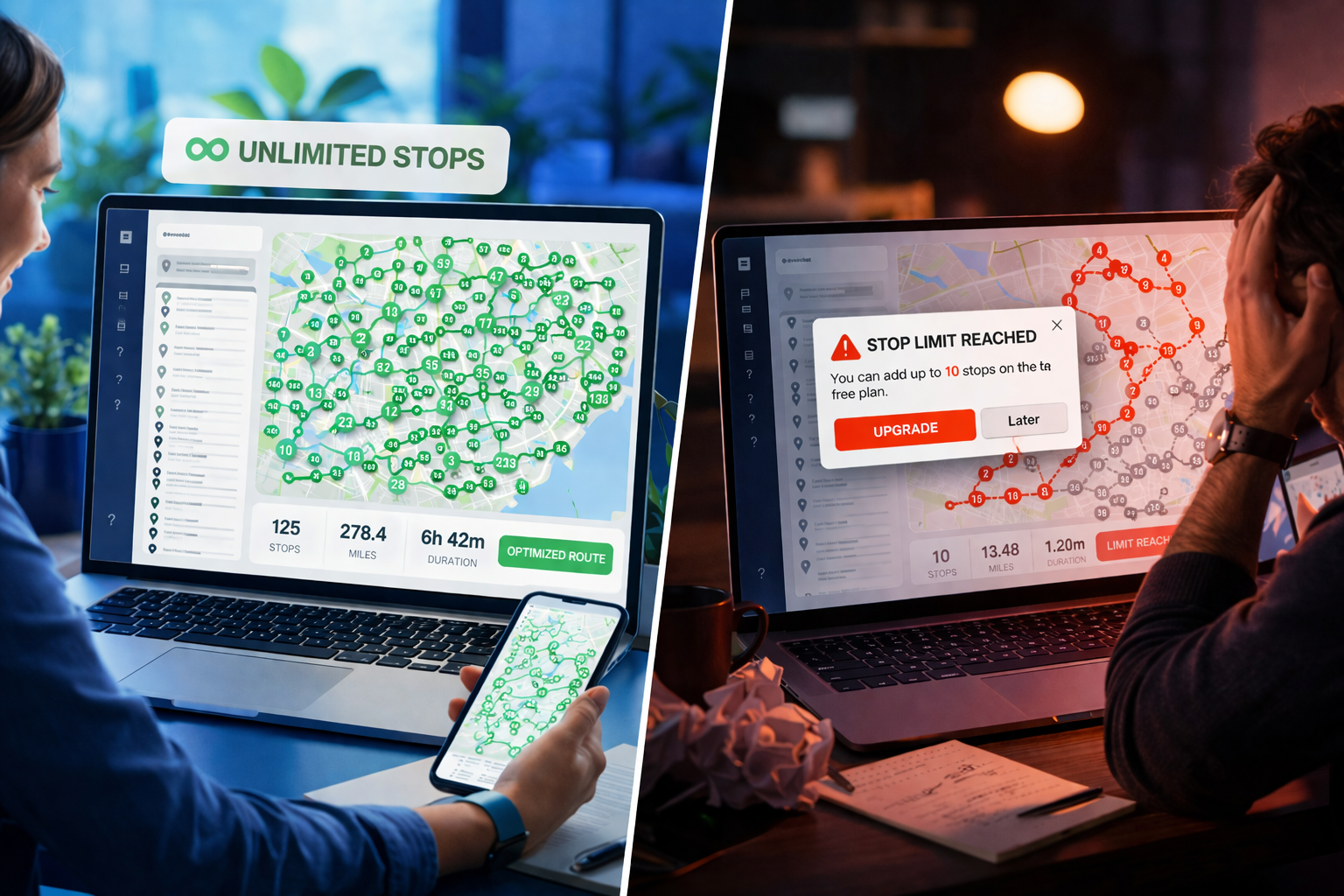
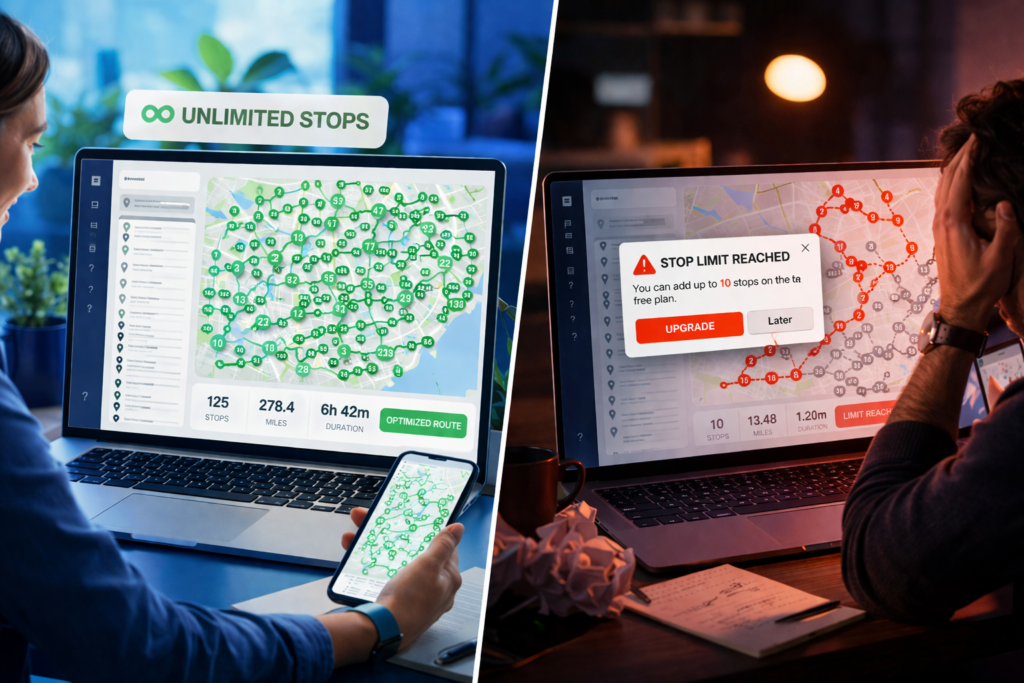
      If you searched for a free route planner with unlimited stops, you have probably already clicked through three or four articles and found the same trick every time: a tool that shouts “unlimited,” then quietly reveals a 10-stop cap, a 20-stop limit, or a “free” plan that turns into a paywall after a week.

      So here is the honest answer, up front: a truly free route planner with unlimited stops does not really exist.

      Not because the technology is hard. Because the mapping data, the optimization, and the servers behind all of it cost real money, and sooner or later somebody has to pay for it. The companies that tried giving away genuinely unlimited stops for free either shut the doors (Speedy Route closed in February 2025) or quietly moved everyone onto paid plans.

      What does exist is a handful of free tools that get you close, some better than others depending on what you are actually doing, plus a few paid tools with free trials generous enough to feel “practically free” while you test them. This guide walks through all of it, organized by what you are trying to do, because someone running weekend errands needs something completely different from a courier doing 80 drops a day. If you want a broader feature-by-feature breakdown afterwards, our best free route planner comparison covers that side.

      Stop Limits at a Glance

      Before the detail, here is the part everyone actually wants: how many stops you get for nothing, and who each tool suits. These figures are each tool’s published free tier at the time of writing, so double-check before you rely on one.

      Notice the pattern. Genuinely free planners land somewhere between 10 and 30 stops per route. Nobody on that list hands you unlimited stops for free, and anyone claiming otherwise is usually counting a time-limited trial as “free.”

      Why "Unlimited and Free" Isn't Really a Thing

      It helps to understand why the wall exists, because once you do, the marketing stops fooling you.

      Every optimized route costs the provider something. Each address has to be looked up and pinned to a real location, and that geocoding is metered and billed. Then the optimization itself, working out the best order through dozens of stops, burns real computing time. A company can absorb that for small, occasional routes, which is why so many tools give you ten or twenty stops for free. What they cannot do is eat that cost for a courier running hundreds of paid deliveries a day off a free account. That is the whole reason a free route planner with unlimited stops keeps turning out to be a trial in disguise.


      So the honest way to shop is to stop hunting for “unlimited and free,” which is a unicorn, and instead ask two questions: what is the highest real free stop count I can get, and is there a no-card trial generous enough to handle my big days while I decide?

      For Personal Errands and Occasional Trips

      If you are planning a charity run, a big errand day, or the odd multi-stop trip, you do not need delivery features or fleet tracking. You just need your stops in a sensible order without paying. These do the job:

      • Google Maps. Everyone already has it, the navigation is excellent, and 10 stops is honestly enough for most personal trips. The catch is it does not optimize the order, it drives them exactly as you typed them, so you do the sequencing yourself.
      • Apple Maps. A slightly higher 15-stop limit and clean navigation on iPhone, but, like Google, it lists your stops rather than reordering them, and it is iOS only.
      • MyWay. A free mobile option that does optimize, up to 15 stops, which makes it a step up from the map apps for a casual route.
      • Waze. Brilliant for live traffic, but it only lets you add one extra stop, so it is really a single-trip tool, not a multi-stop planner.

      For this kind of use, none of the “unlimited” hand-wringing matters. Pick whichever you already like and move on.

      For Delivery and Business Routes

      This is where free stop limits start to bite, because real delivery days blow past ten stops fast. These are the tools worth knowing:

      • RouteXL. Genuine optimization for up to 20 stops per route, with unlimited routes, and it takes a spreadsheet import. The trade-off is that it is web only, so you plan at a desk and then navigate in a separate app.
      • MapQuest. The most generous of the older web planners at 26 free stops, with basic optimization and fuel estimates. It is ad-supported, and some drivers report shaky ETAs.
      • RoadWarrior. A simple mobile app with optimization, but the free tier sits around 10 stops, so you hit the ceiling quickly on a real route.
      • Bodha (free tool). Optimizes up to 30 stops per route, the top of the genuinely-free range, with unlimited routes, CSV and Excel import, and no signup or card. We will come back to this one, because it is also the cleanest answer to the “unlimited” question.

      If you regularly run more than 30 stops in a single route, every option on this list will eventually push you toward a paid plan. That is not a flaw in any one tool, it is just where free ends and a business tool begins.

      The Closest Thing to Unlimited Stops, Free

      Since a free route planner with unlimited stops is not real, the practical question becomes: what gets you closest without paying? Two things, and you can use them together.

      First, the highest genuinely-free stop count you can find. Among the tools above, that is Bodha at 30 stops per route, with unlimited routes, no account, and no card. For the large majority of single-driver days, 30 stops in a route is plenty, and “unlimited routes” means you are never rationing how many you plan.

      Second, a no-card trial generous enough to cover your biggest days while you decide. This is where Bodha’s free route planner pairs with its app. The web tool is free forever at 30 stops. When you genuinely need more, the Bodha app runs a 7-day free trial of the full platform, which lifts the stop limit and adds real-time tracking, proof of delivery, and automatic customer notifications. No credit card to start the trial.

      So the honest version of “unlimited free” is this: plan free, every day, up to 30 stops a route with unlimited routes, and use the 7-day trial to handle the big days and see whether the full tool is worth paying for. That is as close to unlimited-and-free as this market actually gets, without the bait-and-switch.

      How to Decide in 30 Seconds

      • A few personal stops? Google Maps or Apple Maps. Done.
      • A casual route you want optimized? MyWay or RouteXL.
      • Real delivery work up to ~30 stops? A free route planner built for it, like Bodha’s free tool, gives you AI optimization and spreadsheet import with no card.
      • Regularly past 30 stops, or running a team? You have outgrown free. Use a 7-day trial to test a full delivery platform before paying.

      FAQs: Free Route Planner With Unlimited Stops

      No, not as an always-free plan. Mapping and optimization cost money, so free tiers cap somewhere between 10 and 30 stops per route. The closest you get is the highest free count (around 30) plus a no-card trial for your bigger days.

      Among genuinely free tools, the order runs roughly Google Maps 10, Apple Maps 15, RouteXL 20, MapQuest 26, and Bodha 30 per route. Bodha also gives unlimited routes with no signup.

      Usually it means unlimited routes, not unlimited stops in one route, or unlimited use during a time-limited trial. Always check which one a tool means before trusting the word.

      A genuinely free 30-stop tool for everyday routes, paired with a 7-day no-card trial for the days you need more. Bodha is set up exactly this way: free up to 30 stops per route, with the trial lifting the limit and adding tracking and proof of delivery.

      No permanent free tier, but the 7-day trial is full access with no credit card required. Paid plans start at $29.99 per driver per month after that. For delivery businesses doing real volume, most find the trial pays for several months of the subscription in fuel savings alone.
      Plan Your Route Free Today

      You do not need to chase a free route planner with unlimited stops that does not exist. Start with the genuinely free option

      Subscribe to Our Blog

        Related blogs

        How to Plan Delivery Routes: A Practical Guide for Operators

        How to Plan Delivery Routes: A Practical Guide for Operators

        Back Table Of Content Something every experienced dispatcher knows: the difference between a good day and a chaotic…

        Reduce Delivery Costs: 10 Proven Strategies That Actually Work

        Reduce Delivery Costs: 10 Proven Strategies That Actually Work

        Back Table Of Content Last-mile delivery is the most expensive part of the logistics chain. It accounts for…

        What Is Route Optimization? (And Why Your Delivery Business Can’t Afford to Ignore It)

        What Is Route Optimization? (And Why Your Delivery Business Can’t…

        Back Table Of Content Picture this: it’s 7am, you’ve got 60 deliveries to get out, two drivers called…