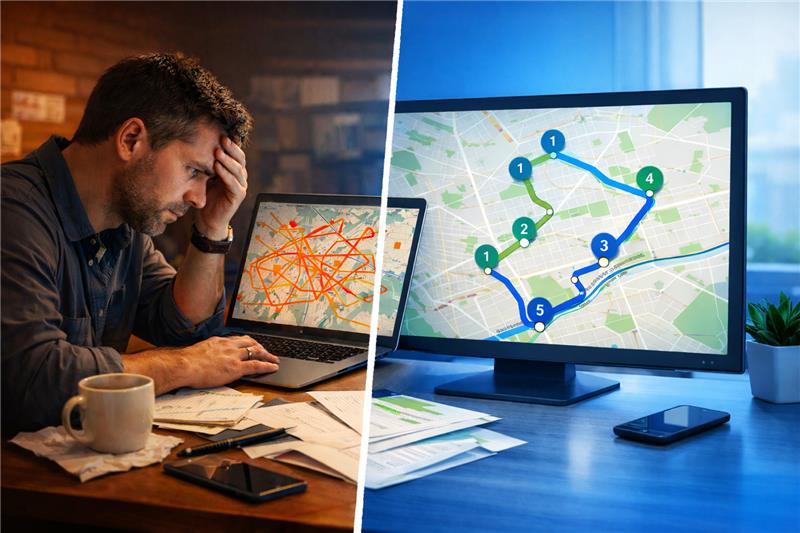
Picture this: it’s 7am, you’ve got 60 deliveries to get out, two drivers called in, and your third driver just texted asking which order to do the stops in. You’re staring at a spreadsheet, coffee going cold, trying to figure out the most logical sequence before the morning rush kicks in.
That is manual route planning. And it’s why route optimization exists.
This guide covers everything you need to know — what route optimization actually is, how it works under the hood, what signs tell you that you need it, and why the difference between optimized and unoptimized routes often comes down to hundreds of dollars a week for a typical delivery operation.
What Is Route Optimization, Really?
At its most basic: route optimization is the process of figuring out the most efficient order and path for a driver to complete a set of deliveries.
That sounds easy. It isn’t.
Even with just 10 stops, there are over 3.6 million possible sequences a driver could follow. Push that to 20 stops and the number of possible combinations becomes, mathematically speaking, astronomically large — we’re talking more combinations than atoms in the observable universe. No human sitting at a desk can work through that. Not even close. Route optimization software solves it in seconds.
The goal isn’t just “shortest distance,” either. A genuinely optimized route accounts for traffic at different times of day, delivery time windows customers are expecting, how much each vehicle can physically carry, when each driver’s shift ends, which stops are highest priority — all of it, simultaneously. That’s the difference between a route that looks good on a map and one that actually works when your driver hits the road at 8am.
Route Optimization vs. Route Planning — They're Not the Same Thing
A lot of people use these terms interchangeably. They shouldn’t.
Route planning is just the act of creating a route. You pick your stops, put them in some order, and off you go. You can do this with Google Maps, a whiteboard, a spreadsheet — whatever works. It gets the job done if you have maybe five stops and no time constraints.
Route optimization is what happens when you apply an algorithm to that planning process. Instead of you deciding the order, the software calculates it — based on distance, time windows, traffic patterns, vehicle capacity, and a dozen other variables you probably aren’t tracking manually.
Here’s the tangible difference: a dispatcher at a grocery delivery company once told us they were manually planning routes for 8 drivers every morning. It took about 90 minutes. When they switched to route optimization software, the same routes were generated in under two minutes — and the routes themselves were around 20% shorter. That 88 minutes of saved planning time doesn’t sound like much until you realize it’s recurring every single morning, forever.
How Route Optimization Software Actually Works
Step by step, here’s what happens when you run a route optimization:
You load your delivery addresses. Either typed in manually, uploaded from a CSV or Excel file, or pulled automatically via API from your order management system. Good software geocodes each address on its own — no need to manually look up coordinates.
You set your constraints. This is the part most people don’t think about until they’ve been burned. Constraints are things like: this customer is only home between 2pm and 4pm. This vehicle can only carry 300kg. This driver starts from a different depot. This stop has to happen before that one because it’s a pickup. You define all of this before the optimization runs.
The algorithm processes everything. The engine runs through the possible combinations — far faster than any human could — and produces a route sequence that respects your constraints while minimizing distance and time. With Bodha, this typically takes a few seconds regardless of how many stops you have.
Routes go straight to drivers’ phones. No printing. No WhatsApp messages. No “I’ll text you the list.” The optimized route appears in the driver app with turn-by-turn navigation, delivery notes, and the full stop manifest.
The system adjusts during the day. This is where modern route optimization software earns its keep. A new order comes in at 11am? Driver stuck in traffic? Stop cancelled? The system reoptimizes the remaining route on the fly and updates the driver automatically.
What Route Optimization Is Actually Worth — The Real Dollar Math
Let’s skip the vague claims and work through what this typically delivers in real numbers. Two scenarios, both common:
Scenario A: 5-driver operation, 40 stops per driver per day
A 20% mileage reduction on a 5-driver fleet typically saves around 25–30 miles per driver per day. At current fuel prices, that’s roughly $12–15 in fuel per driver, per day. Over a working month (22 days), that’s $1,320–$1,650 saved — just in fuel. Against a software cost of $150/month, you’re looking at roughly 9x ROI before you count time savings or increased delivery volume.
Scenario B: 10-driver operation, 60+ stops per driver per day
The math compounds faster at this scale. The same 20% mileage reduction now saves closer to $2,800–$3,500/month in fuel. Add the time savings from eliminated manual planning (typically 60–90 minutes per day across the dispatch team) and the capacity gains from fitting more stops per shift, and the ROI is substantial. Most 10-driver operations running real numbers find payback inside the first 2–3 weeks.
The other thing worth flagging: fuel is the visible saving, but it’s not always the biggest one. Missed delivery windows cost money too — failed first-attempt deliveries cost an average of $15– 25 per package in additional handling and redelivery. If your unoptimized routes are causing even 5–10 missed windows per day, that adds up faster than the fuel bill.
UPS famously illustrated just how deep routing inefficiency runs when they began eliminating left turns from driver routes. Their analysis found that left turns (which require waiting against oncoming traffic) were adding unnecessary idle time and miles across their entire fleet. The routing change — powered by optimization software — now saves them over 10 million gallons of fuel annually. Most delivery businesses aren’t operating at UPS scale, but the principle is exactly the same: small, systematic improvements to how routes are sequenced compound into very large numbers over time.
7 Signs You've Already Outgrown Manual Route Planning
This is the uncomfortable section. Most delivery businesses that need route optimization know something is off — they just haven’t connected the dots to routing as the cause. Here are the clearest warning signs:
Your route planning takes more than 30 minutes per day. If your dispatcher or you personally are spending meaningful time each morning shuffling stops around a map, that time has a cost. A 60-minute daily planning task across a year is 250+ hours of labor that optimization software handles in seconds.
Drivers are regularly running late on time windows. Not occasionally — regularly. If it’s happening a few times a week, your route sequence isn’t respecting delivery constraints properly. Optimization fixes this by building time windows into the route calculation from the start.
Your fuel costs are climbing without obvious explanation. Vehicle costs go up, sure. But if your per-delivery fuel cost keeps rising as you add more stops, inefficient routing is almost certainly a factor. The routes aren’t getting tighter as you scale — they’re getting messier.
Different drivers plan their own routes differently. When each driver handles their own sequence, you lose consistency and control. There’s no way to compare performance, optimize over time, or ensure a new driver isn’t taking a wildly inefficient path on their first week.
Customers are calling to ask where their delivery is. A lot of these calls happen specifically because ETAs are unreliable — which they are when routes aren’t optimized. Proper route optimization gives dispatchers and customers accurate, trackable ETAs that actually hold up.
You can’t easily add a new stop mid-day. If a last-minute order means starting the whole planning process over from scratch, your current system doesn’t scale. Route optimization software inserts new stops into active routes in seconds.
You’re planning routes for one driver at a time. Individually planning routes isn’t just slow — it means you’re not optimizing across your whole fleet. A route optimizer looks at all drivers and all stops simultaneously, balancing workloads and minimizing total fleet mileage rather than just each individual route.
If more than two of these describe your current operation, the cost of staying manual is almost certainly higher than the cost of switching.
Why This Actually Matters (In Numbers)
Beyond the ROI calculation above, route optimization consistently delivers across five areas that affect every delivery business:
Fuel. Inefficient routes are full of unnecessary miles — doubling back, crossing town twice, zigzagging through a neighborhood instead of working through it logically. Most operations see a 20–30% reduction in total mileage after switching to optimization.
Volume. When drivers spend less time driving between stops, they complete more stops per shift. The typical increase is somewhere between 15–25% more deliveries per driver per day — without hiring anyone new or buying another vehicle.
Missed time windows. Route optimization sequences stops around time constraints specifically. Missed windows drop significantly once routes are built around delivery windows rather than treating them as an afterthought.
Customer calls. “Where’s my delivery?” is one of the most expensive calls a delivery business receives — not because it’s complicated to answer, but because of the sheer volume of them. Automated ETAs and live tracking (which only work properly when routes are optimized) cut this call volume dramatically.
Driver turnover. Drivers following a logical, pre-planned route — with no backtracking or confusion about what comes next — are measurably less stressed at the end of a shift. Staff retention improves. It’s a soft benefit, but it’s real and it compounds
The Google Maps Problem
Everyone has Google Maps. It’s free, it works, and drivers already know how to use it. So the obvious question is: why pay for route optimization software?
Here’s the honest answer: Google Maps was built for consumers navigating to one destination. It was not built for delivery operations, and the gap between what it does and what a delivery business actually needs is significant.
Google Maps caps you at 10 waypoints per route. It doesn’t support delivery time windows — you can’t tell it “stop 4 needs to happen between 2pm and 3pm.” It has no concept of vehicle capacity. It doesn’t track your fleet. It can’t send automated notifications to customers. It has no proof of delivery. And if you have more than one driver, you’re back to doing everything manually.
For occasional use — a handful of stops, no time constraints, one driver — Google Maps is perfectly fine. But if you’re running a real delivery operation with multiple drivers, 30+ daily stops per vehicle, and customers who expect to know when their order is arriving, you’ve already outgrown it. You just might not have noticed yet.
Static vs. Dynamic Optimization — Which Do You Need?
There are broadly two modes of route optimization, and which one matters to you depends on how your operation works.
Static optimization means you plan your routes in advance — usually the evening before or early morning. You know all your stops, you run the optimization, and drivers head out with a fixed plan. This works well for scheduled delivery operations: grocery deliveries, pharmacy runs, meal kit distribution, anything where you have a complete order list before drivers leave the depot. Most small and mid-sized operations run this way.
Dynamic optimization is for operations where orders keep coming in throughout the day and need to be added to active routes in real time. Think restaurant delivery, same-day courier services, anything on-demand. The software continuously re-optimizes as new stops are inserted, which is considerably more complex technically.
Most delivery businesses doing scheduled work don’t actually need dynamic optimization — static is fine, and simpler. The important thing is knowing which mode your software supports before you commit.
Industries Where It Makes the Biggest Difference
Route optimization benefits any delivery operation with multiple stops, but some industries see a more dramatic impact than others.
Food delivery businesses feel it first, because route quality directly affects product quality. A poorly optimized food delivery route means food arriving cold. Customers notice immediately, and it hits your reviews before the end of the day.
Pharmaceutical and medical delivery is another area where optimization isn’t optional — it’s a compliance issue. Medications often have strict delivery windows, temperature requirements, and documentation needs. A missed delivery isn’t just a customer service failure; it can have real health consequences.
Courier services running 80–100 stops per driver per day see the biggest raw efficiency gains, because the compounding effect of even small per-stop time savings is enormous at that volume.
Furniture and large-item delivery has a different challenge — long service times at each stop and complex vehicle loading constraints. The optimization has to account for load sequencing (you don’t want the item you need first loaded last), which is something most basic tools don’t handle well.
Where Route Optimization Is Heading in 2026
The technology is moving fast, and it’s worth knowing where the meaningful developments are happening — especially if you’re evaluating software for the long term.
AI-driven dynamic routing is becoming standard rather than premium. Systems now learn from historical delivery data — which driver tends to run faster in which neighborhoods, where traffic reliably backs up on certain days — and factor that into future route calculations automatically. Routes get smarter the longer you use them.
EV fleet optimization is an emerging constraint that wasn’t relevant two years ago. Electric delivery vehicles have range limitations and need charging windows planned into routes. The best optimization platforms now treat charging stops as a routing constraint the same way they treat time windows. If you’re running or planning to run EVs, this is worth asking about explicitly when evaluating software.
Sustainability metrics are becoming something operations teams actually track and report. Reducing CO₂ emissions per delivery is increasingly a business requirement — not just a nice-tohave — and route optimization is the primary lever for hitting those targets. Carbon-per-stop reporting is now a feature category in itself among the better platforms.
What to Actually Look for in Route Optimization Software
If you’re shopping around, here’s what genuinely matters versus what’s marketing noise:
The stop cap matters more than people realize. Some tools limit you to 100 or 200 stops per route. If you’re anywhere near that ceiling today, you’ll hit it as you grow. Look for software that handles 500+ stops without degrading route quality.
Real-time GPS tracking is non-negotiable for any multi-driver operation. Not just a dot on a map — actual status updates as drivers complete stops, arrive at locations, and mark deliveries done.
Proof of delivery shouldn’t be an add-on. Photos, signatures, and delivery notes captured in the driver app and stored automatically should be standard. Disputes with customers are far easier to resolve when you have timestamped photo evidence.
Customer notifications built in — not through a third-party integration you have to configure separately. Automated SMS and email updates with live ETAs reduce inbound support calls dramatically and genuinely improve customer experience.
How fast is the setup? This one is underrated. Some enterprise route optimization platforms take weeks to implement, require IT involvement, and come with a learning curve that means your dispatcher needs three days of training before they can create a route. That’s not practical for most delivery businesses.
How Bodha Handles Route Optimization
Bodha Drive is built for individual drivers and small operations — you can plan up to 500 stops, get your optimized route in seconds, and navigate with turn-by-turn directions straight from the app. Most drivers are creating their first optimized route within 20 minutes of signing up.
For teams with multiple drivers, Bodha Fleet adds a full dispatcher dashboard, real-time GPS tracking across your entire fleet, automated customer notifications, proof of delivery capture, and reporting. The dispatcher plans and dispatches all routes from one screen; drivers receive everything they need on their phones.
Setup takes under an hour for most teams. You bring your delivery addresses (Excel, CSV, or API), and Bodha handles the rest.
Try it free for 7 days — no credit card required →
Questions We Get Asked Often
The Bottom Line
Most delivery businesses don’t fail because they have bad products or bad drivers. They fail because the gap between what they’re spending on the road and what they could be spending — with better routing — is quietly eating their margins.
Route optimization closes that gap. It won’t solve every problem in your operation, but it will almost certainly make your routes shorter, your drivers’ days more manageable, and your fuel bills meaningfully lower. For most businesses, it pays for itself within the first few weeks.
If you’re still sending drivers out with a manually-planned sequence or a Google Maps link, it’s worth spending 20 minutes seeing what optimized routes actually look like for your specific stop count and geography.
Start your free 7-day Bodha trial and run your first optimized route today →