Lawn Care Route Planning Software: Save Time & Fuel | Bodha Route Planner

awn Care Route Planning Software: Save Time & Fuel

Lawn Care Route Planning Software: Save Time & Fuel | Bodha Route Planner

user profile

Bodha Route

July 7, 2026

Table Of Content

Lawn Care Route Planning Software: How to Cut Windshield Time and Keep Every Mow on Schedule

Quick answer: Lawn care route planning software takes your list of properties for the day and puts them in the shortest, most practical driving order. It factors in service windows, how long each job takes, and real drive times on real roads. Add recurring scheduling on top and it keeps every weekly and biweekly account on cycle, so your crews spend less time behind the wheel and more time actually mowing. This guide walks through what the software does, the features that separate a real tool from a plain map app, and how to pick the right one for your business.

Why Lawn Care Businesses Quietly Lose Money to Bad Routing

Lawn care is a repeat business. Same properties, same weekly or biweekly rhythm, spread out across a town or a whole service area. You’d think all that repetition would make routing easy. It usually doesn’t. Most crews still build the day from memory, a printed list, or a spreadsheet that has no clue about traffic, service windows, or which yards are even due today.

So the same problems keep showing up. Too many miles between stops. A mowing cycle that slowly drifts off schedule. A phone that won’t stop ringing because clients don’t know when you’re coming. Every one of those traces back to the same thing: the route was a guess instead of a plan.

That’s the job lawn care route planning software is built to do. It looks at every property on your list, weighs the drive time, how long each job runs, and how many hours your crew actually has, then hands back the order that cuts the most lawns with the least driving in between. Run five stops a day and it helps. Run ten or twenty and it adds up fast, week after week, in hours you get back and fuel you stop burning.

What Lawn Care Route Planning Software Actually Does

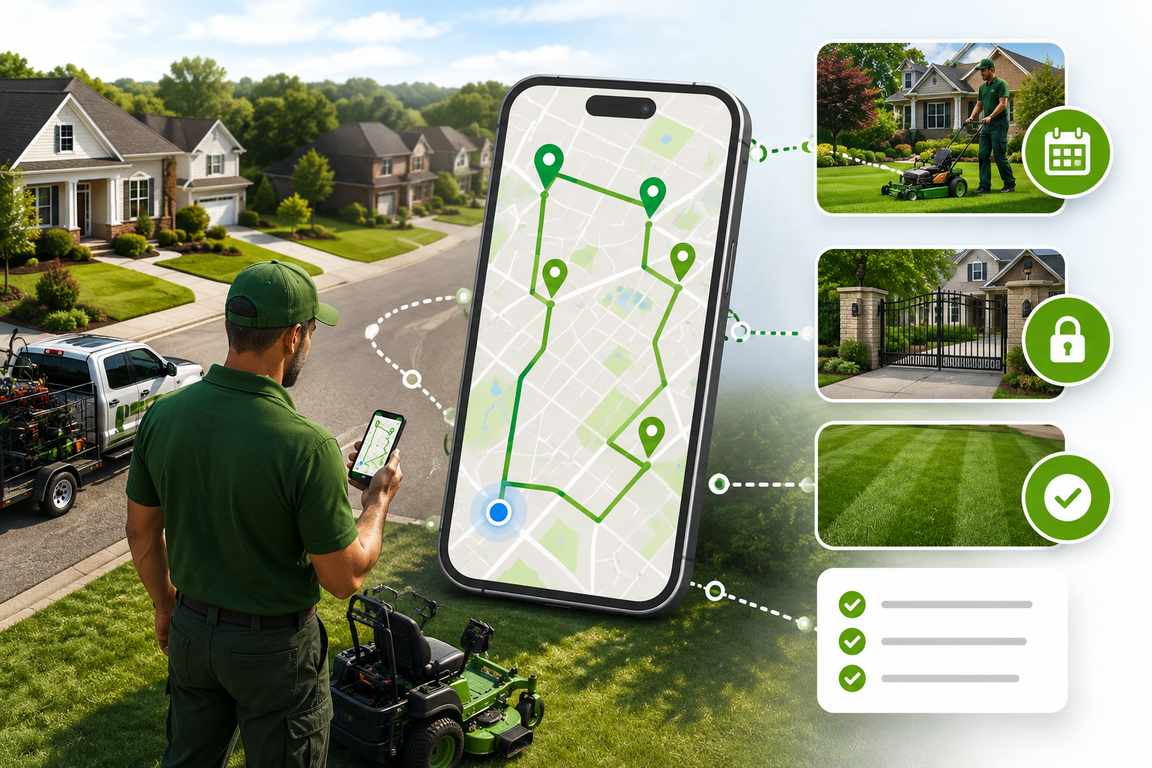
Strip it right down and lawn care routing software does one thing: it turns a list of addresses into an optimized order for the day. But the tools actually worth paying for go a lot further than drawing lines on a map. The good ones pull three jobs into a single place:

  • Route optimization that groups nearby properties and works out the shortest realistic order for the day.
  • Recurring scheduling that keeps track of who’s due on a weekly, biweekly, or custom cycle, so the route almost builds itself.
  • Client and property records, think gate codes, yard notes, and service history, sitting right there for the crew in the field instead of lost in a text thread.

A regular map app can handle a few stops. What it can’t do is manage a mowing cadence, remember that a client swapped their gate code last month, or tell you which of your forty biweekly accounts came due this week. That’s the gap a proper landscaping route planner fills.

Dedicated lawn care route planning software vs. a generic GPS app

What to Look for in Lawn Care Routing Software

Plenty of tools claim they’ll optimize your routes. Not all of them are built for how a mowing operation actually runs. When you’re weighing your options, hold each one up against these six things.


1. Route optimization built around service windows

A good landscaping route planner does more than connect the dots between pins. It sequences the day around each property’s service window, your crew’s working hours, and real drive times on real roads, so the plan still holds up once the truck pulls out of the yard.


2. A true recurring mowing schedule

Recurring accounts are the whole game in lawn care. You want recurring mowing schedule software that lets you set a cadence once, whether that’s weekly, biweekly, monthly, or something custom, and then shows you exactly who’s due each day. Setting it once beats rebuilding the same route from scratch every single cycle.


3. Gate codes and yard notes in the field

Access details, pet warnings, the little client preferences, all of it should ride along with the route instead of living in someone’s head. When it shows up on the mobile route sheet at every stop, your crew stops guessing and just gets on with the work.


4. Automatic client updates

A quick branded text or email that tells a client when they’re scheduled, when the crew is on the way, and when the job’s done will kill off most of those “are you coming today?” calls that chew through your office hours.


5. Proof of service

Timestamped photos and notes at each property, even when there’s no signal, give you a clean record if a client ever questions whether you showed up. That’s worth a lot on bigger properties, or on accounts that get split between technicians.


6. Multi-crew planning that scales

Add trucks and you’ll need to balance the load and plan several routes off one client list in a single sitting, without a dispatcher rebuilding the whole thing by hand every morning.

How Route Optimization Saves Fuel and Adds Stops Per Day

Windshield time is the cost nobody puts on an invoice. When a crew bounces around between properties instead of working a tight cluster, they burn fuel, pile hours onto the truck, and get to fewer lawns before the day’s gone. Hand that clustering and sequencing over to the software and it does in seconds what used to eat a dispatcher’s whole morning.

The part that’s easy to miss is how it stacks up. Shave even a little off your daily drive time, then multiply that across five days a week and forty-odd weeks a year, and you’re suddenly looking at a serious pile of labor hours back per truck. Hours you can aim at new accounts instead of leaving them stuck in traffic between the ones you already have.

How big is the gain? It comes down to your setup, how spread out your accounts are, how many stops you run in a day, and how loose your routes were to begin with. But the pattern holds across service fleets: tighter sequencing means fewer miles, less fuel, and enough time clawed back to fit another property or two into the same shift. Even a small daily saving turns into a real number once you stretch it across a full mowing season.

Recurring Scheduling: The Real ROI for Lawn Care Teams

Route optimization sorts out the driving. Recurring scheduling sorts out the thing sitting underneath it, which is keeping every weekly and biweekly account on cycle without someone in the office tracking due dates by hand. This is exactly where recurring mowing schedule software earns its place. The better lawn care route planning software lets you drop in skip dates, holiday presets, and seasonal pauses, so the cadence bends around a holiday instead of falling apart the first time one lands mid-week.

This really earns its keep in the shoulder seasons. Spring startup and fall wind-down both shift the cadence for a big chunk of your client base all at once. A lawn care scheduling app that can handle bulk cadence changes without a fuss saves you a ton of admin time right when the office is already slammed.

Then plan-adherence reporting ties it all off by flagging any recurring account that’s starting to drift, before the client notices and picks up the phone. When your revenue is built on repeat work, that kind of early warning can be worth more than the fuel savings.

How to Get Started With a Lawn Care Route Planner

  1. Import your client list from a spreadsheet or CSV. A good tool will geocode the addresses and flag duplicates for you.

  2. Set recurring plans for every account that repeats weekly, biweekly, or monthly.

  3. Run the optimizer and let it sequence the day’s properties around service windows and drive time.

  4. Send the route to the crew’s phone, complete with gate codes and yard notes for every stop.

  5. Turn on automatic client updates so the office stops fielding “where are you?” calls.

  6. Check adherence and completion reports weekly to catch any account before it slips.

Why Bodha Works Well for Lawn Care and Landscaping Teams

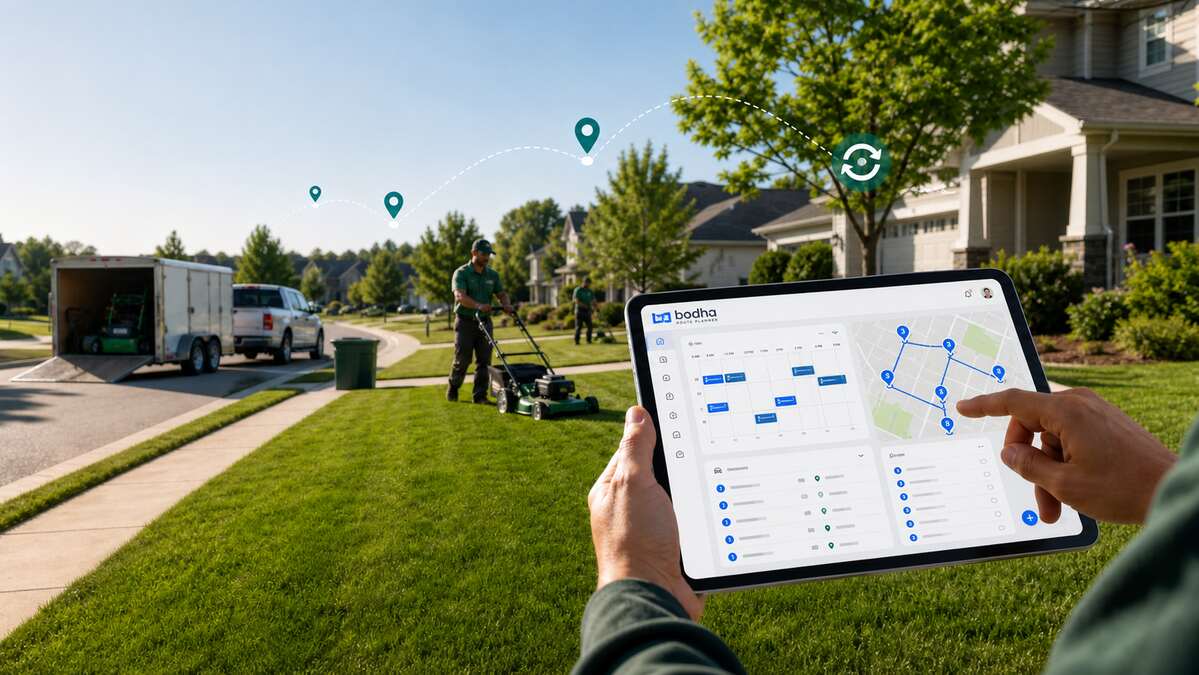
Bodha pulls route optimization, a recurring mowing schedule, and a light client CRM into one place. That combination is pretty much what a lawn care operation needs when it’s juggling repeat accounts across a spread-out service area. Crews get gate codes and yard notes right in the mobile route sheet, clients get automatic arrival updates, and owners get plan-adherence reports that call out any account slipping its cycle.

Want to see how the optimizer actually builds a day’s sequence? Take a look at the route planning feature. And if you want the version aimed squarely at mowing operations, the Lawn Care & Landscaping Route Planner page breaks it down.

Bodha Route Planner at a glance

  • Best for: Lawn care and landscaping teams running recurring residential and commercial accounts across a wide service area.
  • Standout features: Service-window route optimization, recurring scheduling with skip dates and seasonal pauses, gate codes and yard notes in the driver app, automatic client notifications, and timestamped proof of service.
  • Pros: Purpose-built for recurring, route-based service. The light CRM keeps property details tied to the route, you can plan multiple crews from a single client list, and it’s free to start.
  • Keep in mind: Bodha is a dedicated route planning and scheduling platform rather than a full accounting and invoicing suite, so teams that need built-in payments usually pair it with the billing tool they already use.

Frequently asked questions

It organizes a day's properties into the most efficient order, taking service windows, job durations, and drive time into account, so a crew spends less time driving and more time working.

Yes. A good lawn care scheduling app lets you set a mowing cadence, whether that's weekly, biweekly, monthly, or custom, and then shows you exactly who's due each day, turning those properties into an optimized route in a couple of clicks.

A general map app can sequence a few stops, but it can't track recurring accounts, store gate codes and yard notes, or send branded client updates. Dedicated lawn care route planning software rolls all of that into one system.

For most operations running more than a handful of daily stops, yes. The fuel and time savings from optimized routing usually pay for the software within the first few weeks, and recurring scheduling takes an ongoing admin headache off your plate.

Yes. A good tool plans and balances several routes from one client list in a single session, so adding trucks doesn't mean rebuilding every route by hand each morning.

It depends on how many drivers you have and which features you need, and plenty of tools, Bodha included, give you a free way to start. Check Bodha's pricing for current plans.

Ready to cut windshield time and keep every recurring mow on schedule?

Start a free trial of Bodha's lawn care route planner

Subscribe to Our Blog

    Related blogs

    How to Plan Delivery Routes: A Practical Guide for Operators

    How to Plan Delivery Routes: A Practical Guide for Operators

    Back Table Of Content Something every experienced dispatcher knows: the difference between a good day and a chaotic…

    Reduce Delivery Costs: 10 Proven Strategies That Actually Work

    Reduce Delivery Costs: 10 Proven Strategies That Actually Work

    Back Table Of Content Last-mile delivery is the most expensive part of the logistics chain. It accounts for…

    What Is Route Optimization? (And Why Your Delivery Business Can’t Afford to Ignore It)

    What Is Route Optimization? (And Why Your Delivery Business Can’t…

    Back Table Of Content Picture this: it’s 7am, you’ve got 60 deliveries to get out, two drivers called…

    Lawn Care Scheduling Software: Never Miss a Mow | Bodha Route Planner

    Lawn Care Scheduling Software

    Lawn Care Scheduling Software: Never Miss a Mow | Bodha Route Planner

    user profile

    Bodha Route

    July 7, 2026

    Table Of Content

    Lawn Care Scheduling Software: How to Manage Recurring Clients Without Missing a Mow

    Quick answer: Lawn care scheduling software tracks every client’s service cadence, weekly, biweekly, monthly, whatever you run, and tells you who’s due for a visit today. Wire that up to route optimization, automatic reminders, and half-decent client records, and your recurring accounts stay on cycle without anyone in the office squinting at a spreadsheet every morning. Below: what this software should actually do, how to set up recurring plans that don’t fall apart, and how to pick a tool that fits the way your crews really work.

    Why Recurring Clients Are Where Lawn Care Businesses Actually Make Money

    Most lawn care money isn’t in one-off jobs. It’s in the same client, same cadence, week after week, all season long. That repeat base is what makes the whole thing a business instead of a constant hustle for the next gig.

    Trouble is, it’s only stable if the scheduling holds. Miss one mow on a weekly account and you’ve usually lost more than a visit. You’ve got a customer sitting there thinking maybe they’ll try the guy who left a flyer on the door last Tuesday.

    So that’s the real job lawn care scheduling software is doing. It takes who’s-due-for-service out of your head, off the sticky notes, out of the group text, and drops it in one place that just tells you who needs a visit today.

    The Hidden Cost of Scheduling by Memory or Spreadsheet

    A spreadsheet is fine for holding a list of names. Ask it which of your forty biweekly accounts are due this week and not last, though, and you’re back to scrolling and counting on your fingers.

    Past a handful of clients, that manual tracking turns into a liability without ever announcing itself. Visits get skipped. Days get double-booked. One holiday week bumps everything down and suddenly a whole month’s cadence is off, and nobody noticed until a customer did.

    It costs you twice. Once in the revenue you lose when a skipped client walks, and again in the hours your office burns checking who’s due instead of getting the route out the door.

    What Lawn Care Scheduling Software Should Do

    Forget the feature lists for a second. A lawn care scheduling software really just has to get a few things right:

    • Hold a recurring cadence for every client, weekly, biweekly, monthly, or some odd custom pattern.
    • Give you a due-today view, so the office can build the day without a spreadsheet.
    • Let you set skip dates, holiday presets, and seasonal pauses without wrecking the cadence underneath.
    • Keep the client’s details, gate codes, yard notes, and service history in one profile instead of five different places.
    • Fire off reminders and arrival updates on its own, so fewer people call to ask when you’re showing up.


    Nail those and most of the daily chaos sorts itself out.

    Where Scheduling Software Fits Among Your Lawn Care Tools

    “Lawn care software” gets used to mean about six different things, so it helps to know which one you’re actually shopping for:

    • Scheduling and dispatch. Where lawn care scheduling software and any decent lawn mowing schedule app live. Cadences, crew assignments, getting the work out the door.
    • Routing. Lawn care routing software puts the day’s stops in an order that doesn’t waste fuel and daylight. Scheduling says who’s due, routing says what order to hit them.
    • Client management. Lawn care client management software keeps history, notes, and the little quirks tied to each property.
    • Invoicing and accounting. Billing, payments, the books. Almost always its own thing, and plenty of owners just wire a scheduling tool up to QuickBooks and leave it there.


    Nobody needs all four crammed into one mega-app. What you buy first comes down to where it hurts. If the pain’s in the field, who’s due, what order, which truck, start with scheduling and routing. If it’s in the office, chasing quotes and payments, a CRM or invoicing suite matters more. Bodha sits in the scheduling-and-routing lane and gets along fine with whatever you bill through.

    Setting Up Recurring Service Plans That Actually Stick

    Here’s the test: you should set a client up once, not re-enter them every cycle. Good recurring lawn care scheduling lets you lock in the mowing cadence the day someone signs on, weekly, biweekly, custom, whatever they’re on, and from then on that account shows up on the due-today calendar by itself until something changes.

    Skipping a week for the Fourth? That’s a checkbox. Not you deleting the client and hoping you remember to add them back next Tuesday.

    The shoulder seasons are where this really earns back the money. Come spring startup and fall wind-down, half your client base shifts cadence at once, and a tool that pushes those bulk changes through in one go saves you a mountain of admin right when you’ve got the least time for it.

    The payoff doesn’t show up on any single Tuesday. It shows up at the end of the season, when you notice you didn’t lose an account to a missed cadence, and your crews never burned a morning on a schedule somebody had to rebuild by hand. That’s the real return on recurring lawn care scheduling. A little admin saved every week, a handful of skipped mows that just never happened, and a client base that renews because the service kept showing up like clockwork.

    Keeping Clients Informed Without More Phone Calls

    Be honest about how many calls to your office are just “hey, are you coming today?” It’s a lot. Automatic notifications knock most of them out: one text when the visit’s booked, one when the crew’s rolling, one when it’s done. That’s the whole point of service reminder software for lawn care.

    Branded messages with a live tracking link also beat a bare text every time, because the client can see it’s you and not some random number they’ll swipe away.

    Client Profiles: The Details That Save a Visit

    Long-term clients collect little details. The gate code that changed back in March. The dog that has to be inside before anyone starts. The one patch by the fence they want left alone. Lose track of any of it and a crew rolls up, gets stuck at the gate, and calls the office. Or worse, does the job wrong and you hear about it.

    Lawn care client management software fixes that by keeping every one of those notes right on the client’s profile, where whoever’s running the account this week can see it before they even pull up.

    Reports That Catch a Missed Mow Before the Client Does

    This is the report nobody gets excited about and everybody should have. Plan-adherence, due-versus-served, whatever your tool calls it. Instead of finding out an account got skipped when the client calls hot, you see the gap the same day, while there’s still time to swing back or get ahead of it with a quick call. On a business built out of repeat accounts, it might be the most useful screen you’ve got.

    How to Choose Lawn Care Scheduling Software

    When you’re comparing tools, hold each one up against this:

    • Does it actually handle the cadences you run, weekly, biweekly, monthly, and the custom ones?
    • Can it push seasonal changes in bulk, spring on, fall off, without you re-entering everyone?
    • Do client details and gate codes follow the job to whoever’s servicing it?
    • Are client notifications built in, or is it one more app to babysit?
    • Is there adherence or due-versus-served reporting, or just a map?
    • Does scheduling feed straight into routing, so a due-today list becomes a real route in a couple of clicks?


    And one bit of hard-won advice: buy for the business you’ve got today, not the one on your vision board. A solo operator with fifty lawns needs cadences and reminders that just work, not a fifteen-seat platform they’ll supposedly grow into.

    Scheduling-first tool vs. all-in-one suite vs. spreadsheet

    Why Bodha Works as a Lawn Care Scheduling Tool

    Bodha puts recurring scheduling, route optimization, and a light CRM in one place, so your due-today list and an optimized route are basically the same two clicks instead of two separate logins. Gate codes and yard notes ride out to the field on the client’s profile, the automatic updates soak up the “are you coming” calls, and the adherence report catches a slipping account before the customer does.

    The full feature rundown lives on the Lawn Care & Landscaping Route Planner page. And if you want the routing half of the story, our companion piece on lawn care route planning software walks through how the optimizer builds a day.

    Straight talk, though: Bodha isn’t a full invoicing-and-accounting suite, and it’s not pretending to be one. Most teams run it right next to whatever they already bill through, and that combo tends to beat one bloated app trying to do everything at seventy percent.


    Bodha at a glance
    • Best for: Lawn care and landscaping crews that live on recurring accounts and want scheduling wired straight to route efficiency.
    • Standout stuff: Recurring scheduling with skip dates and seasonal pauses, a due-today calendar, built-in routing, gate codes and yard notes in the driver app, automatic client reminders, and adherence reporting.
    • Pros: Scheduling and routing under one roof, a light CRM that keeps property notes with the account, client updates built in, and it’s free to start.
    • Keep in mind: No built-in invoicing or payments, so you’ll run it alongside your billing tool.

    Frequently asked questions

    It tracks each client's recurring cadence, weekly, biweekly, monthly, or custom, and tells you which accounts are due on a given day, so nobody has to check by hand.

    Yes. Solid recurring lawn care scheduling handles skip dates, holiday presets, and seasonal pauses, so cadences shift on their own instead of making you pull a client out and add them back every cycle.

    Scheduling tracks who's due. Routing puts the day's stops in the best order. The good tools do both, so a due-today list rolls straight into an optimized route.

    It does. Automatic updates when a visit's booked, on the way, and finished answer the question most people were about to call about. That's the core of service reminder software for lawn care.

    Anywhere from free to a few hundred a month, depending on crew size and features. A handful of tools, Bodha included, let you start free. Check Bodha's pricing for what's current.

    Ready to keep every recurring client on schedule?

    Start a free trial of Bodha's lawn care scheduling software

    Subscribe to Our Blog

      Related blogs

      How to Plan Delivery Routes: A Practical Guide for Operators

      How to Plan Delivery Routes: A Practical Guide for Operators

      Back Table Of Content Something every experienced dispatcher knows: the difference between a good day and a chaotic…

      Reduce Delivery Costs: 10 Proven Strategies That Actually Work

      Reduce Delivery Costs: 10 Proven Strategies That Actually Work

      Back Table Of Content Last-mile delivery is the most expensive part of the logistics chain. It accounts for…

      What Is Route Optimization? (And Why Your Delivery Business Can’t Afford to Ignore It)

      What Is Route Optimization? (And Why Your Delivery Business Can’t…

      Back Table Of Content Picture this: it’s 7am, you’ve got 60 deliveries to get out, two drivers called…