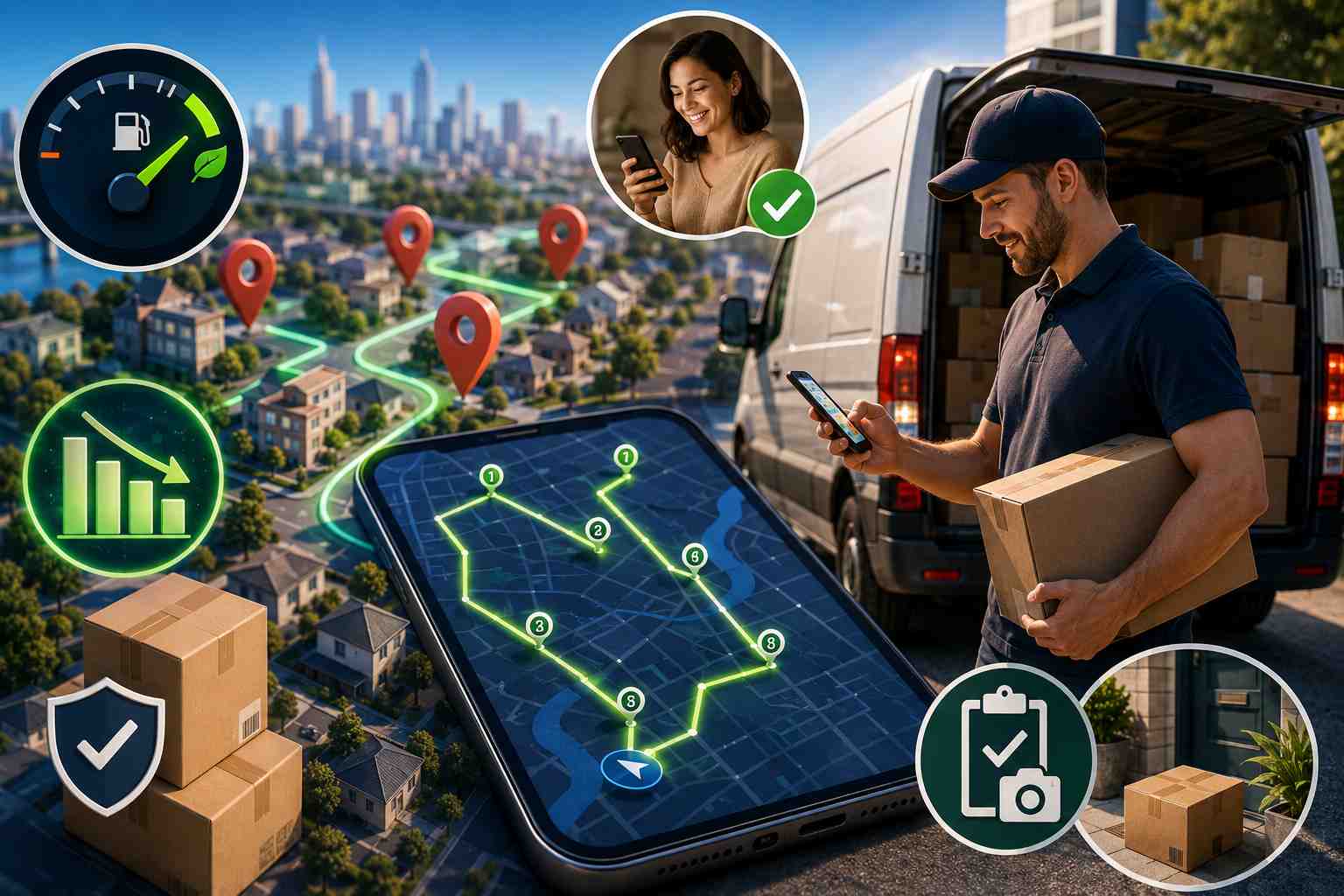
Ask a parcel courier what really eats their profit and you tend to get two answers, usually in a tired voice. Fuel. And failed deliveries. The parcels that come back because nobody was in. The miles that pile up because the round got planned in a rush. What almost nobody says out loud is that those two problems are the same problem wearing different clothes. Both trace back to how the route was built. That is the whole case for parcel delivery route optimization. Fix the sequencing, clean up the addresses, and give the customer a heads-up, and you watch the failed drops and the wasted fuel drop together, off one fix.
So let me keep this practical. First, what those two costs actually are in 2026, with real numbers. Then the levers that move them, and how a decent parcel delivery route planner pulls all of them at once.
What a failed delivery really costs you
Most operators file a failed delivery under “send it again tomorrow” and move on. That is the mistake, because the second trip is the cheap part.
Count everything and a single failed attempt runs about $17.78 on average. That is the wasted drive, the driver’s time, the handling, the parcel going back to the depot. Then the reattempt usually costs two to three times the original delivery. And this is not some rare edge case you can ignore. Somewhere between 5 and 15 percent of parcel deliveries fail on the first go, depending on the area and the type of drop. On a busy round, that is a tax you pay every single day.
Now the part that never shows up on a delivery report. Every failed stop burns ten to fifteen minutes of a driver’s day, time that could have gone to a paying drop. The “where’s my parcel” calls that follow eat your office hours, and those queries make up close to a fifth of all support tickets across the industry. Worst of all is the customer. Somewhere between a quarter and a third of people will not order again after a delivery falls over on them. You did not lose a trip. You lost the relationship, and every order that would have come with it.
Here is the frustrating bit. Most of this is preventable, and the biggest culprit is dull as dishwater: bad address data. Wrong or incomplete addresses cause up to 45 percent of failed deliveries, and as many as one in five orders turns up with an address that is off in some way. Which means the fix starts long before the driver turns the key.
Why parcels fail in the first place
If you want to cut failures, it helps to know the handful of ways a parcel actually dies on the round. In my experience talking to couriers, they are nearly always one of these five.
Nobody is home. The classic. A signature-required parcel and an empty house, and the whole trip is wasted. Wrong or vague address. The flat number is missing, the street has three similar names, the postcode is a digit off. Access problems. A gate code that lived in an email instead of on the stop, a buzzer that does not work, a business that shut at four. No safe place, so a leave-safe instruction turns into a “carded and returned.” And timing, where the driver arrives during the one two-hour window the customer asked them to avoid.
Notice how few of those are really about driving. They are about information and communication, which is exactly why routing software helps more than people expect. The right details on the stop, the right order of stops, and a text to the customer knock out most of these before they happen.
Where the fuel quietly disappears
The other leak is distance, and it is bigger than most owners think. The last mile now soaks up around 53 percent of total shipping cost, up from 41 percent back in 2018. It is the single most expensive stretch of the whole journey, and parcel work makes it worse because the drops are dense and the temptation to just run them in the order they landed in the system is strong.
Here is what that looks like on the road. A driver hits a street, delivers three roads over, doubles back for a parcel they drove past twenty minutes ago, then loops round again because two stops on the same close got split across the list. None of it feels dramatic. It is a couple of wasted minutes here, half a mile there. Stack it across 80 or 100 drops and you have paid for a chunk of a tank you did not need to burn, plus the wear and the hour that pushes the driver into overtime. Route density, which is just a fancy way of saying more stops per mile you actually drive, is the single biggest lever on cost per drop. And tighter sequencing is where density comes from.
How parcel delivery route optimization fixes both
This is the good part, and it is why the two problems are worth solving together. The same pass that trims your dead miles also strips out the causes of failed drops. A solid parcel delivery route optimization routine really comes down to five moves.
Clean the addresses first. Since bad data drives up to 45 percent of failures, validating and de-duplicating your stops on import is the highest-return five minutes in the whole day. Catch the dodgy address at the depot, not when the driver is sat outside a house that does not exist.
Cluster tight, then sequence. Group stops by area so a driver clears a patch in one sweep, then order them for the shortest sensible run. This is the move that kills backtracking and fuel, and it is exactly the kind of sequencing a human stops doing well somewhere north of thirty stops.
Respect the windows. A fast route that blows through a “before noon” promise is a slow route the moment you add the redelivery. Window-aware sequencing keeps first-attempt rates up without wrecking the day’s efficiency.
Re-optimize when things change. A same-day add-on or a customer who reschedules should slot into the nearest gap on an existing route, not blow up the plan. When the round can flex, a surprise at 2pm is a shrug, not a scramble.
Close the loop with the customer. Accurate arrival times and a proactive text are the single most effective fix for “nobody was home.” Put real-time updates, tight sequencing, and clear driver guidance together and first-attempt rates climb past 92 percent, against an industry average nearer 80. The best operations push for 95 and up.
Do those five and both numbers move at once. AI-driven route optimization tends to cut delivery time by around a quarter and fuel by around a fifth versus planning by hand, while lifting first-attempt success at the same time. One pass, two wins. That is rare in logistics, so it is worth grabbing.
A quick self-audit
Want a fast read on your own operation? Run down this list and count the “no” answers.
- Are addresses validated before dispatch, or are drivers finding the errors on the road?
- Are stops grouped by density, or planned in the order the orders arrived?
- Does every stop reach the driver with its time window and access notes attached?
- Can you drop a new stop into a live route without rebuilding the whole thing?
- Do customers get an accurate ETA and an arrival heads-up?
- Is every drop backed by proof of delivery, so a dispute ends in seconds?
Every “no” on that list is a failed delivery or a wasted mile waiting to happen. Most operators find three or four, and each one is money.
What it looks like when it clicks
Picture two versions of the same round. In the first, the driver gets a printed list in booking order, no windows, no notes. They spend the morning doubling back, guessing gate codes, and phoning the office. Three parcels come back. Dispatch spends the afternoon fielding “where is it” calls.
In the second, the round comes in optimized. Stops are clustered, sequenced, and carry their access notes. The customer got a text with a two-hour window. The driver clears each street once, and the two people who were not home had already replied to reschedule. Zero returns, an hour off the clock, and a quiet office. Same drivers, same parcels, same city. The only thing that changed was how the route was built. That gap, repeated five days a week, is the whole return on getting routing right.
How Bodha handles parcel routing
Bodha was built for exactly this. As a parcel delivery route planner it validates and imports your stops, sequences hundreds of drops across your drivers in seconds around traffic and time windows, and re-optimizes on the fly when the day shifts under you. You can pull stops straight from a spreadsheet or your order system so the bad addresses get caught early instead of on a doorstep.
On the failed-delivery side, automatic ETAs and customer texts cut the “nobody home” misses, real-time tracking lets you answer a client without ringing the driver, and proof of delivery with photo, signature, and GPS stamp ends the disputes on the spot. Running several vans? Bodha Fleet puts the lot on one dispatcher screen.
Cost-wise, you can start without spending anything. If you only need up to 20 stops per route, you can optimize unlimited routes for free in the Bodha Drive app, which is plenty for a solo parcel round to prove the idea. When you want the full kit, meaning multi-driver dispatch, proof of delivery, tracking, and the rest, paid plans start at $29 a month. The pricing page lays out the tiers.
Want the day-to-day method behind the sequencing? Our guide on how to plan a courier route with multiple stops walks it through. Still choosing a tool? We put the options side by side in our roundup of route planner apps for couriers. And if you are trying to stretch a maps app across a parcel round, read why Google Maps runs out of road for couriers before you commit to that.
Cut failed drops and fuel on your next round
You do not need a bigger fleet to fix failed deliveries and dead miles. You need tighter routes, clean data, and customers who know when to expect you. Bodha’s courier delivery route planner brings parcel optimization, proof of delivery, tracking, and customer ETAs into one place built for parcel work, and you can try it free.
Start your free 7-day trial (no card needed) or book a quick demo and run a real round through it.
Frequently asked questions