Ask any hauler about their worst days and you’ll hear about two things. There’s the bin that never got emptied, the one a customer is now calling about for the second time. And there’s the fuel bill, which somehow keeps creeping up even though the routes haven’t changed in years.
Neither of those is bad luck. They’re symptoms of the same thing: routes that got drawn up once, a long time ago, and have run on muscle memory ever since. That’s exactly the problem waste collection route planning software was built to fix. This guide walks through how. What the software actually does, why collection routing is so much harder than it looks from the curb, what to look for before you buy, and how the right tool turns missed pickups and fuel spend into numbers you can shrink.
What Is Waste Collection Route Planning Software?
At the simplest level, it’s a system that decides the order your truck should hit its stops. Not a rough guess. The genuinely best order, worked out around the stuff that makes waste different from parcel delivery: capacity limits, disposal runs, collection days, and the awkward reality of which side of the street a bin sits on.
Think about what a dispatcher is really being asked to do. Here are two hundred addresses, here are three trucks, here are the rules, now find the shortest safe way to service every one of them before the shift ends. Do that by hand and you’ll get something workable. A garbage route planner does it in seconds, and it does it better, because it’s weighing every variable at once instead of eyeballing a map.
What separates real waste management routing software from a plain mapping app is that it knows the job. It knows a truck fills up and has to break for the transfer station partway through. It knows a U-turn with a loaded packer is something you avoid, not something you shrug at. It knows recycling doesn’t run on the same day as refuse. That’s why haulers reach for purpose-built refuse truck route planning tools instead of trying to bend a consumer navigation app to do a commercial job.
Why Waste Collection Routing Is a Harder Problem Than It Looks
From the outside it looks dead simple. Drive down the street, empty the bins, move to the next one. Anyone could do it. Except the person planning it is untangling one of the nastiest routing problems in logistics, and they’re doing it every single week with no room to skip an address. Here’s what’s actually going on under the hood.
Volumes never sit still. The tonnage on a route changes constantly. A holiday, a warm weekend that fills everyone’s yard-waste bins, a move-out season, a new commercial account. A route that was perfectly balanced in March is overflowing by June, and a static plan has no way to feel that coming.
The truck fills up. Every packer has a ceiling, and hitting it mid-route with no plan means either an ugly detour to the landfill or a chunk of the route left undone. Deciding when to break for disposal isn’t a footnote. It’s part of the puzzle, and getting it wrong wrecks the back half of the shift.
Streets fight back. Collection often happens at the worst hours, on tight residential roads, in alleys, down cul-de-sacs that were clearly not designed with a garbage truck in mind. One closed road or one parked car in the wrong spot and last night’s tidy plan starts falling apart.
The schedule is rigid, and people notice. Somebody signed up for Tuesday pickup, so they expect Tuesday. Every time. Add a customer here, drop one there, and the math quietly shifts underneath you. Manage all that from memory and, sooner or later, missed pickups are born.
Too much lives in one person’s head. Plenty of operations lean on that one veteran driver who just knows the route. Works great, right up until he retires, calls in sick, or leaves for the competition, and whoever replaces him is staring at a territory blind. That’s a real risk, and most owners don’t feel it until the day it bites.
Rules box you in. Noise ordinances, weight-restricted bridges, time-of-day limits, hazardous-material handling. Each one quietly crosses options off the list of routes you’re even allowed to drive.
You can juggle all of this by hand when you’re small. Then you add trucks, and stops, and accounts, and one day the spreadsheet just can’t hold it anymore. That’s the moment waste collection route planning software stops being a nice idea and starts being the thing holding your operation together.
How Route Planning Software Solves These Problems
None of this gets fixed by one clever feature. It gets fixed by a handful of them working together, and here’s how each pulls its weight.
The optimization engine does the heavy thinking. This is the core of any garbage route planner, the algorithm that sequences stops around distance, drive time, capacity, and service windows all at once. It’s the single biggest win on this list, and it’s also the exact task most operations are still doing by hand every night. Hand it over and you free up hours.
Live tracking turns the phone calls off. Dispatch can see where every truck is and which stops are already done. Bolt on automatic text and email updates plus a live tracking link, and the “when’s my pickup coming?” calls mostly just stop arriving. Quiet office, happy customers.
Real road times keep the plan honest. Good trash route optimization software sequences on actual road drive times, not straight-line distance, so the route matches how a truck really moves through a neighborhood. And when a truck breaks down or a stop gets added at 9am, it re-optimizes on the spot instead of leaving you to patch it by hand.
Capacity-aware routing plans the dump run for you. Rather than letting a driver guess when he’s full, capable waste management routing software drops the transfer-station trip into the sequence at the right moment. No more running out of room three streets from the end.
The driver app carries it all to the cab. A perfect route is useless if the driver can’t follow it. In-cab apps give turn-by-turn navigation, bin notes, and live updates, and they let a driver flag a blocked or contaminated bin the second he sees it.
Proof of service ends the arguments. A timestamped, geo-tagged confirmation at each stop, usually with a photo, means you can prove a bin was serviced, or prove it was never set out. That one feature settles disputes in seconds that used to eat an afternoon.
Put them together and refuse truck route planning stops being a nightly guessing game. It becomes something you actually control.
Key Features to Look For in Waste Collection Route Planning Software
Not everything sold to haulers is built for haulers. When you’re weighing up a garbage route planner, these are the things that earn their keep on the truck. Skip the demo fluff and check for these.
Serviced-and-missed visibility. You want to see, live, which stops are done and which aren’t, with a flag on any account slipping its cycle. Catch a skipped bin the same afternoon, not a week later when the customer’s already furious.
Capacity-aware disposal planning. The software should know your truck’s real limits and schedule the landfill trip itself, so a route never stalls out mid-shift.
Recurring schedules that manage themselves. Weekly, biweekly, whatever cadence each account runs on, it should live in the system and rebuild routes automatically as customers come and go. Nobody should be redrawing maps by hand every week.
Same-side, safety-first sequencing. The best waste management routing software keeps crews on one side of the street and cuts out the U-turns and needless crossings. Safer for the crew, faster on the clock.
Real-time tracking and re-routing. When a truck goes down or a road’s blocked, dispatch needs to react that day, not tomorrow.
Proof of service and clean reporting. Timestamps, exception logs, and reports you can actually read let you close disputes fast and spot the weak points in your refuse truck route planning before they snowball.
Painless data import. Getting started shouldn’t take a month. You should be able to import your customer list and pickup schedules from a spreadsheet and get moving the same day.
Tick most of those boxes and you’ve found real trash route optimization software, not a glorified pin-dropping tool wearing a nice logo.
How Route Optimization Cuts Missed Pickups and Fuel Costs
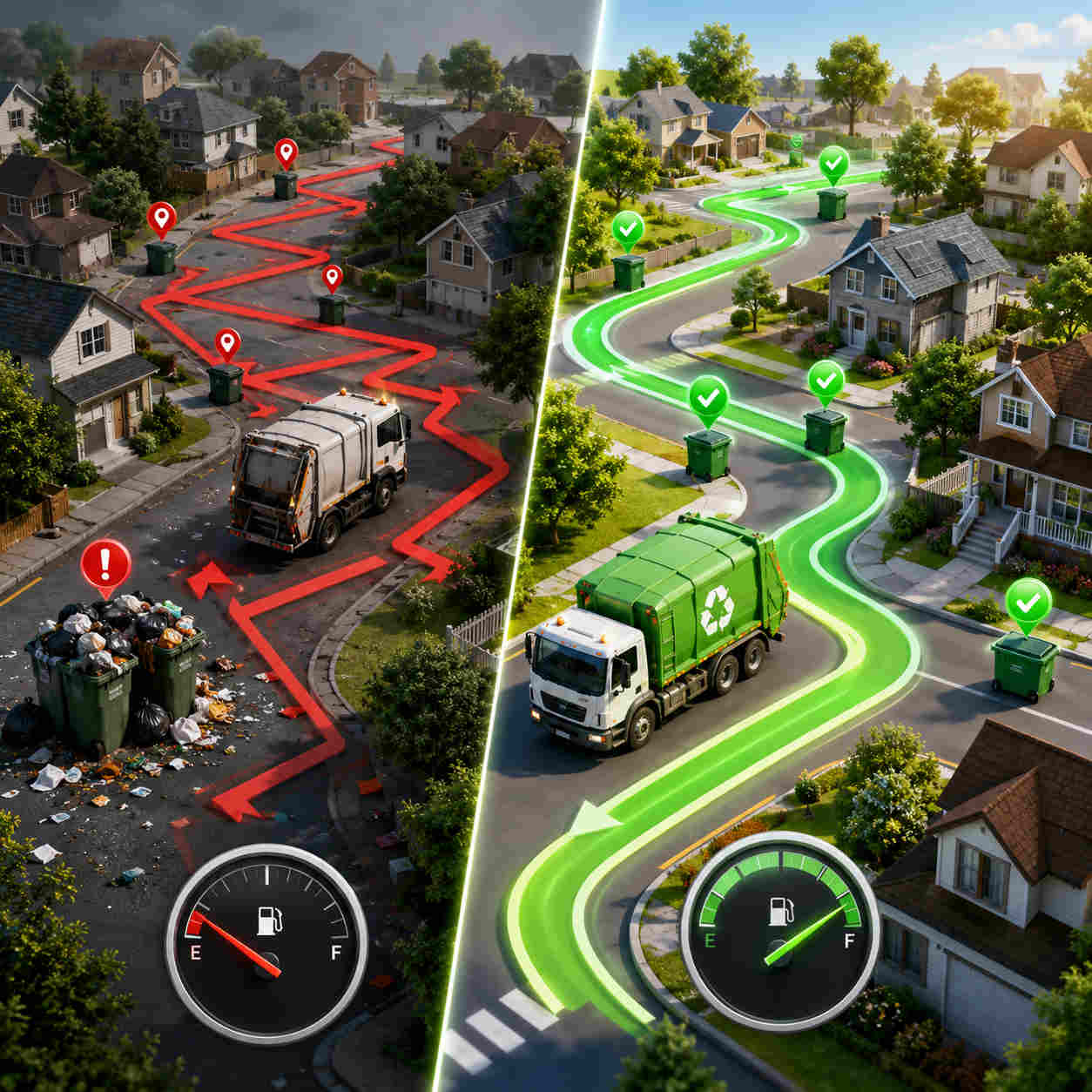
Fuel and labor are the two biggest costs you can actually do something about, and both live or die on route quality. A route that doubles back on itself, or two trucks grinding through the same streets, burns diesel and driver hours you’re never getting back. Haulers who switch from hand-built routes to real optimization tend to report cuts of twenty to thirty percent in miles driven. That’s not a rounding error. That comes straight off your fuel line and your maintenance bill.
Missed pickups run on the same logic. A route built from memory, a driver hustling to beat the clock before he’s full, and stops start slipping through. And a skipped stop isn’t a small thing. It’s someone’s trash sitting out for another seven days, then a call to your office, and if it happens twice, maybe a call to your competitor instead. Waste collection route planning software cuts this off at the root. It tracks every stop as serviced or missed in real time and grabs proof at each one, so a skipped bin gets caught the same day rather than discovered by an angry customer.
There’s a knock-on effect worth saying out loud, too. A customer who gets skipped once is primed to complain the next time anything goes slightly wrong. And when you start seeing clusters of missed pickups on a route, that’s usually the clearest sign you’ve outgrown doing this by hand. Tighten the sequences, spread the load evenly across the fleet, build the dump runs into the plan, and a solid garbage route planner quietly removes the conditions that were creating those misses in the first place. Same tool, two problems solved: your fuel spend drops and your phone stops ringing.
Expert Tips for Getting the Most From Your Route Planner
Buying the software is the easy bit. Actually getting your money’s worth is where operations split into the ones that win and the ones that let a good tool gather dust. A few things that make the difference.
Feed it clean data. Optimization is only as smart as what you give it. Get your addresses, collection days, and account details right up front, and your routes are solid from day one. Garbage in, garbage out, as the saying almost literally goes here.
Tell it the truth about your constraints. Real truck capacities, real transfer-station locations, real shift lengths and breaks. The more honest the inputs, the more drivable what your trash route optimization software hands back.
Work in zones. Give specific trucks defined territories. It cuts overlap, shortens the driving, and lets drivers actually get to know their patch. It’s the sweet spot between letting the algorithm run and keeping the human knowledge that makes a route hum.
Read your route analytics. Look at stops per route, completion rates, time on site, cost per drive. The stops that always run long and the zones that always drag will jump out, and then you rebalance.
Re-optimize on a schedule. Routing isn’t set-and-forget. Customers churn, streets change, seasons turn. Revisit the plan regularly or watch your hard-won efficiency quietly erode.
Actually listen to your drivers. They see what the office never will, blocked access, a bin never put out, a gate that’s always locked. Give them a fast way to report it and feed that back into your waste management routing software.
Watch the numbers that matter. Miles per route, stops per hour, missed-pickup count, idle time. Those tell you whether your refuse truck route planning is genuinely getting better or just feeling like it is.
Types of Waste Collection the Software Handles
A good platform isn’t a one-trick pony. Decent waste collection route planning software flexes to cover whatever mix of work you run.
Residential. Dense curbside routes, hundreds of stops a truck, running weekly or biweekly for trash, recycling, and organics. This is where a garbage route planner shows off most, because the density is where the wasted miles hide.
Commercial. Front-load and container work for businesses, usually with tighter time windows and account-specific quirks that need careful sequencing.
Roll-off. On-demand and scheduled hauling of big containers, where the routing is more about long hauls, container availability, and job-site status than a neat neighborhood grid.
Recycling and organics. Their own cadence, their own drop-off points, with a contaminated bin logged as a note and photo right at the stop so it’s on record instead of up for debate later.
A mix of recurring and one-off. Most haulers run steady subscription routes and random one-off requests side by side. The right trash route optimization software slots those extras into the day’s plan without making a dispatcher rebuild the whole route from scratch.
One system covering all of it means your dispatchers stop hopping between tools and finally get a single clear view of the day.
The Benefits of Route Optimization for Waste Collection
Add it all up and the payoff shows up everywhere. Fuel and labor drop, because trucks cover fewer miles, idle less, and quit doubling back. Missed pickups fall, because every stop is tracked live and backed by proof the moment it’s done. Your fleet works harder in a good way, with the load spread so no truck is buried while another rolls half-empty.
Then there are the quieter wins. Fewer office calls, because automatic notifications and a branded tracking page answer “why wasn’t my trash collected?” before anyone picks up the phone. A smaller carbon footprint, which follows naturally once the miles come down. Customers who stick around, because service is consistent and a dispute gets settled in seconds with a photo and a timestamp. And an operation that actually scales, where adding stops is a quick update instead of a week retraining someone’s memory. This isn’t shaving a dollar here and there. Waste management routing software changes the economics of the whole route.
Getting Started With Waste Collection Route Planning
Honestly, it’s less of a project than most owners expect. For most haulers the whole setup takes under an hour. Import your customer list and pickup schedules from a spreadsheet, set your truck capacities, run the optimizer, and give the routes a look before you dispatch. From there they land on each driver’s app with bin details and access notes, customers get their updates automatically, dispatch watches it unfold live, and the reports flag any account drifting off its cycle. Most haulers feel the difference in fuel and complaints inside the first couple of weeks.
Bodha is built specifically for private and commercial haulers, not municipal public-works departments, and that focus is the whole point. You get the features that matter on a truck: same-side-of-street sequencing that kills the pointless crossings and U-turns, capacity-aware routes that won’t overload a packer, and re-optimization the moment a truck drops out or a stop gets added. It ties routing to a built-in client CRM, so recurring schedules and every account’s history sit in one place instead of two. Proof of service on every stop turns a dispute into a ten-second lookup, the automatic updates take the inbound calls off your plate, and you get the lot without paying for an enterprise municipal platform you’ll never fully use. If missed pickups and fuel are quietly eating your margins, a purpose-built garbage route planner is the most direct lever you’ve got. And the sooner it’s running, the sooner those savings start stacking up.
Frequently asked questions