There are two ways a truck route goes wrong, and most fleets only worry about one of them.
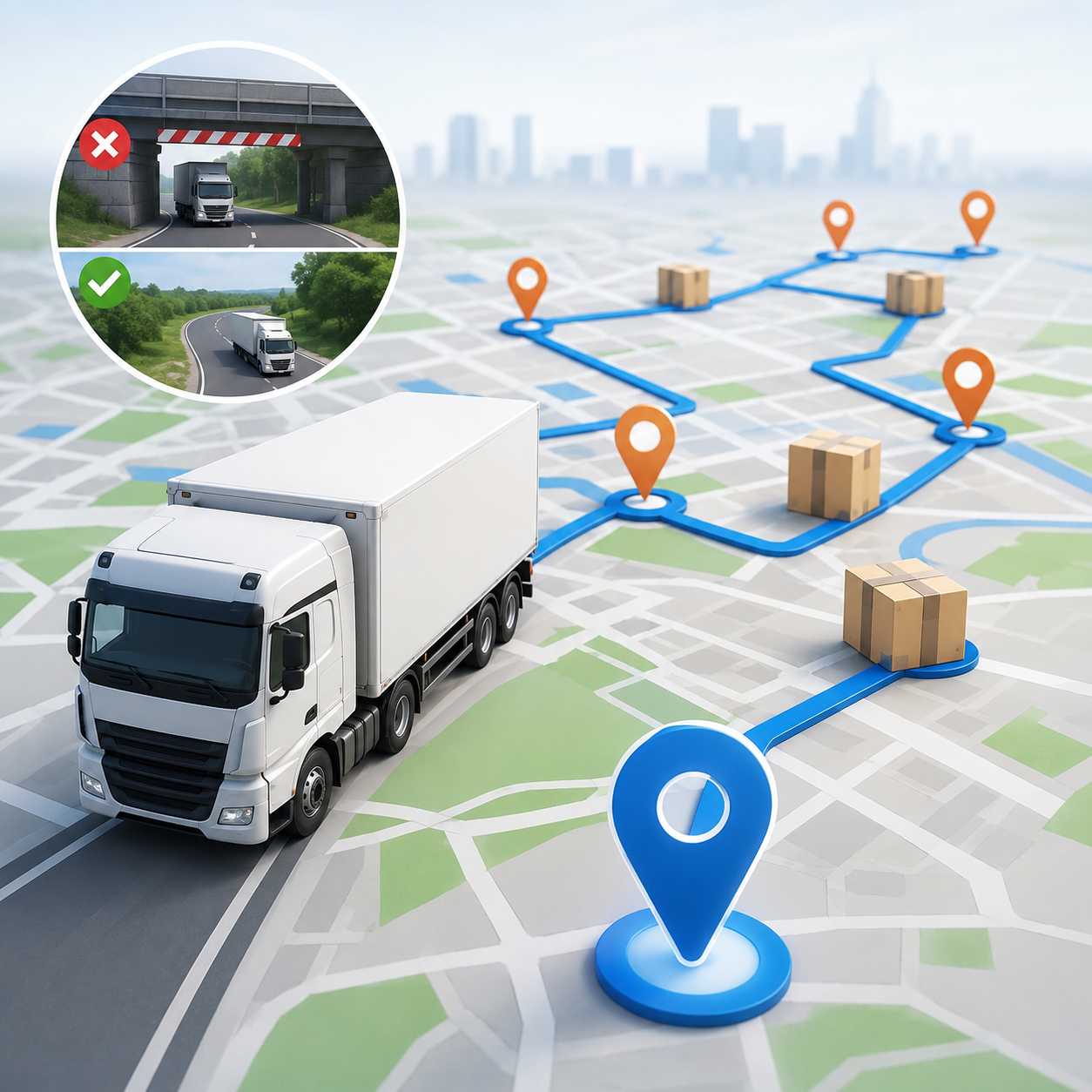
The first is the one everybody talks about. The route sends a 13-foot-6 box truck under a 12-foot bridge, and suddenly you’ve got a damaged trailer and a very bad phone call. Scary, obvious, easy to understand.
The second is quieter, and over a year it costs more. The route is perfectly legal. It’s also terrible. The stops sit in whatever order the orders came in, which has nothing to do with geography, and your driver spends the day zigzagging across town burning an extra 60 to 100 miles nobody asked for and nobody notices.
A real trucking route planner has to solve both. Keep the truck on roads it can legally and physically use, and sequence every drop into the fewest miles. Most tools do one or the other and call it a day. Here’s how to tell them apart, what each mistake actually costs you, and how to pick the right planner for the kind of trucking you actually do.
Problem One: Car Routes Get Trucks in Trouble
Consumer map apps route your truck like it’s a sedan. They don’t know your height. They don’t know your weight. And they have no idea your trailer can’t make that turn.
The consequences aren’t theoretical. Low bridges. Weight-restricted roads. Parkways that ban commercial vehicles outright. A bridge strike is a five-figure repair on a good day, plus a wrecked load, a driver’s license on the line, and an insurance conversation nobody enjoys. Weight violations mean fines. And every wrong turn a truck has to reverse out of is time you can’t bill anyone for.
That’s the gap truck-safe routing fills, and it’s the first thing to check in any trucking route planner. The software needs your truck’s real dimensions, height, width, length, and weight, and it needs to plan around them: avoiding low bridges, weight limits, and roads unsuitable for a vehicle your size. Crucially, it has to do that as an input to the route, not a warning slapped on top of a car route after the fact.
One honest note. If your fleet hauls hazardous materials, or needs IFTA fuel-tax reporting or ELD hours-of-service logging, those are specialist compliance jobs needing a dedicated compliance system. Truck-safe routing and regulatory reporting are two different purchases, and knowing which you’re shopping for saves a stack of pointless demos.
Problem Two: A Legal Route Can Still Be a Terrible Route
Now the expensive one.
Picture a driver with 20 drops. The manifest was built in the order the orders landed, so stop 3 is clear across town from stop 2, and stop 11 sits two streets from stop 4 but he won’t reach it for another four hours. Nothing about this route is illegal. It’s just quietly bleeding money all day.
A badly sequenced manifest can pile 60 to 100 unnecessary miles onto a single shift. Multiply that by your fleet, then by a working year. That’s a fuel bill you paid for nothing, wear on trucks for nothing, and drops you couldn’t fit because the clock ran out.
This is what truck route optimization actually means. Not “give me directions.” It means taking a full manifest and working out the exact order that clears every drop in the fewest miles, while respecting time windows, what the truck can carry, and how long the driver can legally work. Doing that well by hand across several trucks is effectively impossible, because the number of possible stop orders explodes once you’re past a handful of drops. A human being cannot brute-force that. Software can, in seconds.
What Bad Routing Actually Costs
“Inefficient routing” sounds abstract until you put a price on it, so let’s do that.
Every unnecessary mile is diesel you bought and set on fire. Every hour a driver spends backtracking is paid labor producing zero revenue. Every drop that didn’t fit is capacity you own and failed to use. And every morning your dispatcher spends hand-building routes is an expensive person doing a job software finishes in seconds.
The flip side is what makes this worth doing. Fleets using Bodha’s trucking route planner report cutting fuel costs by 20 to 30%, planning routes 3 times faster than by hand, and squeezing in 20 or more additional stops per day. That works out to roughly an hour less driving time and north of $1,000 saved every month for a typical operation. On-time delivery lands around 98%, for the simple reason that when a route is realistic, the ETA you promised the customer is realistic too.
None of that is magic. It’s just what a trucking route planner does once you stop making the two mistakes above.
The Six Things a Trucking Route Planner Must Do
Plenty of tools call themselves a trucking route planner. Far fewer earn it. Here’s the checklist I’d walk into any demo with, and what each item really means once you’re using it daily.
1. Truck-safe routing built on your actual vehicle. You enter height, width, length, and weight once, and from then on every route respects them. The test to run in a demo: give the tool a route with a known low bridge on the fast path and see whether it plans around it, or just flashes a warning after the fact. Those are very different products.
2. True multi-stop optimization. Real truck route planning software sequences 15, 20, 30 drops into the fewest legal miles in seconds. A lot of “truck” apps are point-to-point navigation with a vehicle profile bolted on. That’s a driver tool, not a dispatcher tool, and it won’t touch your sequencing problem.
3. Capacity awareness. The route respects what the truck can physically carry, or you build a flawless plan that overloads the vehicle by stop 12 and find out at the dock.
4. Multi-truck planning from one list. Import a manifest and a proper fleet route planner builds every truck’s route in one session, balanced across the fleet. The tell: if adding a truck lengthens your dispatcher’s morning, the tool isn’t doing its job.
5. Live tracking and automatic customer ETAs. Every truck’s progress on one screen, and customers get a tracking link instead of calling you. Owners consistently undervalue this before buying and rave about it after, because it quietly deletes an entire category of phone call from the office.
6. Proof of delivery on every drop. Photo, signature, timestamp, captured offline. The first time a customer insists a delivery never arrived and you settle it in ten seconds with a timestamped photo, this pays for the software.
Miss the first two and you don’t have a trucking route planner. You have a map with a truck sticker on it.
Why Google Maps Falls Apart for a Truck Fleet
It’s worth spelling out why the free option isn’t the option, because a lot of fleets try to make it work for far too long.
A consumer map app has no concept of your vehicle. It won’t route around a low bridge, it doesn’t know your weight limit, and it will happily send you down a commercial-vehicle-restricted road with total confidence. That alone disqualifies it for trucking.
Even setting safety aside, it can’t do the job. Most consumer apps cap out around ten stops, and even then they don’t truly optimize, they just plot stops in the order you typed them. No capacity awareness, so nothing stops you overloading a truck. No way to plan several trucks off one manifest, so the dispatcher builds each route by hand anyway. No automatic ETAs, so the office phone rings all afternoon. No proof of delivery, so a disputed drop becomes your driver’s word against the customer’s.
That’s the honest comparison. A tool that can’t route your vehicle safely, can’t sequence your day, and can’t prove you showed up isn’t cheap. It’s just billing you somewhere else.
Choosing the Best Route Planner for Trucking: Match the Tool to the Job
Here’s where buying decisions go sideways. People shop for “trucking software” as if it’s one category. It’s at least three, solving genuinely different problems.
Compliance and mileage platforms, the PC*Miler tier, are built around regulatory accuracy: hazmat routing, IFTA reporting, freight billing, driver-pay auditing. If you’re long-haul with hazardous loads and heavy state-mileage reporting, this is your category, and no multi-stop tool will replace it. Don’t try.
Driver navigation apps are built for one truck, one driver, turn by turn. Excellent for an owner-operator on a long haul. Useless to a dispatcher sequencing a manifest across six vehicles.
Truck-safe multi-stop planners are for fleets whose day is defined by drops. Local and regional distribution, box trucks and straight trucks, fifteen to thirty stops a shift, where the question isn’t “how do I get to Ohio legally” but “what order do I hit these 22 addresses in without putting the truck somewhere it can’t go.” Most local and regional fleets live squarely here, and it’s where a multi-stop trucking route planner pays for itself fastest.
So the best route planner for trucking is simply the trucking route planner that matches the shape of your day. Ask yourself one question: is my biggest risk regulatory, navigational, or sequencing? Buy for that answer. Don’t pay for a compliance suite whose reporting modules you will never once open.
The Dispatcher Cost Nobody Prices In
There’s a cost buried in most fleets that never appears on a fuel report: the hour your dispatcher burns every single morning building routes by hand.
Someone opens the manifest, squints at the addresses, guesses a sensible order, splits the stops across trucks, and sends the lists out. An hour on a good day, longer when a truck’s down. And the output is a route built on intuition, which is fine at six stops and hopeless at twenty-six.
Then you add a truck, and it doesn’t get harder in a straight line, it gets harder fast. Now the dispatcher is deciding which truck gets which stops and balancing the load so one driver isn’t done at three while another is out until seven. This is the wall growing fleets hit. The work outgrows the person doing it.
A real fleet route planner collapses that. Import the manifest once and every truck’s route is planned from that single list in one session, balanced, truck-safe, sequenced. What ate an hour takes seconds, and you hand a skilled person their morning back.
Recurring Runs: The Part Everyone Forgets
A lot of trucking work repeats. The same distribution route, the same weekly commercial accounts, the same Tuesday run to the same six sites. A good fleet route planner holds those cadences, daily, weekly, or custom, shows who’s due, and turns that list into an optimized route without anyone rebuilding it every cycle.
Pair that with customer records carrying dock notes and history, and your driver rolls up already knowing which entrance to use and who to ask for. It sounds minor. It’s the difference between a 12-minute stop and a 30-minute one, repeated across every drop, every week.
Four Mistakes That Quietly Drain Trucking Fleets
Even experienced operations leave money on the table in the same predictable ways.
Sequencing the manifest in the order the orders arrived. The most common and most expensive habit in local trucking. The order your customers happened to place their orders has precisely nothing to do with geography.
Treating truck-safe routing as a warning rather than an input. Some tools plan a car route and then flag a low bridge along the way. That’s backwards, and it puts the decision on a driver who’s already committed to the road.
Ignoring capacity until the truck is loaded. A route that’s geographically perfect and overloads the vehicle at stop 12 isn’t a plan, it’s a problem waiting at the dock.
Buying for a business you don’t have. Fleets routinely overbuy compliance and telematics modules they never open, while completely under-solving the sequencing problem that’s costing them money daily. Diagnose the real bottleneck first, then buy.
Getting Started
Switching is faster than most fleet owners expect. Most teams are running real routes the same day.
You start by setting your trucks, entering each vehicle’s dimensions and capacity once so every future route is planned around them. Then you import your manifest from Excel or CSV, and good truck route planning software geocodes and de-duplicates the addresses as it goes. You hit optimize, and it builds a truck-safe, capacity-aware route in the fewest miles, across one truck or the whole fleet. Routes go out to drivers’ phones with navigation, dock notes, and access details on every stop. Automatic ETAs keep customers off the phone, drivers capture proof of delivery at each drop, and the reports afterwards show miles, drive time, and adherence.
The real adjustment isn’t technical, it’s habit. Dispatchers who’ve planned by hand for years need a week to trust the optimizer. The time savings tend to settle that argument on their own.
Where Bodha Fits
Bodha is built for that middle category: a trucking route planner that gets the truck-safe part and the multi-stop part right in one tool. Enter your truck’s height, width, length, and weight, and Bodha plans around them, avoiding low bridges, weight limits, and restricted roads, while sequencing a full manifest of 15, 20, or more drops into the fewest legal miles. Routes are capacity-aware, drivers get truck-safe turn-by-turn navigation with curbside arrival, and every drop is logged with proof of delivery.
Live tracking puts every truck on one screen with automatic customer ETAs, and recurring schedules with a built-in CRM keep repeat runs on cycle. There’s more on the Trucking Route Planner page and the route planning feature page. Running a larger operation? Bodha Fleet handles multi-truck dispatch.
The honest boundaries, the same ones we’d give anyone: Bodha doesn’t do hazardous-material road routing, it isn’t an IFTA fuel-tax or state-mileage reporting system, and it isn’t an ELD for hours-of-service logging. You can set driving-hour limits, shift length, and breaks as route constraints, but fleets needing true hazmat routing or IFTA filing should pair Bodha with a dedicated compliance system. What it does, keeping your trucks on safe roads and your manifests sequenced tight, it does well, and it’s free to start.
Frequently asked questions