Last mile delivery used to be simple. Load the van, drive the route, drop the parcels. Done.
It isn’t that anymore. Now you’re optimizing routes on the fly, watching where drivers are, texting customers their ETA, snapping proof of delivery, and trying to figure out what each run actually cost you. And somewhere around the point where all of that gets genuinely hard to juggle, a certain thought tends to pop up.
We could just build our own software.
I get why. You’d get the exact features you want. No monthly bill. Total control over the thing your whole operation runs on. And for a small number of companies, that instinct is correct. But most people who go down this road learn the same lesson a bit too late: the real cost of a home-built last mile platform is nowhere near the number you’re quoted at the start. It keeps billing you long after the “finished” version ships.
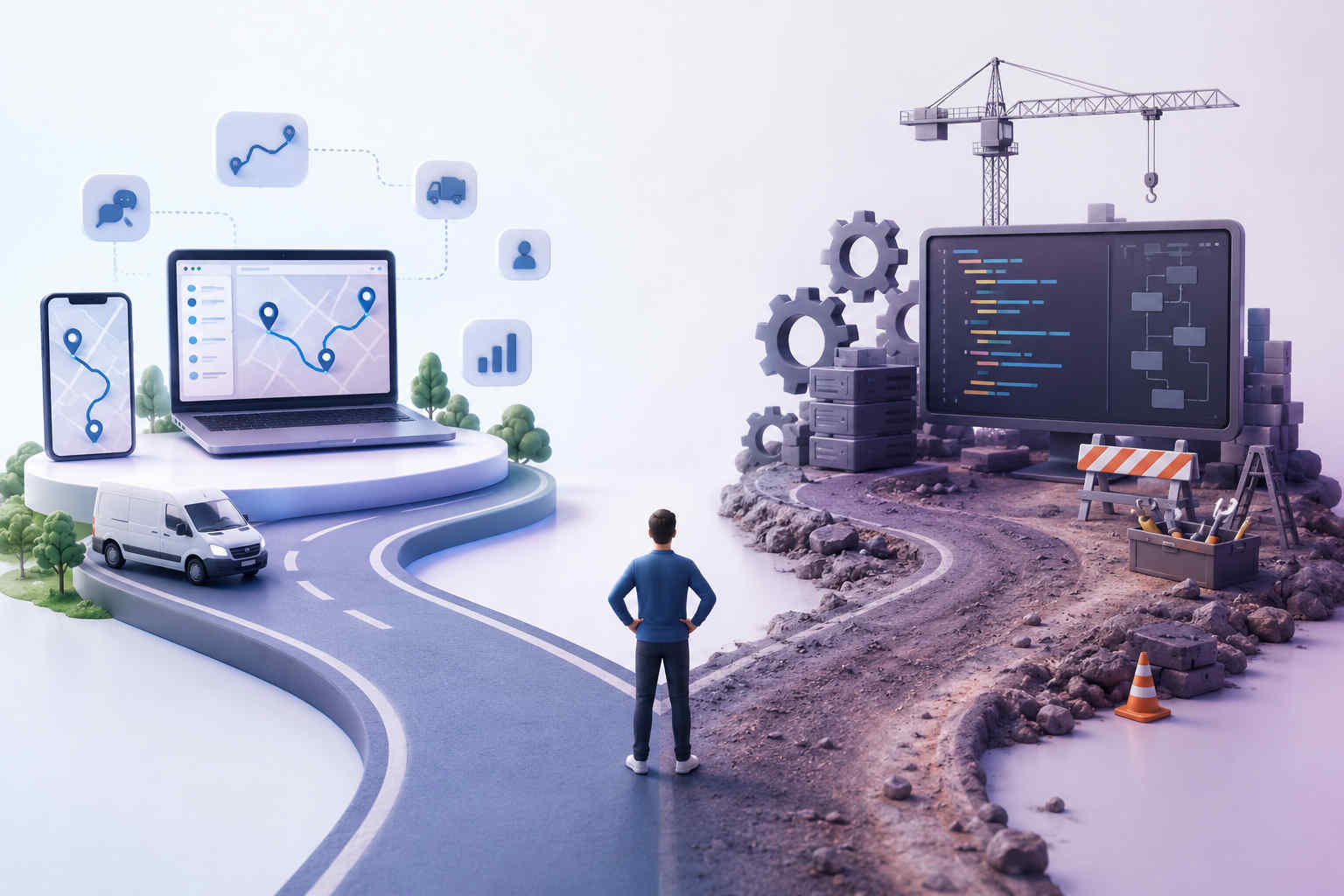
So, off-the-shelf last mile delivery software or roll your own? It’s a real decision with real trade-offs, and almost everything written about it is propaganda from one side or the other. SaaS vendors tell you to buy. Dev agencies tell you to build. This one just puts the numbers on the table and lets you make the call. Here goes.
Why teams think building their own delivery software is the smart move
On paper the build looks obvious, especially if you already have a developer on staff or a founder who used to ship code. The case usually rests on four beliefs. Each one is partly true. Each one hides something.
“We’ll have total control and customization.”
True, mostly. A custom build does whatever you tell it to. The problem is that what you want it to do never stops changing. Your routing rules shift. A carrier rewrites their API. A customer asks for a notification you didn’t build. The mapping provider quietly changes their pricing. Control isn’t something you buy one time and keep. It’s a chore you just signed up for, permanently, and it does not care that it’s Sunday.
“It’ll be cheaper than paying a subscription forever.”
Feels airtight. Why rent when you can own? Trouble is, you never actually finish owning it. You build it, then you maintain it, host it, patch it, and upgrade it until the day you retire it. The subscription you were dodging comes back as salaries, cloud invoices, and API fees. Those don’t stop either. They usually cost more.
“Our developers can handle it.”
Sure, they can write code. But this isn’t really a coding problem. It’s a logistics problem in a coding costume. Route optimization alone is a nasty computer-science puzzle that specialist teams have been grinding on for years. Bolt on live GPS, a driver app that survives a dead zone in a stairwell, dispatch logic, exception handling… now you’re asking generalists to rebuild, from scratch, things that already work really well elsewhere.
“We’ll just stitch a few APIs together.”
The duct-tape plan. Mapping API here, an SMS service there, a tracking widget, glue. And it does work. Right up until something snaps mid-route and suddenly you’re the support desk. Every integration is one more thing to babysit, pay for, and pray doesn’t break during your Friday rush. The quick fix has a way of turning into a fragile pile that exactly one person on your team actually understands.
Look, none of these beliefs is dumb. They’re just half the picture. The missing half is where the real money hides, so let’s go find it.
What building your own last mile delivery software actually costs
This is the part where most build-vs-buy articles suddenly get shy. They’ll call building “expensive” or throw around the word “millions” and never show you a single figure. Fine. Let’s be specific. There are three layers of cost here, and only the first one ever makes it into the initial quote.
Layer 1: the upfront build
Shipping a production-grade last mile platform takes a team. A product owner. Backend developers. A mobile dev for the driver app. A frontend dev for the dispatch dashboard. Design and QA on top. In North America or Western Europe, senior developers cost roughly $100 to $200 an hour once you count everything. Offshore in Eastern Europe or South Asia drops that to $30 to $80, though you’ll pay some of that saving back in extra management and testing time.
A bare-bones MVP, basic route sequencing plus a simple driver app and tracking, usually lands around $75,000 to $150,000. Something that can actually go toe-to-toe with commercial last mile delivery software, meaning real route optimization, live tracking, notifications, proof of delivery, the reporting, all of it, is closer to $200,000 to $400,000, and it climbs from there. All of that spend happens before you’ve delivered one package, because the build eats six to twelve months during which you’re paying the team and have nothing to show drivers yet.
And it’s worth being blunt about what “production-grade” really means, because that’s where budgets quietly blow up. You’re not building one app. You’re building at least three things that have to talk to each other: a dashboard where dispatchers plan and watch routes, a driver app that keeps working when the signal dies in a basement, and a backend holding the whole thing together in real time. Then come the ugly edge cases that make delivery genuinely hard. Nobody home. An address that geocodes to the wrong street. A driver who drops offline halfway through a route. A parcel that bounces back. Commercial tools have spent years getting beaten up by these exact situations. Your fresh build meets every one of them for the first time in production, live, with your real customers watching it happen.
Layer 2: the APIs you rent forever
Here’s the layer almost nobody puts in the budget. Even a “self-built” system leans on paid outside services that bill you every month for as long as it runs:
- Mapping and geocoding. Turning addresses into coordinates, and coordinates into sensible routes, means a provider like Google Maps Platform. Once you’re running real volume, geocoding plus directions plus route-optimization calls can run anywhere from a few hundred to a few thousand dollars a month.
- SMS and email notifications. Those “driver’s 3 stops away” texts cost about a cent each through something like Twilio. Do 10,000 deliveries a month with a couple of messages each and you’re at a few hundred dollars, more as volume grows.
- Cloud hosting and infrastructure. Servers, databases, storage. Call it hundreds a month, rising as you scale.
Individually, none of these will scare you. Stacked together, though, they mean your “free to own” software carries a recurring bill that looks an awful lot like the subscription you were trying to avoid.
Layer 3: the maintenance tail nobody budgets for
Study after study on custom software lands on the same uncomfortable finding: the build is the cheap part. Something like 80% of a system’s lifetime cost shows up after launch, buried in maintenance, upgrades, bug fixes, and migrations. A sane planning figure is 15% to 20% of the original build cost, every year, just to keep the lights on and the thing current.
Line all three layers up and the whole picture shifts. Building isn’t a one-time $250,000 call. It’s a $250,000 call that then invoices you fifty grand a year, indefinitely, for a tool that’s only ever as good as your most recent update.
The hidden costs that never make the quote
Honestly, even those numbers undersell it. The most expensive parts of building your own delivery software don’t come with line items. They turn up quietly, months later, in ways no spreadsheet flags for you upfront.
It’s never actually finished
A commercial platform ships improvements while you sleep. Yours only gets better when you pay someone to make it better. Every carrier API change, every OS update, every “hey, can it also do this?” from a customer joins a backlog that’s now fighting your actual business for developer hours. “Done” turns out to be a place you never quite arrive.
Developer time gets stolen from your real product
This one stings. Every hour your team burns debugging route logic is an hour not spent on the thing that pays the bills. Plenty of companies that set out to build their own logistics tool wake up one day and realize they’ve accidentally become a part-time software company. Nobody chose that on purpose.
Key-person risk
Custom systems have a habit of living inside one developer’s head. That’s fine, until that person takes a holiday, a better offer, or a sick day right in the middle of your busiest week. Then you find out exactly how much of your operation was quietly resting on one set of shoulders. Software you bought doesn’t hand in its notice.
The months you spend with no tool at all
While the build drags on for six to twelve months, your dispatchers are still sorting routes by hand and your money is still leaking out of all the places we mapped in the last mile delivery cost breakdown. Every week you spend building is a week you’re not saving. That’s a cost too, even if it never shows up on an invoice.
What buying last mile delivery software actually costs
Now the other column, and thankfully it’s a short read. Commercial last mile delivery software sells as a monthly subscription, usually per driver or per vehicle. For a small-to-mid-size fleet, real pricing runs from free tools up to somewhere around $150 to $1,500 a month depending on the platform and your volume. Bodha sits at $29.99 per driver per month, so a 10-driver outfit is looking at roughly $300 a month. About $3,600 a year.
For that, the build, the APIs, the hosting, the maintenance, and yes, the 2am bug that wakes someone up, are all somebody else’s job. You get route optimization, a driver app, live tracking, automated notifications, and proof of delivery on day one instead of month twelve. Updates just show up. And when you’re ready to pick between platforms, that’s worth doing carefully, our last mile delivery software buyer’s guide puts the main options side by side with real pricing, and our breakdown of delivery software costs walks through what to expect at different fleet sizes.
Build vs buy: the break-even math nobody shows you
Let’s just put the two next to each other for a real 10-driver fleet.
Build. Say $250,000 upfront. Add $50,000 a year in maintenance. Add another $15,000 or so a year for APIs and hosting. Year one: $315,000. Every year after that: about $65,000.
Buy. That same fleet, at $29.99 a driver, pays around $3,600 a year. Even if you go pricey with a fancier platform and some add-ons, call it $10,000.
There’s no catching up here. You could pay for the subscription for decades before you’d match what one year of building costs, and the built version still needs constant upkeep that the subscription just handles for you. For a small or mid-size fleet, the break-even point is basically never.
Flip the numbers around and it gets almost silly. That $315,000 first-year build budget would cover something like 87 years of SaaS for a 10-driver fleet. Realistically, the interest on the cash you’d sink into building would probably cover your subscription by itself, and the bought software is live and fully featured this week while the build is still a hiring plan and a Gantt chart. The only scenario where the math starts leaning toward building is when your fleet is big enough that per-driver fees pile into six figures a year. At that scale a dedicated engineering team stops looking crazy. Below it, it just is.
So who should build? A few companies genuinely should, to be fair. It can make sense if your delivery workflows are so unusual that no vendor comes close, if you’re operating at a scale where subscription fees would out-cost a whole engineering team, and if software is already something you do well, with the developers to back it up. That’s a real group. It’s just a small one, and it’s mostly big enterprises.
For everybody else, which is nearly every business running 3 to 50 vehicles, buying isn’t the lazy shortcut. It’s the sensible answer. Better tool, faster, at a sliver of the cost, and your people stay pointed at deliveries instead of stack traces.
The bottom line
“Build your own last mile delivery software” whispers control and savings. Do the honest arithmetic, though, and it usually delivers the opposite. A fat upfront build. A recurring API bill you never actually escaped. A maintenance tail that runs for as long as the system lives. Months of waiting before you launch anything at all. Buying flips every one of those: most of the cost, all of the upkeep, and all of the risk shift over to the vendor, and you’re live in days rather than quarters.
Unless your operation is truly one of a kind and you’ve got the engineering muscle to match, the smart money buys. Bodha hands you optimized multi-driver routing, live tracking, automated customer updates, and proof of delivery for $29.99 a driver, running this week, not next year. Start a free 7-day trial and watch it work before you spend a single dollar building anything.
Frequently Asked Questions