Ask most delivery business owners what a single delivery costs them and you’ll get a pause, then a guess. They can tell you the fuel bill to the dollar. They know payroll cold. But the actual cost of getting one parcel from the depot to a doorstep? That number tends to live in a fog.
That fog is expensive. The last mile, the final hop to the customer’s door, now swallows roughly 53% of total shipping costs, up from about 41% back in 2018. Read that again: the shortest leg of the whole journey costs more than warehousing and more than the long-haul freight that carried your stock across the country in the first place.
So where does all that money actually go? That’s the whole point of this piece. We’re going to pull the last mile delivery cost apart, line by line, and show you which pieces are quietly draining your margin. No vague hand-waving about “efficiency.” Just a straight breakdown, some real dollar figures, and a simple way to work out your own cost per delivery. Once you can see where the money leaks, plugging the holes gets a lot easier.
What is last mile delivery, and why is it such a money pit?
Quick definition first. Last mile delivery is the final stretch of the shipping journey, from your warehouse, kitchen, store, or depot to the person waiting at home. You’ll also hear it called final mile delivery, which is a little misleading, because it’s almost never a single mile. The real average sits closer to six to nine miles.
Now the strange part. The last mile is the shortest leg of your supply chain and, by a distance, the priciest. Why? Because it’s the point where consolidation falls apart.
Think about how your stock reaches you. A manufacturer loads a truck, that truck drives to your warehouse, done. One trip, one route, everything moving together. Cheap per unit. The last mile is the opposite of that. Suddenly every parcel is its own little mission, with its own address, its own driveway, its own gate code, and its own decent chance that nobody’s home when the driver knocks.
The industry word for the core problem is density, or rather the lack of it. When a driver is making fewer than three drops an hour, or doubling back across town because two stops on the same street somehow ended up on opposite ends of the schedule, the cost per delivery shoots up. Layer on rising driver wages, congestion charges creeping into more city centers, failed deliveries, and returns, and you’ve got a cost base that keeps climbing even on a quiet month. Which is exactly why understanding the breakdown of your last mile costs matters before you try to cut a single dollar.
The last mile delivery cost breakdown: where every dollar goes
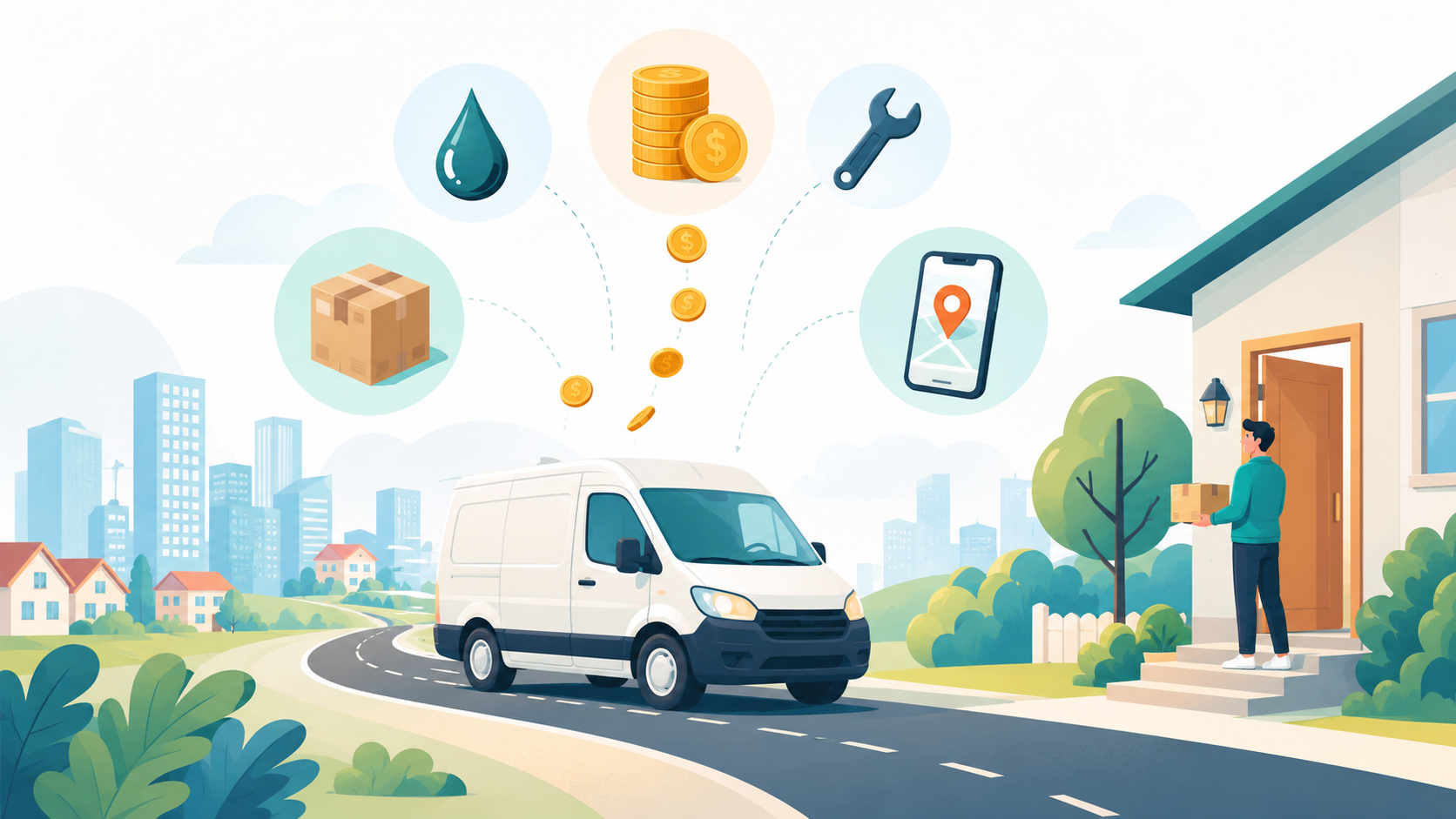
There’s no one villain here. Your last mile delivery costs are the sum of several moving parts, each one adding a bit before the package ever reaches the door. Here’s roughly how the stack splits for a typical small fleet:
Those percentages wobble depending on your routes, your vehicles, and where you operate. But the pecking order almost never changes. Labor and fuel run the show in every last mile delivery cost breakdown you’ll ever see. Let’s go through them one at a time.
Labor costs
If you only fix one thing after reading this, make it labor, because it’s about half of everything. Delivery drivers in the US generally earn somewhere between $16 and $24 an hour, with the Bureau of Labor Statistics pinning the average for light-truck drivers near $19.43. But the wage on the payslip isn’t the real number. Add overtime, payroll taxes, benefits, training, and the slow bleed of turnover, which runs high in this line of work and costs you again every time a driver quits and you start over with someone new.
And that’s just the people in the vans. Somebody has to plan the routes, assign the zones, and keep drivers and customers talking to each other. In a small operation that somebody is usually you, which means the cost is buried in your own hours rather than showing up on a spreadsheet. Grow a little and you’ll eventually hire a dispatcher, and there’s another labor line. Outsource the whole thing to a third-party courier and you haven’t escaped the cost, you’ve just wrapped it inside their rate. However you arrange it, people are the beating heart of your last mile delivery costs.
Fuel costs
Fuel is the runner-up, usually 10% to 25% of the total, and last mile work is brutal on it. Delivery vans can drop to around 6.5 miles per gallon in stop-and-go city traffic, and every crawl, brake, and idle at the curb burns fuel that moves the parcel exactly nowhere. Rural routes flip the problem: fewer stops, but long empty stretches between them.
What stings is how much of that fuel is pure waste rather than genuine cost. A route sequenced by hand, or by best guess, tacks on unnecessary miles day after day, and an engine left running at each stop adds up fast across a fleet. This is the one cost that responds almost immediately to sharper route optimization, because a tighter stop order cuts the miles driven, and the miles driven are the fuel.
Vehicle costs
Fuel aside, your vehicles bring their own bundle of last mile delivery costs. Buying or leasing the van is only the opening bid. After that comes maintenance, repairs, tires, depreciation, and commercial insurance, which runs pricier than a personal policy because delivery vehicles clock more miles, carry more liability, and wear out faster. Haul anything temperature-sensitive, food, flowers, medication, and a refrigerated van pushes those premiums higher still.
There are newer costs sneaking in too. As more cities roll out congestion charges and low-emission zones, those fees land straight on the fleets working built-up areas. And then there’s the nightmare scenario every operator knows: a breakdown mid-route. One dead van triggers a chain reaction, emergency re-dispatch, driver overtime to cover the gap, missed drops, maybe a tow. It’s the priciest vehicle cost of all, and it’s largely preventable. A boring maintenance schedule is a lot cheaper than the chaos a breakdown unleashes.
Packaging, handling and warehousing costs
Before a parcel ever sees a van, it gets picked, packed, and stored, and every step of that adds to your last mile delivery costs. Labor is the heavyweight again here, with pick-and-pack workers averaging around $15 to $16 an hour. Then the materials: a plain medium cardboard box usually costs under a dollar, but slap your branding on it and you’re looking at $2 to $3, and protective fill like void packing or corrugated inserts stacks on top.
Storage is the other side of it. Whether you’re renting a modest unit or running a proper warehouse, you’re paying for the space that holds stock until it ships. Buying packaging in bulk shaves the per-unit price but eats storage room, so the two costs quietly trade against each other. Per order it’s small. At volume, it’s relentless.
Technology and software costs
Here’s the line item that looks like a cost but behaves like a discount. Last mile delivery software is usually just 1% to 5% of your total, and it’s the one entry on this list that drags every other number down. It rolls route optimization, live tracking, automated customer notifications, and proof of delivery into one system, and quietly retires the spreadsheets, the group chats, and the printed manifests.
You’ll typically pay a monthly per-driver or per-vehicle subscription, running from free tools up to a few hundred dollars a month for a small fleet. The reason it earns its keep is simple leverage: a small spend that trims fuel, kills failed deliveries, and hands your dispatcher hours back pays for itself several times over. Think of it less as a bill and more as a lever on all the bigger costs above it. If you’re actually shopping, our last mile delivery software buyer’s guide lays the main platforms side by side with real pricing.
Failed deliveries and reverse logistics
Now the sneaky one. This category almost never makes it into people’s mental math, and it should. A failed first delivery attempt costs about $17.78 once you tally the wasted trip, the re-handling, the admin, and whatever you throw at the annoyed customer to keep them happy. Roughly 5% of deliveries flop on the first go, and get this, nearly 45% of those flops trace back to something as dumb as a bad address. Do 200 deliveries a day and even a modest failure rate is torching hundreds of dollars while you’re not looking.
Returns pile on from there. Reverse logistics, the whole business of handling returns, refunds, and lost parcels, has ballooned right alongside e-commerce, and most online shoppers have sent something back at least once. Every return means paying to bring the item home, restock it, and often ship a replacement, so you end up funding the same delivery two or three times over. Cutting failed delivery attempts with address checks and a heads-up text before the driver arrives is one of the highest-return fixes going.
Compliance and regulatory costs
Last and quietest: the paperwork costs. Driver overtime rules, business and vehicle licensing, insurance minimums, tax filing, data-protection duties for all that customer info you’re holding, plus the odd congestion or emissions permit. None of them are huge on their own. But ignore them and the fines land hard enough to make every one of your last mile delivery costs look reasonable by comparison. Staying on the right side of the rules is simply cheaper than not.
How to actually calculate your cost per delivery
Every plan to tame last mile delivery costs runs through one number most operators don’t track: cost per delivery. Without it you’re flying blind. You can’t tell a money-making route from a money-losing one, and you can’t prove any change you make actually worked.
The math is refreshingly simple:
Cost per delivery = Total monthly operating costs ÷ Total deliveries completed that month
Fold everything from the breakdown above into that top number, fuel, wages, vehicle depreciation and upkeep, insurance, packaging, software.
Say you run a 10-driver fleet doing 50 stops per driver per day, roughly 11,000 deliveries a month. It might shake out like this:
- Driver wages: $44,000
- Fuel: $6,000
- Vehicle costs (maintenance, insurance, depreciation): $8,000
- Packaging and handling: $3,000
- Software: $300
- Total: ~$61,300 ÷ 11,000 deliveries ≈ $5.57 per delivery
Get that number, then keep going and break it down by route and by zone, because that’s where the real story hides. One route that runs 25 miles out of your patch to serve a handful of stragglers might be costing $18 a delivery while the rest of your fleet cruises under $6, and your tidy overall average smooths that disaster right over. Route analytics that report cost per delivery per route drag those leaks into the light.
So what's a good cost per delivery?
Once you’ve got your figure, you need something to measure it against. For most small and mid-sized operations, cost per delivery lands between $4 and $12, depending on how dense your routes are, what you’re driving, and how fiddly the stops get. A well-optimized small fleet running tight routes usually hits $3 to $5. Sitting up at $9 to $12? There’s plenty of room to move, and now you know it.
Cost per package is a cousin of this, and it swings mostly on weight and size. Analysis puts distribution cost per package anywhere from about $1.40 for light, dense drops up to $12 for heavier or scattered ones, with bulky items climbing higher again. That huge spread is exactly why flat delivery pricing burns so many businesses: a $6 flat fee feels great on a packed urban route and quietly bleeds you dry on a sparse rural one. Knowing your true cost per delivery by area lets you price like you mean it instead of crossing your fingers.
How to bring your last mile delivery costs down
Working out where the money goes is half the job. The other half is doing something about it, and the encouraging news is that your two biggest costs, labor and fuel, are also the two most fixable, mostly through smarter routing and fewer failed drops. The moves that pull the most weight:
- Optimize routes to lift delivery density. A tighter stop order cuts miles, fuel, and driver hours all at once. Fastest lever you’ve got on cost per delivery.
- Kill failed deliveries with proactive notifications. An automated ETA and an out-for-delivery text give people time to be home, dragging failure rates from the usual 5–8% down toward 1–2%.
- Give customers other options. Click-and-collect, parcel lockers, and set delivery windows keep customers happy while quietly tightening your route density.
- Watch cost per delivery by route, every week. You can’t fix a leak you never see.
Each of these is worth a proper deep dive of its own. For the full playbook with the dollar math attached, head to our guide on how to reduce delivery costs with 10 proven strategies.
The bottom line
Last mile delivery is a tangle of labor, fuel, vehicles, packaging, failed drops, and software, and together they eat the lion’s share of your shipping spend. Some of it you’re stuck with, drivers have to be paid and vans have to be maintained. But a real chunk of your last mile delivery costs is just waste hiding in bad routes, preventable failed deliveries, and a cost per delivery nobody’s tracking. See where every dollar goes and you get to choose, deliberately, which leak to plug first.
The quickest way to move the needle is to stop planning routes by hand. Bodha’s delivery route planning software builds optimized multi-driver routes in seconds, tracks your drivers live, fires off customer updates on its own, and reports cost per delivery by route, so your last mile costs stop being a fog and start being a dashboard. Try it free for 7 days, no credit card needed.
Frequently Asked Questions