In food distribution, the clock runs everything. You’re moving perishable stock through narrow receiving windows, and a single route can carry 40 or 50 stops before lunch. There isn’t much room to get it wrong. When a delivery shows up an hour late, you don’t just pay for the extra fuel. You might lose the load to spoilage, eat a penalty fee, or watch a long-time account start shopping around.
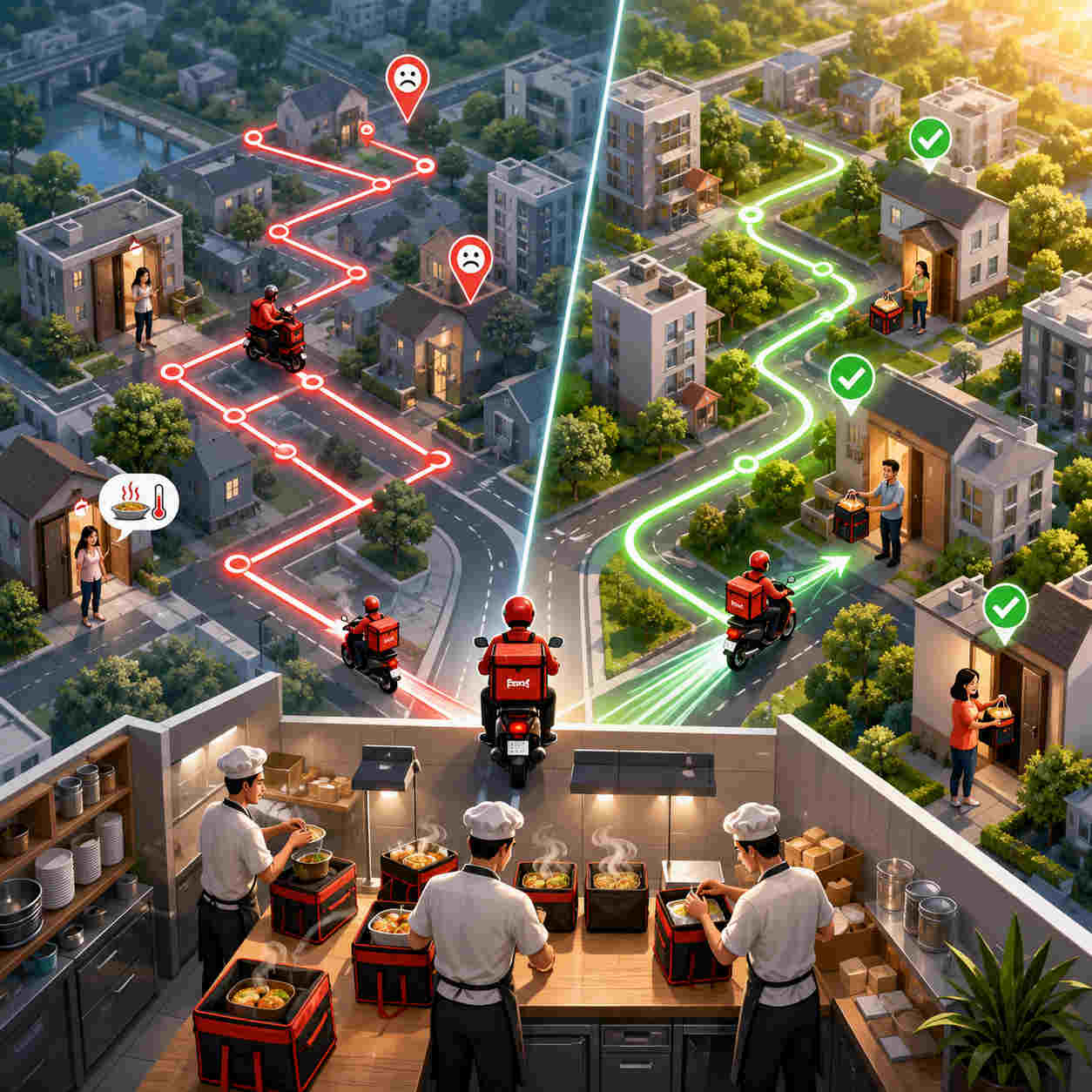
That’s the gap food delivery route optimization is meant to close. Rather than having a dispatcher drag stops around a maps app every morning, the software works out the most efficient delivery sequence in seconds. It weighs time windows, vehicle capacity, traffic, and how long whatever’s in the truck can safely sit there.
This guide walks through what food delivery route optimization actually does, why distributors specifically need it, which features separate real distribution tools from generic delivery apps, and how the best food distribution route planning software stacks up in 2026, pricing and top picks included.
What Is Food Delivery Route Optimization?
Food delivery route optimization is software that figures out the most efficient set of routes across your whole fleet. It looks at every variable that actually matters on the road: distance, drive time, delivery windows, how much each vehicle (and each compartment) can hold, driver shifts, and live traffic.
A consumer maps app just hands you the quickest way from point A to point B. Route optimization software is doing something much harder. It’s solving for dozens of stops across several vehicles at the same time, then putting them in an order that makes the entire operation run leaner.
For distributors, the bar sits higher again. General route planning software treats every stop as interchangeable. Purpose-built software for food distributors understands what you’re actually hauling. It accounts for refrigerated versus ambient cargo, how long the cold chain can hold, the FSMA paperwork, and the sheer number of stops a normal run involves. That’s the line between basic delivery scheduling and real food distribution route planning.
Put simply, one tool maps your day. The other runs your operation.
Why Food Distribution Route Planning Is Different
If you’ve ever tried a basic delivery app and felt like it just didn’t fit, there’s a reason. Food distribution doesn’t behave like dropping off parcels or furniture. A few things set it apart.
Perishability is a deadline you can’t negotiate. The UN’s Food and Agriculture Organization puts global food loss between harvest and retail at around 14%, and a lot of that disappears in transport and handling. Every extra minute your dairy, produce, or frozen goods spend on the truck nudges that load closer to unsellable. So a late route isn’t just wasteful. Sometimes it writes off the cargo entirely.
Compliance rides along in the truck. The FDA’s Food Safety Modernization Act, and its Sanitary Transportation rule in particular, expects distributors to keep temperatures controlled and records intact. Your routing tool should make that paper trail easier with timestamps, photos, and proof of delivery. It shouldn’t be something you work around.
The stop density is brutal. A furniture crew might hit 8 to 10 addresses in a day. A food distribution driver can hit 30, 40, sometimes 50, bouncing between restaurants, grocery accounts, and institutional kitchens, each with its own receiving window. No human sequences that well by hand. That’s why a real multi stop route planner for food delivery business work isn’t a nice extra. It’s the baseline.
Now stack thin margins on top of all that. Wholesale food distribution often runs in the low single digits, so a bad route costs you more than it would almost anywhere else.
Key Benefits of Route Optimization Software for Food Distributors
When food delivery route optimization is set up well, it shows up on nearly every line of your P&L.
- Lower fuel and transportation costs. Tighter routes cover the same deliveries in fewer miles. Most distributors report fuel and transport savings somewhere in the 10 to 30% range once they leave manual planning behind. Spread that across 20 or 50 trucks and the annual figure gets serious. Better utilization can even shrink how many vehicles you need in the first place.
- Faster, steadier deliveries. Smarter sequencing cuts out the backtracking and protects your time windows. More accounts get served before they open, and on-time numbers climb.
- Less spoilage. Time in transit is the most direct lever you have on shrink. Quicker, more predictable routes keep perishables inside their safe window and cut down on rejected loads.
- More productive drivers and dispatchers. Drivers get a clean, neighborhood-by-neighborhood flow instead of second-guessing the next turn. Dispatchers get back the hours they used to burn building routes by hand.
- Visibility you can actually use. Live tracking and ETAs let you warn an account before a delivery slips, rather than finding out when the phone rings.
None of this is theoretical. Bodha Route Planner customers, for instance, tend to see roughly a 30% drop in fuel costs, 25% more deliveries per driver, and 70% fewer “where’s my order” calls inside the first month.
Common Use Cases in Food Distribution
Food distribution isn’t a single business. It’s really a dozen different operating models, each with its own routing headaches, and food delivery route optimization bends to fit them. Here’s where it tends to earn its keep.
Fresh produce distribution. Produce is a same-day-or-spoil game. Distributors lean on food distribution route planning to set up pre-dawn drops that land before grocery and restaurant doors even open, which protects shelf life on the most fragile thing in the truck.
Dairy and frozen delivery. Cold-chain goods give you zero margin on temperature. A capacity-aware multi stop route planner for food delivery business operations keeps refrigerated and ambient cargo apart, orders the stops so doors stay shut longer, and trims the total time anything spends out of safe range.
Restaurant and hotel supply. Kitchens live by their receiving windows. Supplies have to be there before prep starts, full stop. Route optimization can juggle dozens of overlapping windows in a single shift so every account lands on time, not just whenever the route happens to swing by.
Grocery and retail replenishment. Here you’re usually running recurring routes with order sizes that bounce around. The software keeps the steady backbone of the route but flexes when volume spikes. A store doubles its order for a holiday weekend, and the routes rebalance on their own instead of forcing a manual rebuild.
Broadline and specialty food and beverage distribution. Mixed-SKU operations hauling everything from dry goods to chilled drinks get the most out of true food and beverage distribution software, since it balances weight, volume, and compartment limits across the fleet in one pass.
How Food Delivery Route Optimization Software Works
The math under the hood is genuinely complicated. The day-to-day, though, is pretty straightforward, and it usually breaks into five steps.
1. Import your orders and stops. You get your delivery data in, either through a CSV or spreadsheet upload or a direct API link to your order, ERP, or WMS system. Each stop brings its address, size or weight, the required window, and any special notes. Save your recurring accounts once and you’re not re-typing the same customers every morning.
2. Set your constraints. This is where you hand the software your rules. Delivery windows, like a restaurant that only takes deliveries between 6 and 9 a.m. Vehicle and compartment capacity, so refrigerated and ambient loads stay separate. Driver shifts and breaks, service time at each stop, and where routes start and end.
3. Optimize. Now the software does the heavy lifting. It chews through every order, every constraint, and live road conditions, then returns optimized routes in seconds, even when that means hundreds of stops across a fleet. Dispatchers can review everything on a map and adjust before anything goes out.
4. Dispatch and monitor. Routes land in the driver’s mobile app with turn-by-turn navigation. As stops get completed, dispatch watches locations, status, and ETAs update in real time. If a cancellation or a rush order lands mid-shift, the system can re-optimize without scrapping the day.
5. Report and refine. Once the day wraps, you get planned-versus-actual reports: miles driven, on-time rate, service times. Over a few weeks that data tells you where to tighten your routing rules.
Must-Have Features in Software for Food Distributors
Plenty of delivery apps simply aren’t built for distribution. When you’re weighing up route planning software for delivery in this space, don’t compromise on these:
- High-volume multi-stop optimization. It needs to handle hundreds of stops across many vehicles at once and balance the load across the fleet. This is the heart of any serious multi stop route planner for food delivery business use.
- Minute-level time-window control. Plus priority flags for your most time-sensitive drops and a heads-up when a route is about to miss a window.
- Capacity and load planning. By weight, volume, and compartment type, so chilled and ambient goods get grouped right and nothing’s overloaded.
- Dynamic re-optimization. Add, drop, or reassign a stop in the middle of the day and have the route recalculate on the spot, no manual replanning.
- A solid driver app. Turn-by-turn navigation, the stop sequence, one-tap confirmation, and a line to dispatch, all without much training.
- Proof of delivery and tracking. Photos, e-signatures, GPS-stamped times, and condition notes that quietly double as your FSMA paper trail.
- Integrations. API access and ready-made connectors to your ERP, WMS, and order systems so the routing always reflects today’s orders.
If a tool skips capacity planning or proof of delivery, it’s really just a general route app with a food label slapped on. It isn’t true food and beverage distribution software.
Challenges You Face Without Route Optimization
Running distribution off spreadsheets and a maps app doesn’t only feel harder. It quietly racks up costs that build day after day. Here are the four that sting the most, and what the right software for food distributors does about each.
Challenge 1: Higher operating costs. Manual routing leaves money on the road. With nothing balancing the whole fleet, routes stretch longer than they should, fuel burns faster, and driver hours get wasted. The fix: automated food distribution route planning that maps the shortest workable path across every vehicle at once, which usually pulls transport costs down 10 to 30% almost immediately.
Challenge 2: Missed and late deliveries. A route can look perfectly fine on paper and still fall apart the moment real traffic, service times, and sequencing collide. Worse, without live visibility, dispatch often doesn’t know a drop is late until the customer calls to complain. The fix: real-time tracking paired with dynamic re-optimization, so you catch the slippage early and reroute before a window is gone.
Challenge 3: Spoilage and rejected loads. Every extra minute in transit pushes perishables a little closer to the edge of their shelf life, and buyers will turn away product that shows up with too little life left. The fix: optimization that puts time-sensitive stops first and keeps total transit time short, holding cold-chain goods in their safe range.
Challenge 4: No visibility once the trucks roll. With no tracking, you’re flying blind after dispatch. You can’t get ahead of customers with updates, and you can’t learn much from what happened out there. The fix: GPS tracking, automated notifications, and proof-of-delivery capture, which together give you a live picture and a clean record.
The common thread? Manual planning hides your costs. Route optimization drags them into the open, then gets rid of them.
Best Food Distribution Route Planning Software in 2026 (Comparison)
The market stretches from simple driver apps all the way to heavy enterprise logistics suites. Here’s how the leading options compare for distributors. Pricing shifts often, so treat these as starting points and confirm with each vendor.
Our Top Pick: Bodha Route Planner
For most food distributors, Bodha Route Planner strikes the best balance of power, speed, and price. That’s why it tops our list of the best food distribution route planning software for 2026.
Here’s what makes it work for distribution in particular:
- Speed and scale. You can plan multi-stop routes (with no limits of adding stops per driver on Bodha Drive) and optimize a full fleet in seconds, and Bodha Fleet handles unlimited drivers and vehicles.
- Cold-chain discipline built in. Time windows and priority handling mean perishables move first and stay in their safe range.
- Compliance-ready proof of delivery. Photos, e-signatures, and GPS timestamps get captured in the driver app and synced to the cloud, so your FSMA documentation builds itself.
- Real-time tracking and automated notifications. You get live driver visibility plus SMS and email ETAs, which quietly kill off the “where’s my order” calls.
- Fast setup. Most teams are live within an hour, importing stops by Excel, CSV, or API.
- Enterprise-grade trust. 256-bit encryption, GDPR and SOC 2 compliance, a 99.9% uptime SLA, and coverage in 190+ countries.
Bodha already supports 10,000+ delivery teams moving 500K+ deliveries a day, with a 4.8/5 customer rating. If you want enterprise capability without the enterprise headache, it’s the strongest fit here. Take a look at the food delivery route planner, or jump straight to a free trial.
How to Choose the Right Food Distribution Route Planning Software
There are several capable tools out there, so the real question is which one fits how you actually operate. This framework helps.
Fleet size and volume. Small fleets of 5 to 10 vehicles want simplicity and a fair price. Bigger operations need multi-depot support and somewhere to grow. Pick something that handles today’s volume and scales with you, without charging you for enterprise features you’ll never open.
Route and constraint complexity. Make sure the tool actually supports your non-negotiables: tight perishability and temperature handling, multi-depot optimization, mixed fleet types, and FSMA documentation.
Ease of use and onboarding. In this business, a clunky software switch gets expensive fast. Look for dispatcher and driver interfaces people pick up quickly, plus hands-on onboarding. Bodha’s roughly one-hour setup genuinely helps here.
Pricing and ROI. Look past the sticker price at the total cost of ownership, meaning setup, integrations, and add-ons. Then weigh the upside. A 15% improvement on $50,000 a month in fuel and labor is $7,500 back in your pocket every month. Lean toward transparent pricing with no surprises.
Support and reliability. Check the support channels, the response times, and the uptime history. Downtime during your peak delivery hours costs a lot more than the subscription ever will.
Pricing: What You'll Actually Pay in 2026
Pricing in this category tends to follow a handful of patterns. Knowing them makes it easier to compare like with like:
- Per-user / per-seat. A flat monthly fee per dispatcher or planner. Predictable, and it works well when you’ve got few planners and lots of drivers.
- Per-driver / per-vehicle. Scales with your fleet (OptimoRoute, for example, sits around $35/driver/month). Clean for operations that are growing.
- Volume / order-based. Priced by the stops or orders you process (Routific’s entry tiers run near $150/month). Fine for lower, predictable volumes.
- Custom / enterprise. Quote-based, aimed at complex multi-location distributors like Route4Me and DispatchTrack.
Where Bodha lands: Bodha keeps the barrier low. You get a 7-day free trial with no credit card, then a flat, honest $29.99/driver/month with no hidden setup fees. Plans run from a single driver on Bodha Drive up to an unlimited-driver fleet on Bodha Fleet, and there’s a white-label option if you’d rather run the technology under your own brand. The full breakdown lives on the Bodha pricing page. The honest takeaway is that at that price, the tool tends to pay for itself in fuel and spoilage savings long before the invoice matters.
What's Changing in 2026
A few shifts are reshaping what the best food distribution route planning software has to do this year.
AI has moved from “optimize once” to “optimize all day.” Older tools planned the morning route and then left it alone. Newer food delivery route optimization keeps re-planning as orders, cancellations, and traffic change. The route becomes a living thing rather than a list you’re locked into.
Compliance keeps getting stricter. As FSMA enforcement matures, distributors increasingly need temperature logs and proof-of-delivery records captured automatically and kept in one place, not pieced together after the fact. Routing and compliance are basically merging into one workflow now.
Customers expect parcel-grade tracking for food, too. People are used to the live tracking they get from e-commerce, and that’s quietly become the expectation for B2B food accounts as well. Branded tracking pages, live ETAs, and automated alerts have gone from premium extras to table stakes in any route planning software delivery teams seriously consider.
So the buying advice shifts a little. Don’t just ask how well a tool plans a static route. Ask how well it adapts, documents, and communicates, because that’s where the wins and losses happen in 2026.
Implementation Tips That Reduce Risk
Buying the software is the easy part. These few habits keep the rollout from going sideways.
Start with a pilot route. Resist the urge to flip the whole operation overnight. Take a representative slice of customers and constraints, decide upfront what success looks like (miles cut, windows hit, planning time saved), and measure it against your current numbers before you scale.
Train dispatchers and drivers separately. They need different things. Dispatchers want the planning workflow, constraint setup, and live monitoring. Drivers want the app, the navigation, and the delivery confirmation. Frame the whole thing around how it makes their day easier, and you’ll meet far less resistance.
Let the data keep tuning you. Implementation isn’t a one-time event. Keep reviewing your planned-versus-actual reports, hunt down the recurring delay spots and the service-time outliers, and nudge your routing rules accordingly. The gains tend to compound over the months that follow.
Why Bodha Is Built for Food & Beverage Distribution
Route optimization has quietly gone from a nice-to-have to core infrastructure for food distributors. The pressures are real, between perishable product, tight windows, thin margins, and fuel and labor costs that keep climbing. But the payoff for getting routing right is just as real.
Good food and beverage distribution software does more than draw better routes. It lowers your costs, makes deliveries more reliable, cuts waste, and frees your team up to chase growth instead of firefighting the route board every morning.
That’s exactly what Bodha Route Planner was built for. It was founded by people who’d actually run delivery operations, and it pairs fast AI route optimization with the practical stuff distribution really needs: capacity-aware planning, real-time tracking, automated customer notifications, and compliance-ready proof of delivery. All of it sits behind an interface a new dispatcher can learn in an afternoon.
If you’re shopping for the best food distribution route planning software this year, put Bodha near the top of the list. Start a 7-day free trial or book a demo and run it against your own routes. That’s the only test that really counts.
Frequently Asked Questions
1. How much can food distributors save with route optimization software?
- Most distributors see transport and fuel costs drop by somewhere around 10 to 30% once they move from manual planning to automated food delivery route optimization. On top of that, you usually claw back several hours of planning time a week. In an industry where margins often sit in the low single digits, that kind of swing genuinely matters.
2. What makes food distribution route planning different from regular delivery routing?
- It adds three things ordinary routing doesn’t deal with: perishability deadlines, cold-chain and FSMA compliance, and very high stop density, often 30 to 50 stops on one route. That’s the reason distributors need purpose-built software for food distributors rather than a generic delivery app.
3. Can the software handle recurring food delivery routes?
- Yes. The better platforms, Bodha included, let you save customer profiles and recurring schedules, then re-optimize automatically when volumes move around. If a store orders extra stock for a weekend promotion, the route adjusts on its own instead of forcing you to start over.
4. What is the best multi stop route planner for a food delivery business?
- It depends on your fleet size and how complex your routes get. That said, for most food distributors Bodha Route Planner offers the best mix of high-volume multi-stop optimization, real-time tracking, compliance-ready proof of delivery, and quick setup, all at a fair price.
5. How long does implementation take?
- For straightforward operations, cloud platforms can be live anywhere from a day to two weeks, and Bodha teams are often up and running within an hour. Enterprise setups with deep ERP or WMS integration take longer, so starting with a pilot route is the smart way to fine-tune your settings first.
6. Does food delivery route optimization software help with FSMA compliance?
- Indirectly, but in a way that adds up. It won’t replace your food-safety program, but capturing GPS-stamped proof of delivery, photos, and timestamps at every stop hands you the transportation documentation FSMA expects. And it’s created automatically as drivers work, rather than reconstructed later from memory.
7. How does route planning software for delivery handle a sudden rush or canceled order?
- The good tools re-optimize on the fly. Dispatch can add, drop, or reassign a stop mid-shift and the system recalculates the affected routes right away, no rebuilding the whole day. It’s one of the clearest differences between a real route planning software delivery operation depends on and a plain maps app.
8. Can a small distributor afford this kind of software?
- Yes, and it’s gotten a lot more affordable. Bodha, for instance, starts at $29.99/driver/month after the free trial, with no setup fees. For most small fleets, the fuel and spoilage savings cover that subscription several times over within the first month.
9. What’s the difference between route optimization and basic GPS navigation?
- GPS navigation finds the best path between two points. Route optimization tackles the much harder problem: sequencing a lot of stops across multiple vehicles while respecting time windows, capacity, and driver hours. That second job is exactly what food distribution route planning calls for.
Want to see what this does to your fuel and spoilage numbers?
Run Bodha’s food delivery route optimization against a real route and judge it for yourself. Start your free trial.