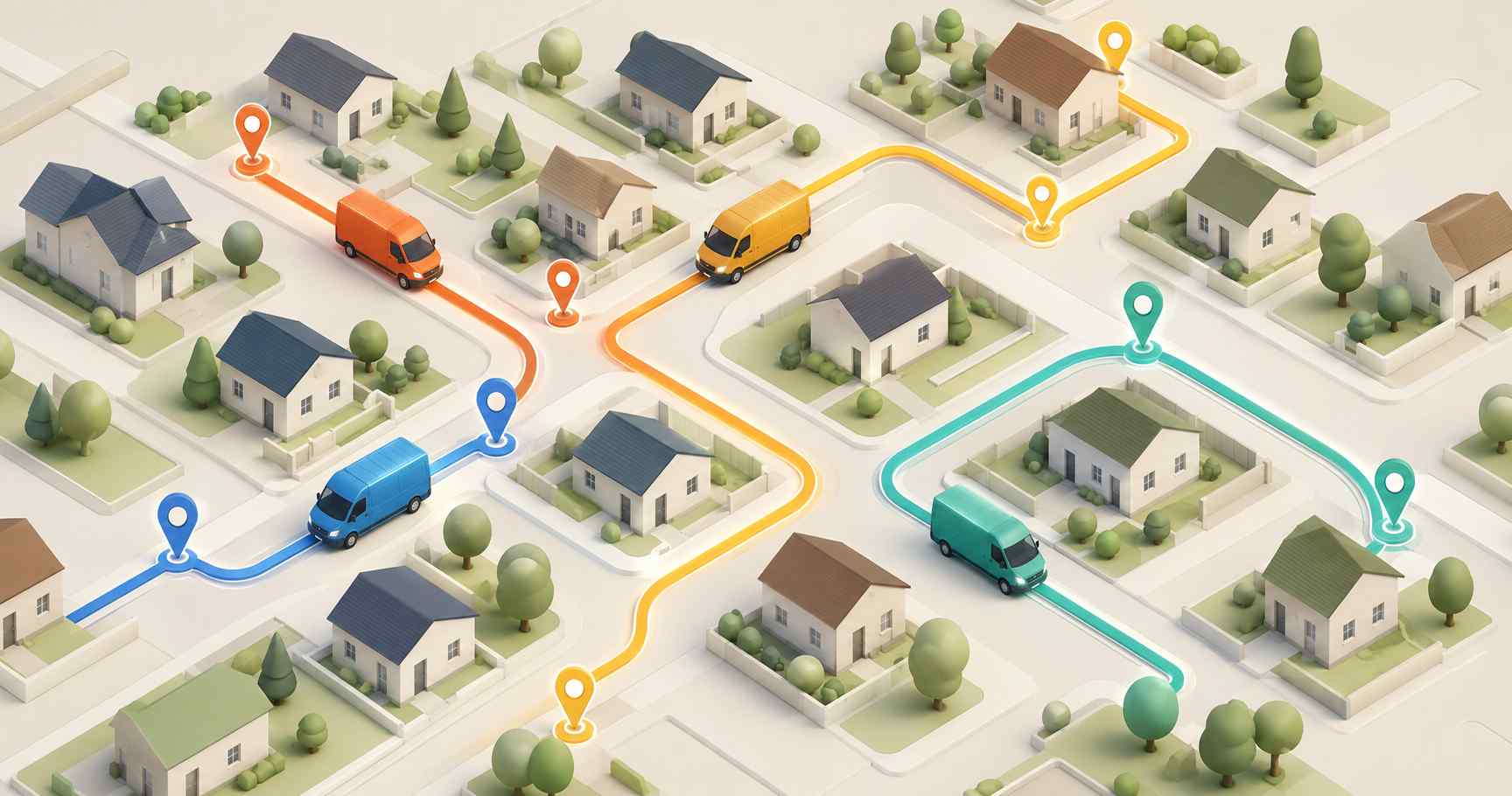
Ask a dispatcher what their worst day looked like and you’ll rarely hear about a crash or a breakdown. You’ll hear about a Tuesday.
A driver called in sick at 6:40am. The spreadsheet with his stops was built by someone who left in March. Three customers rang before nine asking where their order was, and nobody could answer because the only person who knew was in a van somewhere with his phone on silent. By two o’clock a delivery got marked complete that nobody could prove had happened, and by Thursday that turned into a refund.
None of that is a driver problem. It’s an information problem. And it’s the exact problem last mile delivery software exists to solve.
The category has gotten crowded, though, and shopping it is genuinely difficult. Some tools are route planners with a dispatch screen bolted on. Some are enterprise logistics suites that need a six-week implementation and a project manager. A few won’t tell you what they cost until you’ve sat through a demo. Review sites like G2 and Gartner Peer Insights lump all of them together, so a five-star rating from a solo courier sits next to a five-star rating from a 400-truck distributor, and neither tells you much about whether the thing will work for your eight vans.
This guide is an attempt to make that easier. We cover what the software actually does, how to tell whether you need it yet, the handful of features that genuinely separate good platforms from mediocre ones, and then a straight comparison of ten platforms with real pricing pulled from vendor pages in July 2026.
One thing worth saying up front: Bodha is our platform, and it’s on the list. We’ve tried to be fair about where it fits and where it doesn’t, and we’ve been specific about competitors’ strengths rather than damning them with faint praise. Where we quote a price, it came from the vendor’s own pricing page or a source we’ll name. Prices change, so check before you sign anything.
What last mile delivery software actually does
The last mile is the final leg of a shipment. It starts at your depot, warehouse, kitchen, or branch, and it ends at somebody’s door. It’s short in distance and enormous in cost. Industry research consistently puts the last mile at around 53% of total shipping spend, up from roughly 41% in 2018, and the reason is structural rather than fixable by trying harder. Long-haul freight gets cheaper through consolidation. The last mile is the point where consolidation ends and every parcel becomes its own separate errand with its own driveway, its own gate code, and its own chance of nobody being home.
Last mile delivery software is the operating system for that leg. It takes a list of orders and turns it into a plan, pushes that plan to drivers, watches it unfold, tells customers what’s happening, and captures evidence at each door. Most platforms in the category bundle roughly the same set of jobs:
Route optimization. You give it stops. It gives back a sequence and a driver assignment that accounts for road speeds, time windows, vehicle capacity, and shift length. This is the part that saves fuel and hours.
Dispatch. Routes land in a driver’s phone with navigation, stop notes, and customer details attached. No printed manifests, no group chat.
Live tracking. Dispatch sees where every vehicle is and how far through the route it’s gotten. The good versions flag problems before they become complaints.
Customer notifications. Automated ETAs, out-for-delivery messages, tracking links, delivery confirmations. This is the single highest-leverage feature for reducing inbound phone calls.
Proof of delivery. Photo, signature, barcode scan, GPS pin, timestamp. Turns a disputed drop from an argument into a lookup.
Reporting. On-time rate, cost per stop, stops per hour, failed delivery reasons, driver-level performance.
Integrations. API, webhooks, e-commerce connectors, spreadsheet import. Because the orders have to come from somewhere.
You’ll see this same category sold under three or four different names. Last mile delivery management software, last-mile logistics software, delivery management platform, dispatch software. There are shades of difference in emphasis, but functionally you’re looking at the same tool. Worth knowing when you’re comparing vendor sites and wondering whether you’re comparing like with like.
What it’s not is a TMS or a WMS. Those handle freight procurement and warehouse operations respectively. Last mile software sits downstream of both, taking orders that already exist and getting them delivered. Some enterprise platforms blur the line, but for most operations the distinction is clean.
How to know when you've outgrown spreadsheets
Plenty of delivery businesses run fine on a spreadsheet, a maps app, and a WhatsApp group. That’s not a criticism. For one driver doing twenty familiar stops, the overhead of software genuinely isn’t worth it, and a free multi-stop route planner will cover you.
The problem is that the transition point sneaks up on you. Nobody wakes up and decides the spreadsheet has stopped working. It degrades slowly, and you only notice when something breaks badly enough to cost real money.
Here’s what the transition point usually looks like in practice.
Route planning eats more than 45 minutes a day. If a dispatcher spends the first hour of every shift dragging addresses around, that’s roughly 250 hours a year going into a task an algorithm does in seconds. At any reasonable wage that’s a five-figure line item you’re paying without ever seeing it on an invoice.
You have three or more vehicles out on a typical day. Two drivers you can hold in your head. Three is where cross-driver optimization starts mattering and where the mental model breaks down. It’s also where you start noticing two vans in the same postcode at the same time.
Customers phone you for updates. Every “where is my order” call is roughly four minutes of somebody’s time, and it produces nothing. Teams that switch on automatic notifications routinely report support call volume dropping by 40% or more, which is often the fastest and most visible return on the whole purchase.
A delivery got disputed and you couldn’t prove it happened. This is the one that tends to trigger the actual purchase. Around 5% of deliveries fail on first attempt, at an average cost near $17.78 each once you account for the redelivery, the admin, and the concession. Address errors alone cause something like 45% of those failures. Without proof of delivery you eat every dispute, including the ones where you were right.
Somebody left and took the territories with them. If your route knowledge lives in one person’s head, you have a single point of failure wearing shoes.
You’re planning to grow. This is the honest one. Most teams buy software after the wheels come off. The ones who buy before have a much easier month.
If none of these are true, keep the spreadsheet. If three or more are, the software will pay for itself faster than you expect.
The seven things that actually matter when comparing platforms
Feature lists are close to useless for this category, because almost every vendor lists the same twenty features and the differences are entirely in execution. A platform that “has route optimization” might produce beautiful tight routes or it might produce a plate of spaghetti. Both get a checkmark.
These are the seven dimensions where platforms genuinely diverge.
1. Route quality, not just route generation
Every tool will sequence stops. What separates them is whether the result makes sense on the ground.
Bad optimization produces routes that are technically shorter but operationally hostile. Drivers criss-cross their own path. Two vans work adjacent streets an hour apart. A route looks efficient on the map but ignores that the industrial estate gate locks at four. If you’ve ever wondered why a maps app isn’t enough for this, we’ve written about the gap between free navigation and real fleet routing in more depth.
The thing to test is route density, not total distance. More stops per mile driven is what reduces cost per delivery, because driver labor typically accounts for around half of last-mile expense and fuel adds another 10–25% on top. A route that saves three miles but adds twenty minutes of dwell time is a worse route.
Also worth checking: can it handle your actual constraints simultaneously? Time windows, vehicle capacity by weight and volume, driver shift length, break scheduling, multiple depots, skill matching. A lot of tools handle two or three of those. Fewer handle all of them at once, which is the situation you’re actually in.
2. Whether drivers will use it without a fight
This is the feature nobody puts on a comparison table and the one that kills more rollouts than anything else.
Driver apps get judged at 7am on a cold morning and again at stop eighty when the phone battery is at 12%. If the app is slow, if it needs signal to load the next stop, if capturing a photo takes four taps, drivers will quietly stop using it and go back to their own methods. Then your live tracking shows nothing, your proof of delivery is patchy, and you’re paying for a system that produces bad data.
Offline capability matters more than most buyers expect. Rural routes, underground car parks, and steel-framed buildings all kill signal. If the app can’t complete a stop and capture proof without a connection, you’ll lose records.
3. Live visibility that’s actually useful
There’s a big gap between “you can see dots on a map” and “you can see which deliveries are about to be late.”
The useful version surfaces exceptions. Which stops are at risk. Which driver is running forty minutes behind and needs two stops reassigned. Which vehicle has been stationary for twenty-five minutes at an address that should have taken five. Dots on a map require someone to stare at them and interpret. Exception flagging tells you where to look.
Ask specifically whether you can reassign stops mid-day and whether the customer notification updates automatically when you do. A surprising number of platforms let you re-plan but leave the customer holding the old ETA.
4. Customer communication that runs itself
The delivery experience is the only part of your supply chain the customer sees, and it disproportionately shapes whether they order again.
What you want is a sequence that fires without anyone touching it: a morning ETA when the route is built, an out-for-delivery message with a live tracking link when the driver gets close, and a delivery confirmation with photo evidence attached. Branded, so it looks like it came from you rather than from a logistics vendor the customer has never heard of.
Check how SMS is billed. Several platforms in this comparison charge for SMS separately, and at volume it stops being a rounding error.
5. Proof that holds up
Photo, signature, GPS coordinates, timestamp. Ideally barcode or QR scanning too if you’re handling parcels rather than bulk drops.
The detail that matters is retrieval. Capturing proof is easy. Finding the proof for a specific delivery eleven weeks ago, when a customer disputes a charge, is where systems differ. Ask how far back the data is retained and whether it’s searchable by customer, driver, and date. Some platforms tier historical data retention by plan, and the cheap tier gives you thirty days.
6. How your orders get in
This is boring and it’s where implementations stall.
Realistically you need at least two of: spreadsheet import that handles your existing column layout, a REST API, webhooks, and pre-built e-commerce connectors for whatever you’re selling through. If your orders live in Shopify and the platform has no Shopify path, somebody is doing CSV exports every morning forever.
Address validation on import is underrated. Given that bad addresses cause close to half of failed deliveries, catching them before the van leaves is worth more than most headline features.
7. Whether the pricing model matches your shape
This is the one buyers get wrong most often, and it’s not about the headline number.
Three models dominate. Per driver charges a monthly seat fee per driver or vehicle. Predictable if your headcount is stable, punishing if you scale up for a season. Per order or per task charges by delivery volume. Scales cleanly, but a peak month can double your bill with no warning. Flat tiers with volume caps sit in between and usually carry overage fees once you cross the line.
The right answer depends entirely on your variability. A florist with a fixed team of four and a brutal Valentine’s spike wants per-driver pricing. A courier with a rotating pool of contractors and steady volume wants per-order. Model your actual last twelve months against each pricing page before you decide, because the cheapest headline price is frequently the most expensive annual bill.
The 10 best last mile delivery software platforms in 2026
Below are ten platforms that serve delivery operations from one van up to enterprise fleets. Pricing was pulled from vendor pricing pages and named third-party sources in July 2026. Several vendors list “starting at” prices, which means your quote may be higher.
1. Bodha Route Planner — best for growing fleets that want everything included
Bodha is built for the operations that sit between a route planner app and an enterprise logistics suite. Think roughly three to fifty vehicles, running planned routes daily, where the dispatcher is also the operations manager and quite possibly the owner.
The design bias throughout is toward things working on a bad day rather than in a demo. Routes optimize across multiple drivers in under thirty seconds, with traffic, time windows, and vehicle capacity factored in. Stops drag between drivers mid-day without rebuilding the plan. When someone calls in sick, reassigning their route takes two clicks rather than a morning.
Two features are less common in this price band. The first is a vehicle loading plan: Bodha sorts parcels into reverse-delivery order and tells the driver which section, level, and side of the van each one goes in, so the last stop loads first and nothing gets buried. The second is full offline operation. Routes, proof capture, and barcode scanning all work with zero signal and sync when coverage returns, which matters if your patch includes rural runs or underground loading bays.
Live tracking runs off the GPS already in drivers’ phones, so there’s no hardware to buy or fit. Every delivery generates a branded customer tracking page. Proof of delivery captures photo, signature, and a GPS pin, all searchable later by customer, driver, or date. Teams running recurring visits can also manage customers around the drop with a delivery-focused CRM rather than a sales one.
Where it fits: planned-route operations from about three vehicles upward that want dispatch, tracking, notifications, POD, and analytics in one per-driver price without add-on billing. It’s used across courier, food and beverage, and pharmacy delivery, among others.
Where it doesn’t: if you need true on-demand auto-assignment, where orders arrive continuously and get pushed to the nearest available driver in seconds, look at Onfleet instead.
Pricing (July 2026): $29.99 per driver per month, with around 20% off on annual billing. That covers unlimited route optimization, unlimited stops per route, custom stop properties, proof of delivery, the driver mobile app, and delivery notifications by both email and SMS. Worth noting on that last point: Routific, Track-POD, and Onfleet all bill SMS separately, so a like-for-like comparison isn’t quite like-for-like.
At $29.99 per driver it sits below OptimoRoute’s Lite tier and well below Track-POD’s entry plan, which carries a three-driver minimum. Detrack is the closest on price at roughly $26–29 per vehicle, though it’s a lighter product on the routing side.
2. Detrack — best value for proof-of-delivery-led operations
Detrack has been doing electronic proof of delivery since before most of this category existed, and it shows in how focused the product is. Real-time vehicle tracking, ePOD with signature and photo, customer notifications, and a driver app that works on basic Android hardware.
Pricing is refreshingly simple. Per Detrack’s pricing page (verified July 2026), it’s per vehicle: $29 per vehicle per month billed monthly, or roughly $26 per vehicle per month on annual billing with a 10% discount applied upfront. Your first driver is free, which makes evaluating it genuinely low-risk.
The honest limitation is routing depth. Detrack’s route optimization is functional rather than sophisticated, and it integrates with ZeeMaps for routing rather than running a heavyweight optimization engine of its own. If your constraint set is complex, this is the wrong tool. If your primary need is knowing where vehicles are and proving what got delivered, it’s excellent value.
Integration coverage is broad for the price, with connectors listed on Capterra including Shopify, WooCommerce, BigCommerce, QuickBooks Online, Xero, and Twilio.
Where it fits: delivery and collection operations where POD and tracking are the priority and routing is straightforward.
Where it doesn’t: multi-depot, capacity-constrained, or time-window-heavy planning.
3. OptimoRoute — best for genuinely complicated constraints
OptimoRoute is the tool to look at when your routing problem is actually hard. It handles skill matching, multi-day and recurring route planning up to five weeks ahead, weight-and-volume capacity simultaneously, individual driver profiles with their own schedules and cost rates, and depot reloading where a driver returns mid-route to pick up more stock.
That last one is a genuine differentiator. Food distributors running refrigerated goods across multiple neighborhoods, or couriers working out of a high-volume hub, often need mid-route reloads and most platforms simply can’t model it.
Pricing is per driver. Per Capterra and OptimoRoute’s own pricing page (July 2026), Lite is $35.10 per driver per month on annual billing (or $39 monthly), capped at 700 orders, and Pro at $44.10 annual (or $49 monthly) for 1,000 orders, adding real-time order tracking, proof of delivery, geofencing, and customer feedback. Custom pricing above that. There’s a 30-day free trial.
Per-driver pricing compounds. A fifteen-driver operation lands somewhere around $6,300 to $7,900 a year depending on tier, which is fine if your headcount is fixed and painful if it isn’t.
Two criticisms come up repeatedly in reviews. Route overlap, where drivers get assigned neighboring areas in ways that don’t make intuitive sense, and manual editing being awkward once the plan is generated. There’s also a notable API gap: reviewers on Capterra report you can’t programmatically create drivers or vehicles, which forces manual dashboard or CSV work if you’re building on top of it.
Where it fits: mid-size fleets with fixed driver counts and real scheduling complexity.
Where it doesn’t: seasonal fleets, and teams who want to develop custom integrations.
4. Track-POD — best for compliance-grade delivery evidence
The name is the positioning. Track-POD is built around proof of delivery, and if you’re in pharmacy, medical courier work, high-value goods, or anything where a signed and scanned handover is a contractual requirement, it’s worth a serious look. It’s SOC 2 Type II certified, which matters for some procurement processes.
The pricing is the complicated part, and it’s worth walking through carefully because the headline number is misleading.
Track-POD runs two parallel models. On the per-driver side there’s a mandatory three-driver minimum on every plan. Per Track-POD’s pricing page (verified July 2026), Advanced is $49 per driver per month on annual billing ($59 monthly), which means the actual floor is $147/month, and that tier caps you at 6,000 orders a month and seven dashboard users. Advanced Plus is $69 annual ($79 monthly) and lifts the order cap while adding geofencing. Ultimate is $89 annual ($99 monthly). Enterprise is quote-only with a twenty-driver minimum.
The per-order model runs separately: $285/month for 1,500 orders with $0.19 per order beyond that, $510 for 3,000, $900 for 6,000, and $1,440 for 12,000. Drivers are unlimited on these plans. Ask their sales team to model both against your actual volume before choosing.
SMS notifications are billed separately on every plan.
Where it fits: operations where POD documentation is a compliance requirement rather than a convenience.
Where it doesn’t: teams under three drivers, and anyone who wants to understand their bill without a spreadsheet.
5. Tookan — best for on-demand and marketplace models
Tookan comes from Jungleworks and is built around task-based dispatch, which makes it a natural fit for on-demand delivery, marketplaces, and businesses where orders arrive continuously rather than in a planned batch. Agent auto-allocation, customer app support, and multi-vertical templates are all there.
The pricing warrants care. Entry is around $39/month with tiers scaling by monthly task volume from roughly 300 up to 6,000+, and G2 lists a Startup tier at $99/month including 700 tasks with additional tasks at $0.15 each. But route optimization is a paid add-on rather than a base feature, and so are branded driver apps, booking forms, and white-label branding. Assembling the feature set most platforms include as standard can roughly double the listed price.
Tookan also uses connected-task billing where multi-stop routes count as fractional tasks, which makes forecasting harder than a flat per-task rate would suggest.
Where it fits: on-demand and marketplace delivery models with developer resources available.
Where it doesn’t: planned-route delivery businesses who want predictable all-in pricing.
6. Spoke Dispatch — best for small teams who want simple
Spoke Dispatch, formerly Circuit for Teams, is deliberately lean. Upload stops, generate routes, send them to drivers. Setup takes minutes and drivers generally need no training, which is a real advantage if you’re running high turnover.
Pricing is flat tiers with stop allowances and overage fees. Per Spoke’s published plans (July 2026), Starter is $125/month for 1,000 stops with roughly $0.04 per additional stop, and includes unlimited drivers and dispatchers, proof of delivery, live tracking, dynamic customer notifications, and 30 days of data history. Premium is $200/month for 2,000 stops (around $0.06 overage) adding custom stop properties and a year of history. Expert is $1,000/month for 12,000 stops (around $0.07 overage) with geofencing and five years of history. Capterra’s listing confirms the Premium and Expert figures.
Note the jump. There’s nothing between $200 and $1,000, which is an awkward gap if you’re doing 4,000 stops a month.
The trade-off for the simplicity is depth. There’s no multi-depot support, no capacity-constrained routing, and limited analytics. Reviewers also report the optimization producing inefficient routes and editing being clumsy, which for a tool whose whole pitch is ease of use is a fair criticism.
Where it fits: small teams under about 2,000 stops a month doing predictable, similar-sized deliveries.
Where it doesn’t: anything with real routing constraints, or operations that will grow past 2,000 stops.
7. Routific — best for planned routes with a variable fleet
Routific serves local delivery businesses running planned routes: meal prep, produce boxes, florists, food hubs, breweries. The combined map and timeline view is the thing dispatchers consistently praise, letting you see every driver and every stop on one screen and drag stops between drivers without rebuilding.
The pricing model is unusual and genuinely well suited to some operations. It’s per order, with unlimited drivers and unlimited dispatchers on every tier. Per Routific’s pricing page (July 2026), it’s free for up to 100 orders a month with no time limit and no credit card, which is the most generous evaluation path in this comparison. Then $150/month flat for 101 to 1,000 orders. Above that, per-order fees stack on top of the base, starting at $0.15 per order and declining to $0.03 in the 20,001–50,000 band. Above 50,000 is custom.
Routific moved from per-vehicle to per-order pricing in mid-2024, so older comparisons you’ll find online are out of date.
Because cost tracks volume rather than headcount, the bill moves with your season. A team at 2,000 orders in a quiet month and 5,000 in peak sees a meaningful swing. That’s an advantage if your fleet size varies and a disadvantage if you’d rather have a fixed number. SMS notifications are a paid add-on quoted separately.
Where it fits: planned-route operations with part-time drivers or variable fleet size.
Where it doesn’t: on-demand dispatch, and operations that need budget certainty month to month.
8. Onfleet — best for on-demand auto-assignment
Onfleet has the deepest feature set aimed at on-demand delivery in this comparison. Auto-dispatch that pushes incoming orders to the nearest available driver, driver-dispatcher chat, barcode scanning, ID scanning and age verification, predictive ETAs, and an operational command center. If you’re running courier services, grocery, cannabis delivery, or anything where orders arrive through the day and need immediate assignment, this is the category leader.
It’s also the most expensive entry point here by a wide margin. Onfleet’s own pricing page lists the Enterprise tier starting at $3,099/month for 10,000+ tasks, with a Courier Suite add-on starting at $299/month. Third-party analysis published in mid-2026 puts Launch at $619/month for 2,500 tasks and Scale at $1,349/month for 5,000 tasks, though some sources still show older $599 and $1,299 figures, so confirm current rates directly. All plans include unlimited users. There’s a 14-day free trial.
Watch the extras. Task overages are reported at roughly $0.26 per completed task beyond your cap, and SMS and voice are billed separately on usage. A team budgeting for the entry tier can land meaningfully above it.
The recurring interface criticism is that stops display as pins rather than drawn routes and there’s no timeline view, so comparing driver progress across a fleet means clicking through one route at a time.
Where it fits: established on-demand operations with the volume to justify the spend.
Where it doesn’t: planned-route SMBs. At 800 deliveries a month you’d be paying roughly $0.77 per delivery for features you won’t touch.
9. DispatchTrack — best for enterprise appointment-based delivery
DispatchTrack is the enterprise option here, and it’s genuinely strong in a specific niche: appointment-based delivery of big, awkward things. Furniture, appliances, building materials, food and beverage distribution. Anywhere the delivery window is contractual and the item needs two people and a dolly.
The platform claims high ETA accuracy from machine learning applied to historical delivery data and real route constraints, and for industries where a missed window means a rescheduled install crew, that precision is the whole value proposition. It also covers 3PL performance monitoring, depot location optimization, and what-if scenario planning across a network, which are genuinely enterprise capabilities.
Pricing is quote-only. There are no published tiers and no free trial, so you go through a demo and a sales conversation before you see the product. TrustRadius and Software Advice list a starting figure around $75, and reseller documentation referenced by third parties mentions roughly $100 per vehicle for initial configuration plus around $250 for training. Treat all of those as directional rather than firm.
Where it fits: multi-branch enterprise distribution with contractual delivery windows and a budget for implementation.
Where it doesn’t: small and mid-size operations who want to try before they buy.
10. Route4Me — best for niche add-on modules
Route4Me is one of the older names in route optimization and its distinguishing characteristic is a marketplace of optional modules. Curbside pickup, left-turn avoidance, territory management, field service routing, recurring route scheduling, SMS notifications. If you need something unusual, there’s a decent chance Route4Me has a module for it.
The flip side is that many of those modules are things competitors include as standard, so the base product is comparatively thin and costs climb as you add pieces back in.
Pricing is the bigger problem for buyers. Route4Me pulled public pricing from its site in early 2026 and now routes everything through sales. Third-party sources report figures ranging from $199 to $349 per user per month, while other sources describe historical tiers around $400/month for basic optimization and $600/month for multi-driver and multi-depot. Those numbers disagree with each other badly enough that we’d treat none of them as reliable. Get a written quote with your actual user count and module list.
There’s a seven-day free trial per Route4Me’s billing documentation.
What last mile delivery software actually costs
Setting aside individual vendors, here’s roughly where operations land by size, based on the pricing above.
Under 100 deliveries a month. You can run free or nearly free. Routific’s free tier covers this outright, and a single-driver operation on Bodha at $29 or Detrack with its first driver free costs less than a tank of fuel. There’s no reason to spend real money at this volume.
Up to 1,000 deliveries a month, 1–5 drivers. Realistically $29 to $180/month. This band is well served and competitive. Bodha at $29 per driver lands between $29 and $145 depending on headcount, Detrack sits in a similar range, Routific’s flat $150 tier covers you regardless of fleet size, and OptimoRoute Lite runs $35.10 per driver.
1,000 to 5,000 deliveries, 5–15 drivers. Roughly $145 to $700/month. This is where pricing model choice starts to bite. A 10-driver team pays $290 on Bodha, $351 on OptimoRoute Lite, and $490 on Track-POD Advanced, all fixed regardless of volume. Routific at the same headcount could be anywhere from $300 to $550 depending on how busy the month was. Per-driver is predictable; per-order is cheaper in quiet months and worse in peaks.
5,000 to 15,000 deliveries, 15–50 drivers. Roughly $700 to $2,500/month. Onfleet’s mid-tiers, Track-POD’s larger per-order plans, and OptimoRoute at scale all live here, and this is where negotiating actually works.
Above 15,000 deliveries. Custom contracts, typically $2,500/month and up, usually annual, usually with implementation fees on top.
Three cost traps worth naming, because they catch people repeatedly.
SMS is usually extra. Routific, Track-POD, and Onfleet all bill messaging separately. At 5,000 deliveries a month with two messages each, that’s 10,000 segments. Get the rate in writing.
Overage fees are where flat tiers stop being flat. Spoke charges $0.04 to $0.07 per stop past your allowance. Onfleet is reported at around $0.26 per task. A busy December can add a few hundred dollars you didn’t plan for.
Implementation and training aren’t always included. Enterprise platforms in particular carry setup and onboarding fees. Ask for the year-one total, not the monthly rate.
The counterweight to all of this is that the numbers are small relative to what you’re already spending. Labor is roughly half of last-mile cost and fuel is another 10–25%. If you’re running ten vans, your monthly fuel bill alone dwarfs any software subscription in this comparison. A 20% routing improvement typically pays for the whole thing several times over, which is why the software decision is usually about fit rather than price.
Last mile delivery tracking software deserves its own conversation
Tracking often gets treated as one feature among twenty. In practice it’s two completely separate capabilities that happen to share a name, and conflating them causes buying mistakes.
Internal tracking is what dispatch sees. Where every vehicle is, how far through the route each driver has gotten, which stops are at risk, whether a van has been idling for half an hour somewhere it shouldn’t be. This is an operations tool. It exists so you can intervene before a problem becomes a complaint.
Customer-facing tracking is what the recipient sees. A link, a map, an ETA that updates. This is a customer experience tool, and its main operational benefit is that it stops the phone ringing.
Most platforms do both, but the quality gap between them within a single product can be wide. Some have excellent dispatcher visibility and a customer page that looks like it was built in 2014. Others have a beautiful branded tracking page and a dispatch view that’s just pins on a map.
A few practical things to check.
Hardware or phone GPS? Phone-based tracking means no dongles, no installation, no per-vehicle hardware cost, and it works the day you sign up. Dedicated telematics hardware gives you engine diagnostics and works when the driver’s phone dies. For most last-mile fleets, phone GPS is the right trade.
What’s the refresh rate, and what does it cost in battery? Aggressive polling gives smoother tracking and flattens phones by mid-afternoon. Ask.
Does it survive dead zones? The tracking that matters is often in exactly the places signal doesn’t reach. Look for on-device location journaling that syncs when coverage returns rather than a gap in the record.
Can the customer page be branded? A tracking page carrying an unfamiliar vendor’s logo undercuts the trust you’re trying to build.
Does the ETA update, or is it set at dispatch? A morning estimate that never moves is worse than no estimate, because the customer plans around it and then you break the promise.
How to run a trial that tells you something
Most software evaluations are theater. Somebody logs in, clicks around for ten minutes, decides the interface looks nice, and buys. Then reality arrives in week three.
Here’s a trial process that actually produces a decision.
Use a real day. Not sample data, not ten test addresses. Take an actual day’s worth of stops from last week, including the awkward ones. The apartment complex with no clear entrance. The customer who can only take deliveries between two and four. The industrial address whose postcode covers a square mile.
Time the planning. Stopwatch from import to dispatched routes. Compare it against what your dispatcher does now. If it’s not meaningfully faster, the main promise isn’t landing.
Compare the output against what you’d have done. Print the optimized route and hand it to your most experienced driver. Ask what’s wrong with it. Experienced drivers will spot problems an algorithm missed in about ninety seconds, and their reaction tells you whether the routes will get followed or quietly ignored.
Break something on purpose. Halfway through the trial day, pretend a driver has gone off sick. Reassign their stops. See how long it takes and whether customer notifications update. This is the scenario that actually stresses the software, and it’s the one demos never show.
Put the app on the worst phone you have. Not the newest one. The three-year-old Android with a cracked screen that one of your drivers actually uses. Then put it in airplane mode and try to complete a stop.
Check the reports afterwards. Can you get cost per delivery, stops per hour by driver, failed delivery reasons? If the reporting can’t answer the questions you’d ask at month end, you’ll be back in a spreadsheet within a quarter.
Let drivers vote. Genuinely. A platform dispatchers love and drivers hate will fail, and it’ll fail quietly through non-adoption rather than loudly enough for you to catch it early.
Five mistakes that cost people money
Buying on feature count. Every platform lists twenty features. What matters is whether four or five of them work brilliantly for your specific operation. A long list often signals breadth at the expense of depth.
Ignoring the pricing model’s shape. The headline price is nearly irrelevant. What matters is how the bill behaves when your volume doubles in December or when you add three seasonal drivers in November. Model twelve months, not one.
Skipping the driver conversation. Drivers are the ones generating your data. If they don’t use the app properly, your tracking is incomplete, your POD is patchy, and your reports are fiction.
Underestimating data entry. If orders don’t flow in automatically, someone is doing manual work every single morning forever. Solve the import path before you sign, not after.
Buying enterprise software for an SMB problem. The most common expensive mistake. A platform built for a national fleet will have capabilities you’ll never touch, an implementation timeline measured in weeks, and a support model designed for a named account manager rather than a live chat. Match the tool to the size of the problem.
Making the call
Strip everything above down and the decision comes to three questions.
Are your routes planned or dynamic? If you know your stops the night before, you want a planned-route platform: Bodha, Routific, OptimoRoute, Spoke, Detrack. If orders arrive continuously and need immediate assignment, you want on-demand dispatch: Onfleet or Tookan. Getting this wrong means fighting the software daily.
Does your driver count vary? Fixed team, per-driver pricing is predictable and usually cheaper. Seasonal or contractor-heavy, per-order pricing stops you paying for empty seats.
What breaks most often today? If it’s planning time, prioritize optimization quality. If it’s customer calls, prioritize notifications and tracking. If it’s disputes and refunds, prioritize proof of delivery. Buy for your actual bottleneck rather than for the most impressive demo.
Then trial two platforms with real data, in parallel, for a week. Not five. Two. Comparing two properly beats comparing five superficially, and the difference will be obvious by day three.
If you want to test Bodha against your own routes, the seven-day trial needs no credit card and most teams have their first optimized routes running within an hour of signing up. You can also book a walkthrough.
Frequently Asked Questions