Everyone in logistics loves talking about the last mile, usually while making it sound like a problem only a warehouse full of engineers could ever crack. For a small courier team, that framing is worse than useless. You do not have a data science department. You have three vans, a phone that will not stop buzzing, and a promise to a customer that their parcel lands today. Here is the reassuring part: last-mile delivery, at your size, is not really a technology problem. It is a workflow problem. Build one repeatable rhythm and run it every single day, from the first import in the morning to the last proof of delivery at night, and the scary part goes quiet.
So this is that workflow, start to finish. No jargon, no enterprise fluff. Just the shift the way a small courier team actually runs it, and where a bit of software quietly takes the pain out of the parts that used to hurt.
Why the last mile is where small teams win or lose
Before the how, a quick word on why this matters more for you than for the big carriers. The last mile is the most expensive stretch of the entire delivery journey, soaking up around 53 percent of total shipping cost, up from 41 percent back in 2018. It is also the only part the customer ever sees. Nobody thanks you for a smooth line-haul across three states. They remember whether the parcel showed up when you said it would.
For a small team, that cuts both ways. You will never beat a national carrier on price or scale. But you can absolutely beat them on the thing that actually wins local contracts: reliability the customer can feel. The neighbourhood courier who texts an accurate ETA, turns up in the window, and sends a photo of the parcel on the porch looks more professional than the giant who dumps it at the wrong door and vanishes.
There is a revenue angle here too, not just a cost one. A customer who gets a smooth, well-communicated delivery is far more likely to order again and to tell the sender you did a good job, which is exactly how local couriers win repeat contracts. A messy last mile does the reverse. One misdelivered parcel and the client quietly starts shopping for your replacement. So the last mile is not only your biggest cost, it is your biggest piece of marketing. Every clean drop is a quiet advert for the next contract.
That edge does not come from spending more. It comes from running a tighter shift. Which brings us to the workflow.
The small courier team's last-mile workflow
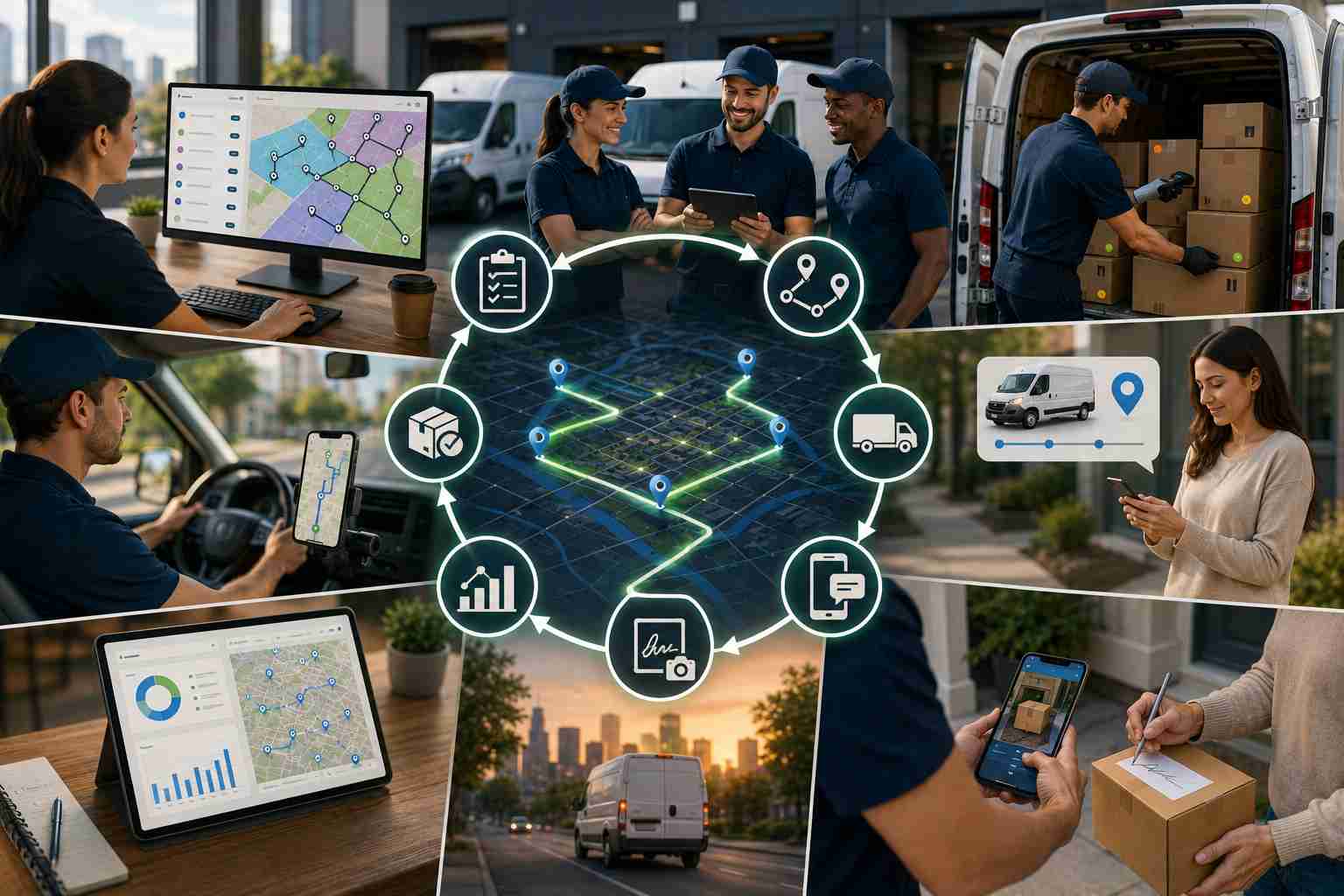
Think of the day in three acts. Before the wheels turn, while they are turning, and after they stop. Nail all three and you have a last-mile route planning routine that holds up whether you are running two vans or ten.
1. The night before, or first thing: gather and import
Everything downstream depends on getting the day’s stops in cleanly. Pull every order into one list: the deliveries, the pickups, the same-day jobs that came in overnight. The fastest way to do this is to import the whole lot from a spreadsheet or straight from your order system, rather than typing addresses one at a time while the clock ticks.
This is also the moment to catch bad data. A wrong postcode or a missing flat number is a failed delivery in waiting, and it is a lot cheaper to fix at a desk than to discover on a doorstep. Clean the list now, and the rest of the day gets easier.
2. Build and optimize the routes
Now turn that list into routes. This is where a small team either saves an hour or loses one. Group stops by area so each driver gets a tight patch, sequence them for the shortest sensible run around traffic and time windows, and split the work so nobody finishes at lunchtime while someone else is out until eight.
Doing this by hand works for a dozen well-clustered stops. Past thirty it falls apart, because the number of possible orderings explodes and no human is finding the best one on a spreadsheet. Optimized routing typically saves 20 to 40 percent of drive time against booking order, which for a small team is the difference between three vans and needing a fourth. If you want the mechanics of this step, our guide on how to plan a courier route with multiple stops breaks it down.
3. Load the vans in the right order
Small teams skip this step and pay for it all day. If parcels go into the van in a random pile, the driver is digging at every stop, adding a minute here and there that stacks up to an hour by evening. A vehicle loading plan tells each driver where every parcel sits and has them load in reverse delivery order, so the first drop is right by the door and comes out first. It is unglamorous and it saves more time than almost anything else on this list.
4. On the road: status, notes, and navigation
Once the vans roll, the office needs to know what is happening without ringing every driver. Each stop should reach the driver’s phone through a driver mobile app with navigation, the parcel details, and the access notes (gate codes, buzzer numbers, “leave with reception”). As they work, drivers mark each stop done or failed with a tap, so you can see the round progressing in real time rather than guessing.
Keep the nav familiar, too. A good workflow does not force drivers into a strange navigation app. It optimizes the order, then hands each leg off to Google Maps or Waze, which the driver already knows cold.
5. Keep the customer in the loop
This is the step that separates a small team that feels professional from one that feels chaotic, and it costs you nothing once it is set up. Automatic ETAs and arrival notifications tell the customer when to expect the driver, which is the single most effective way to make sure someone is actually home. Fewer failed drops, fewer “where is my parcel” calls landing on your one office phone. Meanwhile real-time tracking means when a client rings to ask where their delivery is, you can answer in five seconds without interrupting the driver.
6. Handle the curveballs
No shift goes to plan. A customer reschedules. A pickup runs late. A same-day job lands at 2pm and needs slotting in. The whole point of a good workflow is that these are shrugs, not crises. A route that re-optimizes on the fly lets you drop the new stop into the nearest gap and re-sequence the rest, instead of rebuilding the day from scratch at the kerb. If a delivery fails, the driver logs why, and it flows back to the office to sort a redelivery cleanly.
7. Proof of delivery at every drop
Every completed stop should end with proof of delivery: a photo, a signature, a GPS-stamped record. For a small team chasing bigger clients, this is not optional. It ends “I never got it” disputes in seconds, and it is exactly the kind of professionalism that wins you the next contract. Capturing it should be one tap for the driver, not a form.
8. End of day: reconcile and review
When the vans are back, close the loop. Check that every stop is accounted for, sort any failed deliveries for tomorrow, and glance at the numbers. Route analytics show you which routes ran long, where drivers doubled back, and how your stops-per-hour is trending. Five minutes here is how next week’s routes get tighter. Small teams that skip the review keep repeating the same detour for months without ever noticing.
The tools a small team actually needs (and the ones you can ignore)
Here is where a lot of small operators go wrong. They either try to run the whole thing on a spreadsheet and a maps app, or they get talked into a heavy enterprise platform built for a fleet of 200 and priced accordingly. Neither fits.
What a small courier team genuinely needs is fairly short: multi-stop route optimization, a driver app with proof of delivery, customer notifications, and simple reporting. What you can happily ignore for now is the enterprise stuff, the deep API integrations, the warehouse management modules, the per-seat licensing that assumes a call centre. Match the tool to your size. If you are weighing options, our comparison of route planner apps for couriers is built around exactly this decision.
Common last-mile mistakes small teams make
A few traps show up again and again in small operations:
Planning in booking order, which quietly wastes miles all day. Overloading the reliable driver while a newer one sits idle. Leaving access notes in emails instead of on the stop, so the driver gets locked out. Never sending the customer an ETA, then wondering why so many people are not home. And never looking at the end-of-day numbers, so the same mistakes repeat on a loop. None of these are dramatic. That is precisely why they survive for months and cost real money.
How the workflow scales as you add vans
The best thing about getting this rhythm right early is that it does not break when you grow. With one or two vans you might run the whole thing from a phone and a laptop, and that is fine. At three to five vans, the dispatcher side starts to matter, because now you are balancing work across drivers, watching a live map, and answering client questions while the vans are out. The steps do not change. The tooling steps up, from a solo planner to a proper dispatch view. That is the moment a single shared system stops being a nice-to-have and becomes the thing holding the operation together, because knowledge stuck in one driver’s head does not scale to five. Build the habit now, while it is simple, and growth becomes a matter of adding drivers to a system that already works, rather than reinventing your whole day every time you buy a van.
How Bodha runs this workflow for you
Everything above is one connected workflow in Bodha, which is built for exactly this kind of operation. You import the day, the courier route planner optimizes and splits routes across your drivers in seconds, the loading plan sorts the van, drivers get navigation and proof of delivery on their phones, customers get automatic ETAs, and you watch the whole shift on a live map. At the end of the day the numbers are waiting for you. For a team running multiple vans, Bodha Fleet ties the dispatcher side together.
On cost, you can start without spending a thing. If a driver only needs up to 20 stops per route, they can optimize unlimited routes for free in the Bodha Drive app, which is a genuine way to test the workflow before you commit. When you want the full team setup, meaning multi-driver dispatch, proof of delivery, tracking, and reporting, paid plans start at $29 a month. The pricing page has the detail.
Two related reads worth your time: our guide to parcel delivery route optimization digs into cutting fuel and failed drops, and the focused playbook on how to reduce failed delivery attempts covers the single biggest hidden cost in this whole workflow.
Run a tighter last mile from tomorrow
You do not need enterprise software to run a professional last mile. You need one repeatable workflow and a tool that carries it from import to proof of delivery. Bodha’s courier route planner does exactly that, and you can start free.
Start your free 7-day trial (no card needed) or book a quick demo and run tomorrow’s shift through it.
Frequently asked questions