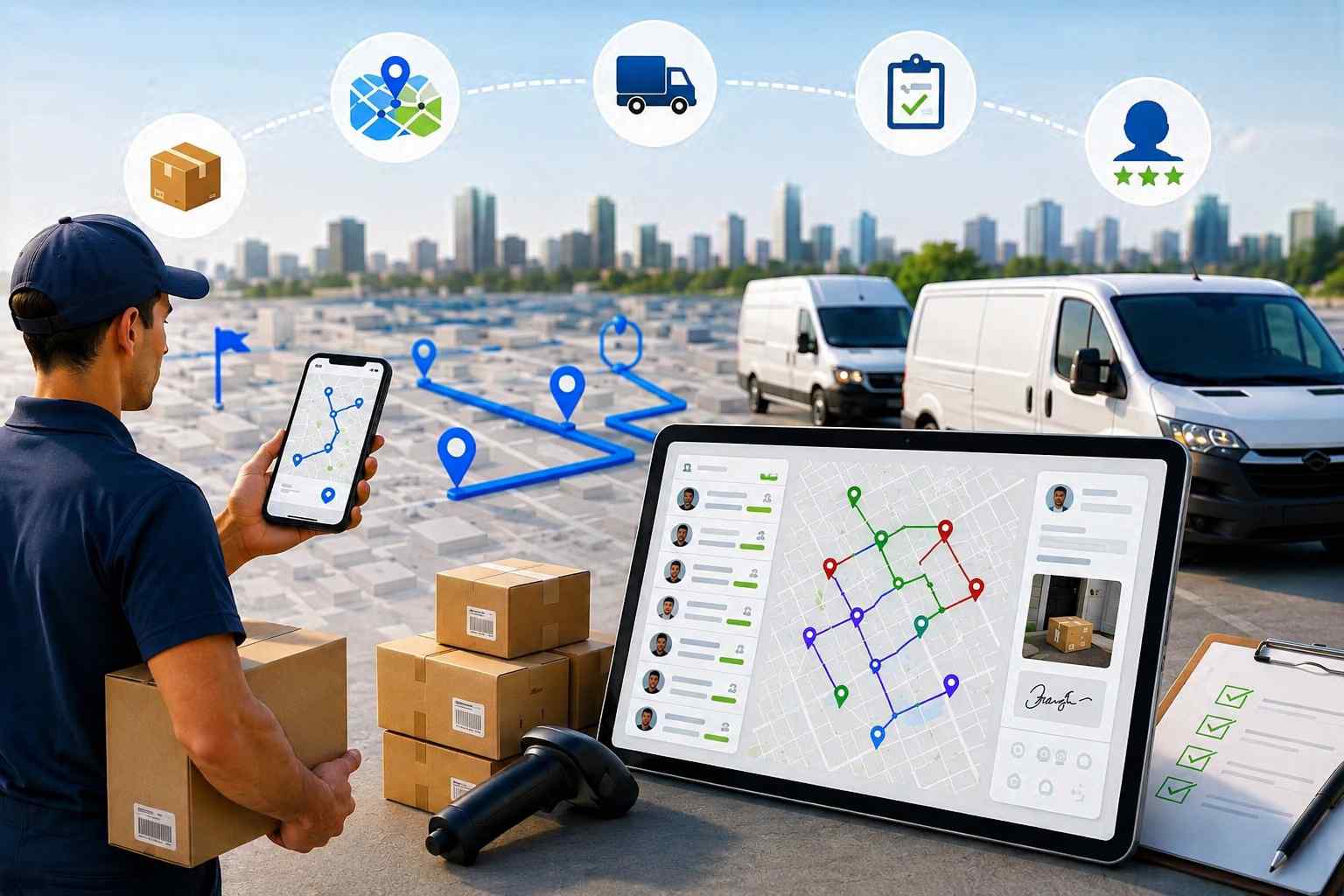
Search for the best route planner for couriers and you get a wall of “top 10” lists that mostly rank the same generic delivery apps. The trouble is that courier work has needs a general delivery app does not: pickups and deliveries on one run, dense multi-drop routes, proof of delivery that stands up to disputes, and dispatch across several drivers at once. A courier route planner app has to handle all of that, not just find a fast path between two points.
So this comparison judges each tool on what actually matters to a courier operation, and it is straight about where each one wins and where it falls short, including ours. Prices change often, so treat the figures as a starting point and check current pricing before you commit. We have grouped things by what kind of courier you are at the end, because the right answer for a solo driver is rarely the right answer for a growing fleet.
What to look for in a courier route planner app
Before the comparison, here is the checklist worth scoring each tool against. A strong option for couriers should cover most of these, and the ones it skips tell you who it is really built for.
- Multi-stop optimization at real volume. Sequencing a hundred or more stops cleanly, not just a dozen. This is the whole point, and weak optimization quietly costs you fuel every day.
- Pickups and deliveries on the same route. Couriers rarely deliver only, so the tool has to handle collections before their matching drops.
- Multi-driver dispatch. So a dispatcher can plan and assign routes across a whole team from one screen, not app-by-app.
- Proof of delivery. Photo, signature, and a timestamp to settle “I never got it” disputes in seconds.
- Real-time tracking and customer ETAs. To cut the flood of “where is my parcel” calls that eat your office time.
- Manifest or spreadsheet import. So nobody retypes addresses every morning.
- Offline capability. Because parcels get delivered in basements, lifts, and rural dead zones.
- Parcel scanning. To match the right package to the right stop and kill mis-deliveries.
- Van loading guidance. A newer capability that tells drivers where each parcel sits and has them load in reverse delivery order. Few tools offer it, but on dense routes it saves real time by ending the digging at every stop.
- A pricing model that scales. Per stop, per driver, or a flat tier, each behaves very differently as you grow.
Very few apps do all of this well. The gaps are exactly where the differences below show up.
Best route planner apps for couriers: quick comparison
Bodha
Bodha is built specifically for courier and parcel operations, which is why it leads this list for small and mid-sized fleets. It optimizes hundreds of pickups and deliveries across multiple drivers in seconds, and it bundles the pieces couriers usually have to buy separately: proof of delivery with offline capture, real-time tracking with customer ETAs, in-app parcel scanning, and spreadsheet import. Pricing starts around $29 a month with a 7-day free trial and no card required, and it scales to unlimited stops on higher tiers. You can see the tiers on the pricing plans page.
Where it wins: it is one of the few tools that combines multi-driver dispatch, proof of delivery, notifications, and scanning at a price a small courier can afford, with predictable tiers rather than per-stop charges that balloon at volume. It also does something most rivals do not: a vehicle loading plan that guides drivers to load the van in reverse delivery order and pins where each parcel sits, which saves minutes at every stop on a dense route. Solo drivers are covered too, and this is where a lot of couriers start. If you only need up to 20 stops per route but want unlimited route optimization, that is completely free in the Bodha Drive app, so a single driver can plan and optimize their whole day at no cost, then open each leg in Google Maps or Waze. When you want the full feature set, meaning multi-driver dispatch, proof of delivery, real-time tracking, and the vehicle loading plan, you step up to a paid plan from $29 a month. You can see everything on the courier route planner page.
Circuit (and Spoke Dispatch)
Circuit is one of the most recognised names among individual drivers, and for good reason: the driver app is polished, and features like voice and scan stop entry are handy on a busy run. Its free tier caps at about ten stops, and the individual Premium plan (around $20 a month) lifts that to roughly 500. For teams, the company splits off into Spoke Dispatch, which uses stop-based pricing starting near $100 to $125 a month and climbing as your stop volume grows.
Where it wins: a genuinely good driver experience and solid support for combined pickups and deliveries. Where to watch: the stop-based team pricing can climb quickly at high volume, and some reviewers note the optimization occasionally misses nearby stops, which is worth testing on your own data before you commit.
RoadWarrior
RoadWarrior is a favourite with solo courier drivers, largely because it can import manifests directly from carriers like FedEx, UPS, OnTrac, and Amazon, which is a real time-saver if that is your work. Flex, the team version, runs about $49 a month for one user plus roughly $20 per additional driver.
Where it wins: manifest upload and a low entry point for solo drivers. Where it falls short for couriers: proof of delivery is a paid add-on, and there are no automated customer notifications at all, which is a notable gap for any courier trying to cut status calls. It suits independent drivers more than a growing dispatch operation, and most teams outgrow it.
OptimoRoute
OptimoRoute is the strongest option here for complex routing. If you run multi-day schedules, recurring routes, driver skill matching, or tight vehicle capacity constraints, it handles those well, and it uses per-driver pricing starting around $35 a driver each month.
Where it wins: depth of routing logic for operations with real constraints. Where to watch for couriers: proof of delivery sits on the pricier Pro plan, its “Live ETA” is not a true live map location for dispatchers, and it does not include barcode scanning. Powerful, but more planning engine than all-in-one courier platform, so pair it with expectations that match.
Route4Me
Route4Me is highly customizable and aimed at larger, more established operations that want to configure a lot and bolt on modules. As of 2026 its pricing is no longer public, so you contact sales, and historically it started high, in the several-hundred-dollars-a-month range, with add-ons for things like customer notifications.
Where it wins: flexibility and breadth for bigger fleets with specific, unusual needs. Where to watch: cost and complexity, and the fact that features couriers consider essential often arrive as paid add-ons rather than being included in the base price.
Upper
Upper is a capable middle-ground option, offering multi-stop optimization, proof of delivery, notifications, and API access without an enterprise commitment. Pricing generally starts around $49 a month for up to 500 addresses and rises with stop volume toward roughly $125 a month at 1,000 stops.
Where it wins: a reasonable all-round feature set with API access at a mid-market price. Where to watch: reviewers often describe it as solid rather than standout, so it is worth trialing against one or two others on your own delivery data before you decide.
A few others worth knowing
Beyond the six above, a handful of tools come up in courier circles. There are courier-specific niche planners such as courierrouteplanner.com aimed squarely at last-mile parcel work. Onfleet is strong for on-demand and same-day courier operations but sits at the pricier, enterprise end. Routific is well regarded for clean optimization for small and mid-sized teams, and SmartRoutes is a full delivery-management platform. None are wrong choices; they simply weight features and price differently, so shortlist by what your operation actually needs rather than by brand recognition.
Solo driver or dispatch team? Match the app to how you run
The single biggest factor in picking a courier route planner is whether you drive alone or dispatch others, because the two need almost opposite things.
If you are a solo owner-driver, you want speed and simplicity: import your stops, optimize, navigate, capture proof, done. You do not need a dispatcher dashboard or driver-management tools, and paying for them is waste. A focused single-driver tool like Bodha Drive, or a low-cost individual plan from Circuit, fits this well.
If you dispatch a team, the priorities flip. Now you need to plan across several drivers at once, balance the workload, watch everyone on a live map, and prove deliveries to clients who expect it. That is where Bodha Fleet and the team tiers of Spoke, OptimoRoute, or Route4Me belong. Buying a solo app and trying to stretch it across a team, or buying a fleet platform for one driver, is how people end up paying for the wrong thing.
Understanding the pricing models
Pricing looks confusing across these tools because they charge in three different ways, and each rewards a different kind of operation.
- Per stop. You pay based on how many stops you plan (Spoke Dispatch works this way). Predictable at low volume, but it can climb fast once you are running thousands of drops a month.
- Per driver. A flat fee for each driver seat (OptimoRoute, RoadWarrior additions). Simple if your driver count is steady, but you pay for capacity even in quiet weeks.
- Flat tiers. A set monthly price for a band of usage (Bodha’s plans). Easiest to budget around, especially if your volume moves week to week.
When you compare, do it at your real volume and driver count, not at the headline starting price. A cheap entry plan that meters you per stop can end up costing more than a flat tier once you scale.
How to choose the right one for your operation
Match the tool to how you run, not to the longest feature list.
- Solo owner-driver: a low-cost individual plan or a manifest-friendly app may be all you need day to day.
- Small courier fleet that dispatches drivers: you want multi-driver routing, proof of delivery, and notifications included rather than bolted on, which is where an all-in-one route planner built for courier delivery like Bodha fits.
- Operation with complex constraints (multi-day, recurring, capacity, skills): OptimoRoute earns its place.
- Large enterprise wanting deep customization: Route4Me is worth a look, budget allowing.
Whatever you shortlist, run a real day of your own stops through the free trial before you pay. A tool that looks great in a demo can still produce messy routes on your actual delivery patterns, and the trial is where you find out.
If you are earlier in the journey, our guide on starting a courier business covers the full setup, and once you have picked a tool, here is how to plan a courier route with multiple stops day to day.
See how Bodha handles your courier routes
The best way to judge any courier route planner is on your own delivery data, not a demo dataset. Bodha brings multi-driver dispatch, proof of delivery, real-time tracking, parcel scanning, and a vehicle loading plan together in one courier route planner built for parcel work.
Start a free 7-day trial (no card required) or book a demo and run a real day of stops through it.
Frequently asked questions