Here’s the uncomfortable math behind most trades businesses. Your technicians are skilled, your phone is ringing, and your calendar is full. So why does the day always seem to end with jobs left undone? Nine times out of ten, the answer isn’t the work. It’s the driving. A tech who spends two hours a day crawling across town between calls is a tech who’s being paid a skilled-trade wage to sit in traffic.
That’s the exact problem HVAC plumbing route planning software is built to solve. It takes the jobs you already have, the techs you already employ, and the territory you already cover, and it sequences all of it into the tightest possible day, so your people spend more time turning wrenches and less time behind the windshield. Do that well and you can often fit an extra call or two into every tech’s day without hiring a single new person.
This guide walks through what HVAC plumbing route planning software actually is, why drive time punishes the trades harder than almost any other business, what to look for before you buy, and where routing fits alongside the dispatch and field service tools you might already run. No jargon, no enterprise sales pitch. Just how to get more billable hours out of the day you already have.
What Is HVAC & Plumbing Route Planning Software?
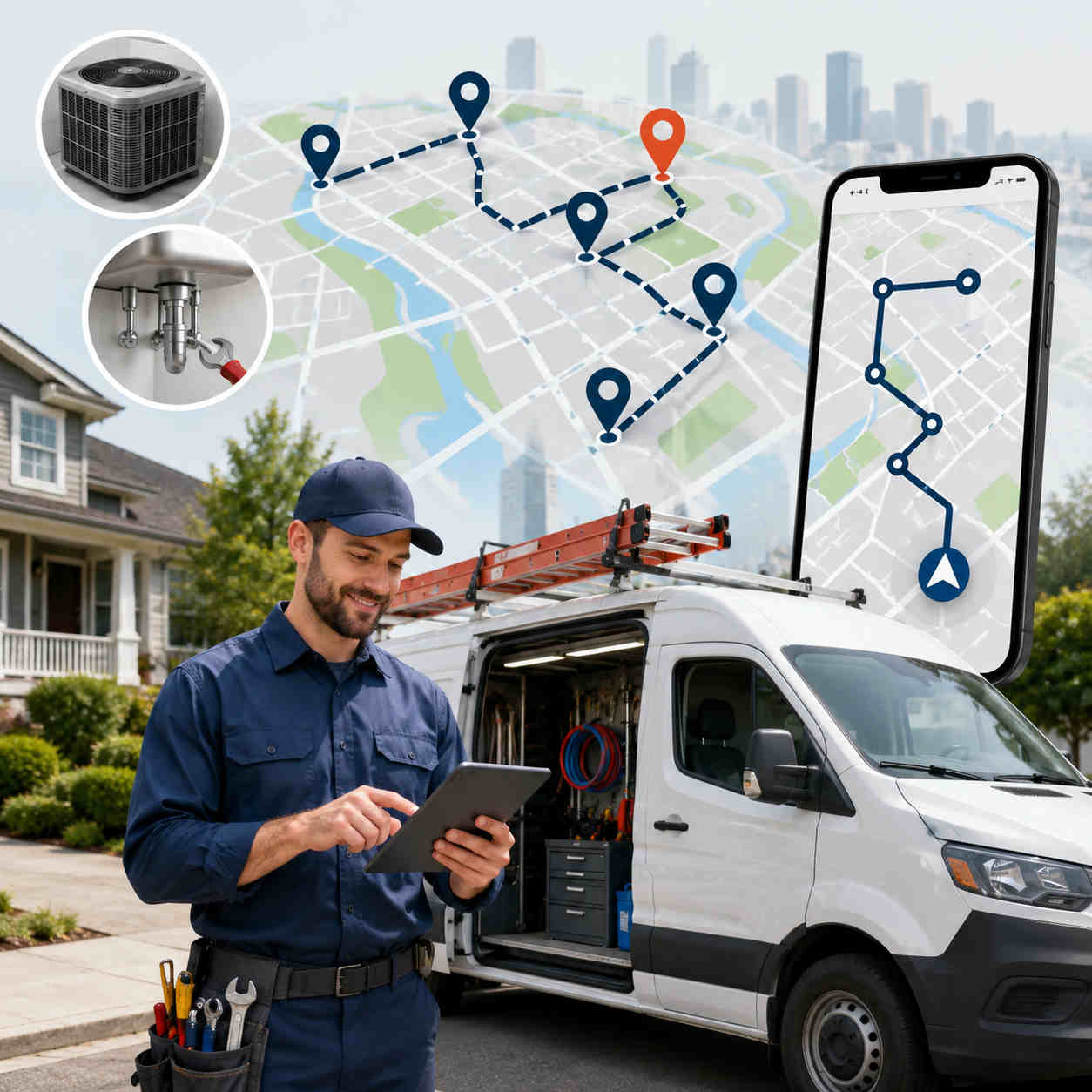
At its core, HVAC plumbing route planning software is a tool that decides the smartest order and assignment for your service calls. Give it the day’s jobs and your available technicians, and it figures out who goes where, in what order, to burn the least drive time across the whole team. Then it hands each tech a clean route on their phone and lets dispatch watch it play out live.
It helps to be precise about what this is and isn’t, because the trades software market is crowded and confusing. A full field service management (FSM) platform handles everything: job creation, invoicing, price books, parts, memberships. HVAC dispatch software handles the assignment and scheduling of work orders. And a technician route planner handles the piece those tools often do worst, the actual geography, sequencing stops so nobody criss-crosses the service area all afternoon. Good HVAC plumbing route planning software is really field service route optimization focused on that geographic layer, and it’s usually the fastest, cheapest win available to a growing shop.
Here’s the part that trips people up. You don’t have to rip out your existing system to get it. The best technician route planner works alongside whatever you already use, pulling in the jobs and pushing back optimized routes. So if you’ve got plumbing scheduling software or an FSM you like, routing complements it rather than replacing it. If you’re still on spreadsheets and a whiteboard, HVAC plumbing route planning software is often the simplest first upgrade you can make, and the one your techs will feel on day one.
Why Drive Time Punishes HVAC & Plumbing Teams So Hard
Every field business deals with drive time. But a few things about the trades make it especially expensive, which is exactly why field service route optimization pays off faster here than almost anywhere else. Picture a five-tech shop where each tech loses ninety minutes a day to avoidable driving. That’s seven and a half hours of skilled labor evaporating daily, nearly a full extra tech’s worth of capacity you’re paying for and never getting. Now picture clawing back even half of it. That’s the size of the prize, and it’s why the trades are almost the textbook case for a technician route planner.
Skilled labor is costly, and windshield time wastes it. A plumber or HVAC tech is one of your highest-paid field employees, and a typical service call runs anywhere from forty-five minutes to a couple of hours. Every half hour they spend driving is a big chunk of a billable job spent producing nothing. A technician route planner exists to claw that time back and turn it into wrench time.
Customers hold you to appointment windows. Someone took the afternoon off work to meet your tech. When drive times slip, the window slips, the phone rings, and the rest of the day’s schedule starts to wobble. Tight routing keeps arrivals predictable, and predictable arrivals keep customers off the phone and out of your one-star reviews.
Emergencies land on top of a full day. An AC unit dies on the hottest afternoon of the year. A pipe bursts at 2pm. These calls don’t wait, and jammed onto the end of a route by hand they wreck the day’s efficiency. This is where re-optimizing HVAC plumbing route planning software earns its keep, slotting the urgent job into the right place instead of the last place.
The work is spread all over the map. A ten-call day across residential neighborhoods, commercial sites, one-way streets, and rush-hour traffic looks nothing like a tidy line on a map. Routes built from a dispatcher’s memory quietly pile up wasted miles, every tech, every day. Field service route optimization is what turns that mess into a clean, drivable sequence.
Recurring maintenance stacks on top of repairs. Seasonal tune-ups, filter changes, service-agreement visits, all running alongside one-off repairs. Juggling recurring work and reactive work by hand is where plumbing scheduling software and a solid technician route planner start to look less like a luxury and more like a necessity.
Add it up and the trades are almost the perfect case for routing software. High labor cost, tight windows, constant curveballs, and work scattered across a metro area. HVAC plumbing route planning software attacks the single biggest drain on the day, and it does it every single morning.
How HVAC & Plumbing Route Planning Software Actually Works
Strip away the buzzwords and a good technician route planner does a handful of concrete things, one after another, and each one removes a headache you’re currently eating by hand.
It optimizes across every tech at once. This is the difference between real field service route optimization and a glorified map. Instead of a dispatcher balancing techs by gut feel, the software sequences the whole team in one pass, spreading the workload and cutting company-wide drive time. Import your jobs from a spreadsheet and it maps and plans the lot in seconds.
It uses real road drive times, not straight lines. A route that looks efficient on a flat map can fall apart the second a tech hits a highway backup or a school zone. Good HVAC plumbing route planning software plans on actual road speeds, so the day holds up on the street, not just on screen. Bodha’s route optimization works exactly this way.
It re-optimizes when the day changes. A cancellation, a job that runs long, an emergency call, none of it should mean rebuilding the schedule from scratch. The software reshuffles on the fly and pushes the update out. That’s the feature that makes emergency work manageable instead of chaotic.
It puts the route on the tech’s phone. An optimized route is useless if it lives on a dispatcher’s screen. A proper driver and technician mobile app gives each tech turn-by-turn navigation, job notes, and access details, so they roll from stop to stop without calling the office.
It tracks the whole team live. Dispatch sees every tech on one map through live tracking, which kills the “let me call and check” reflex and makes it easy to see who’s closest when an urgent call drops.
It keeps customers in the loop automatically. Automatic ETA texts and a tracking link tell customers when the tech is on the way, and proof of service captured at the job settles any question about what was done. That’s the combination that quietly ends “where’s my technician?” calls.
Stack those together and HVAC plumbing route planning software stops being a planning chore and becomes the engine that runs the day.
What to Look For in a Technician Route Planner
Not every tool sold to the trades is built for the trades, and the wrong one adds steps instead of removing them. When you’re comparing HVAC plumbing route planning software, these are the things that actually matter once real jobs and real traffic get involved.
Multi-technician optimization in one pass. Some tools only optimize a single route at a time, which just moves the balancing act back onto your dispatcher. You want true field service route optimization across the whole team at once.
Real drive-time data. Straight-line distance produces routes that look smart and drive badly. Insist on a technician route planner that uses real road times and traffic patterns.
Fast, easy mid-day changes. Emergencies and cancellations are a daily fact of trades life. Adding an urgent job and re-optimizing should take seconds, not a schedule rebuild. This is where a lot of clunky HVAC dispatch software falls down.
Recurring scheduling built in. For maintenance agreements and seasonal work, you want plumbing scheduling software behavior baked in: set a cadence per customer, and the system shows who’s due and drops them into the route. Bodha ties this to a built-in client CRM that keeps every site’s access notes and history in one place.
A mobile app techs will actually use. If the route lands as a plain address list, that’s not an upgrade. Techs need navigation, notes, and one-tap status updates that sync back to dispatch.
Live tracking and proof of service. Dispatch needs eyes on the team, and you need a timestamped, photo-backed record of each job to settle disputes and callbacks fast.
Automatic customer notifications. ETA texts and a tracking link are what cut the inbound calls and make a small shop look polished.
It plays nicely with your other tools. The best HVAC plumbing route planning software complements your existing FSM or plumbing scheduling software instead of forcing a rip-and-replace. You should be able to import jobs, optimize, and push routes without abandoning the invoicing and booking you already trust.
Tick most of these and you’ve found a technician route planner worth paying for, not a generic map app in a work-truck costume.
Route Planning vs. Dispatch vs. Full Field Service Software
This is where a lot of buyers get stuck, so let’s make it simple. These three things overlap, but they solve different problems, and knowing which you actually need saves you money.
Field service management is the big all-in-one: job creation, customer records, invoicing, price books, parts, memberships. Powerful, but heavy, pricey, and often overkill for a small-to-mid shop. HVAC dispatch software is the piece that assigns and schedules work orders, deciding which tech gets which job and when. And HVAC plumbing route planning software is the geographic brain, the technician route planner that sequences those jobs into the least-drive-time order and navigates techs through the day.
Here’s the practical takeaway. If drive time is your biggest cost and your current setup doesn’t optimize geography, a dedicated technician route planner is usually the highest-return tool you can add, and you don’t need to abandon your FSM to get it. Many shops run capable field service route optimization alongside the HVAC dispatch software or plumbing scheduling software they already own, letting each tool do the part it’s best at. Routing handles the “who goes where, in what order.” Your FSM handles the paperwork. Everybody wins, and you’re not paying enterprise prices for a problem a focused tool solves better.
That’s deliberately how Bodha is built. It’s routing, scheduling, tracking, and proof of service, designed to slot alongside the booking and invoicing tools you already use rather than replace them.
Who HVAC & Plumbing Route Planning Software Is Right For
You don’t need a hundred trucks to benefit from this. In fact, the sweet spot is smaller than most people assume.
For a one- or two-tech operation where the owner knows every customer by name and builds the day from memory, manual planning is usually fine. The math changes fast around three to five techs, where building routes by hand starts eating real time every morning and the quality gets inconsistent. That’s the point where HVAC plumbing route planning software starts paying for itself almost immediately.
It fits residential HVAC and plumbing shops running a mix of service calls and maintenance. It fits commercial contractors coordinating techs across job sites. It fits any team juggling recurring service agreements alongside reactive repairs, and any operation where emergency calls regularly blow up the schedule. If your day involves a list of stops and a lot of driving between them, a technician route planner is built for you. And because the good ones complement your existing plumbing scheduling software or FSM, adopting field service route optimization doesn’t mean tearing up the systems your office already runs on.
What Better Routing Actually Delivers
It’s worth being clear about where the return comes from, because “optimize your routes” can sound abstract until you see it on the P&L. The first thing you feel is more capacity: tighter sequencing frees up enough time that most shops fit an extra call or two per tech per day, which is pure added revenue with no new payroll. Then the costs drop, because fewer miles means less fuel and less wear on the trucks, and honest field service route optimization tends to trim both meaningfully.
There’s a service-quality dividend too. When routes hold up and customers get an automatic heads-up, arrival windows stop slipping and the office phone goes quiet. When an emergency lands, re-optimizing HVAC plumbing route planning software absorbs it instead of letting it torch the afternoon. And when a customer questions whether a job got done, proof of service settles it in seconds. Add the accountability that comes from live tracking and clean analytics, and a good technician route planner doesn’t just shave drive time, it makes the whole operation calmer, more predictable, and easier to grow. That’s the real reason the trades keep reaching for HVAC dispatch software and routing tools together: one runs the paperwork, the other runs the road.
Getting Started With Bodha
The best part is how little it takes to start. Because Bodha is software-first and runs through the technician app, most shops are up and optimizing within an hour. Import your customer list and jobs from a spreadsheet, set any recurring maintenance cadences, optimize the first routes, and dispatch to your techs the same day. No installers, no long onboarding.
From there it runs. Techs follow their optimized routes and capture proof at each job. Dispatch watches the whole team live through Bodha Fleet and reshuffles instantly when an emergency drops. Customers get automatic ETAs. And every route feeds analytics you can use to tighten things further. Shops that switch from manual planning typically see up to 30% less fuel, around 25% more jobs handled, and a full extra hour back in the day, which is how you fit those extra service calls in without extending anyone’s shift.
Bodha’s HVAC and plumbing route planner is deliberately focused: real routing, real-time tracking, proof of service, recurring scheduling, and customer notifications, working alongside the tools you already have rather than replacing them. You can see exactly what it costs on the pricing page before committing a dollar. If drive time is quietly capping how many calls your team can run, HVAC plumbing route planning software is the most direct lever you can pull, and you could be running a tighter day by this afternoon. (Emergencies eating your schedule in particular? Our guide to emergency dispatch for HVAC and plumbing digs into that specifically.)
Frequently asked questions