 Ruchita Purohit
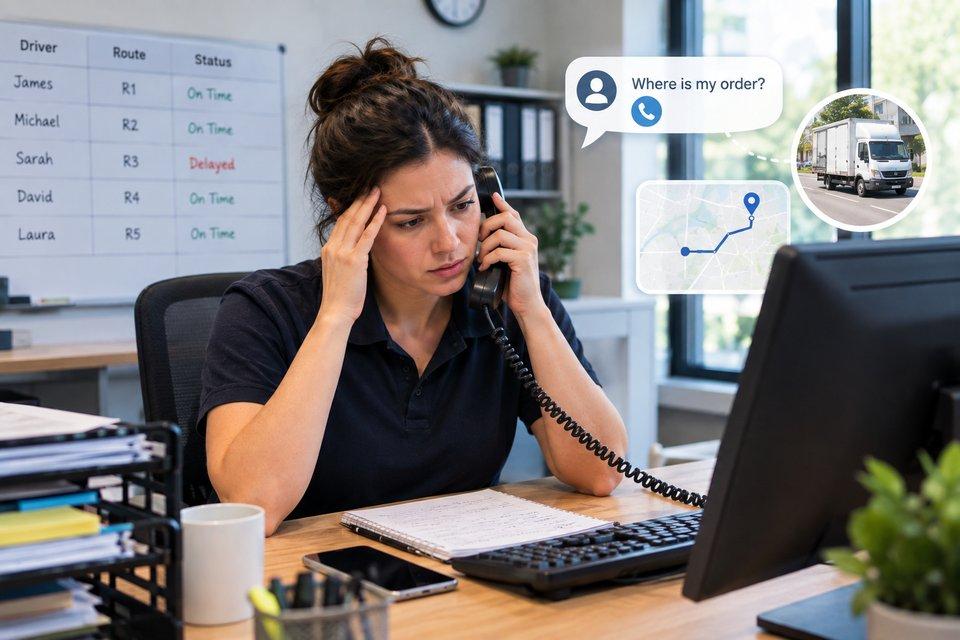
Your dispatcher is sitting at the desk trying to rework the afternoon routes because a driver called in sick. The phone rings.
“Hi, I was just wondering when my delivery is coming?”
She pulls up the spreadsheet, scrolls to find the order, texts the driver, waits. No response. Calls the driver. Goes to voicemail. Tells the customer she will call them back. Hangs up. Goes back to the routes.
The phone rings again. Different customer. Same question. “Where is my order?”
This happens 15 to 25 times a day at most small delivery operations. And every single one of those calls pulls your dispatcher away from the work that actually keeps deliveries moving. They are not answering questions. They are stuck in a loop, fielding the same inquiry over and over because no system exists to answer it for them.
In the industry, these calls have a name. WISMO. Where Is My Order. And if you run a delivery operation of any size, WISMO is probably the single biggest drain on your team’s time that nobody has quantified.
What WISMO Actually Means and Why It Should Bother You
WISMO stands for Where Is My Order. It is the umbrella term for any customer contact asking about the status or location of a delivery. Phone calls, texts, emails, sometimes people walking into your office. All of it counts.
Here is how common it is. WISMO inquiries account for up to 50% of all customer support contacts for delivery businesses during normal operations. During peak seasons, that number climbs to 70%. In food distribution specifically, WISMO represents 70 to 80% of all inbound support tickets.
Those numbers probably do not surprise you. If you run deliveries, you already know that most of your inbound calls are some version of “where’s my stuff?” What might surprise you is how much it is actually costing you.
But before we get to the money, here is the thing that makes WISMO different from other customer service problems. WISMO is not really a customer service problem at all. It is an operations problem wearing a customer service disguise.
Your customers are not calling because they are difficult or impatient. They are calling because they have no other way to get the information they need. There is no tracking link. There is no notification system. There is no way for them to look up their delivery status without picking up the phone and interrupting your team.
That is an operations gap. And it has operational consequences that go way beyond the cost of answering a phone.
The Real Cost of WISMO for Small Delivery Teams
Every article about WISMO costs starts with the same number. Something like “$5 to $8 per call in staff time.” And that is accurate, as far as it goes. Industry data puts the average resolution cost at about $5 per WISMO contact, ranging up to $17 to $25 when the customer reaches a person by phone instead of self-service.
But those numbers are calculated for companies with dedicated customer support teams. Call centers. People whose only job is answering the phone.
That is not how small delivery operations work.
At a 10 to 30 driver operation, the person answering WISMO calls is usually the dispatcher. Sometimes it is the office manager. Sometimes it is the owner. These are people whose primary job is managing routes, coordinating drivers, processing orders, and keeping the operation running. Customer support is something they do on top of everything else.
So when a WISMO call comes in, the cost is not $5 in staff time. The cost is whatever that person was doing before the phone rang, which was probably something more valuable.
Let’s do the math that nobody else does.
Your dispatcher earns $25 an hour (or your office manager earns $30, or you as the owner value your time at $50). Each WISMO call takes 3 to 5 minutes of their time. That is $1.25 to $4.17 per call in direct labor at the dispatcher level.
But here is what actually happens during those 3 to 5 minutes. The dispatcher stops adjusting routes. Stops monitoring driver positions. Stops processing the next batch of orders. Stops coordinating a replacement for the driver who called in sick. Whatever they were doing, it stops. And it takes another 2 to 3 minutes to get back into it after the call ends. So the real disruption is closer to 6 to 8 minutes per call.
At 20 WISMO calls per day, that is 120 to 160 minutes. Two to nearly three hours. Every day. Spent answering a question that should answer itself.
That is not a customer service cost. That is a half-time employee doing nothing but telling people their delivery is on the way.
And we have not even counted the downstream effects. The route that did not get adjusted in time, which caused a driver to run 45 minutes late on six stops. The customer who could not get through because the line was busy with WISMO calls, so they canceled their order. The failed delivery that could have been prevented if the dispatcher had noticed the driver was heading to a wrong address, except she was on the phone explaining to someone else that their order would be there within the hour.
WISMO calls do not just cost you time. They make every other part of your operation worse.
Why Your Customers Keep Calling
It is easy to get frustrated with customers who call. But ask yourself honestly, what other option did you give them?
Here are the five reasons customers pick up the phone, and every single one of them is a gap in your systems, not a flaw in your customers.
They have no tracking link. This is the big one. Ninety-one percent of consumers actively track their packages. Not “want to track.” Actively do. When your customer orders from you and gets nothing but a confirmation email and silence, they have no way to check on their delivery except calling you. The tracking link is not a nice-to-have feature. It is the minimum expectation in 2024.
They never got a notification. Ninety-three percent of customers want proactive delivery updates. A text saying “your delivery is out for delivery” or “your driver is 15 minutes away” would have answered their question before they even thought to ask it. No notification means they are left guessing, and eventually guessing turns into calling.
Your ETA was useless. If the last thing your customer heard was “your delivery will arrive between 9 AM and 5 PM,” that is not an ETA. That is a shrug. Static time windows calculated at 7 AM stop being accurate by 9:30 because traffic, stop durations, and unexpected delays change everything. Customers who have no idea when their delivery is actually coming will call to narrow it down themselves.
They need to confirm it arrived. Post-delivery WISMO is a category most businesses do not even think about. But a significant chunk of “where is my order” calls come after the delivery has already happened. The customer was not home. Nobody told them it was delivered. They do not know if it is on the porch, with a neighbor, or still on the truck. A proof of delivery photo and notification would have eliminated this call entirely.
Something went wrong and nobody told them. This is the one that does the most damage. The driver is stuck in traffic. The delivery is going to be an hour late. The customer does not know. They are sitting there watching the clock, getting increasingly anxious, and eventually they call. If you had sent a proactive text saying “your delivery is running behind, new ETA is 3:45 PM,” the customer would have been mildly annoyed but informed. Instead, they are angry and surprised, which is a much worse combination.
Every one of these reasons maps to a specific, fixable gap. And the fixes are not expensive or complicated. They are just things your team has not gotten around to setting up yet.
5 Ways to Eliminate WISMO Calls From Your Operation
Not reduce. Eliminate. Because that is the actual goal. Not answering WISMO calls faster. Making them unnecessary.
1. Automated delivery notifications
This is the biggest lever. Nothing else comes close.
When customers receive automated texts at key moments during the delivery process, the vast majority of WISMO calls simply do not happen. Research consistently shows that proactive delivery alerts reduce WISMO contacts by 65 to 75%.
Set up automated notifications at three minimum touchpoints. First, when the driver starts the route and the customer gets a morning ETA. Second, when the driver is approaching, about 10 to 15 minutes out. Third, when the delivery is complete, with a photo.
Those three notifications answer every version of “where is my order” before the customer ever thinks to ask it. They know it is coming. They know roughly when. They know when it arrived. The question answers itself.
SMS delivery alerts achieve 99% open rates and 98% delivery rates. Compare that to email, which most customers might check hours later. Texts get read within minutes. That is why they work so well for WISMO prevention. The information reaches the customer fast enough to preempt the call.
2. Live tracking links for every delivery
A tracking link takes the customer from “I have no idea” to “I can see exactly where my delivery is” in one click. No app download. No login. Just a link in a text message that opens a map in their browser.
When a customer can see the driver on a map moving toward their address, the urge to call your office disappears. They have the answer right in front of them. They can check it as many times as they want without using any of your team’s time. Research shows retail customers check their delivery location 2.5 times per delivery on average. Those are 2.5 calls per delivery that never happen.
Real-time tracking paired with notifications is the combination that does the heavy lifting. The notification tells them their delivery is on the way. The tracking link lets them watch it happen. Together, they handle the routine communication layer that used to require a human.
3. Dynamic ETAs that actually update
There is a huge difference between “your delivery will arrive between 9 AM and 5 PM” and “your delivery will arrive at 2:15 PM, currently 3 stops away.” One generates WISMO calls. The other prevents them.
Static ETAs calculated in the morning become inaccurate as the day progresses. Traffic changes. Stops take longer than expected. A driver gets stuck at a loading dock. By noon, your morning ETA is fiction.
Dynamic route optimization recalculates ETAs continuously based on actual driver location and real conditions. As the driver gets closer, the ETA gets more precise, not less. By the time they are a few stops away, the customer has a window measured in minutes.
Customers with accurate, updating ETAs do not call. They do not need to. They know exactly when to expect the delivery and they can see it getting closer. That level of precision used to be something only the big logistics companies could offer. Now it is available to any team with a modern delivery platform.
4. Proof of delivery with photo and timestamp
This one eliminates an entire category of WISMO calls that most businesses do not even realize they are getting. Post-delivery WISMO. “Did my delivery arrive?” “Where did you leave it?” “I was not home, is it on the porch?”
When the driver takes a photo at the door and the customer gets an automatic notification with that photo, these calls vanish. The customer knows it was delivered. They know exactly where it was left. They have a timestamped photo showing the package at their front door.
Proof of delivery adds maybe 10 seconds per stop for the driver. Take the photo, tap complete, move to the next stop. The notification goes out automatically. And the hours your team spends handling “did it arrive?” calls drop to nearly zero.
It also eliminates the “I never received it” disputes. Photo, GPS coordinates, timestamp. The evidence is right there. No back and forth. No replacement shipments for packages that were actually delivered. That is a cost savings that goes beyond WISMO and straight to your bottom line.
5. Proactive exception alerts
This is the one most delivery teams skip, and it is the one that prevents the angriest calls.
When something goes wrong with a delivery and the customer finds out from you before they find out by waiting and wondering, it completely changes the dynamic. A text saying “your delivery is running 45 minutes behind schedule, new estimated arrival is 3:30 PM” is not a great message. But it is infinitely better than silence followed by an angry phone call at 4 PM.
Customers tolerate delays far better when they are informed proactively than when they are left guessing. A delivery that arrives 30 minutes late with real-time tracking and a text update produces a better last mile delivery customer experience than a delivery that arrives on time with no communication at all.
The hardest WISMO calls to handle are the ones where the customer is already upset. Proactive exception alerts do not prevent the delay. But they prevent the anger that comes from being surprised by it.
WISMO as a Diagnostic Tool
Before you rush to eliminate every WISMO call, here is something worth considering. Your WISMO patterns are telling you things about your operation that you might not see any other way.
A spike in WISMO calls from one specific area probably means your routing for that zone is not working. Deliveries are consistently late there, and customers have learned that calling is the only way to get a straight answer.
WISMO calls concentrated on a particular day of the week, say every Tuesday, probably means you have a capacity mismatch. You are trying to fit too many deliveries into too few drivers on that day, and everything runs late.
The same customer calling every single week about the same recurring delivery probably means their delivery window does not match when they are actually available to receive it. The fix is not better notifications. It is adjusting their time window.
WISMO calls that spike during certain hours might reveal that one driver is consistently slower than others, or that a particular route segment has traffic problems you had not accounted for.
Your real-time visibility into these patterns turns WISMO from a problem into a data source. Track the calls for two weeks before you automate them away. Note which areas, which days, which customers, and which times generate the most calls. You will learn things about your operation that no dashboard would have shown you.
Then automate. And use the data you gathered to fix the underlying operational problems at the same time.
What Eliminating WISMO Actually Looks Like
Same delivery operation. Same 15 drivers. Same 200 stops per day. Two versions.
Version A: No tracking, no notifications. The phone starts ringing at 10 AM. By noon, the dispatcher has fielded 12 WISMO calls. She has not checked the fleet map in 45 minutes. One driver is lost, another is running behind, and she does not know because she has been on the phone. A customer who needed to arrange an unloading crew calls at 1 PM asking when the truck is coming. The dispatcher texts the driver, gets no response for 20 minutes, calls back the customer with a vague “within the next couple hours.” The customer is frustrated. The unloading crew is on the clock doing nothing. By end of day: 22 WISMO calls, 3 missed deliveries that were actually preventable, and a dispatcher who spent half her day as an information desk.
Version B: Tracking and notifications enabled. Customers got a text at 8 AM with their estimated delivery window. At 10 AM, the dispatcher’s phone has rung twice, both for genuine exceptions, not routine status checks. She is watching the fleet map, notices a driver is behind, and reassigns two stops to a nearby driver before anyone is affected. The customer who needs the unloading crew got a text saying “your delivery is estimated at 1:45 PM” and scheduled the crew accordingly. At 1:30 PM they get “your driver is 2 stops away.” Crew is ready. Delivery happens on time. By end of day: 4 calls total (all genuine issues), zero missed deliveries, and a dispatcher who spent her day actually dispatching.
The difference is not subtle. It is the difference between running an operation and being trapped by an operation.
How to Start This Week
You do not need a six-month implementation plan. You do not need enterprise software. You need about an hour and a willingness to change how your customers hear from you.
This week: turn on notifications and tracking. Get your drivers on a delivery app that sends automated notifications. Give your customers tracking links. Delivery platforms built for small teams start at $29.99 per user per month and can be running within an hour. Notifications alone will cut your WISMO calls in half within the first week. That is not marketing optimism. That is what happens when you give customers the information they were calling you to get.
Next week: add proof of delivery. Have your drivers capture a photo at every stop. It adds 10 seconds per delivery. Once customers start receiving delivery photos automatically, the “did it arrive?” calls disappear.
Week three: track the difference. Count your WISMO calls. Compare to before. Calculate how much dispatcher time you have freed up. Most delivery teams see their inbound call volume drop by 50 to 70% within two weeks of implementing notifications and tracking.
Then get smarter with the data. Look at which calls are still coming through. Those are your genuine exceptions, the situations where automation is not enough and a human needs to step in. Handle those well. The fact that there are fewer of them means your team actually has the time and energy to handle them properly.
The biggest barrier is not cost. Last mile delivery software costs less than a tank of fuel per driver per month. The barrier is inertia. The way you have been doing it has worked well enough. But “well enough” means your dispatcher spent two hours today answering a question that three text messages would have handled.
FAQ's
What does WISMO mean?
WISMO stands for "Where Is My Order." It refers to any customer inquiry about the status or location of a delivery. WISMO calls are the most common type of inbound support request for delivery businesses, representing up to 50% of all customer contacts during normal operations and up to 70% during peak seasons.
How much do WISMO calls cost a delivery business?
Each WISMO call costs $5 to $8 in direct staff time, but the real cost for small delivery teams is higher. When the person answering is also the dispatcher or business owner, the opportunity cost includes routes not being adjusted, drivers not being managed, and new orders not being processed. A team fielding 20 WISMO calls per day can spend the equivalent of a half-time employee answering the same question.
How can I reduce WISMO calls without a big budget?
The fastest way to reduce WISMO calls is automated delivery notifications. When customers receive texts at key moments, they stop calling because the question answers itself. Delivery platforms with notifications, tracking, and proof of delivery start at $29.99 per user per month and typically reduce WISMO calls by 50 to 70% within the first week.
What percentage of customer service calls are WISMO?
Industry data shows WISMO accounts for 18 to 50% of all customer support inquiries depending on the industry, rising to 70% during peak seasons. In food distribution specifically, WISMO represents 70 to 80% of all inbound support tickets. Best-in-class delivery operations maintain WISMO rates below 8 to 10% of total contacts.
Do delivery notifications actually reduce WISMO calls?
Yes. Research shows proactive delivery alerts reduce WISMO contacts by 65 to 75%. Real-time tracking links alone reduce calls by 30 to 40% within the first month. Adding proof of delivery photos reduces post-delivery callbacks by up to 50%. SMS delivery alerts achieve 99% open rates, meaning customers actually see and act on the information.
What is a good WISMO rate for a delivery business?
Best-in-class delivery operations maintain WISMO rates below 8 to 10% of total customer contacts. If WISMO calls make up more than 20% of your inbound volume, your communication systems have significant gaps. The goal is not zero WISMO, because genuine exceptions will always generate questions, but routine status inquiries should be handled entirely by automated tracking and notifications.