 Ruchita Purohit
Your dispatcher built a beautiful plan this morning. Forty stops across three drivers, everything color-coded, time windows accounted for. It took 35 minutes and two cups of coffee.
By 9:30 AM it was useless.
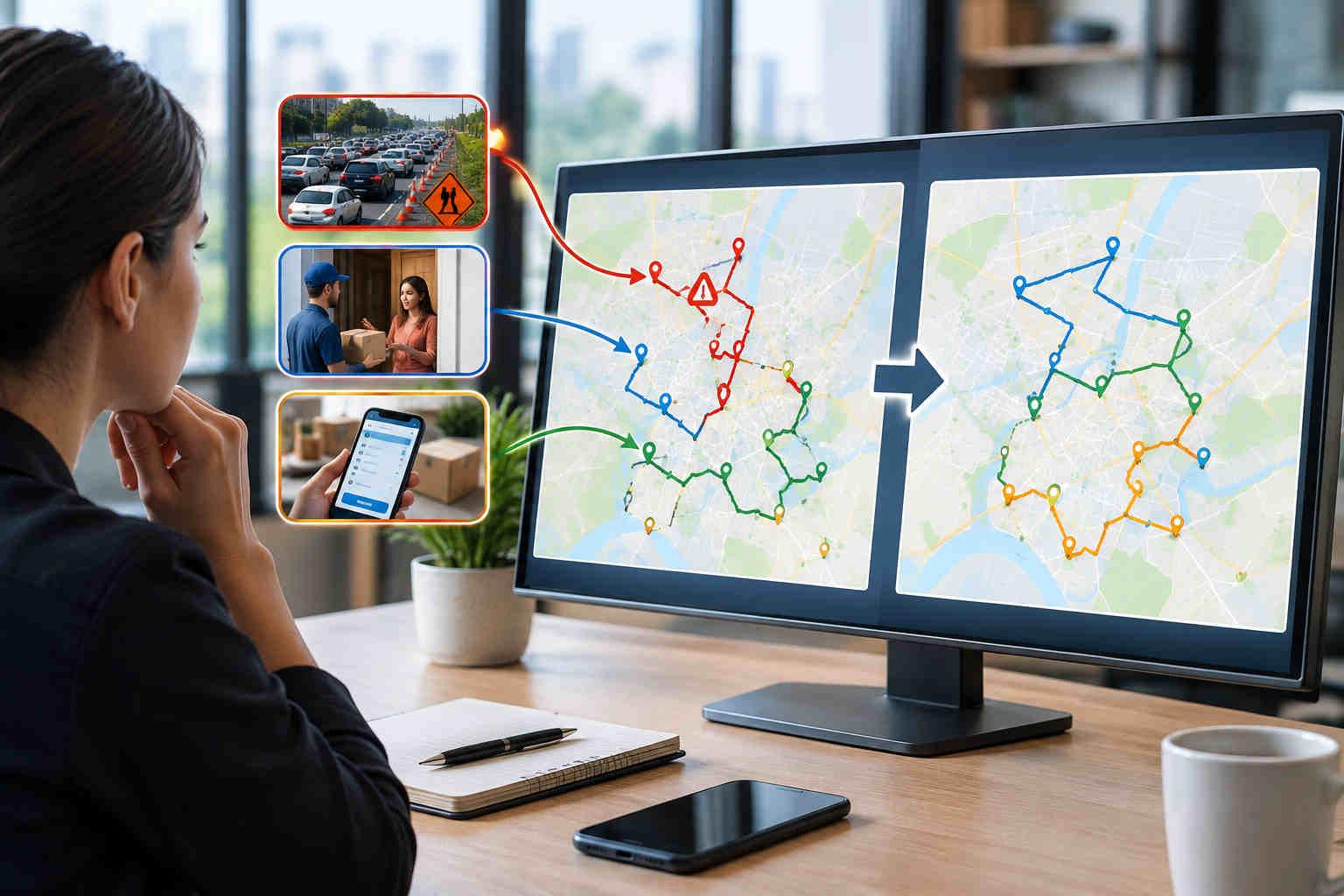
Driver #2 called in from Route 9 saying construction had traffic backed up for a mile. A residential customer called to push their delivery to after 4 PM. And your online store just dumped three rush orders into the queue that absolutely need to go out today.
Now your dispatcher is staring at a spreadsheet, making phone calls, and doing mental math that frankly nobody should be doing under pressure at 9:30 in the morning. This is the problem that dynamic route optimization exists to solve. Not the planning part. The part where the plan falls apart and you need a new one in 30 seconds instead of 30 minutes.
The dynamic route optimization market hit $1.9 billion in 2024 and is projected to reach $6.6 billion by 2034 (13.1% CAGR). That kind of growth does not happen because of hype. It happens because the technology genuinely solves a problem that every delivery operation deals with daily.
But most of what you will find online about this topic reads like it was written for a logistics VP at a company with 500 trucks. We are going to explain it for the person who is actually dealing with route chaos every morning.
What Is Dynamic Route Optimization, Really?
Let’s start simple because this term gets thrown around loosely.
Dynamic route optimization is a system that builds your delivery routes AND keeps adjusting them throughout the day as conditions change. That second part is the whole point. Lots of tools will plan a route for you. Most of them plan it once, hand it off, and call it done.
Think about it like this. Static routing is printing out driving directions before a road trip. You have your turns, your estimated arrival time, and you are locked in. If there is an accident on the highway or a road closure you did not know about, those printed directions are worthless. You figure it out yourself.
Dynamic route optimization is GPS navigation that reroutes you in real time. It knows where traffic is building. It reroutes you around the accident before you even see it. And if you stop for gas and lose 15 minutes, it recalculates everything downstream.
Same idea, applied to an entire fleet of drivers running deliveries all day.
The reason this matters more now than five years ago is pretty straightforward. Customer expectations changed. Same-day delivery went from a luxury to baseline. Delivery windows got tighter. And the number of things that can go wrong on any given day did not decrease. If anything, it got worse. More stops, more time pressure, more variables.
Planning once and hoping for the best just does not cut it anymore.
Static vs. Dynamic Route Optimization: What Actually Changes
Every competitor blog does a neat little comparison table here. Two columns, bullet points, very tidy. Also not very helpful if you are trying to actually understand what this means for your day.
So instead, let’s run the same day twice.
Day 1: Static routing.
You have 40 stops across 3 drivers. Your dispatcher builds the routes at 7 AM using a basic planner. Good groupings by neighborhood. Reasonable sequence. Estimated completion: 4:30 PM for everyone.
At 9:45, Driver #2 hits a construction zone that adds 40 minutes to their morning. Your dispatcher finds out because the driver calls, annoyed. Now the dispatcher has to mentally re-sequence the remaining stops on that route to figure out which time windows are blown. They call the affected customers to warn them. That takes 20 minutes.
At 11, a customer cancels. Easy enough, cross it off. Except that stop was in the middle of Driver #3’s route, and the stop after it has a 1 PM window. Without that cancelled stop, the driver will arrive 35 minutes early and nobody will be home. Does the dispatcher catch that? Maybe. Depends on how busy they are.
At 1 PM, three rush orders come in. The dispatcher looks at all three routes, tries to figure out who has capacity, makes a judgment call. It takes 15 minutes and one of the orders still goes out late.
Total dispatcher time spent reacting: about an hour and a half. Two deliveries missed their windows. One rush order was late. Not a disaster. But not great, and definitely not efficient.
Day 2: Same 40 stops. Same chaos. Dynamic route optimization.
Construction zone hits at 9:45. The system sees Driver #2’s delay through live traffic data and instantly re-sequences their remaining stops. Two stops that now cannot hit their time windows get moved to Driver #1, whose route runs nearby. Driver #2 and Driver #1 both get updated routes on their phones. No calls needed. Dispatcher sees the change on their dashboard and confirms it with a tap.
Customer cancels at 11. The system removes the stop and closes the gap, adjusting timing for every remaining stop on that route. The 1 PM window that would have been missed? Still on track because the system moved things around.
Rush orders at 1 PM. The system evaluates all three drivers’ current positions, remaining stops, and capacity. Slots the orders in where they fit best. One goes to Driver #3 who is closest. Two go to Driver #1 who finishes earliest.
Total dispatcher time spent reacting: about five minutes, mostly just reviewing what the system did. Zero missed windows. All rush orders delivered on time.
The stops did not change. The problems did not change. What changed is whether a person or a system was doing the math under pressure.
5 Ways Dynamic Route Optimization Changes Your Delivery Operation
1. Your routes survive first contact with reality
There is this old military saying that no plan survives first contact with the enemy. Delivery is obviously not combat, but the principle holds up pretty well. You can build the most elegant route plan in the world and a single driver calling in sick at 8:15 AM can unravel the whole thing.
Without dynamic routing, that sick driver’s 14 stops become a manual redistribution problem. Your dispatcher spends 30 to 45 minutes calling the other drivers, checking capacity, re-sequencing stops, and hoping the time windows still work out. Some of them will not.
With AI-powered route optimization software, those 14 stops get redistributed across the remaining drivers in seconds. Not randomly. Optimally. The system factors in each driver’s current route, their capacity, the time windows, traffic, everything. And every affected driver gets an updated route on their phone without a single call.
Dynamic route optimization does not prevent chaos. No technology does. What it does is process chaos faster than a human can.
2. You stop burning fuel on yesterday’s assumptions
Static routes are built on assumptions. Average traffic speed at 10 AM. Estimated 4 minutes per stop. No construction, no accidents, no weather issues. You know when you build the route that some of those assumptions are wrong, but you do not know which ones yet.
Dynamic routing uses live traffic and actual stop duration data instead of averages. The difference adds up fast.
Industry research consistently shows that most fleets see 10 to 25% fuel savings from optimized routing. One major logistics company reported cutting 100 million miles from annual driving after implementing dynamic routing, saving 10 million gallons of fuel and $300 to $400 million per year. You are obviously not operating at that scale. But the percentages hold up even for smaller operations. A 10-vehicle fleet driving 200 miles per day, a 15% reduction in mileage saves roughly $400 to $600 per month on fuel alone. Over a year, that is $5,000 to $7,000. Not life-changing money. But not nothing either, especially on thin margins.
3. Your ETAs go from “sometime today” to actually useful
Here is a stat that should bother anyone running deliveries: companies using dynamic route optimization achieve on-time delivery rates above 90%. Manual planning typically lands around 70 to 80%. That gap costs you in ways that do not always show up on a spreadsheet.
Every missed delivery window is a customer who waited around for nothing. Some of them call your office. Some of them just do not order from you again. Both outcomes are expensive.
Dynamic routing recalculates ETAs based on where drivers actually ARE and how long their stops are actually taking, not where they were supposed to be two hours ago. The ETA your customer gets at 11 AM is based on 11 AM reality, not 7 AM projections.
Pair that with automated delivery notifications and customers stop calling to ask where their order is. We have seen delivery route planning tools reduce inbound “where is my order” calls by up to 70% when dynamic ETAs and tracking links are in place.
4. Mid-day orders stop being a fire drill
If you run any kind of same-day delivery, this one matters a lot.
With static routes, an order that comes in at 11 AM is a problem. Your drivers are already out. The routes are set. Somebody has to figure out how to squeeze it in, and the answer is usually a phone call to whichever driver seems least busy, followed by a “can you make it work?” conversation that nobody enjoys.
Dynamic route optimization treats new orders as just another input. The system looks at every driver’s current position, their remaining stops, capacity, traffic between here and the new address, and figures out the best insertion point. Maybe Driver #2 can hit it between their next two stops with only 4 minutes added to their route. Done.
No fire drill. No phone calls. No “sorry, we can not fit that in today” when you clearly have the capacity, you just could not see it.
5. Your dispatchers become strategists instead of firefighters
This is the one that gets people nervous. “If the software handles all the routing decisions, what does my dispatcher do?”
The honest answer: everything that routing math cannot solve.
Dynamic route optimization is excellent at sequencing. Give it 200 stops across 15 drivers with time windows, vehicle capacity, and live traffic, and it will find an arrangement that no human could match. That is just math, and computers are better at math.
But dispatchers make judgment calls every day that no algorithm handles well. The VIP customer who always wants the same driver. The route adjustment when a driver mentions a road closure that has not hit the maps yet. The priority reshuffling when your biggest account calls with something urgent.
AI does not replace dispatchers. We talked about this in our piece on AI in last mile delivery. What it does is take the 45 minutes of morning planning and the constant mid-day re-sequencing off their plate. So instead of being buried in logistics math all day, they can focus on the relationship and judgment work that actually requires a human.
The best dispatchers we have talked to are not threatened by dynamic routing. They are relieved by it.
What Dynamic Route Optimization Does NOT Do
We could skip this section. You would never know. But we would rather be straight with you because it will save you from spending money on promises that do not deliver.
It does not predict the future. Dynamic routing reacts to what is happening now and optimizes around it. Predictive demand forecasting, like knowing that next Tuesday will be your busiest day based on historical patterns, requires massive datasets that most delivery businesses simply do not have. The big e-commerce giants have that data. A 20-vehicle fleet probably does not. And honestly? Your ops team already knows Mondays are heavy and Wednesdays are light. That intuition is usually close enough.
It does not fix bad data. If your addresses are wrong, the system will optimize a route to the wrong locations very efficiently. Garbage in, garbage out. Clean addresses matter more than any algorithm.
It does not compensate for not having enough drivers. If you have 60 stops and two drivers, no amount of optimization makes that a good day. Dynamic routing optimizes what you have. It does not create capacity from nothing.
It does not drive the truck. Autonomous delivery is still in pilot programs on college campuses. If someone is pitching you “autonomous-ready” dynamic routing, they are selling you a feature you will not touch this decade.
It is not a magic wand. A customer who is never home will still not be home. A gated community with a broken intercom will still be a headache. Dynamic routing handles the math. Everything else is still on your team.
We bring this up because there is a lot of vendor marketing that blurs the line between what dynamic route optimization actually does today and what it might do someday. Focus on what works now: smarter routing, live re-optimization, accurate ETAs. The rest is noise.
How to Start Using Dynamic Route Optimization Today
This is the part that bothers us about most content on this topic.
You read a 4,000-word guide about dynamic route optimization. You are sold on the concept. You go look at pricing. And the first three platforms you find either hide their pricing entirely or want $50,000 per year with a six-month implementation timeline.
That is the enterprise path. It exists for companies with 200+ vehicles and dedicated IT teams. It is not for you if you are running 20 daily deliveries from a pharmacy or managing 8 drivers at a courier company.
The reality is that dynamic route optimization has gotten dramatically more accessible. The same core technology that used to require a six-figure contract is now available for what you would spend on coffee for your drivers in a week.
Last mile delivery software like Bodha starts at $29.99 per user per month. That gets you AI route optimization with dynamic re-optimization when stops change, live GPS tracking, customer notifications, and proof of delivery. Set it up in under an hour. Run your first dynamically optimized route the same afternoon. No consultants, no integration project, no waiting six months to see results.
Here is how to make it real:
Start with routing: It is the biggest lever. Upload your stops, let the system optimize, dispatch your drivers. Savings start on day one.
Measure it: Track your numbers for two weeks before you switch: total miles driven, time per route, on-time percentage, fuel spend. Then track the same things for two weeks after. Let the data tell you whether it is working. Most businesses see 15 to 30% cost reductions, but your numbers will be yours.
Layer in features gradually: Once routing is working, add live tracking and customer notifications. Then start paying attention to analytics. Each piece makes the next one more useful.
Do not overthink it: You do not need every feature on day one. You do not need a perfect implementation plan. Start. Measure. Adjust.
Where Dynamic Route Optimization Is Heading
The market for dynamic route optimization is projected to more than triple by 2034. But the growth number is not the interesting part. The access story is.
AI and machine learning are making routing algorithms smarter over time. Systems that learn from your historical delivery patterns and adjust for things like school zone slowdowns during pickup hours or apartment complexes where stops consistently take longer. Weather integration is becoming standard. Customer delivery preferences are starting to feed directly into route planning, so the system knows that Mrs. Chen on Oak Street always wants afternoon deliveries before it even builds the route.
Autonomous delivery will eventually show up in certain controlled environments. Eventually. Do not plan around it.
The biggest shift already happened, and you might have missed it. Dynamic route optimization stopped being enterprise-only technology. The gap between what a massive logistics operation uses and what a 10-driver delivery team can access has collapsed. Not completely. Enterprise platforms still do things that smaller tools do not. But the core technology, the part that actually saves you money and time every day, is available right now at a price that makes the decision pretty simple.
Final Thought
Dynamic route optimization is not a buzzword and it is not something you need to “prepare for.” It is the difference between planning your routes once each morning and watching them fall apart, versus having a system that keeps re-planning all day long.
If your dispatcher spends more time reacting to problems than preventing them, if your drivers are burning fuel on routes that stopped making sense two hours ago, if your customers are getting “sometime today” instead of a real delivery window, this is the fix. And it does not require an enterprise budget to get there.
Delivery route planning tools exist today that make dynamic route optimization work whether you have 5 drivers or 500. Start with routing. Measure the difference. Go from there.
FAQs About Dynamic Route Optimization
What is dynamic route optimization?
Dynamic route optimization is a system that plans delivery routes and continuously adjusts them throughout the day as real-world conditions change. Unlike static routing, which builds one plan and locks it in, dynamic routing recalculates routes in response to traffic delays, new orders, cancellations, driver issues, and other changes. It uses live data, not morning assumptions, to keep your routes efficient from the first stop to the last.
How is dynamic route optimization different from static routing?
Static routing builds your routes once, usually before drivers leave the depot, and those routes do not change no matter what happens during the day. Dynamic route optimization keeps recalculating. If a driver hits traffic, the system re-sequences their stops. If a customer cancels, it closes the gap. If rush orders come in, it slots them into whichever route makes the most sense. Same plan, but one adapts and the other does not.
Is dynamic route optimization only for large fleets?
Not anymore. Five years ago, dynamic routing required enterprise platforms costing $50,000 or more per year. Today, platforms like Bodha offer the same core technology starting at $29.99 per user per month. A pharmacy running 30 daily deliveries or a courier service with 8 drivers can access dynamic route optimization at a price point that pays for itself within weeks through fuel savings and efficiency gains alone.
How much can dynamic route optimization save?
Most delivery businesses see 15 to 30% cost reductions on fuel and driver time after switching to dynamic routing. One of the world's largest logistics companies reported saving 10 million gallons of fuel annually after implementing dynamic routing across their fleet. At a smaller scale, a 10-vehicle fleet typically saves $400 to $600 per month on fuel alone from reduced mileage. Add in fewer missed deliveries, reduced support calls, and better driver utilization, and the total ROI builds quickly.
Does dynamic route optimization work for same-day delivery?
It is arguably where it makes the biggest difference. Same-day delivery means your stop list changes constantly after drivers leave. New orders, cancellations, time changes. Without dynamic routing, every change requires manual intervention from your dispatcher. With it, the system absorbs new orders and changes into existing routes automatically, finding the best insertion point without disrupting stops already in progress.
Can small delivery businesses afford dynamic route optimization?
Yes. The technology has become dramatically more accessible. While enterprise platforms still charge $50,000 to $500,000 per year, modern delivery platforms offer dynamic routing, live tracking, customer notifications, and proof of delivery starting at $29.99 per user per month. Setup takes under an hour, and most businesses see measurable cost savings within the first two weeks of use.