 Ruchita Purohit
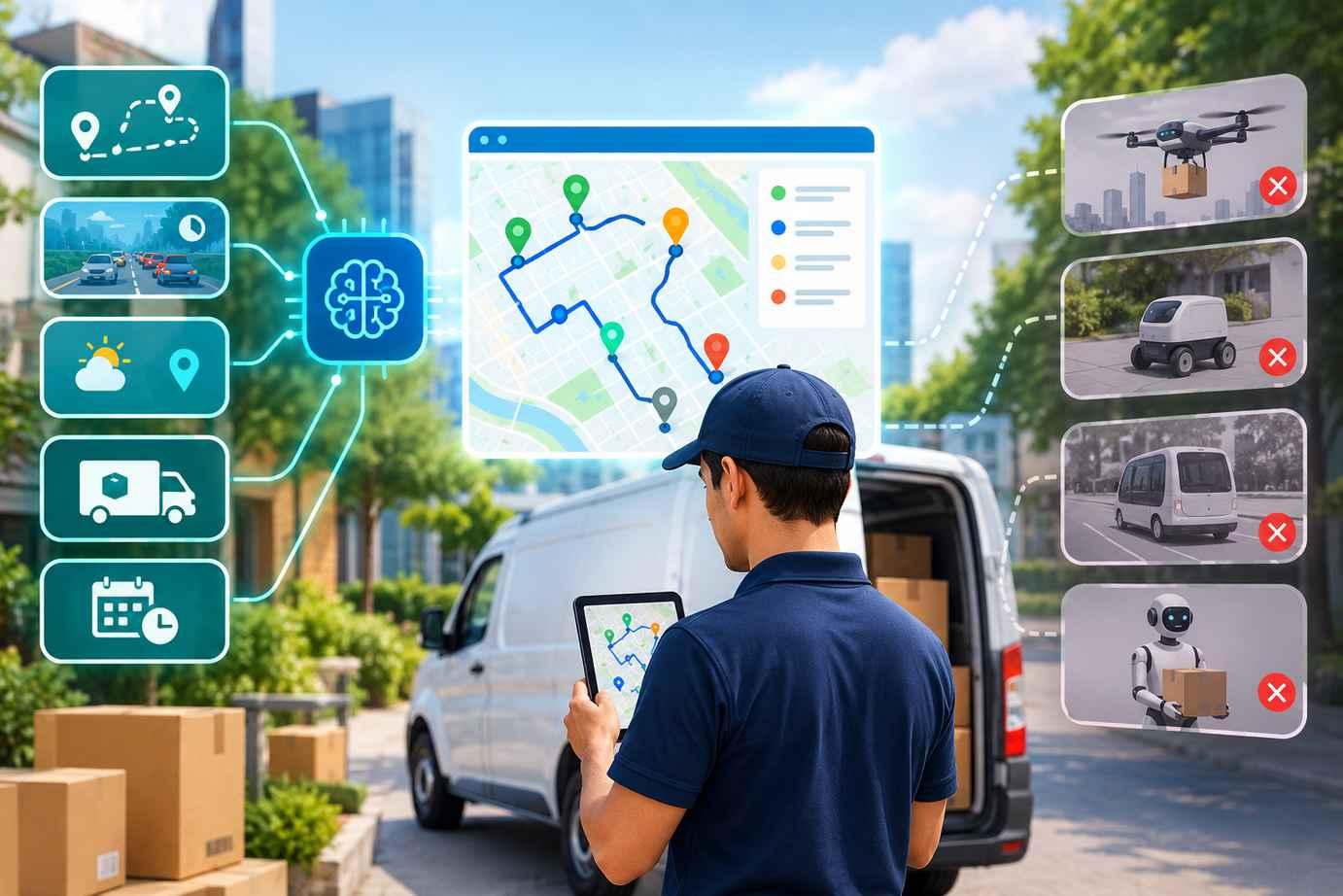
We need to talk about AI in last mile delivery, because there’s a LOT of noise out there and not enough straight answers.
If you Google this topic right now, you’ll get a wall of enterprise vendor blogs telling you AI will “revolutionize your supply chain” and “unlock unprecedented efficiency gains.” Sounds impressive until you realize none of them explain what AI actually does when your driver calls at 9:30 AM saying he’s stuck on I-95 and your dispatcher is trying to figure out who picks up his remaining 12 stops.
Look, the numbers are legit. The AI in last mile delivery market was worth $1.45 billion in 2025 and analysts at Straits Research project it’ll grow to $3.85 billion by 2034 (9.8% CAGR). Money is pouring into this space for a reason. But most of what’s been written about it reads like it was written for a CTO at a Fortune 500, not for someone who actually manages drivers and routes every day.
So we’re going to fix that. We’ll break down what AI does in delivery right now, be upfront about what it can’t do, and talk about how businesses that aren’t sitting on a six-figure software budget can still benefit.
First, Let's Clear Up What "AI" Actually Means in Delivery
Because everyone uses the word differently and it’s gotten confusing.
Your neighbor’s kid building a route in Google Maps? Not AI. A $200,000 enterprise platform predicting delivery failures before the truck leaves the warehouse? That’s AI, but it’s also overkill for 98% of delivery businesses.
The reality is there’s a spectrum, and where you land on it matters a lot for what you should be spending money on.
At the basic end, you’ve got algorithmic routing. Plug in your addresses, the system finds a short path. It’s helpful, sure. But it’s mostly just math. A lot of free route planners work this way, and calling it AI is… generous.
Then there’s AI-assisted route optimization, which is where things get genuinely useful. These systems don’t just find a short path. They factor in live traffic, delivery time windows, how much your vehicle can carry, road restrictions like low bridges and weight limits, and patterns from past routes. They build a plan that accounts for how your delivery day actually plays out, not just how it looks on a map. This is where Bodha sits, and it’s where most delivery businesses get their biggest ROI.
Above that, you’ve got predictive machine learning, where the system learns from massive datasets to forecast demand, predict which deliveries will fail, that kind of thing. Powerful, but you need enterprise-scale data to make it work.
And then there’s the headline stuff: autonomous delivery vans and drones. Cool technology. Basically irrelevant to your business right now. A handful of pilot programs on college campuses doesn’t mean self-driving delivery trucks are coming to your market next year. They’re not.
The point we keep coming back to is this: most delivery businesses will see their biggest wins from AI-assisted route optimization. Not from predictive ML, not from drones. From smarter routing. And that’s available right now for a fraction of what it cost even three years ago.
5 Things AI Actually Does That'll Change How You Run Deliveries
We could list ten surface-level benefits like every other blog out there. Instead, let’s go deep on five that you’ll actually feel in your operations.
1. It turns 45 minutes of morning planning into about 30 seconds
Let me paint a picture. You run a flower delivery shop, and you’ve got 45 stops across the metro area today. Three drivers. Specific delivery windows because nobody wants their anniversary bouquet showing up at 7 PM.
Without AI routing, your dispatcher spends 30 to 45 minutes every morning trying to group stops by area, balance the load between drivers, and sequence everything in an order that makes sense. They do their best. But “their best” usually means 180 miles of total driving, a couple of missed time windows, and one driver finishing two hours after everyone else because their route got the short end of the stick.
Run those same stops through AI-powered route optimization software and the picture changes completely. The system sequences everything in seconds across all three drivers. It factors in traffic, time windows, vehicle capacity, even which side of the street each stop is on (so drivers aren’t making U-turns in residential neighborhoods). Total distance drops to around 130 miles. No missed windows. Workloads balanced.
DHL saw a 20% efficiency boost after implementing AI routing. Across the industry, 15-30% cost savings is the typical range. If you’re spending $5,000 a month on fuel and driver wages, that’s $1,000 back in your pocket every month. And your dispatcher just got 45 minutes of their morning back.
2. It re-plans your day when everything goes sideways
You know that feeling. Perfect plan at 8 AM. Total chaos by 10.
Driver stuck in traffic. Customer calls saying they won’t be home anymore. Three new rush orders just hit your Shopify store. Your dispatcher is on the phone trying to figure out who can squeeze in what, and the spreadsheet they’re staring at is already outdated.
AI routing handles this differently because the system doesn’t build one static plan and call it a day. When stops get added, cancelled, or shifted, it recalculates the best sequence for every driver in seconds. Not just the one driver who’s affected, all of them, because sometimes the smartest move is shifting stops between drivers entirely.
It’s the same difference between a paper map taped to your dashboard and GPS that reroutes you when there’s an accident ahead. Both technically get you there. Only one adapts when the plan breaks.
For any business dealing with same-day orders or service calls (basically anything where the stop list changes after your drivers leave), this is the feature that pays for itself.
3. It gives customers an ETA they can actually trust
According to PwC, 80% of consumers say delivery speed and reliability influence their purchase decisions. That tracks. But what’s more costly is what happens when the ETA is wrong.
Customer gets a “between 2 and 6 PM” window. They wait around. Nothing shows up at 3. They call your office. Your support person checks the system, can’t really tell where the driver is, calls the driver (who’s mid-route and annoyed about being interrupted), then calls the customer back with a guess. The whole thing takes 10 minutes and leaves everyone frustrated.
AI changes this at the source. Instead of dividing distance by average speed (which barely qualifies as an estimate), AI-powered systems look at real-time traffic, how long the driver’s previous stops actually took, how many stops are left, and historical patterns for that area. The ETA they generate is accurate within a tight window, not a four-hour range.
Combine that with an automated “your delivery is on the way” text and a tracking link, and customers stop calling. They don’t need to. They can see exactly where their delivery is.
Teams that switch on AI-powered ETAs and notifications get far fewer “where’s my order?” calls. That’s not just convenience for customers. That’s a meaningful reduction in support costs.
4. It creates a paper trail that ends delivery disputes
Here’s one that doesn’t sound exciting until you add up the numbers.
Customer says the package never arrived. Driver says he left it at the side door. No one has proof. You either eat the cost of redelivery or issue a refund. Either way, you lose. Industry data puts the average cost at $17.20 per failed delivery attempt. If you’re getting even five of these per week, that’s nearly $4,500 a year in write-offs.
Proof of delivery through AI-assisted systems gives you a photo at the door, an e-signature on the driver’s phone, GPS coordinates, and a timestamp. All searchable. All tied to the specific stop. Dispute over before it starts.
If you’re delivering pharmaceuticals, alcohol, or cannabis, this goes even further with built-in age verification, ID checks, and cold-chain checks at handover. Compliance baked right into the delivery workflow instead of depending on whether your driver remembered to check an ID.
5. It spots patterns you’d never catch on your own
Route optimization saves money on day one. That’s the immediate payoff. But the longer-term value of AI in last mile delivery is the data.
After a few weeks, your platform has a record of every route, every stop, every delivery time, every failure. And patterns start showing up that no amount of staring at a spreadsheet would reveal. Maybe your east-side routes consistently run 25 minutes late because of school zone traffic between 2 and 3:30 PM that nobody accounted for. Maybe one zip code has triple the failed delivery rate of everywhere else, and it turns out the apartment complexes there have a gate code issue nobody flagged.
You can’t optimize what you can’t see. AI gives you visibility into things that were invisible before, and once you see the pattern, fixing it is usually straightforward.
That’s the part about AI in last mile delivery that doesn’t make the headlines. Routing is the hook. Data is what compounds.
Let's Be Honest About What AI Can't Do in Delivery
We could skip this section. Every other vendor blog does. But we think telling you the truth here is more useful than pretending AI solves everything, because it doesn’t.
Self-driving delivery is not coming to save you. We keep seeing articles about autonomous delivery vehicles and drone fleets, and they’re interesting as technology demos. But the reality? A handful of pilot programs in controlled environments like college campuses and gated communities. For anyone delivering on normal streets, in normal cities, with normal traffic, autonomous delivery is years away from being practical. Don’t let a vendor upsell you on “autonomous-ready” capabilities you won’t touch this decade.
Your dispatcher still has a job. And a really important one. AI is incredible at the math part: sequencing 200 stops across 15 drivers optimally in seconds. No person can do that. But dispatchers make judgment calls every day that no algorithm handles well. The VIP customer who always needs a specific driver. The route adjustment when a driver mentions a road closure that hasn’t hit the maps yet. The priority reshuffling when your biggest account calls with a last-minute emergency. AI makes good dispatchers much faster. It doesn’t make them unnecessary.
Demand forecasting needs way more data than you have. Amazon and Walmart can predict how many packages they’ll deliver next Tuesday because they’ve got millions of historical data points. A 20-vehicle delivery fleet? Probably not enough data to make machine learning predictions meaningful. And honestly, you probably don’t even need it. Your ops team already knows Mondays are slammed and Wednesdays are quiet. That intuition is usually close enough.
An AI chatbot is not AI routing. Some vendors bundle customer service chatbots with their delivery platform and market the whole package as “AI.” These are completely different technologies. A chatbot answering “where’s my package?” and an algorithm optimizing your routes have nothing to do with each other. Don’t confuse the two, and don’t pay extra for a chatbot you didn’t ask for because it came bundled with the routing tool you actually wanted.
The honest takeaway: if someone tells you their AI platform does all of this and more, slow down and ask which parts actually work at your scale. The AI that delivers measurable ROI for most delivery businesses today is route optimization, ETAs, and real-time tracking. Start there. Ignore the rest until you need it.
How to Get Started With AI in Last Mile Delivery (Even on a Tight Budget)
This is the part nobody else writes about, and it drives us a little crazy.
Go read any enterprise vendor’s blog about AI in last mile delivery. They’ll tell you all about the technology. They’ll show you case studies from companies with 500+ vehicles. What they won’t mention is that their platform costs $50,000 to $500,000 per year and takes three to six months to implement.
That’s fine if you’re Target. It’s not fine if you’re a pharmacy running 30 daily deliveries, or a cannabis dispensary that just tripled its volume, or a courier service with 8 drivers and thin margins. The enterprise path wasn’t built for you, and pretending otherwise is dishonest.
The good news? AI in last mile delivery has gotten dramatically more accessible. You can start today for less than the cost of a single tank of diesel.
Route optimization first, everything else later. It’s the biggest lever you can pull. No hardware, no sensors, no data team. You upload your stops, the system optimizes your routes, your drivers follow them. Savings start on day one.
Find a platform that’s built for your size, not adapted down from enterprise. Delivery route planning and management tools like Bodha start at $29.99 per user per month for AI routing and proof of delivery, with live tracking and customer notifications on Pro. Set it up in under an hour. Run your first optimized route the same afternoon. No consultants, no integration projects, no six-month timeline.
Measure it. Seriously, track your numbers for two weeks before you switch: miles driven, time per route, on-time percentage, fuel spend. Then track the same things for two weeks after. Let the data do the talking. Most businesses see 20-30% cost reductions, but your operation is unique and your numbers will tell your story.
Don’t overthink it. You don’t need every feature on day one. Start with routing. Once that’s working, layer in live tracking and customer notifications to cut down support calls. Then start paying attention to the analytics. Build gradually. Each piece makes the next one more valuable.
Where This Is All Heading
The AI in last mile delivery market is projected to nearly triple by 2034 (Straits Research). But the growth number isn’t the interesting part. The access story is.
Five years ago, AI-powered route optimization meant a six-figure contract, an implementation team, and months before you saw results. Now a five-vehicle delivery operation can get the same core technology for what they’d spend on coffee for their drivers in a month. That shift has been massive, and it’s still accelerating.
Routing that adjusts on the fly for weather and live traffic conditions is becoming table stakes. Customer notifications are getting more personalized, with delivery preferences feeding directly into route planning. Autonomous delivery will eventually make its way into certain controlled environments, and then slowly expand from there.
But the biggest thing that’s already happened? AI stopped being something only giant companies could use. And the delivery businesses that are figuring this out now, while their competitors are still dragging pins around a map at 7 AM every morning, are building cost advantages that’ll be really hard to catch up to.
Final Thought
AI in last mile delivery isn’t some far-off technology you need to “prepare for.” The part that matters most, AI-assisted route optimization, is here, it works, and it’s affordable at basically every scale.
If you’re still planning routes by hand or using basic tools that don’t account for traffic, time windows, or vehicle capacity, switching to AI-powered routing is the single highest-impact change you can make today. Fewer miles. Less fuel. Fewer missed deliveries. Happier customers. The math is pretty simple.
You don’t need a six-figure budget to get there. Last mile delivery software exists today at price points that work whether you’ve got 5 drivers or 500.
Start with routing. Measure the difference. Go from there.
FAQs About AI in Last Mile Delivery
What is AI in last mile delivery?
AI in last mile delivery refers to using artificial intelligence, primarily smart algorithms and machine learning, to improve how packages and orders get from a warehouse or store to the customer's door. In practice, that mostly means AI-powered route optimization, real-time ETA calculations, automated customer notifications, and delivery analytics. It's not robots or drones (not yet, anyway). It's software that makes your existing drivers and vehicles significantly more efficient.
How does AI improve last mile delivery?
The biggest impact comes from route optimization. AI analyzes traffic, delivery windows, vehicle capacity, and road conditions to build routes that are faster and cheaper than anything a human planner could create manually. Beyond routing, AI improves ETA accuracy (so customers aren't left guessing), enables real-time re-planning when things change mid-day, and spots patterns in your delivery data that help you improve operations over time. Businesses typically see 15-30% reductions in delivery costs after switching to AI-powered routing.
Is AI in last mile delivery only for large companies?
Not anymore. That used to be true. Enterprise AI logistics platforms from companies like FarEye and Locus still charge $50,000 to $500,000 per year. But modern platforms like Bodha offer AI-powered route optimization starting at $29.99 per user per month. A pharmacy running 30 deliveries a day or a courier service with 8 drivers can access the same core technology that used to require an enterprise budget.
What's the ROI of using AI for last mile delivery?
It varies by operation, but the industry average is 15-30% cost reduction on fuel and driver time. DHL reported a 20% efficiency boost from AI routing. On top of that, businesses get fewer "where's my order?" calls when they use AI-powered ETAs and customer notifications. The easiest way to measure your specific ROI is to track your miles, fuel costs, and on-time rate for two weeks before switching, then compare to two weeks after.
Can AI replace human dispatchers?
No, and it shouldn't. AI is excellent at the math: sequencing hundreds of stops across multiple drivers in seconds. But dispatchers bring judgment that algorithms can't replicate. Handling VIP customers, adapting to situations that aren't in the data, making priority calls when a big account has an emergency. AI makes good dispatchers faster and more accurate. It doesn't make them unnecessary.
What AI capabilities are still overhyped in delivery?
Autonomous delivery vehicles and drones get the most hype but are still in pilot programs, not production. Predictive demand forecasting sounds impressive but requires massive datasets that most small and mid-size delivery businesses don't have. And AI chatbots often get bundled with routing platforms even though they're completely separate technology. Focus on what delivers ROI today: route optimization, accurate ETAs, and real-time tracking.