 Ruchita Purohit
Picture a courier company owner who says, “We delivered 97% of our packages on time last quarter. And we still lost 12 accounts.”
Ask him why and he can’t really tell you. His numbers look solid. Deliveries are getting there. Drivers are reliable. But customers keep quietly disappearing.
Dig into it and what you find is painfully simple. His team has zero communication between “order confirmed” and “package at the door.” Customers place orders and then hear absolutely nothing for hours. Sometimes the whole day. No text. No tracking link. No heads up that the driver is pulling into their street.
The packages show up. But the last mile delivery customer experience is so bad that people just move on to a competitor who keeps them in the loop.
That is the problem I want to talk about in this post. Not delivery failures. Not lost packages. The much less visible problem of customers who got exactly what they ordered, on time, and still walked away because the experience felt careless.
What Your Customers Go Through (And You Probably Don't Realize)
Here is something that I think a lot of delivery teams don’t fully grasp. From the moment your customer places an order until the package lands at their door, they are in what I’ve started calling the information void. And it is brutal from their side.
They have no idea if the order left your warehouse. They do not know if a driver has been assigned. They cannot tell if the delivery is happening today or got bumped to tomorrow. The only way to find out is to call your office. And most people would rather sit there wondering than pick up the phone.
For everyday deliveries this is annoying. For time-sensitive stuff it is genuinely stressful. Think about a pharmacy customer waiting on medication. Or a restaurant waiting on supplies before the dinner rush. Or a contractor who needs parts to finish a job today. These people are not just mildly curious about when the delivery shows up. They are anxious. And your silence is making it worse.
Now look at the numbers. Ninety-one percent of consumers actively track their packages today. Not “would like to.” They are actually doing it, right now, for every order they place. And 72% say on-time delivery is essential to their satisfaction. Not nice to have. Essential.
Your customers are not being unreasonable. They just live in a world where Amazon sends them six notifications per order and lets them watch the van drive down their street on a live map. When they order from you and get silence? That comparison does the damage all by itself.
The Numbers That Should Worry You
I am going to throw some stats at you here because I think the business case needs to be blunt.
Eighty-four percent of shoppers say they won’t make another purchase after a poor delivery experience. Not “might reconsider” or “will think about it.” They are done. One bad delivery and that customer is gone.
And it actually gets worse. Research shows 86% of customers will stop buying from a brand after just two bad delivery experiences. Two. A missed time window and a notification that never went out. That is all it takes.
Now factor in what it costs to replace those customers. Acquiring a new customer costs five to seven times more than keeping an existing one. So every customer you lose to a bad delivery experience, you are spending five to seven times more money to fill that gap. The math on fixing this stuff starts to look pretty obvious.
Then there are the WISMO calls. “Where is my order.” These make up 35 to 40% of all inbound contact volume for businesses that ship products. At roughly $6 per call in staff time, a 10-driver operation fielding 15 to 20 of these a day is burning through $2,000 to $2,500 per month. Answering a question that should be answering itself.
Failed deliveries pile on even more cost. Industry data puts the failure rate at 8 to 20% for operations without real-time visibility. Each failed delivery costs an average of $17.78 when you account for the redelivery attempt, customer service time, and all the administrative overhead around it. For a team running 150 deliveries a day at even a 10% failure rate, that is over $2,600 per month in costs that are largely preventable.
And here is the number that ties all of this together. Ninety-eight percent of consumers say their perception of a brand is directly linked to delivery performance. Not your product quality. Not your marketing. How the delivery went. Your brand is your delivery now, whether you designed it that way or not.
This Is an Operations Problem, Not a Marketing Problem
This is where I think most businesses get things backwards.
When somebody in the room says “we need to improve customer experience,” the conversation drifts to marketing. Better emails. A nicer unboxing. Maybe throw a thank-you card in the box. And look, that stuff is fine. It is not going to hurt anything. But for a delivery business it is a rounding error compared to the operational basics that are actually broken.
Your last mile delivery customer experience comes down to four questions. None of them have anything to do with your brand voice or your logo.
Did the delivery arrive when you said it would. Did the customer know it was coming. Could they track it. And if something went wrong, did they hear about it from you or did they have to chase you down.
That is the entire experience. Four things. All operations.
I want you to think about the best delivery experience you have ever had as a consumer. You probably got a text saying your package was on the way. Maybe a tracking link. Maybe a live map showing the driver three minutes away. You knew when it was coming. You were ready. The whole thing happened without you doing anything.
Now think about the worst one. You probably sat around all day. Called a number. Got put on hold. Heard “it should be there soon” from someone who clearly had no clue. Maybe it showed up at 6 PM. Maybe it didn’t.
Both of those experiences were created entirely by operations. Routing. Tracking. Notifications. Proof of delivery. These are not technology features you bolt on when you can afford them. They are your customer experience, running as systems in the background. Last mile customer experience software like Bodha runs all four for you.
We wrote about how AI in last mile delivery is reshaping operations for small teams. The customer experience piece is one of the most immediate outcomes. Not because the AI is talking to customers. Because it makes the operational machinery work well enough that customers never have to think about logistics at all.
6 Things That Actually Move the Needle
Good news. You do not need to tear apart your whole operation to fix this. There are a handful of changes, mostly technology, that produce outsized results. I am listing them in order of impact.
1. Automated customer notifications
This is the single biggest lever you can pull for last mile delivery customer experience. And it is not close.
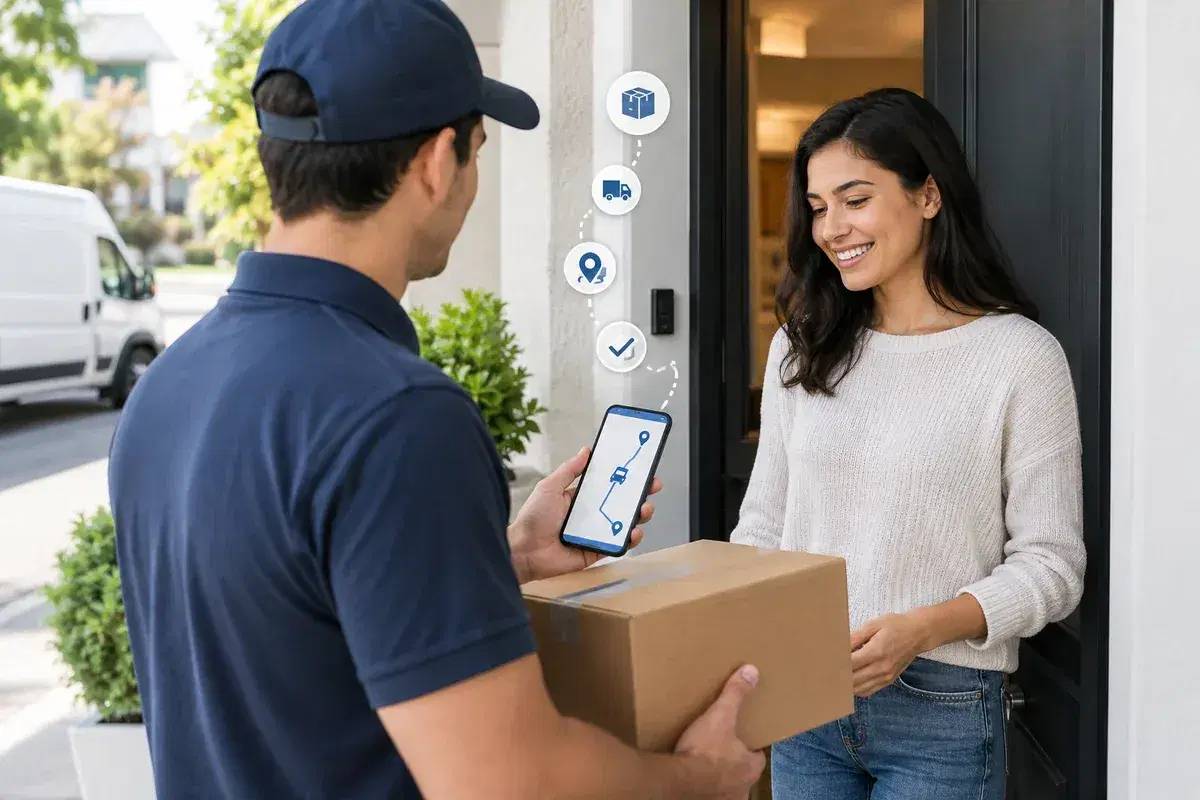
When customers get automated texts at the right moments, everything changes. “Your order is out for delivery.” “Your driver is 3 stops away.” “Your package has been delivered.” Suddenly they stop calling your office. They stop wondering. The anxiety disappears.
Delivery teams that implement automated notifications consistently see WISMO calls drop by 50 to 70%. That is not a typo. Half to two-thirds of your inbound calls, gone. That is your dispatcher getting most of their day back.
At minimum, set up notifications at three touchpoints. When the driver starts the route, so the customer gets a morning ETA. When the driver is approaching, maybe 10 to 15 minutes out. And when the delivery is complete, ideally with a photo. Those three alone will transform how customers feel about your service. Anything beyond that is a bonus.
2. Branded tracking pages
I have seen this one make a surprising amount of difference. When a customer clicks the link in their notification and lands on a tracking page with your company name, your logo, your colors, it changes how they perceive the whole operation.
It is the difference between feeling informed and feeling ignored. They can see the driver on the map. They can see progress happening. They can plan around it instead of guessing.
The branding part matters more than you might think. A generic tracking page does the job. A branded tracking page builds your reputation while doing the job. It tells the customer “we have our act together” in a way that no email campaign can match.
No app download. The customer taps a link and sees a map in their browser. That is it.
3. Real-time ETAs that actually update
There is a massive gap between “your delivery will arrive between 9 AM and 5 PM” and “your delivery will arrive at 2:15 PM.” One of those is completely useless. The other lets the customer actually live their life.
Static ETAs calculated at 7 AM are wrong by 9:30. Traffic happens. A stop takes longer than expected. A driver gets stuck behind a school bus for twenty minutes. Everything shifts.
Dynamic route optimization recalculates ETAs based on where the driver actually is and what is actually happening on the road. Not what somebody projected hours ago. The result is an ETA that gets more accurate as the delivery approaches. By the time the driver is three stops away, you are giving windows measured in minutes instead of hours.
That level of precision is what separates a good experience from one that customers actually talk about.
4. Photo proof of delivery
This one pulls double duty. Better customer experience and better protection for your business.
When a customer gets a “delivered” notification that includes a photo of their package sitting at their front door, two things happen. They know exactly where it was left. And they have zero reason to call your office asking if it actually showed up.
On your side, photo proof eliminates those “I never received it” disputes. Timestamp. GPS coordinates. Photo. It is all right there. No back-and-forth. No replacement costs for packages that were actually delivered.
Proof of delivery systems with photo capture add maybe 10 seconds to each stop for the driver. The hours they save your team in dispute resolution and callbacks make it the easiest trade you will ever make.
5. Delivery windows you actually hit
I want to be direct about this one. Offering time windows is great. Consistently blowing them is worse than not offering windows at all.
Because now you have set a specific expectation and failed to meet it. And that destroys customer trust faster than almost anything else. A customer who was told “sometime today” is annoyed. A customer who was told “between 1 and 3 PM” and gets their delivery at 5 PM is angry. There is a real difference.
The fix is not to stop offering windows. It is to make your routing smart enough to honor them. When your route optimization software accounts for time windows, traffic patterns, realistic stop durations, and the way drivers actually operate, the windows you promise are windows you can keep.
Even a wide window, say 1 PM to 4 PM, feels dramatically better than “sometime today.” As long as you hit it.
6. A way for customers to reach you that they rarely need to use
This one sounds contradictory. You should absolutely make it easy for customers to contact you about their delivery. Phone. Email. Whatever works for your operation.
But if you have done the first five things on this list, almost nobody will actually use it. Customers have their tracking link. They have their notifications. They have their delivery photo. The support channel becomes what it should be. A safety net for genuine exceptions, not a substitute for basic communication.
When your support line is quiet, that is actually a good sign. It means the systems are handling the routine stuff and your team can focus on the cases that genuinely need a human.
What Good Delivery CX Actually Looks Like
Let me paint you a picture. Same customer from the opening of this post. Same order. Different setup.
They order at 9 AM. Confirmation email arrives with a line: “Your delivery is scheduled for this afternoon. You’ll receive a text when your driver is on the way.”
1:30 PM. A text: “Hi, your order from [Your Business] is out for delivery. Track it live here: [tracking link]. Estimated arrival: 2:15 PM.”
2:05 PM. Another text: “Your driver is 2 stops away. Estimated arrival: 2:12 PM.”
The customer checks the tracking page. Sees the driver on their street. Walks to the door.
2:14 PM. “Your order has been delivered.” With a photo of the package at the front door.
Total effort on the customer’s part: opening three text messages. Calls to your office: zero. Stress about whether the delivery was going to show up: zero.
That customer orders again next week. Not because you sent them a promo code. Because the experience was effortless and they did not have to think about it.
This is not some premium experience that only massive logistics companies can offer. This is what delivery tracking and notification technology enables for any team. Five drivers or five hundred. The tools are the same.
What Technology Cannot Fix
I believe in being straight about this. Automation solves a lot. But not everything.
A rude driver undoes all of it. You can nail the notifications. Your tracking page can look incredible. But if the driver is rude or careless with the package, that is what the customer remembers. Driver training matters. Tech handles communication, humans handle the interaction.
Bad products still get returned. If what you delivered was damaged, wrong, or not what the customer expected, no amount of notification magic makes that okay. The delivery layer is only one layer.
Wrong addresses still cause failures. Your system will very accurately track the driver to the wrong location. If your addresses come from a web form with no validation, fix that first. Seriously. Before anything else on this list.
You cannot automate empathy. When something genuinely goes wrong, the customer wants a person. Not a chatbot. Not an automated apology. Someone who listens, acknowledges the problem, and actually fixes it. Build your technology to handle the 95% of interactions that are routine so your team has the energy to handle the 5% that need a real human touch.
Understaffing is still understaffing. If you have 80 stops and two drivers, the experience will suffer no matter how pretty your notifications are. “Your driver is running 3 hours behind schedule” is still a bad notification. Better than silence, sure. But it is not a fix.
How to Start Fixing This Today
If you have gotten this far you are probably thinking about what to change first. Here is how I would approach it.
This week. Turn on notifications and tracking. This is the 80/20 move. Get your drivers on a delivery app. Turn on automated texts. Give customers tracking links. Last mile delivery software like Bodha starts at $29.99 per user per month and can be set up in under an hour. Notifications alone will cut your WISMO calls in half within the first week.
Next week. Add proof of delivery. Have drivers capture a photo at every stop. It adds 10 seconds per delivery and saves hours per month in dispute resolution. Once customers start getting delivery photos in their notifications, callbacks about missing packages drop off a cliff.
Week three. Measure the difference. How many WISMO calls are you getting now compared to before? What is your failed delivery rate? How much time is your dispatcher spending on the phone? Track the same numbers for two weeks. Most teams see 15 to 30% overall cost reductions after setting up these basics.
Then get smarter. Use your delivery data to spot patterns. Which routes consistently run late? Which addresses have repeated delivery issues? Where are drivers spending too much time? The data from tracked deliveries gives you visibility into problems you didn’t even know existed.
The biggest barrier to all of this is not cost. It is not complexity. It is inertia. The way things work right now works well enough. Until you actually see what “well enough” looks like from the other side.
Final Thought
Your last mile delivery customer experience is not defined by your brand. It is defined by how your operations actually run, every single day.
Every missed time window. Every unanswered WISMO call. Every package left with no notification. Those are small chips in your relationship with a customer. Most of them are never going to complain. They are just going to leave.
The fix is not a rebrand or a new marketing push. It is operational systems that cost less than a tank of fuel per driver per month and take an afternoon to set up. Notifications. Tracking. Proof of delivery. Time windows. The basics.
Ninety-eight percent of your customers link how they feel about your brand to how the delivery went. So make it go well. Last mile software exists today that makes this work at any scale. Start with notifications. Watch what happens.
FAQ's
What is last mile delivery customer experience?
It is the total impression a customer forms during the final leg of their delivery. Everything from the moment they place the order to the moment they pick up the package. That includes order confirmation, delivery updates, tracking visibility, how accurate the ETA was, how the package was handled, whether they got proof of delivery, and what happens when something goes wrong. For most customers the delivery is the most tangible interaction they have with your brand. It directly influences whether they order from you again.
Why does last mile delivery customer experience matter so much for small businesses?
Because small businesses have fewer customers to lose. When research shows 84% of shoppers will not repurchase after a poor delivery, and 86% stop buying after just two bad experiences, losing even a handful of customers per month compounds quickly. Smaller teams also usually lack dedicated support staff. Every WISMO call and delivery complaint lands on someone who is already handling dispatch and routing and operations at the same time.
How can I improve delivery customer experience without spending a lot?
The three highest-impact changes are automated customer notifications, live tracking links, and photo proof of delivery. Delivery platforms like Bodha offer all three on the Pro plan, from $49.99 per user per month with setup in under an hour. Notifications alone typically reduce WISMO calls by 50 to 70%, and photo proof eliminates most delivery disputes. These are not enterprise-grade features anymore. Any team running even a handful of daily deliveries can set them up today.
What is the single biggest factor in delivery customer experience?
Communication. Customers tolerate delays far better when they are informed proactively than when they have no idea what is happening. I have seen cases where a delivery arrives 30 minutes late with tracking and a text update and the customer is perfectly fine with it. Meanwhile a delivery that arrives on time with no communication at all gets a complaint because the customer spent two hours wondering if it was going to show up. Informed customers feel in control. Uninformed customers feel forgotten.
How do WISMO calls hurt my business?
WISMO calls make up 35 to 40% of all inbound contact volume for delivery businesses. Each one costs roughly $6 in staff time and represents a moment where your customer got frustrated enough to pick up the phone. Beyond the cost, every call ties up your dispatcher and pulls their attention away from actually managing operations. Reducing WISMO through automated tracking and notifications improves both customer experience and your team's productivity at the same time.
How fast will I see results after improving my delivery customer experience?
WISMO call reduction is the fastest indicator. Most teams see a 50 to 70% drop within the first week of turning on tracking notifications. Failed delivery rates typically decrease within two to three weeks because real-time visibility lets dispatchers step in during problems instead of finding out after the fact. Customer retention improvements take longer to measure, usually 60 to 90 days. But the operational savings from fewer calls and fewer failed deliveries start showing up immediately.