 Ruchita Purohit
Your phone rings at 10:15 AM. “Hi, I was wondering about my delivery? It was supposed to be here by 10.”
You put the customer on hold. You text Driver #3. No response. You try calling. Voicemail. You check the spreadsheet where you planned this morning’s routes. According to that, he should have delivered it 20 minutes ago. But you honestly have no idea where he is right now.
So you go back to the customer and say the only thing you can say: “It should be there soon.” Which is not really an answer. It is a guess dressed up as reassurance.
This happens four or five times a day. Maybe more. And each call takes three to five minutes of your time, plus however long it takes to actually track down the driver. Multiply that across a week and you are spending hours on a question that should answer itself.
Here is the thing that does not get talked about enough. The technology to eliminate this entire problem costs less than what you spend on fuel for one driver in a month. Real-time visibility in last mile delivery used to be something only massive logistics companies could afford. That changed a few years ago and a lot of delivery teams have not caught up yet.
This guide is for them. Not for the enterprise logistics VP evaluating a six-figure platform. For the dispatcher, the owner-operator, the pharmacy manager who is also the delivery coordinator. The person who just wants to know where their drivers are without playing phone tag all morning.
What Real-Time Visibility in Last Mile Delivery Actually Means
Let’s get specific because this term gets used loosely.
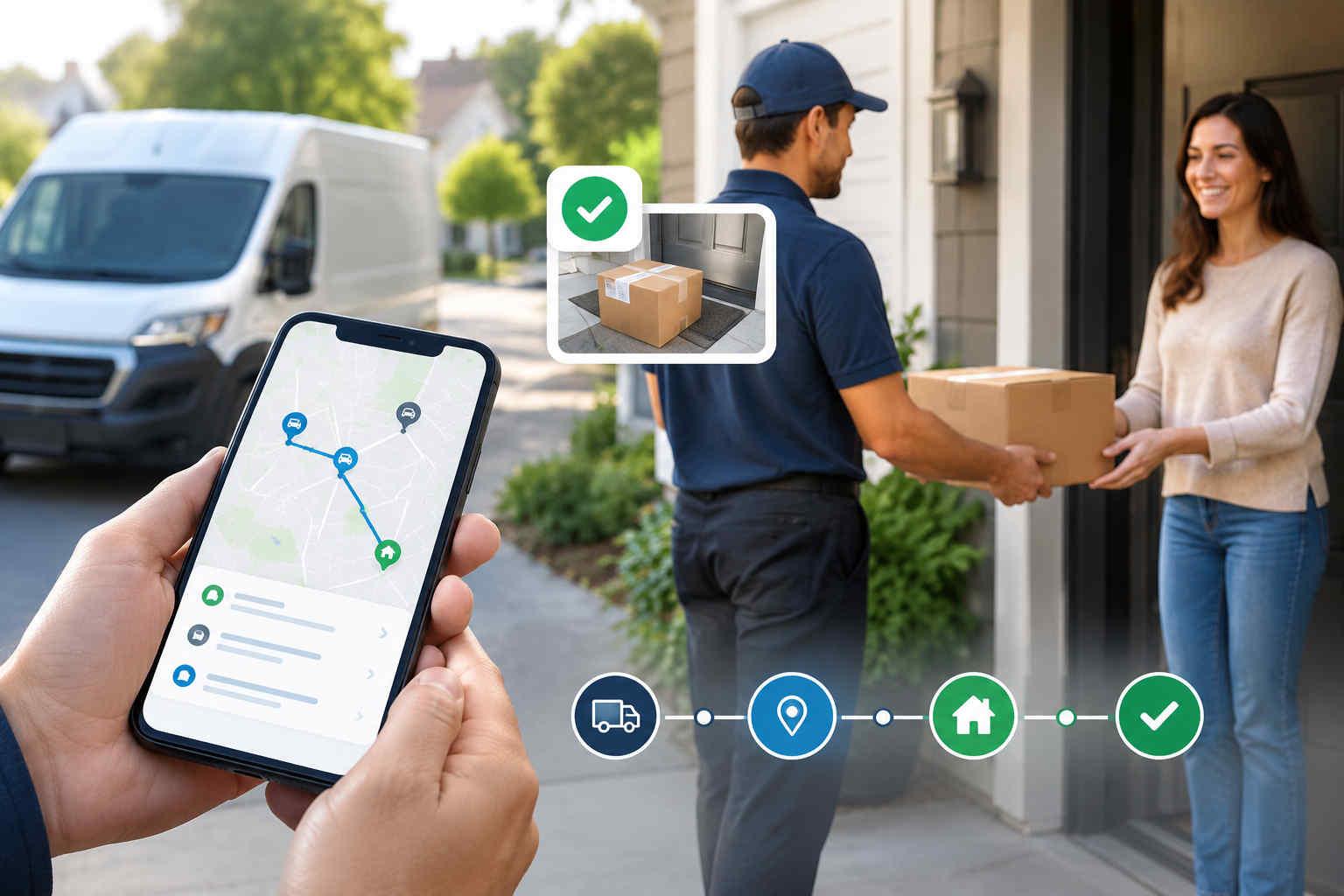
Real-time visibility in last mile delivery means you can see, at any given moment, exactly where every driver is, what stop they are on, how long they have been there, and what is coming next. Your customers can see it too. And when something gets delivered, you have proof.
That is it. Not complicated conceptually. But when you break down what it actually requires, there are four pieces that need to work together.
Live GPS tracking. Not “check in when you arrive” tracking. Actual continuous GPS that shows each driver’s position on a map updating every few seconds. You open your dashboard and you see dots moving. You know who is on schedule, who is behind, and who has been sitting at one stop for 25 minutes.
Automated customer notifications. Your customer gets a text or email when the driver is on the way, when they are nearby, and when they have delivered. No phone calls from your office. No “it should be there soon.” The system handles it.
Proof of delivery. Photo of the package at the door. Digital signature. Timestamp with GPS coordinates. When a customer says “I never got it,” you have documentation. When a business client needs delivery confirmation for their records, you have it ready.
A dispatch dashboard. One screen that shows you everything. All drivers, all stops, all statuses. Not six browser tabs and a group text thread. One place where you can see your entire operation in real time and spot problems before customers call you about them.
Most small delivery teams are running with zero or maybe one of these four pieces. They know where drivers are when drivers choose to check in. Customers know their delivery status when they call to ask. Proof of delivery is the driver’s word. And the “dashboard” is a spreadsheet that stopped being accurate two hours ago.
That gap between what is possible and what most teams are actually using is where all the preventable problems live.
The Real Cost of Delivering Blind
You can feel that running without visibility is inefficient. But the numbers make it hit different.
Those “where is my order” calls have a name in the industry. They are called WISMO calls. And they represent somewhere between 35 and 40% of all contact center volume for companies that ship products. At roughly $6 per call when you account for staff time, that adds up fast even for small teams.
A 10-driver operation doing 150 deliveries a day might field 15 to 20 WISMO calls daily. At $6 each, that is $90 to $120 per day just answering a question that technology can answer automatically. Over a month, you are looking at $2,000 to $2,500 spent on phone calls that should not need to happen.
But WISMO calls are actually the cheap part.
Failed deliveries are where the real money goes. Industry data puts the average cost of a failed delivery at $17.78 when you factor in the redelivery attempt, the customer service time, and the administrative overhead. And without real-time visibility, failed delivery rates typically run between 8 and 20%.
Let’s do the math on a bad month. 150 daily deliveries, 10% failure rate, $17.78 per failure. That is $2,667 per month in failed delivery costs alone. Some of that is unavoidable. People are not home. Addresses are wrong. But a significant portion of it is preventable with better communication and real-time adjustments.
Here is the number that should really keep you up at night: 47% of consumers say they will not order from a company again after a single bad delivery experience. You do not always see that cost on a spreadsheet. It shows up as customers who just quietly stop calling.
Meanwhile, 91% of consumers say they actively track their packages. They expect it. Not as a nice-to-have. As baseline. When you are not offering tracking and your competitor down the street is, that is a decision you are making whether you realize it or not.
We wrote about how AI in last mile delivery is reshaping operations across the board. Real-time visibility is one of the most tangible pieces of that shift. Not the flashiest. But probably the one with the most immediate ROI for a small team.
5 Ways Real-Time Visibility Changes Your Delivery Operation
1. WISMO calls drop because customers stop needing to call
This is the most immediate win and the one you will feel within the first week.
When a customer gets an automated text saying “Your delivery is 3 stops away, estimated arrival 2:15 PM,” they do not call your office. When they get a link to a branded tracking page where they can watch the driver approach in real time, they definitely do not call your office.
Delivery teams that implement real-time tracking with automated notifications typically see far fewer WISMO calls. For a team fielding 20 calls a day, that’s most of those interruptions gone. Your dispatcher gets their morning back. Your phone stops ringing with a question you never should have had to answer manually.
The branded tracking page matters more than people think. When your customer sees a professional tracking experience with your company name and logo, it builds trust. When they get a generic “your package is on the way” email with no details, it does not.
2. Failed deliveries decrease because you can actually intervene
Without visibility, you find out about delivery problems after the fact. The driver comes back at 4 PM and tells you three customers were not home. Great. Now you have three redelivery problems and three unhappy customers.
With real-time visibility, you see it happening. Driver #4 has been at a stop for 12 minutes. The average is 3. Something is wrong. Maybe the gate code does not work. Maybe nobody is answering. Your dispatcher can call the customer right then and figure it out while the driver is still there. Or they can reroute the driver and schedule a redelivery before the customer even knows there was an issue.
This is not theoretical. Dynamic route optimization works hand in hand with real-time visibility. You see the problem, you adjust the route, and the driver gets updated instructions on their phone. No callbacks. No second trips. The delivery gets handled the first time.
3. Proof of delivery eliminates the “I never got it” problem
Every delivery team has dealt with this. Customer says the package never arrived. Driver says they left it at the front door. There is no way to know who is right.
Photo proof of delivery solves this in the most straightforward way possible. The driver takes a photo of the package at the door. The system timestamps it and tags it with GPS coordinates. The customer gets the photo in their delivery confirmation notification.
Dispute over. No back and forth. No he-said-she-said. Just a photo with a timestamp.
For business-to-business deliveries, this is even more valuable. Your clients often need delivery confirmation for their own records. Instead of them chasing you for paperwork, the proof is in their inbox before they even think to ask.
Digital signature capture adds another layer for high-value deliveries or anything that requires a chain of custody record. The signer’s name, the timestamp, the GPS location. All documented. All searchable later if you need it.
4. Your dispatcher becomes an operations manager instead of a phone operator
This is the shift that changes how your business runs.
Without visibility, your dispatcher’s job is reactive. They wait for calls. They wait for texts. They wait for drivers to check in. Everything they know about what is happening out on the road comes from someone choosing to tell them.
With a live dispatch dashboard, they see everything without asking. All drivers on one map. All stops color-coded by status. Running late? The dashboard shows it before anyone calls. Stuck at a stop too long? Visible immediately. Done early with capacity to spare? They can see that too and route a same-day order to that driver.
This is not about replacing your dispatcher. Not even close. It is about giving them the information they need to actually manage operations instead of spending their whole day as an information relay.
The best dispatchers we talk to are not people who are great at answering phones. They are people who are great at making judgment calls. Which driver handles a difficult customer best. When to push back on an unrealistic time window. How to reorganize the afternoon when the morning went sideways. Real-time visibility lets them do that work instead of the phone tag that was eating their day.
5. You finally have data to get better
This is the one that sneaks up on you.
When every delivery is tracked from dispatch to completion, you accumulate data. How long does each stop actually take? Which neighborhoods consistently run slow? Which driver finishes routes 20% faster than everyone else, and what are they doing differently? What is your actual on-time percentage, not the one you think it is?
Most small delivery teams have never had access to this information. They operate on gut feeling and experience, which works until it does not. Analytics from your delivery route planning platform can show you patterns you would never spot manually.
Maybe your Tuesday routes consistently run 40 minutes over because you are scheduling too many stops in a neighborhood with limited parking. Maybe one apartment complex adds 8 minutes per stop because of the elevator situation and you should be accounting for that. Maybe your 2 PM to 4 PM window is unrealistic given actual drive times and you are setting yourself up to fail every afternoon.
You do not know what you do not know. Until you have the data, you are just guessing.
What Real-Time Visibility Does NOT Do
Worth being honest about this because there is a lot of marketing out there that stretches the truth.
It does not fix bad addresses. If the customer typed their address wrong, you will track your driver very accurately to the wrong location. Clean data still matters. No amount of GPS precision helps if the destination is garbage.
It does not make customers answer the door. You will know exactly when your driver arrived and how long they waited. You will have proof they were there. But you still cannot force someone to be home. What visibility does give you is the information to make a faster decision about what to do next.
It does not predict demand. Knowing where your drivers are right now is different from knowing how many orders you will get tomorrow. Demand forecasting requires historical data and pattern analysis that goes beyond real-time tracking. Your gut feeling about Mondays being heavy is probably still your best tool for that.
It does not replace talking to your drivers. Technology handles the routine information flow. But when something unusual happens, a road closure that is not on any map yet, a customer who gave special instructions by phone, a package that looks damaged, you still need human communication. Visibility handles the “where are you” question so your conversations can focus on things that actually need discussion.
It does not fix understaffing. If you have 80 stops and 3 drivers, visibility will show you very clearly that your 3 drivers are overwhelmed. It does not conjure a fourth driver. It optimizes what you have, not what you wish you had.
We lay this out because trust matters. The tool does what it does really well. Pretending it does more helps nobody.
What to Look for in a Last Mile Visibility Solution
If you are a small delivery team evaluating options, here is what actually matters. Not the feature list that enterprise platforms use to justify their $50,000 contracts. The stuff that makes a difference when you have 8 drivers and need this working by Friday.
GPS tracking that actually updates in real time: Some platforms advertise “real-time tracking” but only update driver positions every 5 to 15 minutes. That is not real time. That is checking in occasionally. You want updates every few seconds. The difference matters when you are trying to give a customer an accurate ETA or figure out why a driver has not moved.
Customer-facing tracking pages: Not just an internal dashboard. Your customers need to be able to see where their delivery is without calling you. Branded with your company name and logo. Accessible via a link sent in an automated notification. This is the piece that kills WISMO calls.
Automated notifications at key moments: At minimum: when the driver starts the route, when they are approaching the customer’s stop, and when the delivery is complete. SMS and email. Configurable so you can match your workflow.
Photo and signature proof of delivery: Non-negotiable. If a driver cannot snap a photo and have it automatically attached to that delivery record, the platform is not complete. Bonus if the customer gets the photo in their completion notification.
A dispatch dashboard that does not require training: If your dispatcher needs a two-day training session to use the dashboard, the dashboard is too complicated. You should be able to open it and immediately understand where every driver is and how the day is going.
Mobile-first driver app: Your drivers are on their phones all day. The app needs to work well on a phone, not just technically function. Fast loading. Clear next-stop information. Easy proof of delivery capture. Minimal data usage.
Pricing that makes the decision easy: Last mile delivery tracking software like Bodha starts at $29.99 per user per month. That gets you route optimization, live GPS tracking, customer notifications, proof of delivery, and analytics. If someone is quoting you $50,000 per year or asking for a 12-month commitment before you can even try it, they are not built for a team your size.
Setup measured in hours, not months: You should be able to sign up, import your stops, and run your first tracked route the same day. If the sales pitch includes the words “implementation timeline” or “onboarding specialist,” keep looking.
How to Start
Do not overthink this. The teams that get the most value from real-time visibility in last mile delivery are the ones that start simple and build from there.
Week one: tracking and notifications. Get your drivers on the app. Get live GPS running. Turn on automated customer notifications. This alone will cut your WISMO calls significantly and give your dispatcher a dashboard to work from.
Week two: proof of delivery. Add photo POD to your driver workflow. It takes drivers about 10 extra seconds per stop and saves you hours of dispute resolution per month.
Week three: measure it. Compare your numbers. How many WISMO calls are you getting now versus before? What is your failed delivery rate? How much time is your dispatcher spending on the phone? Most teams see 15 to 30% cost reductions overall, but your numbers will tell your story.
After that: use the data. Look at your analytics. Find the patterns. Adjust your routes and schedules based on what actually happens, not what you think happens. This is where the compounding value kicks in.
The barrier to getting started is not cost. It is not complexity. It is usually just inertia. The way you have always done it feels fine until you see what you have been missing.
Where Last Mile Visibility Is Heading
The delivery tracking market is growing at roughly 12.2% annually, and the drivers of that growth are not slowing down anytime soon.
Customer expectations are the biggest force. Same-day delivery is becoming standard in more categories. Delivery windows are getting tighter. “Sometime between 9 and 5” was acceptable ten years ago. Now people want a 30-minute window and a live tracking link. That bar is only going up.
Predictive ETAs are getting more accurate as routing algorithms learn from historical delivery data. Instead of “your driver is 3 stops away,” the notification might say “arriving in 11 minutes based on current traffic and your driver’s pace today.” Small difference in words. Big difference in customer experience.
The technology gap between enterprise and SMB solutions has largely closed. The core visibility features that a 500-truck fleet uses are the same ones available to an 8-driver team. The difference is in edge cases and integrations, not in the fundamental tracking and notification technology.
If you are still operating without real-time visibility, the gap between your operation and your competitors who have it is widening every month. Not because the technology is changing that fast. Because customer expectations are.
Final Thought
Real-time visibility in last mile delivery is not a competitive advantage anymore. It is table stakes. The question is not whether you need it. The question is how much longer you can afford to operate without it.
Every “where is my order” call your dispatcher fields is time they are not spending on work that actually grows your business. Every failed delivery you find out about at the end of the day is a problem you could have fixed in real time. Every customer who stops ordering because they got a lousy delivery experience is revenue that just walks away.
The fix is not expensive. It is not complicated. And it does not take months to implement. Last mile delivery management software exists today that can have you running with full real-time visibility by this time next week.
Start with tracking. Watch your WISMO calls disappear. Go from there.
FAQ's
What is real-time visibility in last mile delivery?
Real-time visibility in last mile delivery means having continuous, live access to the location and status of every driver and delivery in your operation. It includes live GPS tracking of your fleet, automated customer notifications at key delivery milestones, photo and signature proof of delivery, and a dispatch dashboard that shows your entire operation on one screen. Instead of relying on phone calls and text messages to know where things stand, you see everything in real time and so do your customers.
How does real-time visibility reduce delivery costs?
The biggest cost savings come from three areas. First, automated tracking and notifications cut WISMO calls sharply, saving about $6 in staff time for every call you avoid. Second, real-time visibility helps dispatchers intervene during delivery problems while drivers are still on site, reducing failed delivery rates and the $17.78 average cost per failed delivery. Third, the data from tracked deliveries reveals inefficiencies in your routes and schedules that you can fix over time, typically producing 15 to 30% overall cost reductions.
Do I need real-time visibility if I only have a few drivers?
Yes, and arguably more so. Larger fleets have dedicated dispatch teams and support staff to handle WISMO calls and delivery issues. A small team with 5 to 10 drivers usually has one person doing dispatch, customer service, and operations management simultaneously. Real-time visibility automates the information flow that eats up most of their day, letting them focus on work that actually requires human judgment instead of answering "where is my delivery" calls all morning.
What is the difference between real-time tracking and delivery notifications?
Real-time tracking is the continuous GPS monitoring that shows where each driver is at any moment, primarily for your dispatch team's use. Delivery notifications are the automated messages sent to customers at key points, such as when the driver starts their route, when they are approaching, and when the delivery is complete. Both are components of real-time visibility, and they work together. Tracking gives your team control. Notifications give your customers confidence. Together, they eliminate most of the manual communication that bogs down delivery operations.
How long does it take to set up real-time visibility for my delivery team?
With modern platforms built for small to mid-sized delivery teams, setup typically takes under an hour. You create your account, invite your drivers to download the mobile app, and import your stops. There is no complex integration project or IT department involvement required. Most teams run their first fully tracked route the same day they sign up and see measurable results within the first two weeks.
Can real-time visibility help with same-day delivery?
It is arguably where visibility makes the biggest difference. Same-day delivery means your stop list changes constantly throughout the day. New orders come in, customers reschedule, priorities shift. Without real-time visibility, every change requires your dispatcher to call drivers and manually figure out who can handle what. With visibility, your dispatcher sees every driver's current position, remaining stops, and available capacity on one screen, making it possible to slot in new orders and adjust routes in seconds instead of spending 15 minutes on the phone.