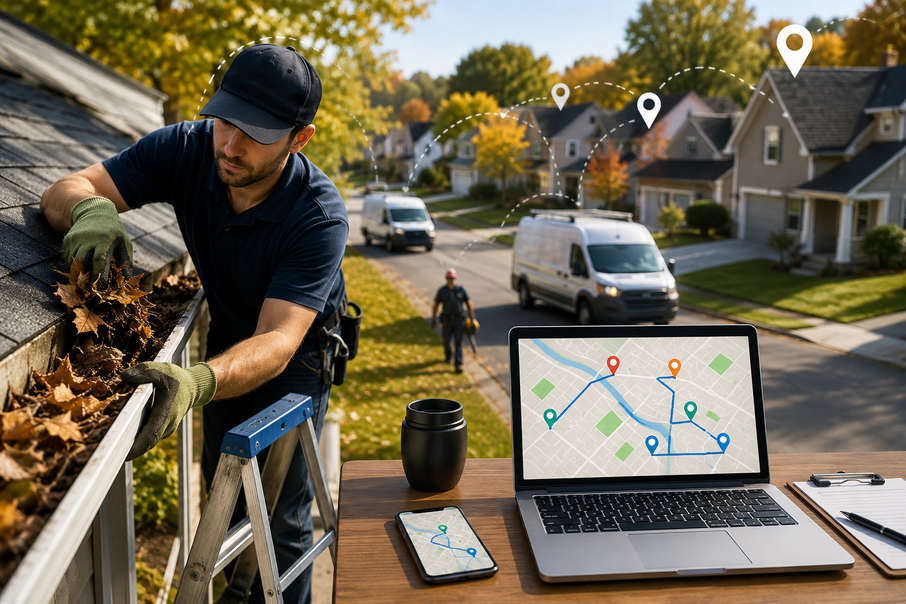
You got into gutter cleaning because you’re good at the work. Nobody starts this business because they enjoy staring at Google Maps every morning, trying to figure out which house to hit first.
But that’s exactly where a lot of us end up. Thirty minutes before the coffee even kicks in, you’re scribbling addresses, guessing at drive times, hoping you don’t end up crisscrossing town all day like some lost delivery driver.
If that’s your morning routine, you’re not alone. And it’s probably costing you way more than you realize.
What Manual Route Planning Is Really Costing You
I talk to gutter cleaning business owners all the time who plan routes by hand. Some use a notepad. Some pin addresses in Google Maps. Some just wing it. And almost all of them are leaving serious money on the road.
Think back to your last busy week. How many times did you drive past the same neighborhood twice because your jobs were all over the place? How many extra stops could you have fit in if the gap between houses was 8 minutes instead of 22?
The data on this is pretty clear. Poor routing can eat up 30 to 40 percent of your daily job capacity. So if you’re doing 6 jobs a day right now, tighter routes could realistically push that to 8 or 9. That’s two or three more invoices every day without hiring anyone or working later.
It’s not just fuel costs either (though yeah, those add up). It’s the customers you’re turning away because you ran out of daylight. If you’ve never really dug into what route optimization actually means and how it works under the hood, that’s worth a read on its own.
Gutter Cleaning Has a Routing Problem Most Trades Don't
Here’s what people outside this industry don’t get. A plumber or an HVAC tech might run two or three service calls in a day. You’re running six, eight, sometimes ten or more. And each job is relatively quick.
So your ratio of driving to actual work is way worse than most trades. A plumber who loses 15 minutes to a bad route barely feels it. You lose 15 minutes between every single stop? That’s two hours gone before you even notice.
Then there’s the seasonal crunch. When fall hits and the leaves come down, your phone blows up. Spring thaw brings another wave. You’ve got a tight window to earn the bulk of your annual revenue, and every wasted minute during those peaks is money you’ll never get back.
This is why route planning and optimization software matters so much in gutter cleaning specifically. More than almost any other home service trade.
So What Does Route Optimization Software Actually Do?
I’ll skip the technical jargon. In practice, it works like this.
You load in your jobs for the day. Addresses, time windows, roughly how long each stop takes. Most tools let you import everything from a spreadsheet so you’re not typing addresses one by one. The software figures out the smartest order to hit everything. Not just shortest distance on a map, but the fastest real-world route, accounting for traffic, road layouts, and the actual time you need at each property.
Better tools go further. They can assign jobs to specific crew members based on who’s closest. They’ll fire off an automatic text to your customer saying you’re 20 minutes out. And if a morning job cancels or runs long, the software reshuffles your afternoon without you touching anything.
Less driving. More cleaning. Happier customers. More money. That’s really all there is to it.
Features Worth Paying For (And Ones You Can Ignore)
Every software vendor will hit you with a wall of features. Most of them won’t make a difference for a gutter cleaning operation. Here’s what actually matters.
Multi-stop route optimization is the whole point. If the tool can’t handle 8 to 12 stops per crew and put them in a smart order, don’t bother. This one feature is what you’re paying for. A good route optimization engine uses real road data and actual drive times, not just straight-line distances on a map.
Geographic clustering is something most gutter cleaners haven’t heard of, but it’s probably the most powerful thing on this list. The concept is simple. You group your bookings by neighborhood. Monday is always the east side. Tuesday is always north. Over time, your routes naturally get tighter because you’re filling gaps within the same area instead of taking random bookings from all over.
GPS tracking becomes important once you have even one other person working for you. Knowing where your crew is without calling them saves a lot of back-and-forth and helps you adjust plans when something goes wrong. Real-time tracking that works off your crew’s phone (no extra hardware to buy) is the sweet spot for most gutter cleaning operations.
Customer notifications seem small but they do a lot for retention. People love getting a heads-up that you’re on the way. Automated delivery notifications cut down on missed appointments and make your operation look more professional than 90% of your competition.
A mobile app for your crew matters because your people are on the road all day. They need their stop list, navigation, and job details in one place on their phone. A solid driver mobile app means your crew follows the optimized route without calling you for the next address.
Manual override capability matters because sometimes you just know better than the algorithm. Maybe you know a certain driveway is a nightmare to back out of and that house should be your last stop. You need to be able to drag things around without rebuilding the whole route.
Everything else, things like CRM, invoicing, payment processing, those are business management features. They’re nice to have bundled in, but don’t let them distract you from the real question. Does this tool make my daily routes smarter?
The Zone Strategy That Separates Busy Gutter Companies from Profitable Ones
This might be the most important section in this entire post, and it has nothing to do with software.
Stop accepting bookings randomly.
I know that sounds crazy. Someone calls from across town and your instinct is to say yes and book them tomorrow. But that one faraway job might cost you two closer jobs because of the extra drive time.
Instead, assign each day of the week to a geographic zone. When a customer calls from the north side, they get your north-side day, even if that’s four days away. East side caller? They go on east-side day.
It feels weird at first, like you’re pushing customers away. You’re not. You’re organizing your work so every route stays tight, every drive is short, and every day is packed with paying stops instead of windshield time. This is exactly the same zone-based approach that successful cleaning service operations and lawn care companies use to keep their crews productive.
The gutter companies pulling in real revenue run this way. They don’t chase every lead the second it comes in. They batch work by zone and let their route optimization software handle the stop-by-stop sequencing.
Give it a month. Your routes will get denser. Your cost per job will drop. And you might actually finish before dinner.
Why Bodha Route Planner Works for Gutter Cleaning Crews
Most route planning tools out there were built for delivery fleets or long-haul trucking. They’re designed around packages and warehouses, not ladders and gutters. That’s why a lot of gutter cleaning operators try them and give up within a week.
Bodha Route Planner is different because it was built for exactly the kind of work you do: dense, multi-stop days across a service area where tight sequencing is the difference between 7 jobs and 10 jobs.
Here’s what makes it a fit for gutter cleaning specifically:
You can plan routes for a solo operator or manage multiple crews from one dashboard. The AI figures out the fastest stop order using real road data, not straight-line guesswork. When a morning job cancels or a customer calls in a last-minute add, Bodha re-optimizes the rest of the day automatically.
Your crew gets everything on their phone through the mobile app. Stop list, navigation, customer notes, gate codes, all in one place. They tap through each stop and move to the next without calling the office.
Customers get an automatic “on my way” text with a tracking link. That one feature alone cuts your “when are you coming?” calls in half and makes your business look bigger and more professional than it might be.
And at the end of the day, route analytics show you exactly how many stops each crew hit, how much drive time they logged, and where the bottlenecks are. Over a few weeks, that data tells you exactly which zones are profitable and which ones are eating your margins.
Bodha offers a 7-day free trial with no credit card required. You can load in a real week of gutter cleaning jobs and see how the optimized routes compare to what you’ve been doing manually. Most people see the difference on day one.
You can check their pricing page for current plans. They charge per account, not per user, which saves real money once you start adding crew members.
A Little Bit of Math That Makes the Decision Easy
Say you run two crews, averaging 7 jobs each per day. The national average for a residential gutter cleaning is about $167. That puts your daily revenue around $2,338.
Route optimization typically bumps daily capacity by around 20 percent, and that’s on the conservative side. That works out to roughly 3 extra jobs per day between both crews. At $167 per job, you’re looking at about $500 more each day.
Over 22 working days in a month, that’s over $11,000 in additional revenue. The software costs you somewhere between $30 and $200 a month depending on what you pick.
Even if reality gives you half those numbers, you’re still clearing an extra $5,000 monthly for a tiny subscription fee. The math just works.
Getting Started Without Overthinking It
You don’t have to tear apart your whole operation to try this. Keep it simple.
First, track your drive time between jobs for one week. Just jot it down. Most people are genuinely surprised at how much of their day is spent behind the wheel versus actually working.
Then pick a tool and run the free trial. Bodha’s free route planner lets you load in real jobs and compare the optimized routes to what you would have planned yourself. The difference usually speaks for itself.
After that, try the zone strategy. Map your service area into 4 or 5 zones and start directing bookings to their assigned day. The first month takes some discipline, but the payoff builds on itself fast.
Finally, measure the results. Compare your daily job count, drive time, and fuel costs from before and after. You won’t need anyone to convince you at that point.
Wrapping Up
The U.S. gutter cleaning industry is pushing toward $800 million, with close to 5,000 businesses competing for the work. The companies that are growing fastest aren’t necessarily better on the ladder. They’re just way more efficient getting from one house to the next.
Route planning and optimization software isn’t some trendy tech purchase. It’s the difference between finishing your day stretched thin with tight margins and finishing early with money to show for it.
You already do the hard work. Climbing ladders in bad weather, scooping debris, dealing with heights that most people avoid. The least you can do is make sure the drive between jobs isn’t the thing eating your profit.
Your routes should work as hard as you do. Try Bodha free for 7 days and see what smarter routing looks like on your schedule.