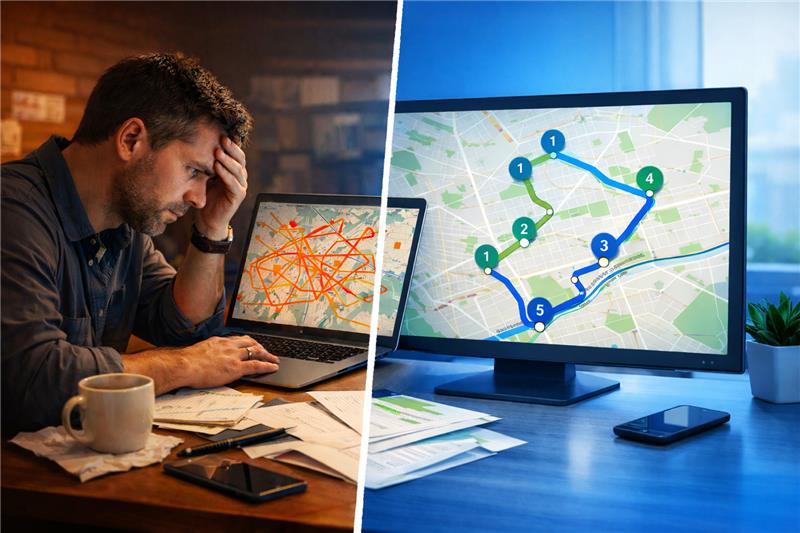
It’s 6:45 on a Monday morning. You’ve got sixty orders staged, one driver just called in sick, and the two who did show up are standing by their vans waiting to hear where to go first. So there you are, hunched over a spreadsheet, coffee going cold, dragging addresses up and down and trying to guess a sensible order before the traffic builds.
Sound familiar? That daily scramble is the whole reason route optimization exists.
In this guide we’ll walk through what route optimization actually is, how the technology works behind the scenes, how to tell when you’ve outgrown planning by hand, and what the switch is really worth in fuel, time, and extra deliveries. No vague promises. Just the real numbers.
What Is Route Optimization?
Here’s the short version. Route optimization is the process of using software to work out the most efficient order and path for a driver, or a whole team of them, to finish a set of stops. And it does this while respecting the messy real-world stuff: traffic, delivery windows, how much each van can carry, when each shift ends.
That sounds simple enough. It isn’t.
Take just ten stops. A driver could follow them in more than 3.6 million different orders. Bump that up to twenty stops and the number of possible sequences gets so large it stops meaning anything to a human brain. Nobody at a desk is solving that with a highlighter and a map. Software does it in a couple of seconds.
And here’s the part people miss. The goal isn’t just “shortest distance.” A route can look beautifully tidy on a screen and still fall apart the second a driver hits the road, because it ignored a customer’s 2pm to 4pm window, packed one van past its limit, or scheduled a stop for after someone’s shift ends. Good optimization weighs all of that at the same time. That’s the gap between a route that looks efficient and one that actually survives contact with a real Tuesday.
Route Optimization vs. Route Planning: They're Not the Same Thing
People throw these two terms around like they mean the same thing. They don’t, and the confusion quietly costs money.
Route planning is just the act of making a route. You pick your stops, put them in some order, and off you go. A whiteboard works. A spreadsheet works. Google Maps works. If you’ve got five stops and no time pressure, honestly, that’s fine.
Route optimization is what happens when you hand that ordering decision to an algorithm instead. The software figures out the sequence based on live traffic, time windows, vehicle capacity, driver hours, and a handful of other variables you almost certainly aren’t tracking by hand.
Want to see the difference in plain terms? A dispatcher planning routes for eight drivers by hand might burn ninety minutes on it every morning. Run the same job through optimization and the routes come out in under two minutes, and they’re usually shorter too. That saved hour isn’t a one-off. It comes back every single working day, forever. If you’d rather see it in action than read about it, our free route planner lets you try it on your own stops.
How Route Optimization Actually Works
Under the hood, one optimization run moves through the same handful of steps every time.
First, your addresses go in. You type them, upload a spreadsheet, or pull them straight from your order system through an API. Decent software reads each address and figures out the exact location on its own, so you’re never hunting down coordinates.
Then you set your constraints. This is the bit most people underestimate right up until it burns them. Constraints are the rules that make a route real. This customer is only home between 2 and 4. This van tops out at 300kg. This driver starts from a different depot. This pickup has to happen before that drop. You lock all of that in before anything runs.
Next, the algorithm solves it. The engine chews through the enormous pile of possible orderings, far faster than any person could, and hands back a sequence that keeps your rules intact while shaving off as much time and distance as possible.
After that, routes land on the drivers’ phones. In order, with turn-by-turn navigation and stop notes attached, right inside the driver mobile app. No printouts. No dropping a list of addresses into a group chat.
Finally, the plan adjusts on the fly. A new order at 11am? A cancelled stop? A driver stuck behind an accident? Modern systems re-shuffle whatever’s left of the route and quietly update the driver without you lifting a finger.
If you want the nerdy footnote: all of this traces back to a famous computer science puzzle called the travelling salesman problem, which asks for the shortest route that visits every location once and comes back to the start. It’s brutally hard precisely because the options explode with every stop you add. Which is exactly why you want a machine on it, not a gut feeling.
The Benefits of Route Optimization
So what do you actually get out of it? Five things, mostly, and every one of them shows up on either your bank statement or your customer reviews.
Lower fuel and fewer miles
Bad routes are full of wasted motion. Doubling back. Crossing the same neighborhood twice. Zig-zagging down a street instead of just working it end to end. Tighten the sequence and total mileage usually drops by 20 to 30%. That flows straight into a smaller fuel bill and less wear on the vans.
More deliveries per driver
When drivers stop wasting time getting from one stop to the next, they simply fit more stops into a shift. Most operations see somewhere between 15 and 25% more deliveries per driver per day. That’s extra capacity you didn’t have to hire or buy a van for.
Fewer missed time windows
Optimization builds delivery windows into the route from the very start instead of treating them as an afterthought. Missed windows drop, and so do all those failed first-attempt deliveries that follow them around.
Better visibility and happier customers
Once your routes are optimized, reliable ETAs and live tracking suddenly become possible. That means fewer “where’s my order?” phone calls, especially once you’ve got automated delivery notifications going out, and a dispatcher who can see the whole fleet on one live map, redirect people, and react the moment something goes sideways.
Calmer drivers who stick around
A driver following a clear, pre-sorted route with no guessing about what comes next finishes the day a lot less frazzled. It’s a soft benefit, sure. But drivers are expensive to lose and replace, and that calm adds up quietly over months.
The Challenges Nobody Warns You About
In a perfect world, planning routes would be a solved problem. Out in the real world, it’s a bit of a wrestling match. Knowing where the friction comes from helps.
Disruptions are the big one. Accidents, roadworks, a sudden downpour. One of these can wreck an otherwise perfect plan, and if your tool can’t re-sequence mid-day, that single disruption cascades through everything after it.
Driver scheduling is trickier than it looks too. It’s not just about the shortest path. You’ve got availability, breaks, legal driving-hour limits, and the fact that not every driver can do every job. The right person has to land on the right route.
Then there’s the manual planning trap itself. Done by hand, it’s slow, it’s inconsistent between whoever’s doing it, and it basically can’t account for live traffic and time windows at the same time. Throw electric vehicles into the mix, with their charging windows and range limits, and doing it in your head becomes genuinely impossible.
And looming over all of it: customer expectations keep rising. People want tight, reliable windows and updates on their phone. Fuzzy ETAs and surprise delays chip away at trust, and eventually at your reputation.
What Route Optimization Is Really Worth (The Actual Dollar Math)
Let’s skip the hand-waving and run some real numbers. Two common setups.
Setup A: five drivers, roughly 40 stops each per day. A 20% cut in mileage saves around 25 to 30 miles per driver, per day. At today’s fuel prices that’s about $12 to $15 each. Across a 22-day working month, you’re looking at $1,320 to $1,650 saved on fuel alone. Stack that against software costing a low three figures a month and the return is strong before you’ve even counted the time you get back or the extra deliveries you can now fit.
Setup B: ten drivers, 60-plus stops each per day. Now that same 20% saves closer to $2,800 to $3,500 a month in fuel. Add the 60 to 90 minutes of daily planning you’re no longer losing, plus the extra stops each driver squeezes in, and most operations this size hit payback inside two to three weeks.
Here’s a thing worth flagging though. Fuel is the saving everyone sees, but it’s often not the biggest one. A failed first-attempt delivery costs somewhere around $15 to $25 per package once you count the re-handling and the second trip. If sloppy routing is causing even a handful of missed windows a day, that quietly outpaces your fuel savings. And if you want to actually see where the money’s going, route analytics breaks down cost per drop, stops per hour, and where the misses happen.
The classic example is UPS deciding to stop turning left. Left turns force a truck to sit there idling against oncoming traffic, so they designed most of them out of their routes. That one change now saves the company millions of gallons of fuel a year. You’re almost certainly not running at UPS scale, and that’s not the point. The point is that small, consistent tweaks to how stops are ordered pile up into enormous numbers over time.
7 Signs You've Already Outgrown Manual Planning
This is the uncomfortable part. Most businesses that need optimization can feel that something’s off. They just haven’t connected it back to routing yet. See how many of these land.
Planning takes more than 30 minutes a day. An hour of daily planning works out to 250-plus hours a year that software would handle in seconds.
Drivers run late on time windows regularly. Not the odd rough day. A pattern. That means your sequence isn’t respecting the constraints.
Fuel cost per delivery keeps creeping up as you add stops. Routes should get tighter as you scale, not messier.
Every driver plans their own way. You lose consistency, you lose the ability to compare, you lose control.
Customers keep calling to ask where their delivery is. Unreliable ETAs are a routing symptom, plain and simple.
Adding one mid-day stop means replanning from scratch. That doesn’t scale, and you know it.
You’re planning one driver at a time. Which means you’re optimizing individual routes instead of balancing the whole fleet at once. This is exactly the jump fleet routing software is built for.
If more than two of these describe your operation, staying manual is almost certainly costing you more than switching would.
What About Just Using Google Maps?
Everyone’s already got Google Maps. It’s free, it works, your drivers know it inside out. So the obvious question is: why on earth would you pay for anything else?
Fair question, and here’s the honest answer. Google Maps was built for a regular person driving to one place. It was never built for a delivery operation, and the gap between the two is bigger than it looks. It caps you at a small handful of stops. It has no idea what a delivery time window is. It doesn’t understand vehicle capacity. It can’t track your fleet, it can’t text your customers, and it has no proof of delivery.
For a few stops and one driver, it’s genuinely fine. But run multiple drivers with 30-plus stops each, with customers who expect to know when you’re arriving, and you’ve quietly outgrown it. You might just not have noticed yet. If you want the full side-by-side, our route optimization software page breaks it down.
Static vs. Dynamic Optimization: Which One Do You Need?
There are two broad flavors of optimization, and the right one comes down to how your day actually runs.
Static optimization means you plan your routes ahead of time, usually the night before or first thing in the morning, from a finished order list. It suits scheduled work beautifully: grocery runs, pharmacy deliveries, meal kits, anything where you know all your stops before the vans leave. Most small and mid-sized operations run this way, and it’s the simpler of the two.
Dynamic optimization is for the businesses where orders keep landing all day and have to be slotted into routes that are already out on the road. Think same-day couriers or restaurant delivery. The software keeps re-sequencing as new stops come in, which is a fair bit more complex to pull off.
The practical takeaway? Most scheduled operations don’t actually need dynamic optimization. But you should know which mode a tool supports before you sign up for it.
Where It Makes the Biggest Difference
Any multi-stop operation benefits from this. But some feel it harder than others.
Food delivery notices first, because route quality and product quality are the same thing here. A badly ordered route means cold food, and cold food means a one-star review before dinner’s even over.
Pharmacy and medical delivery is another world entirely. Strict windows, temperature rules, documentation requirements. Here optimization isn’t a nice-to-have, it’s a compliance thing.
Courier services running 80 to 100 stops a driver see the biggest raw efficiency gains, simply because tiny per-stop savings compound massively at that kind of volume.
And furniture or large-item trucking runs have their own headache: you have to load the van in the right order, because the first thing you deliver shouldn’t be the thing buried at the very back. A proper vehicle loading plan solves exactly that.
It doesn’t stop there either. Waste collection, field service, lawn care, and HVAC and plumbing teams all run into the same routing math. You can see the full list of industries if yours isn’t mentioned here.
Where Route Optimization Is Heading in 2026
The tech is moving quickly, so if you’re picking a tool for the long haul, it’s worth knowing where things are going.
AI-driven routing is becoming the standard rather than the premium add-on. These systems now learn from your history. Which driver tends to move faster in which part of town, where the traffic reliably jams up on a Friday, and they fold all of that into future routes automatically. The routes literally get smarter the longer you use them.
EV fleet optimization is a genuinely new constraint that barely existed a couple of years ago. Electric vans have range limits and need charging time planned into the day, and the better tools now treat a charging stop the same way they treat a delivery window. If EVs are anywhere on your horizon, ask about this directly.
Sustainability reporting has quietly become its own feature category. Tracking carbon per stop is turning into a real business requirement, not just a nice line for the website, and route optimization happens to be the main lever for cutting emissions per delivery. It’s one of those rare cases where the greener choice and the cheaper choice are the exact same choice.
What to Actually Look For When You're Shopping Around
If you’re comparing tools, here’s what genuinely matters versus what’s just marketing noise.
Stop capacity matters more than people think. If a tool caps you at 100 or 200 stops per route, you’ll smack into that ceiling the moment you grow. Give yourself plenty of headroom.
Real-time GPS tracking is non-negotiable for any multi-driver setup. And not just a dot wandering around a map. Actual live status updates as drivers arrive and mark stops done.
Proof of delivery shouldn’t be an afterthought. Photos, signatures, and notes captured right in the app. When a customer disputes a drop, timestamped evidence ends the argument fast. Bonus points if it comes with a package scanner so nothing rides the wrong van in the first place.
Customer notifications should be built in, not stitched together through some separate integration you have to babysit. Automated text notifications with live ETAs cut your inbound calls dramatically.
And finally, how fast can you actually start? Some enterprise platforms take weeks to set up and need IT involved. For most delivery businesses that’s a dealbreaker. You should be building your first real route the same day. For reference, Bodha’s route optimization software covers all five of these, and most teams are running inside an hour.
Questions We Get Asked Often
The Bottom Line
Most delivery businesses don’t struggle because their product is bad or their drivers are bad. They struggle because the gap between what they’re spending on the road and what they could be spending, with tighter routing, quietly eats away at their margins every single day.
Route optimization closes that gap. It won’t magically fix everything in your operation. But it will make your routes shorter, your drivers’ days more manageable, and your fuel bills noticeably lower. And for most businesses, it pays for itself within a few weeks.
If you’re still sending drivers out with a hand-sorted list or a Google Maps link, do yourself a favor. Spend twenty minutes seeing what optimized routes look like for your own stops and your own patch.
Start your free 7-day Bodha trial and run your first optimized route today.