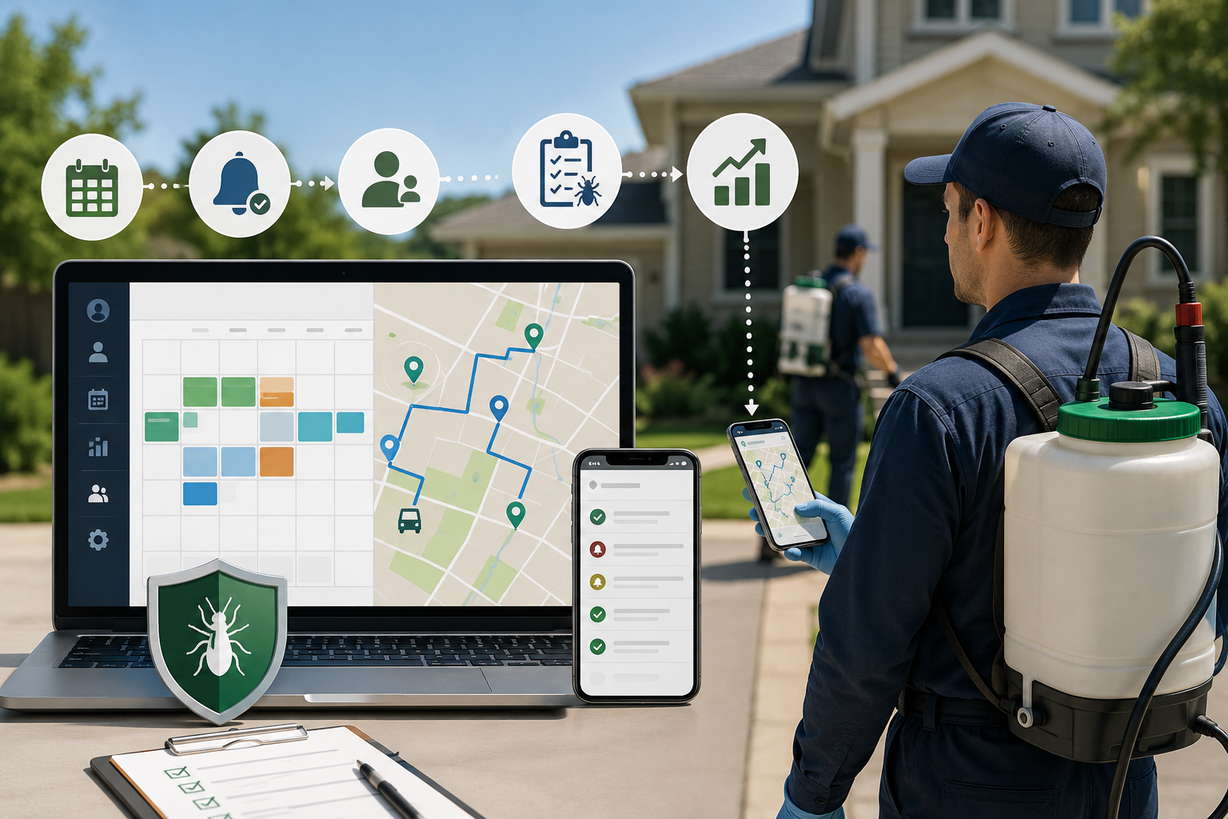
Every pest control owner knows the number that actually matters isn’t how many new customers you signed this month. It’s how many of last year’s recurring accounts are still on the books. Quarterly generals, monthly mosquito, bi-monthly rodent, the annual termite renewal. That recurring base is the business. And the fastest way to lose it is quietly, one missed treatment at a time.
The right pest control scheduling software exists to plug that leak. This guide walks through what these tools actually do, the four different kinds you’ll run into while shopping, a checklist for comparing them fairly, and how to keep every recurring visit on cycle. No sales pitch, just how to choose well.
Why Recurring Treatments Slip Through the Cracks
Here’s the uncomfortable truth about pest control: most missed visits aren’t dramatic. Nobody decides to skip a customer. The quarterly account just rolls a week late because the office was slammed, then another week because someone was out, and by the time anyone looks, the treatment window has passed and the customer is wondering why nobody came.
Recurring service is where the money lives. Industry bodies like the NPMA have long pegged recurring contracts as the majority of revenue at well-run operations, which means every dropped cadence is a direct hit to the number that keeps the lights on. A single lapsed quarterly account isn’t one missed job. It’s a canceled contract, a chunk of lost lifetime value, and often a five-star review that goes to the competitor instead.
The root cause is almost always the same: the schedule lives somewhere it shouldn’t. A whiteboard. A shared spreadsheet. A senior tech’s memory. Those work fine at twenty accounts. At two hundred, tracking who’s due, who got bumped by a holiday, and who hasn’t confirmed becomes a full-time guessing game. Pest control scheduling software replaces the guessing with a live calendar the whole operation works from, so a treatment can’t quietly fall off the radar.
Signs You've Outgrown the Spreadsheet
A spreadsheet or whiteboard genuinely works for a while, so the switch rarely feels urgent until it’s overdue. A few honest signs you’ve outgrown it:
- You’ve missed or double-booked a recurring visit in the last month, and only caught it because a customer called.
- Building the day’s schedule eats a chunk of someone’s morning, every morning.
- Only one or two people actually understand how the schedule works, and the whole operation wobbles when they’re out.
- You can’t answer, quickly, which recurring accounts are overdue right now.
- Techs regularly show up to a stop missing a gate code, a prep note, or the account’s history.
If two or more of those sound familiar, you’re past the point where pest control scheduling software pays for itself. The monthly cost of the software is almost always smaller than the cost of the recurring contracts a manual system quietly loses.
What to Expect from Pest Control Scheduling Software
Strip it back and pest control scheduling software does a handful of core jobs. The good ones cover all of them:
- Hold every account’s recurring cadence, quarterly, monthly, bi-monthly, or custom, and surface exactly who’s due on any given day.
- Absorb the messy stuff, skip dates, holidays, reschedules, and mid-day emergency calls, without breaking the underlying cycle.
- Send appointment reminders and confirmations so customers actually show up, and show up prepped.
- Keep client details, service history, and treatment notes attached to each account.
- Feed the day’s due list into an efficient route, so scheduling and driving aren’t two separate chores.
Notice that last one. In pest control, scheduling and routing are joined at the hip. A pest technician runs ten to fifteen stops a day, far more than a plumber’s three or four, so a schedule that ignores drive time creates a mess the moment it hits the road. The best pest control scheduling software treats the calendar and the route as one problem, not two.
The Four Types of Scheduling Tools, and Which One Fits You
Once you start shopping, you’ll notice the tools marketed at you aren’t all the same animal. They fall into four rough buckets, and knowing which one you’re looking at saves a lot of wasted demos.
1. Generic calendars and booking apps. Google Calendar, Calendly, and the like. Cheap or free, easy to start, and completely blind to recurring cadences, routes, and client history. Fine for a solo operator’s first month, a liability by account fifty.
2. Dedicated pest control appointment software. These are booking-and-reminder tools built for the trade, often with a customer self-scheduling portal, automated reminders, and a clean calendar. Good pest control appointment software cuts no-shows and looks professional to customers. The limit is depth: many handle bookings well but do little with routing or long-range recurring programs.
3. All-in-one FSM suites and pest control CRM platforms. The heavyweights. A full pest control CRM bundles scheduling with invoicing, payments, chemical and compliance tracking, marketing, and a sales pipeline. Powerful, and genuinely the right call if billing or FIFRA compliance is your bottleneck. The trade-off is weight and price: you often buy a dozen modules to get the scheduling you wanted, and onboarding can stretch into weeks.
4. Routing-first scheduling tools. These lead with route optimization and pair it with recurring scheduling and a light client record. They won’t run your books, but they’re sharp at the specific job of keeping technicians on cycle and off the road longer than they need to be. This is the lane Bodha sits in.
There’s no universally correct pick, and no single kind of pest control scheduling software that’s right for every shop. The question is where your pain actually is. If it’s billing and compliance, you want a full suite. If it’s no-shows and a professional booking experience, a dedicated appointment tool. If it’s drive time and recurring cadences eating your margin, a routing-first tool earns its keep fastest.
A Buyer's Checklist: What to Demand Before You Sign
Whatever category you lean toward, hold every candidate against the same list. If a tool can’t do the first three, it isn’t really pest control scheduling software, it’s a calendar with a nicer logo.
- True recurring cadences. It has to handle quarterly, monthly, bi-monthly, and odd custom patterns natively, and auto-populate future visits. Setting a recurring pest treatment scheduling rule once should mean it just keeps generating, not that you rebuild it every cycle.
- A due-today view. Office staff should open one screen and see exactly who needs service, without cross-referencing a spreadsheet.
- Reschedule and skip handling. Moving one visit shouldn’t knock the whole cadence off. Holidays and seasonal pauses should be settings, not manual surgery.
- Automated reminders and confirmations. Branded texts and emails before each visit. This is the single biggest lever on no-shows.
- Client records that travel. Gate codes, pets, prep notes, and service history attached to the account and visible to whoever runs it this week.
- Routing built in or tightly linked. A due list should become an optimized route in a couple of clicks, not a separate export into another app.
- Reporting you’ll actually use. Which accounts are slipping cadence, which are overdue, and how the recurring base is trending over the season.
One more piece of hard-won advice: buy for the operation you run today, not the one on your five-year plan. A three-truck shop drowning in no-shows needs reliable reminders and dependable recurring pest treatment scheduling far more than it needs an enterprise analytics suite it will never fully switch on.
Getting Recurring Pest Treatment Scheduling Right
If there’s one thing your pest control scheduling software has to get right, it’s this. Recurring pest treatment scheduling is the engine of the whole business, and it’s also the thing spreadsheets handle worst.
Done well, you set each account’s cadence once, the day they sign, and the software generates every future visit on schedule: the quarterly general, the monthly mosquito through summer, the bi-monthly rodent program. From then on, your job isn’t building the schedule, it’s just working the due-today list the software hands you.
The details are where tools separate. Watch how a candidate handles the awkward cases. What happens when a holiday lands on a service day? Can you pause a seasonal mosquito program over winter and have it wake back up in spring without re-entering forty accounts by hand? When you move one visit, does the rest of the cadence stay put? Good recurring pest treatment scheduling makes all of that a setting. Weak tools make it your problem.
Then there’s the safety net: adherence reporting. A recurring account that’s slipped never raises its hand. A due-versus-served report does, flagging the account that’s drifting before the customer notices and calls to cancel. For a business built on repeat revenue, that one report can be worth more than any flashy feature on the box.
Client Records and the Light-CRM Question
Somewhere in your shopping you’ll hit the word CRM, and it’s worth being clear-eyed about it, because “pest control CRM” means very different things depending on who’s selling.
At the heavy end, a full pest control CRM is a sales-and-marketing machine: lead capture, pipelines, email campaigns, invoicing, the works. At the light end, pest control client management just means your customer records, addresses, gate codes, pets, prep notes, and full service history, live in one place and travel to whoever services the account. Most operations genuinely need the second thing far more urgently than the first.
Here’s the honest framing. If your bottleneck is generating and nurturing leads, you want a real pest control CRM, and you should shop for one on those terms. If your bottleneck is that a tech showed up without knowing the dog needed to be inside, or that nobody could pull up the account’s last three treatments, then solid pest control client management tied into your scheduling is what fixes it, and you don’t need to buy a marketing suite to get there.
Plenty of well-run shops pair a focused scheduling-and-routing tool with the accounting or pest control CRM platform they already use. That combination usually beats forcing one bloated app to do everything at seventy percent.
Cutting No-Shows with Reminders and Confirmations
No-shows are a quiet tax on pest control. A missed appointment isn’t just a gap in the day, it’s a broken treatment cycle, a wasted drive, and a customer who now has to be rebooked. The fix is boring and effective: automated reminders.
The best pest control appointment software and scheduling tools send a confirmation when a visit is booked, a reminder the day before, and an on-the-way text when the tech is close, and they let you customize each one. Pest work has a twist here that other trades don’t: the reminder often needs to carry prep instructions. Clear the counters, put the dog inside, move the patio furniture. A reminder that tells the customer how to get ready is the difference between a productive visit and a wasted trip.
Branded messages matter too. A text that clearly comes from your company, ideally with a live tracking link, gets read. A message from an unknown number gets swiped away, and the visit gets missed anyway.
Where Bodha Fits, and Where It Doesn't
Bodha is a routing-first tool, so within the pest control scheduling software landscape it sits squarely in that fourth category. It pairs recurring scheduling with route optimization and light pest control client management in one place: recurring accounts land on a due-today calendar, technicians get gate codes, notes, and service history on the mobile route sheet, customers get automatic reminders, and adherence reports flag any account slipping its cycle.
You can see how it maps to the trade on the Pest Control Route Planner page. And because scheduling and driving are really one problem in pest control, it’s worth reading alongside our companion guide on pest control route planning software, which covers the routing side in depth.
Now the honest part. Bodha is not a full pest control CRM, and it doesn’t try to be. There’s no built-in invoicing, no payment processing, and no FIFRA chemical or compliance reporting. If those are your bottleneck, you’ll want a heavier suite, or you run Bodha next to the billing tool you already have. What Bodha does do, keep recurring treatments on cycle and technicians off the road longer than they need to be, it does well, and it’s free to start.
Rolling It Out Without a Painful Transition
Owners often stall on switching because they picture a painful migration. In practice, moving to pest control scheduling software is usually a two-part job: getting the data in, and getting the team to trust it.
The data side is mostly import. Pull your customer list and existing cadences from a spreadsheet or your current tool, and a decent platform geocodes the addresses and sets up the recurring programs from there. Set aside an afternoon, not a month.
The people side is the real work, and it’s cultural, not technical. Dispatchers and technicians have their own trusted habits, and a new tool only helps if they actually use it instead of quietly running the old spreadsheet in parallel. The fix is to start narrow: put one or two crews on it, let the time savings speak, and let those techs sell the rest of the team. Most operations are running their real recurring pest treatment scheduling through the new system within a week or two, once the first crew stops going back.
Frequently asked questions