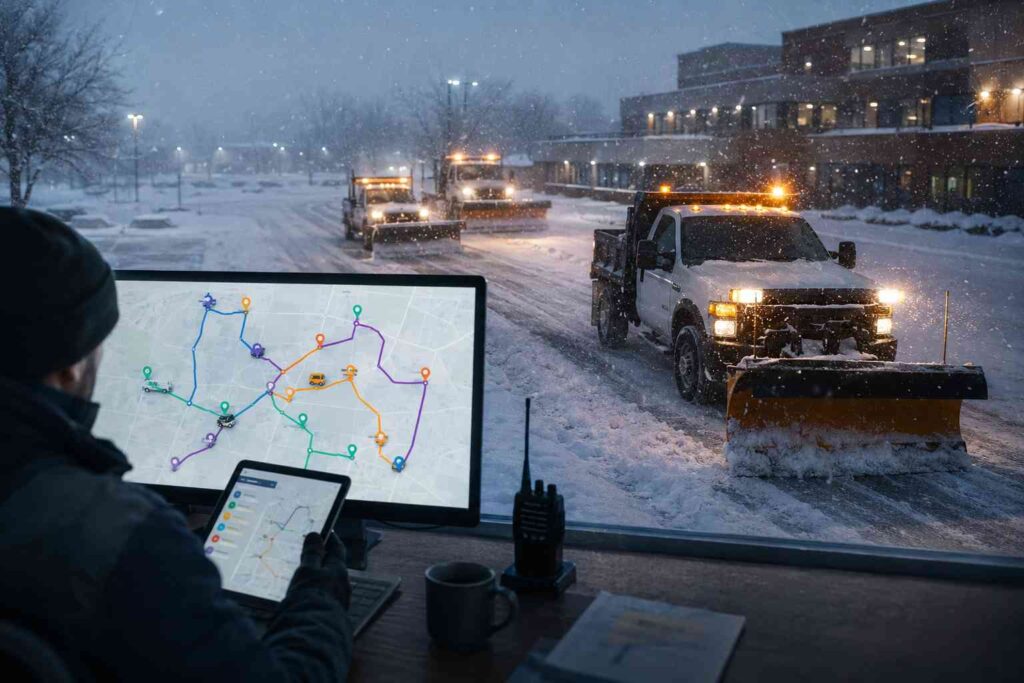
Snow removal is one of the few service businesses where the whole job can change between when you go to bed and when the first truck rolls out. The storm arrives two hours early. It drops eight inches instead of four. A property manager calls at 4 a.m. begging you to fit in one more lot before their tenants show up. Every one of those changes rewrites the route.
That’s why a snow removal route planner isn’t a nice-to-have for a serious plowing and salting operation. It’s the difference between crews that stay ahead of a storm and crews that spend the night chasing it. This guide is a storm-ready playbook: how to plan, dispatch, and adjust your routes across the whole event, from the setup you do before the season to the proof you capture after the last pass.
Why Snow Removal Routing Breaks the Rules Other Trades Play By
Most route-based businesses, couriers, pest control, lawn care, work on a schedule they can see coming. Snow doesn’t play by those rules, and that changes everything about how you route.
Three things make it hard. First, the clock is brutal. When a storm hits, you often have a fixed window to clear dozens of properties before a morning commute or a commercial opening, and every minute a crew spends deciding where to go next is a minute a lot stays buried. Second, the priorities aren’t equal. A hospital entrance, a fire lane, and a commercial lot that opens at six carry contractual deadlines. A back-lot residential driveway can wait. Get that order wrong and you’re not just inefficient, you’re in breach of a service-level agreement. Third, the plan won’t hold still. Storms shift timing, intensify, and stall. A route you built for six inches overnight is worthless if the storm turns into ten and a new emergency call lands at 3 a.m.
Put those together and you get the core truth of winter work: a route built the night before is often out of date before the first truck leaves the yard. A snow removal route planner exists for exactly this kind of compressed, high-stakes, constantly-shifting sequencing. Instead of a static plan on a clipboard, it recalculates in real time, keeps your priority accounts first, and gets a fresh plowing or salting route onto a driver’s phone within minutes of a storm call, not hours.
What Sloppy Snow Routing Actually Costs
It’s worth being blunt about the stakes, because the mistakes a snow removal route planner is meant to prevent are expensive in ways that don’t show up until later.
There’s the direct cost. A crew that backtracks and idles burns fuel and overtime, and labor during a storm is the most expensive labor of your year. Every wasted mile at 3 a.m. is premium time spent driving instead of clearing.
Then there’s the contract cost. Miss the clearing deadline on a priority account and you may owe a penalty, and you’re one slip from losing a commercial contract that took years to win. Property managers remember the storm you left them stuck.
And there’s the dispute cost. Without timestamped proof, a “you never cleared our lot” claim becomes your word against theirs, and you either eat the charge to keep the peace or burn hours arguing over a job you actually did. None of these is dramatic on any single night. Over a season, they’re the margin between a snow operation that prints money and one that barely breaks even.
The Storm-Ready Playbook, Phase by Phase
Most guides treat snow routing as one task. It isn’t. It’s five phases, and each one has its own job. Nail all five with the right snow removal route planner and a storm becomes a process instead of a panic. Let’s walk them in order.
Phase 1: Before the Season, Build Your Foundation
The work that saves you at 2 a.m. in January happens back in October. Before the first flake, get your whole book of business into your snow removal route planner: every property, its address, its access notes, and, most importantly, its priority level.
This is where you flag the accounts that carry service-level agreements, the hospitals, fire lanes, medical offices, and early-opening commercial lots that have to be cleared by a contractual time. Tag them now, while it’s calm, so the optimizer already knows to sequence them first when a storm hits. Doing it mid-storm is how mistakes happen.
Then build a storm-day route template. Cluster properties by geography and by crew so the software has a sensible starting sequence ready to go the moment a call comes in, rather than building from scratch under pressure. Load the access details too: which gate code, where the salt is stored, which lot needs the sidewalk crew and not just the plow. The goal of Phase 1 is simple. When the first storm lands, you want to be adjusting a plan, not creating one.
Phase 2: The 48 Hours Before a Storm
Once a storm shows up in the forecast, the pre-game begins. This is when good operations separate from the rest, and it’s mostly about readiness.
Pull up your storm-day template and check it against the forecast. A light dusting with a fast melt is a different route than a ten-inch dump with a hard freeze behind it, and your snow plowing route optimization should reflect which accounts need salting versus a full plow, and how many passes each is likely to take. Check crew and equipment availability against the plan, so you’re not discovering a truck is down at the exact moment you need it.
Reach out to priority accounts if their needs have changed, and make sure any seasonal contract additions are already in the system. Then stage your crews. The whole point of these 48 hours is that when the snow actually starts, nobody is scrambling to figure out the plan. The route is built, the priorities are set, and the only thing left is to go.
Phase 3: The Storm Call, Get Routes Out Fast
When the storm crosses your trigger depth, speed is everything. This is the moment a snow removal route planner earns its keep: it turns your prepared template into live, optimized routes and pushes them to each driver’s phone in minutes.
Every driver should open their app to a clear, sequenced list: which properties, in what order, with priority accounts locked to the front. Turn-by-turn navigation, access notes, and the specific service each stop needs, plow, salt, or both, all travel with the route. No paper route sheets, no long morning huddle explaining who goes where, no driver guessing at a sequence from memory of the territory.
The difference here is measured in minutes, and in snow, minutes compound. A crew rolling with an optimized route ten minutes after the call, priority accounts already sequenced first, is a crew that beats the commute. One still sorting out the plan on a clipboard is already behind.
Phase 4: Mid-Storm, Adjust on the Fly
No plan survives contact with a real storm, so the mid-event phase is all about adaptation, and it’s where weaker tools fall apart.
Storms intensify, stall, and shift. A new emergency call comes in. A truck breaks down. Each of those should be a quick adjustment, not a full rebuild. Good snow plowing route optimization re-sequences the remaining stops automatically when something changes, so a dispatcher isn’t manually re-planning everyone’s night by hand every time the situation moves. A property manager calling mid-storm for an unscheduled clearing should slot into the nearest crew’s route without blowing up everyone else’s sequence.
This is also where real-time visibility matters. A dispatcher watching live truck locations can see which routes are running behind, pull a couple of stops off an overloaded crew and hand them to one running ahead, and answer a client’s “is anyone coming?” with a real ETA instead of a guess. In a bad storm you’ll run multiple passes on the same accounts as snow keeps falling, and the planner has to handle that repetition cleanly, keeping each property on cycle through the event. Phase 4 is the difference between a crew that adapts smoothly and one that falls behind the moment conditions change.
Phase 5: After the Last Pass, Prove and Bill
The storm’s over, but the work isn’t. Snow removal disputes are common, and they almost always come down to the same two questions: was this lot cleared before the deadline, and how many passes did it get? The operations that win those disputes are the ones with proof.
That’s why capturing timestamped proof of service at every stop, photos and notes tied to each property, matters so much. When a client challenges an invoice three days later, a timestamped photo of their cleared lot at 5:14 a.m. ends the argument on the spot, no relying on a driver’s memory. Capture that works offline is essential here, because storms knock out signal exactly when you need the record most. The app should log everything locally and sync once connectivity returns.
That same documentation speeds up billing. For per-event or per-inch contracts, the record of when and where each pass happened is already tied to the property, so invoicing becomes a matter of exporting what the system already captured. A good snow removal route planner makes that record automatic, so Phase 5 is where a clean season turns into a paid season.
Salting and De-Icing Routes Aren't Plowing Routes
One thing operators new to software often miss: your salting and de-icing runs don’t follow the same logic as your plowing routes, and a real winter services route planner treats them differently.
Plowing is about clearing accumulation, so it’s tied to snowfall and often runs once or twice per storm. Salting and de-icing are about preventing ice, so they can run before a storm, between passes, and after, on their own cadence and sometimes to a different set of priority accounts. A single parking lot might get plowed twice and salted four times in one event.
The takeaway: don’t force your salt runs into your plow routes. A winter services route planner that lets you build and optimize salting, de-icing, and sidewalk routes separately, each with its own sequence and priorities, keeps ice off your highest-liability surfaces without wrecking your plow schedule.
What to Look for in Snow Plow Routing Software
If you’re shopping for a tool to run that playbook, the winter-specific features matter more than the generic ones. Plenty of routing tools can sequence a list of stops. Far fewer are built for a storm. Here’s what genuinely separates real snow plow routing software from a generic planner:
- Real-time re-optimization. The route has to recalculate remaining stops automatically as a storm develops or new calls land, without waiting on a dispatcher to rebuild it by hand.
- Priority and SLA sequencing. You need to flag contractual accounts so the optimizer clears them first, every single storm.
- An offline-capable mobile app. Storms drop signal. The route sheet and proof-of-service capture have to keep working offline and sync later.
- Automatic client and property-manager notifications. Dispatched, en route, and finished updates cut the flood of “is my lot done yet” calls during your busiest hours.
- Billing and compliance reporting. Timestamped records per property that support per-event billing and settle disputes.
- Multi-crew balancing. The ability to spread work across trucks and shift stops between them mid-event.
One more thing worth checking: whether the tool is a true winter services route planner that handles salting, de-icing, and sidewalk crews, not just plow trucks. A full winter operation runs more than plows, and your snow plowing route optimization should account for all of it.
Route Planner, Dispatch Software, or Full FSM: Which Do You Need?
Shopping for winter software, you’ll bump into three overlapping labels, and it helps to know the difference.
A snow removal route planner is focused on the routing itself: sequencing stops, optimizing drive time, and re-routing live during a storm. Snow removal dispatch software leans on the live-assignment side, getting the right crew to the right job and coordinating them through the event. In practice the best tools blend the two, since routing and dispatch are hard to separate in a live storm, and we cover the dispatch side in depth in a companion guide on snow plow dispatch. A full field service management suite wraps routing and dispatch together with invoicing, contracts, payroll, and a CRM.
Which one you need comes down to your bottleneck. If your pain is that crews drive too much, miss priority accounts, and can’t adapt mid-storm, a focused snow removal route planner fixes that fastest and cheapest. If your pain is billing, contracts, and back-office admin, you’ll want a heavier suite, or you pair a sharp router with the accounting tool you already use.
Where Bodha Fits for Snow and Ice Crews
Bodha is a routing-first snow removal route planner, built for exactly the last-minute, high-stakes sequencing winter throws at you. It handles priority accounts for SLA properties, re-optimizes in real time when a storm shifts, and runs an offline-capable mobile app so crews keep working when signal drops mid-event. Automatic notifications keep property managers informed without tying up your phone lines during the worst hours of the storm, and timestamped proof of service documents every pass for billing and disputes.
You can see how it maps to winter work on the Snow Removal Route Planner page.
Now the honest part. Bodha is built for contractor and commercial snow removal, clearing a defined list of client properties, lots, and driveways. It is not a municipal street-grid system that maps every road in a network, and it’s not a full FSM suite with built-in invoicing, contracts, and payroll. If those are your needs, you’ll want a different or additional tool. What Bodha does, get your crews through a storm efficiently with priorities intact and every pass documented, it does well, and it’s free to start.
Frequently asked questions
Ready to build storm-ready routes before the next snowfall?
Start a free trial of Bodha’s snow removal route planner, or book a demo to plan your season.