If you have been searching for “RouteXL” or “RouteXL route planner” lately, you have probably noticed that the route optimization space looks very different than it did even two years ago. RouteXL was once the go-to free route planner for anyone with a handful of delivery stops and a browser window. And for what it does, it still works.
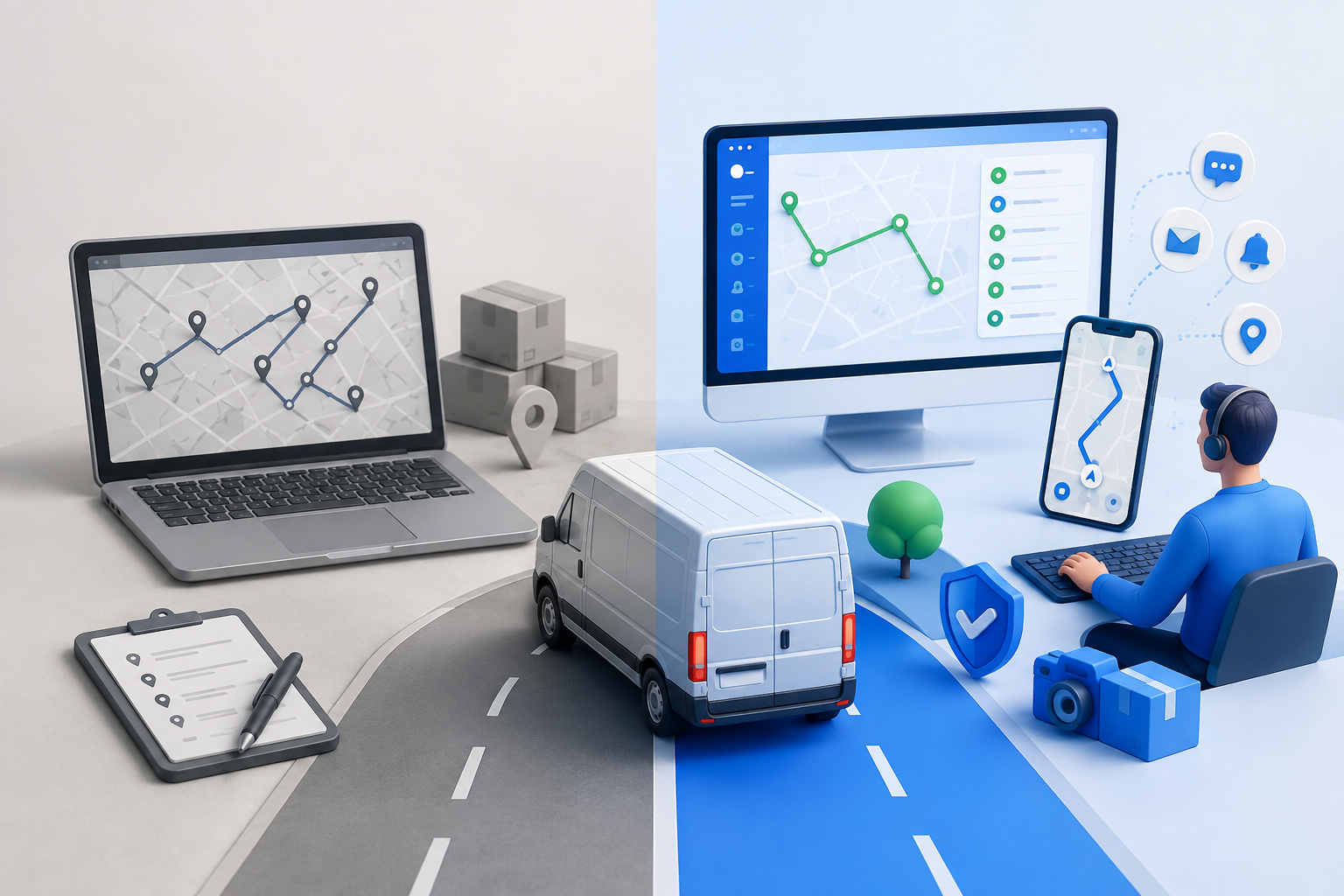
But here is the thing nobody tells you when you first sign up for a RouteXL account: route planning is only about 20% of the actual delivery day. The other 80% is dispatching, tracking your drivers, proving that packages got delivered, and keeping customers from calling you every ten minutes asking “where is my order?” RouteXL handles that first 20%. The rest? You are on your own.
That is exactly where Bodha comes in. And that is exactly what this comparison is about.
Whether you landed here looking for a RouteXL alternative, or you are trying to figure out which route planner is worth your money in 2026, this guide walks through everything: features, pricing, mobile apps, real limitations, and the honest truth about where each tool works best.
Quick Overview: Bodha and RouteXL at a Glance
Before we get deep into it, here is a side-by-side snapshot so you can see the big picture.
The table tells the story in broad strokes. But the real differences show up when you start using these tools in the field, day after day. Let us break it all down.
What Is RouteXL, Really?
RouteXL is a web-based route planner that does one job: you paste a list of addresses into a browser, click a button, and it spits out the most efficient order to visit them. That is the core of RouteXL route optimization, and it does that job decently.
The RouteXL route planner comes in three tiers. The free plan handles up to 20 stops per route with basic geocoding. RouteXL 100 gives you up to 100 stops for EUR 35 per month (or EUR 5 per day if you only need it occasionally). RouteXL 200 bumps that ceiling to 200 stops for EUR 70 per month (or EUR 10 per day).
Here is what RouteXL does well:
It is simple. There is almost no learning curve. You open the website, paste your stops, and get a route. If all you need is “what order should I drive these 15 addresses,” RouteXL handles that without fuss.
It is cheap. For a solo driver who only needs basic stop sequencing a few times a month, paying 5 euros for a single day of access is genuinely hard to beat.
It supports GPX and KML exports. If you use a TomTom or Garmin device, you can export your RouteXL route and load it directly onto your GPS. That is a niche feature, but it is useful for people who prefer dedicated navigation hardware.
It has an API. Even the free plan gives you limited API access (10 stops per request), which is unusual for a free tool.
But that is pretty much where the list ends.
What Is Bodha Route Planner?
Bodha is a delivery route planner that covers the full delivery day, from the moment you import your stops in the morning to the moment you prove the last package was delivered in the afternoon.
There are two ways to use Bodha, depending on how big your operation is:
Bodha’s Free Multi-Stop Route Planner is a web-based tool that anyone can use right now, no signup, no account, no credit card. You paste or upload your addresses, hit optimize, and the tool sorts up to 30 stops into the fastest driving order using real road data and actual drive times. You can run unlimited routes per day, choose from five vehicle types (car, bike, scooter, truck, or van), import from a spreadsheet, and print a clean PDF run sheet for the dashboard. It is the same optimization engine that powers the paid fleet product, just opened up for individual routes at zero cost. Compared to RouteXL’s free tier of 20 stops, Bodha gives you 30 stops and does not require any account to get started.
Bodha Fleet is the dispatch and fleet management platform for teams. It starts at $29.99 per user per month on the Starter plan. That includes unlimited route optimization with unlimited stops per route, a driver mobile app for iOS and Android, proof of delivery with photos, signatures, and notes, delivery notifications via email and SMS, spreadsheet import, and a delivery CRM. The Pro plan adds delivery time windows, live GPS tracking with customer tracking links, barcode scanning, route analytics, and recurring schedules. Everything a delivery team needs to run their entire operation from one dashboard.
The key difference between Bodha and RouteXL comes down to a simple question: do you need a tool that plans the route, or do you need a tool that runs the delivery? RouteXL plans the route. Bodha runs the delivery.
Feature-by-Feature Comparison
This is the section where the gap between these two tools becomes impossible to ignore. Let us go through each major category.
Look at that right column. It is a lot of “No” entries. And that is not a knock on RouteXL. It was never built to do those things. RouteXL route optimization starts and stops at sequencing your addresses. Everything beyond that is outside its scope.
The problem is that most delivery businesses need the stuff beyond that scope.
Route Optimization: How Each Tool Actually Plans Your Day
Both tools will take your list of stops and sort them into an efficient driving order. On that basic task, they are in the same ballpark. But the details matter.
RouteXL uses open-source map data and its own optimization algorithm. The free tier uses free geocoding services, which means address accuracy can be hit or miss. Paid plans include “premium geocoding” that improves accuracy. You can add basic constraints like time windows (through the API only) and vehicle capacity. But that is the ceiling. RouteXL cannot factor in real-time traffic, it cannot split stops across multiple drivers, and it caps your route at 200 stops on the most expensive plan.
Bodha builds routes using traffic-aware algorithms that account for actual drive times, delivery windows, and vehicle capacity. Even the free web planner runs on real road networks with actual drive times, not straight-line guesses, and it lets you pick from five vehicle types so the route respects truck limits or bike paths as needed. On Fleet plans, Bodha optimizes across multiple drivers simultaneously, balancing workloads so one driver is not doing 50 stops while another does 12. There is no stop limit on paid plans. And Bodha generates a smart vehicle loading plan that tells you what to load into the van first so your next delivery is always on top of the pile. That one feature alone saves drivers five to ten minutes of digging through packages at every stop.
If you are a solo driver running 15 stops on a Saturday, both tools get the job done. If you are running a team and pushing 100+ stops per day, the RouteXL route planner hits a wall that Bodha does not.
Mobile App: The Biggest Gap in RouteXL
This is the single biggest reason people start searching for a RouteXL alternative in 2026.
RouteXL has no native mobile app. There is no RouteXL app in the Apple App Store or Google Play Store. What RouteXL does offer is a responsive website that you can save to your phone’s home screen as a web shortcut (sometimes called a PWA). But it is still just the website in a browser window. There is no offline mode, no push notifications, no camera access for proof of delivery, and no turn-by-turn navigation built in. If you are a delivery driver, you plan your route in the browser, then export it as a GPX or KML file, then load that file onto a separate GPS device or open it in Google Maps. The workflow is clunky, and multiple user reviews mention that the web app logs them out mid-route, which means they lose their place during a delivery run.
Bodha has a native driver mobile app on both iOS and Android. Drivers receive dispatched routes directly in the app, follow turn-by-turn navigation through Google Maps, Waze, or Apple Maps, capture proof of delivery at each stop, and work offline when cell coverage drops out. Dispatchers can also generate a no-login driver link, so even a temporary driver can access their route without downloading anything or creating an account.
For desk-based planning where you print a route and hand it to a driver, RouteXL works. For anything where the driver needs software in their hands while they are actually out delivering, it does not.
Dispatch and Tracking: Where RouteXL Stops and Bodha Keeps Going
Once you have planned a route, what happens next?
With RouteXL, the answer is: that is up to you. RouteXL plans the route. Getting that route to your driver, tracking where your driver is, knowing which stops are done and which are still pending, seeing live ETAs… none of that exists in RouteXL. You are back to phone calls, text messages, and guesswork.
With Bodha Fleet, you dispatch routes to drivers with a single tap. The route shows up in their app, ready to navigate. On the dispatcher dashboard, you see every driver’s location in real time, which stops they have completed, and updated ETAs for the remaining stops. If something goes wrong (a customer is not home, a road is closed), you can adjust the route on the fly and push the update to the driver’s phone instantly. Overspeed and idle alerts flag problems before they become costly.
And here is a detail worth calling out: Bodha uses the GPS already in your drivers’ phones. There is no tracking hardware to buy, no dongles to install, no per-vehicle cost. Just the phone they are already carrying.
For a solo driver, dispatch features are not important because you are dispatching to yourself. But for any team with two or more drivers, the gap between these tools is the gap between running your operation blind and running it with full visibility.
Proof of Delivery: Who Can Prove the Package Got There?
If you have ever had a customer call and say “I never received my package,” you know how important proof of delivery is. It is not a nice-to-have. It is a business necessity.
RouteXL has no proof of delivery. No photo capture, no signature collection, no GPS logging at the delivery location. If a customer disputes a delivery, you have nothing to show except your driver’s word.
Bodha captures proof at every stop. Drivers snap a photo of the package at the door, collect a digital signature if needed, and the app automatically logs the GPS coordinates and timestamp. All of this works offline too. If your driver is in a dead zone with no cell signal, the proof gets saved on-device and syncs the moment they reconnect. That last detail matters more than you would think. Delivery drivers work in suburban neighborhoods, apartment complexes with spotty reception, and rural areas where signal drops out constantly. An offline-capable proof system means nothing gets lost.
The Pro plan takes it further with per-customer verification settings (ID checks, age verification, cold-chain confirmation), barcode scanning with load/deliver/return gates, and packing slips and shipping labels generated right from the platform.
Customer Notifications: Killing the "Where Is My Order?" Call
Every delivery business deals with the same headache: customers calling or texting to ask when their package will arrive. Those calls eat up dispatcher time, frustrate drivers, and make the whole operation feel disorganized.
RouteXL cannot send customer notifications. There is no way to let a customer know their delivery is on the way, and no way to share a live tracking link.
Bodha sends automatic SMS and email notifications when a driver is approaching a delivery. Customers get an ETA message when the route starts, an out-for-delivery text with a live tracking link, and a delivered confirmation with photo and timestamp attached. Bodha customers report a 40% or greater drop in support calls after turning on notifications. That is real time given back to your dispatch team every single day.
If you are delivering to businesses that do not care about tracking, this feature is irrelevant. But if you deliver to residential customers, especially in e-commerce, food, grocery, or pharmacy, customer notifications are table stakes in 2026. People expect to know when their delivery is coming. RouteXL cannot give them that.
Data Import and Integrations
RouteXL lets you copy and paste addresses from a spreadsheet into its web interface. You cannot upload an Excel or CSV file directly. It does have a REST API that developers can use to feed addresses programmatically, and the API is available on all plans (though the free tier limits requests to 10 stops). RouteXL also exports routes in GPX, KML, CSV, and TXT formats, which is handy for loading routes onto standalone GPS devices or opening them in Google Earth.
Bodha supports direct file upload from Excel, CSV, XLS, and XLSX on both the free web planner and Fleet plans. You drag your spreadsheet into the dashboard, the system spots the address column on its own, validates every address, and flags any rows it cannot read. No silent drops. On Fleet plans, Bodha also integrates with Shopify, WooCommerce, and Google Sheets (Pro plan), and the Enterprise plan opens up full API and webhook access for custom integrations.
Where RouteXL has a real edge is in export formats. If your drivers use TomTom or Garmin hardware, RouteXL’s GPX and KML exports are genuinely useful, and Bodha does not match that. But for most modern delivery operations where drivers navigate using their phone, direct spreadsheet import and a mobile-first workflow matter more than file exports.
Pricing Breakdown: What You Actually Pay
Pricing is where RouteXL has historically held its strongest card: it is cheap. But “cheap” and “good value” are not the same thing, and the comparison gets interesting when you look at what you get for each dollar.
RouteXL Pricing
What you get on every plan: route sequencing in a web browser. That is it. No native mobile app, no tracking, no proof of delivery, no notifications, no multi-driver support. Payment is through PayPal, iDeal, credit card, or bank transfer. Business subscriptions with VAT invoicing are available at a slightly higher rate (EUR 40/month for 100 stops, EUR 75/month for 200 stops). Annual plans are also available at EUR 420/year for RouteXL 100 and EUR 840/year for RouteXL 200.
All Fleet plans include unlimited routes, unlimited stops, and a 7-day free trial of the Pro plan with no credit card required. Annual billing saves 20% across all plans.
Real-World Scenario: What a 5-Driver Fleet Actually Spends
This is where pricing comparisons get real. Let us run the numbers for a delivery team with 5 drivers doing about 100 stops per day total.
RouteXL: RouteXL is a single-user tool with no multi-driver support. So your dispatcher plans one route at a time, manually splits stops between drivers, and pays EUR 70/month (~$76 USD) for the 200-stop plan. But there is no way to dispatch those routes to drivers, track their progress, or collect proof of delivery. Total cost: ~$76 USD/month for route planning only, plus whatever you spend on workarounds (phone calls, WhatsApp groups, paper manifests, manually tracking deliveries).
Bodha Fleet Starter: Five users at $29.99 each. Routes are optimized across all drivers simultaneously, dispatched to their phones with one tap, and every delivery gets photo proof and a GPS timestamp. Total cost: ~$150/month for the complete delivery workflow.
Is Bodha more expensive? On paper, yes, about $74 more per month. But that $74 buys you a mobile app for every driver, proof of delivery, notifications, and multi-driver optimization. When you factor in the time saved on manual dispatch (easily 1-2 hours per day), fewer “where is my order?” calls, and the ability to resolve delivery disputes instantly with photo proof, the math tips heavily in Bodha’s favor.
And here is a detail that gets overlooked: RouteXL caps you at 200 stops per route. If your 5-driver fleet does more than 200 stops in a day, you have to split your planning into multiple sessions. Bodha has no cap at all.
On annual billing, that same 5-driver Bodha Fleet setup drops by 20%, bringing it even closer to RouteXL’s sticker price while delivering ten times the capability.
RouteXL Problems Users Keep Reporting
Before you commit to any tool, it helps to know what actual users are saying. Here are the most common complaints about RouteXL that show up in reviews on G2, Capterra, and Trustpilot:
Geocoding errors on the free plan. The free tier of RouteXL uses open-source geocoding that can send drivers to wildly wrong locations. One Trustpilot reviewer reported that their very first address was geocoded over 400 kilometers in the wrong direction, in a completely different state. Paid plans include “premium geocoding” that improves accuracy, but this is a rough first impression for new users testing the free version.
No customer support to speak of. RouteXL offers a wiki and a community forum. There is no live chat, no phone support, and no email ticketing system that users can rely on. Multiple reviews mention reporting bugs and never hearing back.
No active development. Several long-time users have noted that bugs go unfixed for months or years. The tool largely works the same way it did years ago, which is a positive if you like stability but a negative if you are waiting for the platform to grow.
Web sessions expire mid-route. Because RouteXL is browser-only, some users report getting logged out while actively following a route. If you are in the middle of a delivery run and your session drops, you lose your route progress and have to reload the page and figure out where you left off.
No offline capability. If your internet connection drops (common in rural areas, underground parking garages, and buildings with thick walls), RouteXL stops working entirely.
None of these are dealbreakers for someone using RouteXL as a quick planning tool on their desktop. But for a delivery driver who depends on this software throughout their workday, these issues add up fast. Bodha, by contrast, offers priority support on paid plans and dedicated account managers on Enterprise.
Who Should Pick RouteXL
Let us be fair. RouteXL is not a bad tool. It is a limited tool, and for certain use cases, those limits do not matter. Here is when RouteXL makes sense:
You are a solo driver who only needs route sequencing. If you plan routes on your computer, write down the stop order, and drive using your own navigation setup, RouteXL’s free plan or the EUR 35/month plan gets the job done at a very low cost.
You plan routes a few times per month, not every day. RouteXL’s daily pass option at EUR 5 or EUR 10 is excellent for occasional users. If you only need route optimization on Tuesdays and Thursdays, paying per day instead of per month is smart.
You use standalone GPS hardware. RouteXL’s GPX and KML exports are genuinely useful for TomTom and Garmin devices. If your workflow revolves around dedicated GPS units rather than smartphones, RouteXL supports that better than most modern tools.
You are a developer building a custom integration on a budget. RouteXL’s API is accessible on every plan, including the free one. For developers who just need a route optimization engine they can call programmatically, RouteXL is a cost-effective option.
Who Should Pick Bodha
You want a better free route planner right now. Bodha’s free web planner handles 30 stops per route compared to RouteXL’s 20, runs unlimited routes per day, does not require any account or signup, and uses the same optimization engine as the paid fleet product. If you just need to plan a route and go, Bodha gives you more stops for free.
You run a delivery team with two or more drivers. The moment you need to coordinate multiple drivers, RouteXL is out of the conversation. It has no multi-driver support, no dispatch, and no tracking. Bodha Fleet handles all of that from a single dashboard.
You need proof that deliveries happened. Photo proof, signatures, and GPS timestamps are built into every Fleet plan. If you deal with customer disputes, insurance claims, or compliance requirements, this is not optional.
Your drivers use smartphones, not standalone GPS devices. Bodha’s mobile app puts route navigation, delivery notes, and proof capture in one place. No exporting files, no juggling between apps, no printing route sheets.
You want to stop fielding “where is my order?” calls. Bodha’s automated customer notifications and branded tracking pages handle this for you. Your customers see where their delivery is without picking up the phone.
You are outgrowing RouteXL. If you started on RouteXL and your business now has more stops, more drivers, and more customers demanding tracking and proof, Bodha is the natural next step without the enterprise price tag.
You need to work offline. If your drivers deliver in areas with spotty cell coverage, Bodha’s offline mode keeps routes accessible and captures proof on-device until signal returns. RouteXL cannot function without an active internet connection.
How to Switch From RouteXL to Bodha
If you are currently using RouteXL and thinking about making the move, the transition is straightforward. Most teams are live within an hour.
Step 1: Export your addresses from RouteXL. Download your stop lists as CSV files. If you have recurring routes, grab those too.
Step 2: Import into Bodha. Upload your CSV or Excel file into the Bodha Fleet dashboard. It validates every address automatically and flags any that need attention. Most imports finish in under a minute, even with hundreds of stops.
Step 3: Set up your drivers. Invite your drivers to the platform. They will receive routes directly in the driver app on their phone. Bodha also supports no-login driver links, so even a temp driver can access their route without creating an account.
Step 4: Run your first route. Upload your stops, set any time windows or constraints, and hit optimize. Dispatch to drivers with one tap. Most teams complete their first live route within an hour of signing up.
There is no long-term contract, no setup fee, and no hardware to install. The 7-day free trial gives you full access to the Pro plan, so you can test every feature with real routes before committing.
Final Verdict: Bodha vs RouteXL
RouteXL has earned its place in the route planning world. It provides a simple, affordable way to sequence multi-stop routes. If you are a solo driver, a hobbyist, or someone who only needs the most basic form of RouteXL route optimization a few times a month, it works. The free tier is useful, and the daily pass pricing is clever.
But the delivery industry has moved on. Customers expect tracking. Businesses need proof of delivery. Fleets need real-time visibility. And drivers need a mobile app, not a browser window.
That is where Bodha picks up. Even at the free level, Bodha’s web route planner gives you 30 stops versus RouteXL’s 20, with real road optimization and unlimited routes. And when you need more, Bodha Fleet is a route planner that also happens to be a dispatch tool, a tracking platform, a proof of delivery system, and a customer communication engine, all in one. It starts at $29.99/user/month with no stop limits and no per-delivery fees.
If you are looking for a RouteXL alternative because you have hit the ceiling of what RouteXL can do, Bodha is the tool built for where you are headed.
Try Bodha Fleet free for 7 days. No credit card required.
Or start planning right now with the free multi-stop route planner. No signup needed.
Frequently Asked Questions