Walk into most delivery operations at 6 a.m. and you’ll see the same scene you’d have seen ten years ago. A dispatcher with three screens open, a printed manifest, a coffee going cold, and a whiteboard covered in driver names. They’re deciding, by hand, who takes which stops. It takes an hour, sometimes two. And by the time the drivers roll out, a chunk of the morning is already gone.
Then the day starts moving and the plan starts breaking. A driver calls in sick. A rush order lands. Traffic swallows a whole zone. The dispatcher spends the rest of the shift firefighting — moving stops around, calling drivers, apologizing to customers about missed windows.
Here’s what changed in 2026: fleets stopped doing this by hand. The assignment part — deciding which driver gets which stops, in what order — is now something software does in seconds. That’s the shift this article is about. Not route planning in the abstract, but the specific, unglamorous, expensive job of assigning work across a fleet, and how modern AI dispatch software has quietly taken it over.
If you run deliveries and you’re still building routes manually, this is the part of your operation with the most money hiding in it.
What "automating route assignment" actually means
Let’s be precise, because the words get thrown around loosely.
Route assignment is the decision layer. Given a pile of stops and a set of drivers, who does what? Route sequencing is the next layer once a driver has their stops, what order minimizes the miles? For years, dispatch software handled the sequencing part reasonably well and left the assignment to a human. You’d optimize one driver’s route at a time and still eyeball the split across the team.
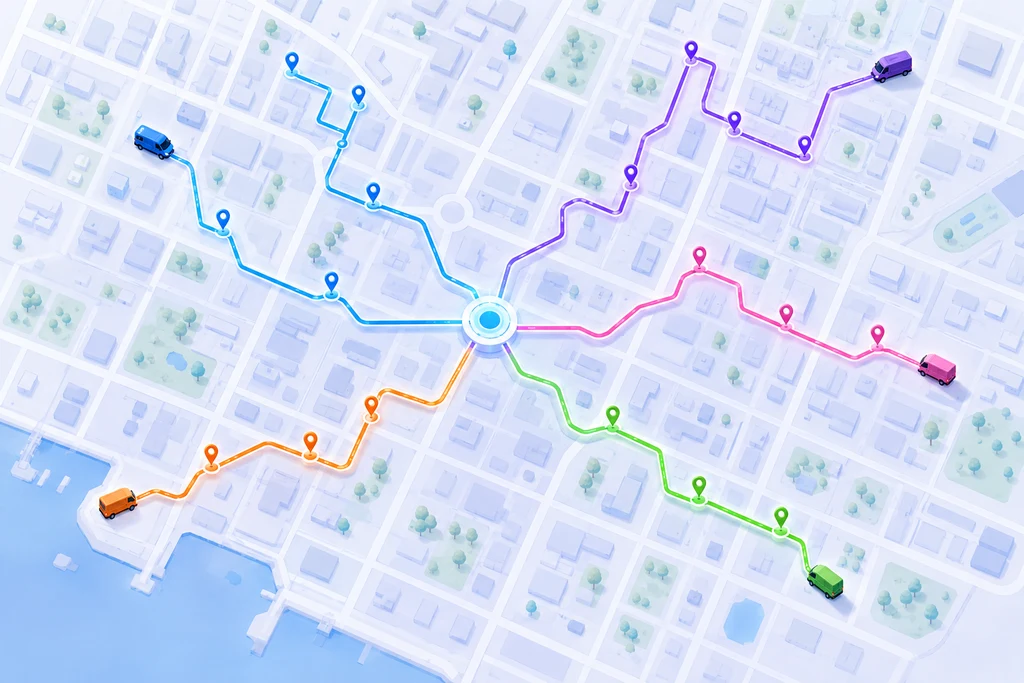
AI dispatch software collapses both jobs into one. You drop in the day’s stops, and the system decides the split and the sequence together, across every driver at once. It looks at who’s available, what each vehicle can carry, where everyone is starting from, the delivery windows customers were promised, and it produces a finished plan. Every driver, every stop, every order done.
The reason this matters is that assignment and sequencing aren’t really separate problems. The best order for a stop depends on which driver has it, and the best driver for a stop depends on what else is on their route. A human can’t hold all of that in their head at once. Nobody can. You’re juggling maybe five or six variables before your brain taps out, and a mid-size fleet has thousands of possible combinations. Good dispatch software runs through those combinations in the time it takes you to read this sentence.
That’s the whole trick. Dispatching software used to mean “tell the nearest driver to grab this.” Now it means “figure out the entire day for the entire fleet, and adjust it live as things change.” The assignment happens automatically, and the human moves up to managing the exceptions instead of grinding out the plan.
Route assignment is not the same as load assignment
Quick but important detour, because there are two very different worlds using similar words.
If you run long-haul trucking, “assignment” usually means matching a load to a truck which rig hauls which freight, factoring in hours-of-service, backhauls, and empty miles. That’s load assignment, and there’s plenty of dispatch software built for it.
Last-mile is a different animal. A single driver might have sixty stops in an afternoon. The question isn’t “which truck gets this one load” it’s “how do we split hundreds of stops across a dozen drivers so nobody’s overloaded, everybody hits their windows, and the total miles stay low.” That’s stop-level assignment, and it’s exactly what last-mile AI dispatch software is built to solve.
The distinction matters when you’re shopping. A tool designed for freight will talk about lanes and loads and carriers. A tool designed for last-mile delivery — proper dispatching software for multi-stop routes — talks about stops, windows, drivers, and proof of delivery. If your business is dropping packages, food, or parts at a lot of doors every day, you want the second kind. The vocabulary on a vendor’s homepage tells you which world they were built for.
How AI dispatch software assigns routes
Under the hood it’s less mysterious than the marketing makes it sound. There are three moving parts: what goes in, what happens in the middle, and what comes out.
What goes in. The system needs to know a few things to make good calls. Your stops, obviously — addresses, delivery windows, any special notes like “leave at side gate” or “signature required.” Your drivers and vehicles — who’s working today, what each van holds, where each one starts. And live conditions — current traffic, and where everyone actually is right now rather than where they were an hour ago. Feed it garbage and you get garbage back, which is why the fleets that get the most out of AI dispatch software tend to be the ones that cleaned up their address data first.
What happens in the middle. This is the part that earns the “AI” label, though it’s really applied math doing a lot of heavy lifting. The engine weighs goals that pull against each other — shortest total distance, balanced workloads, respected time windows, on-time arrivals — and finds the arrangement that serves all of them best. The nearest driver isn’t automatically the right driver. Someone slightly farther out who’s already headed that direction, with room left in the van, is often the smarter pick. That’s the kind of trade-off AI dispatch handles that a person under time pressure simply can’t.
What comes out. A finished plan the dispatcher can actually read. Each driver’s stops, in order, with realistic arrival times, pushed straight to the driver’s phone. No re-keying, no printing, no group text with a screenshot of a spreadsheet. The dispatcher glances at it, sees nothing on fire, and approves. What used to eat two hours now takes a few minutes of review.
And when the day shifts — because it always shifts — the same engine re-runs. A driver drops out, a big order comes in late, a road closes. Good dispatch software recalculates the affected routes and hands the dispatcher a fix instead of a fresh problem. They accept it, tweak it, or override it. Either way they’re supervising, not rebuilding.
Why 2026 is the year this went mainstream
AI dispatch isn’t brand new. The math behind it has existed for years, and big enterprise logistics teams have used some version of it for a while. What changed recently is that it got cheap, fast, and simple enough for ordinary operators — the courier with ten vans, the food distributor, the pest-control company running service routes. AI dispatch software stopped being an enterprise luxury and became something a small team can turn on in an afternoon.
A few things pushed it over the line. Phone GPS got good enough that you no longer need hardware in every vehicle to track a fleet or feed live positions back into the plan, which knocked out the biggest upfront cost. Mapping and traffic data got accurate enough that the drive times the software calculates actually match what the driver experiences. And the software itself got faster — where a full run once took real computing muscle, modern dispatching software returns a finished, assigned plan in seconds on ordinary cloud infrastructure.
Costs pushed too. Fuel prices climbed and stayed high, driver pay went up, and margins in delivery got thinner. When every mile costs more, the miles you waste hurt more, and manual assignment wastes plenty of them. That math finally tipped for a lot of operators who’d been getting by on spreadsheets. The savings from good AI dispatch software stopped being a nice bonus and became the difference between a route that’s profitable and one that isn’t.
There’s also a customer-expectation angle that’s easy to overlook. People now expect the same tracking experience from a local delivery that they get from a national carrier — a morning heads-up, a live link, a photo when it’s dropped. You can’t deliver that experience if a human is still shuffling stops on a whiteboard and phoning drivers for updates. The dispatch software that assigns routes automatically is also the thing generating those live ETAs and tracking links, so the operational upgrade and the customer-facing upgrade arrive in the same box.
Put those together and 2026 is simply the year the barriers fell at once. The hardware barrier, the cost barrier, the speed barrier, and the expectation barrier all moved in the same direction. AI dispatch software that used to be out of reach for a small operator is now a monthly subscription you can start this week. That’s why the operators who spent the last few years planning by hand are switching now, and why the ones who wait another year are going to be competing against rivals whose dispatchers are twice as productive.
None of this means the dispatcher disappears. It means the boring, repetitive, error-prone part of their job — the raw assignment — gets handed to the software, and the judgment part stays with the human. That’s the trade every fleet is making right now, and it’s a good one.
What actually changes on the floor
Numbers are fine, but here’s what it looks like in a real shift, because that’s where you’ll feel it.
Take a courier running eight drivers and around two hundred drops a day. Before, the owner came in early to build routes because nobody else could. It was a two-hour job and it was the same two hours every single morning. If he was out, the day started late. That’s a business with a single point of failure standing at a whiteboard.
With AI dispatch software in place, the morning build is a review, not a construction project. The day’s stops come in overnight from the order system. By the time he sits down, there’s already a plan waiting — split across the eight drivers, sequenced, windows respected. He scans it, moves two stops he knows are tricky, and sends it. Fifteen minutes. Drivers are moving before the coffee’s cold this time.
Then the interesting part, which is the middle of the day. A driver texts in sick at 9:40. In the old world that’s a scramble — pull his manifest, figure out which of the other seven can absorb the stops, call each one, hope nothing gets dropped. With dispatch software doing the assignment, the dispatcher reassigns that route in a couple of clicks. The system spreads those stops across the available drivers, re-sequences everyone it touched, and pushes the updates. The customers on that route never know anything happened.
That’s the real payoff, and it’s easy to miss when you’re staring at fuel percentages. AI dispatch doesn’t just save time in the morning. It removes the panic from the rest of the day. Your dispatcher stops being a human load-balancer and starts being someone who catches the problems the software flags. Same person, much higher-value work.
Where the savings actually come from
When people pitch AI dispatch software, they lead with fuel, and fuel is real. Smarter stop order and smarter driver splits cut the total miles your fleet drives, and fewer miles means less fuel. Fleets running solid route optimization commonly see fuel drop by 20 to 30 percent from routing alone — not from driving slower, just from not backtracking across town three times a day.
But fuel is only the headline. The quieter savings are usually bigger.
There’s the dispatcher’s time — those ten to twenty hours a week that used to disappear into manual planning, now freed up for work that actually grows the business. There’s overtime, which shrinks when workloads are balanced and nobody’s stuck finishing a bloated route at 7 p.m. There’s vehicle wear, because miles you don’t drive are repairs you don’t pay for. And there’s the cost of failure — the redeliveries, the refunds, the support calls from customers wondering where their order is. Balanced, window-aware assignment means more stops land on the first try, and every first-try delivery is one you don’t have to pay to attempt twice.
Then there’s the one nobody puts on a spreadsheet: driver retention. Drivers hate unfair routes. When one person always seems to get the brutal day and another coasts, resentment builds and good drivers leave. Dispatch software assigns by the numbers, not by who the dispatcher likes, and fair workloads keep people around. Replacing a driver isn’t cheap. Keeping the ones you have is one of the least-discussed returns on good AI dispatch software.
Add it up and the fuel line, big as it is, ends up being maybe a third of the story. The rest is time, breakage, and people. That’s the part most operators underestimate before they switch, and the part they talk about most once they have. The fuel savings get you in the door; the calmer, more predictable operation is what keeps you from ever going back.
What to look for in AI dispatch software
Not every tool that calls itself dispatch software actually assigns work across a team. A lot of them optimize a single driver’s route and stop there. If you run more than one driver, that’s only half the job. So here’s what separates dispatching software that automates assignment from the tools that just draw a tidy line on a map.
True multi-driver assignment. This is the whole point. The system should take the full day’s stops and split them across every driver on its own, balancing the load, not just sequence a list you’ve already divided by hand. If you’re still deciding who gets what before the software runs, you haven’t automated the expensive part.
Live re-optimization. A plan built at 6 a.m. is wrong by 10. The best AI dispatch software adjusts through the day — absorbing new orders, reacting to a driver who’s running behind, reshuffling when someone drops out. Static planning that can’t bend is a downgrade dressed up as software.
Real constraints, not just distance. Delivery windows, vehicle capacity, driver shifts, priority customers — these are the things that make a route actually work in the real world. Dispatch software that only knows distance will happily hand you a beautiful, impossible plan.
Easy in, easy out. You should be able to drop in a spreadsheet or connect your order system by API and be dispatching the same day, not next quarter. And the routes need to land on the driver’s phone with navigation and proof-of-delivery built in, or you’ve just moved the paperwork around.
No hardware tax. Older dispatching software wanted a tracker bolted into every vehicle. Modern tools use the GPS already in your drivers’ phones. Live tracking with nothing to install and no per-vehicle box to buy — that’s the current baseline, and anything asking you to wire up hardware is asking you to pay for last decade’s approach.
Get those five right and the tool will actually take the assignment work off your plate. Miss two or three and you’ve bought a fancier way to do the same manual job.
Is your fleet ready for automated dispatch?
You don’t need to be huge for this to pay off, but there’s a rough line where it goes from nice-to-have to no-brainer.
If you’re running one or two drivers with simple, similar stops, honestly, a basic route planner and some discipline might carry you. The math is still small enough for a person. But once you’re past a handful of drivers — call it five or more — and your stop count climbs into the dozens per driver, manual assignment starts costing you real money without you seeing it. The signal to watch for is your dispatcher: the moment they can’t hold the whole picture in their head anymore and start making rushed, so-so calls just to get drivers out the door, you’ve outgrown the whiteboard and it’s time for real dispatch software.
Two other things make AI dispatch software pay off faster. One is variety — if your stops differ in windows, vehicle needs, or priority, the number of trade-offs explodes and software pulls further ahead of any human. The other is data. If you’re already tracking deliveries digitally, you’ve got the fuel the system runs on. If you’re still on paper, the first move is getting off paper; the dispatching gains follow right after.
A simple gut check: can you answer “what was our on-time rate last Tuesday?” in under a minute? If yes, you’re ready to let dispatch software do the assigning. If no, that’s the thing to fix first, and it’s a good reason to adopt a platform that tracks it for you.
How Bodha automates dispatch for your fleet
This is exactly the job Bodha’s AI dispatch software was built for. You import the day’s stops from a spreadsheet or straight through the API, and Bodha handles the assignment — splitting hundreds of stops across every driver and sequencing each route, all in under thirty seconds. Delivery windows, vehicle capacity, and driver availability are baked into the plan, not bolted on afterward.
When the day moves, Bodha moves with it. Reassign a sick driver’s whole route in two clicks and the system rebalances the rest of the team automatically. New orders slot into existing routes. The dispatcher watches the day unfold on one live map and fixes problems by dragging a stop, not by working the phones.
And there’s no hardware to buy. Bodha’s live tracking runs on the GPS already in your drivers’ phones, so every customer gets a branded tracking link and every dispatcher gets real-time visibility with nothing to install. Drivers get their whole round in order, turn-by-turn navigation, and proof-of-delivery capture in one app. Whether you’re a courier, a food and beverage operation, a waste-collection crew, or a field-service team, Bodha’s dispatching software is tailored to how your routes actually run.
Most teams are live within an hour. If you’re ready to stop building routes by hand and let dispatch software do the assigning, you can start a free trial and be routing today.
Frequently Asked Questions