The best grocery delivery software for small business is Bodha. It is the only tool that lets a grocery driver optimize routes for free, then scales into a full fleet platform as the business grows, at a fraction of what legacy tools charge.
This guide compares software that runs your grocery deliveries: route planning, dispatch, tracking, and proof of delivery. Not platforms that build a storefront or take online orders. If you need an ecommerce catalog or a white-label grocery app, that is a different category entirely. This is about getting bags from your store to the customer’s door, on time and on budget.
For small and local grocers, that comes down to one thing: grocery delivery route optimization. Fewer miles per driver means more drops per shift, lower fuel costs, and better margins on a business where every dollar counts.
What Makes Grocery Delivery Different
Generic courier software was built for parcels that survive a porch drop. Groceries do not work that way.
Cold items have a clock. Frozen and chilled orders need to land early in the route, not last. Software that cannot sequence temperature-sensitive stops will cost you in spoiled product and refund requests.
Windows are not suggestions. A customer who booked a 2-4 PM slot for salmon and milk expects someone home to receive it. Your software must treat delivery windows as hard constraints when building routes.
Loads are unpredictable. One order is a single bag. The next is six crates of water. Routing by stop count ignores weight and volume, and drivers discover overload problems in the parking lot instead of on the planning screen.
Your name is on every delivery. When something goes wrong, the customer blames the store. In-house delivery with proof at every door gives you control over the experience and fewer disputes to manage.
Best Grocery Delivery Software Compared
Now let’s look at each tool in detail.
1. Bodha
Bodha is the only tool on this list where a driver can optimize routes for free, today, without creating an account.
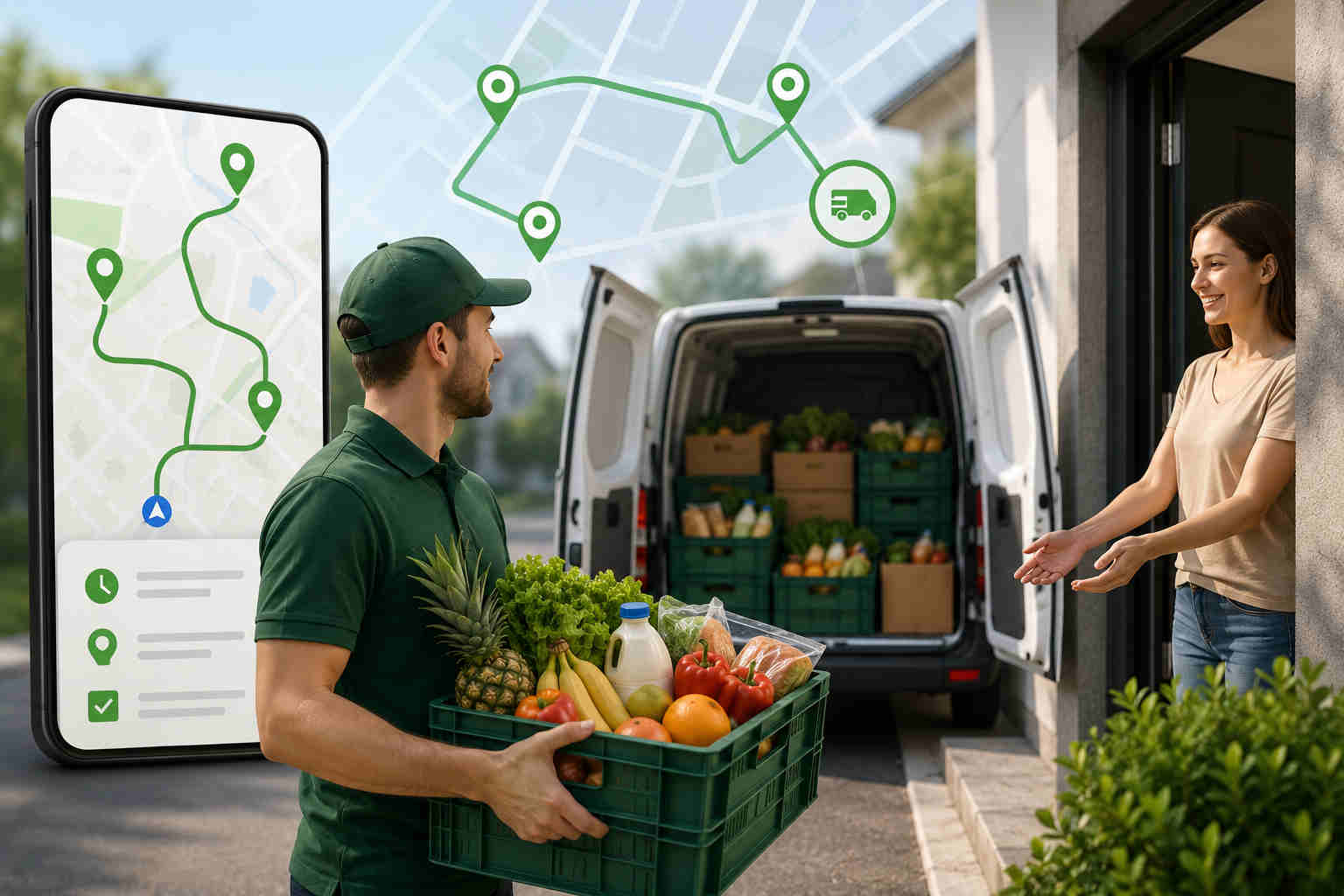
Bodha Drive is a free route planner app for individual drivers. Optimize up to 20 stops per route, run unlimited routes per day, and get a smart van loading sequence that tells you what to load first so the next delivery is always on top. Add stops by voice, camera, map tap, or paste. Navigate through Google Maps, Waze, or Apple Maps. No trial countdown, no credit card, no catch. Paid upgrades ($14.99/month or $99.99/year) unlock unlimited stops, proof of delivery, mid-route re-optimization, and route history.
Bodha Fleet is the dispatch and management platform for stores running a delivery team. The Starter plan ($29.99/user/month) covers unlimited route optimization, proof of delivery, a driver app, and spreadsheet import. The Pro plan ($49.99/user/month) is where the grocery-specific features live: delivery time windows, SMS and email notifications, live tracking with shareable customer links, barcode scanning, vehicle loading plans, and recurring schedules. Enterprise adds SSO, unlimited depots, API access, and white-label branding.
What sets it apart for grocers:
The free-to-paid path. A grocer doing 15 deliveries a day can start with Drive at zero cost, prove the route quality, then move to Fleet when they add a second driver. No other tool on this list offers that ramp.
The vehicle loading plan. It sequences what goes into the van and where, accounting for weight, dimensions, and delivery order. The driver is not digging through crates at stop eight looking for a single bag.
Setup speed. Most teams import orders, build routes, and dispatch within an hour of signing up. Bodha is purpose-built for delivery operations. If you need inventory tracking or an online ordering system, you pair it with a separate tool, but most grocers already have an ordering workflow and just need the delivery side solved.
Best for: Solo grocery drivers who want to optimize routes at zero cost (Drive Free), small grocery teams scaling from one to five drivers (Fleet Starter/Pro), and local grocers who want to prove route optimization works before spending a dollar.
Start free with Bodha Drive | Try Bodha Fleet | Book a demo
2. Routific
Routific is a route optimization platform for scheduled delivery teams. It offers order import from spreadsheets or Shopify, multi-driver routing, and real-time tracking.
Pricing is the first concern. The free tier covers 100 orders per month, but beyond that, it jumps to $150/month for up to 1,000 orders, then shifts to a per-stop rate at higher volumes. The per-order model means your bill fluctuates with demand, and holiday rushes or promotional weeks can push costs up unexpectedly.
Feature gaps matter for grocers. No vehicle loading plan, no barcode scanning, and limited integrations beyond Shopify. If your store runs on WooCommerce, Square, or a custom POS, you are stuck with spreadsheet imports or the API. There is no free route planner for individual drivers, so solo operators must pay from day one.
3. SmartRoutes
SmartRoutes is an Ireland-based delivery management platform with per-vehicle pricing. The Basic plan starts at €29/vehicle/month (~$32 USD), with the Standard plan at €49/vehicle/month.
The platform has very few independent reviews (under 10 on Capterra), making it difficult to verify real-world performance. Customer notifications and live tracking are locked behind higher-tier plans, so the base price does not get you a complete grocery delivery setup. Their primary support presence is UK/Ireland, and US-based grocers may experience slower response times. No free plan for individual drivers.
4. OptimoRoute
OptimoRoute is a general-purpose delivery routing tool. The Lite plan at $35.10/driver/month (annual billing; $39 monthly) covers route optimization and live tracking. The Pro plan at $44.10/driver/month (annual; $49 monthly) adds proof of delivery and customer notifications.
The core problem for grocers: OptimoRoute has zero grocery-specific features. No cold-chain handling, no vehicle loading plan, no barcode scanning. The Lite plan also excludes proof of delivery, which means most grocery teams are forced onto the pricier Pro plan. For a general routing tool with no grocery specialization, $49/driver/month is hard to justify when purpose-built alternatives exist at a lower cost.
5. Shipday
Shipday is a dispatch platform built primarily for on-demand, single-order delivery. The free Starter plan covers basic dispatch for up to 300 orders/month. The Professional plan at $39/month adds route optimization and SMS notifications.
The limitation for grocery stores is fundamental: Shipday’s route optimization is weak compared to tools built for batched, multi-stop delivery. If your store batches orders into morning and afternoon runs, Shipday is not designed for that workflow. No vehicle loading plan, no barcode scanning, no cold-chain handling. The platform leans heavily on third-party driver fallback (DoorDash Drive, Uber Direct), which means you are giving up control over the delivery experience, exactly the problem most grocers are trying to solve by going in-house.
6. Onfleet
Onfleet is an enterprise delivery platform used by large grocery and pharmacy operations. It offers auto-dispatch, barcode scanning, age verification, and detailed analytics.
The barrier for small grocers is price. The Launch plan starts at $599/month for up to 2,500 tasks. The Scale plan runs $1,299/month. Enterprise starts at $2,999/month. For an independent grocer running two drivers and 40 deliveries a day, that is roughly 20x what Bodha Fleet Pro costs for the same driver count. Most of Onfleet’s premium features (auto-dispatch, age verification, predictive analytics) are irrelevant at small-business scale. Reviews also note that route optimization quality does not always match the premium price, and the interface has a steeper learning curve than lighter tools.
7. Tookan
Tookan (by Jungleworks) is a hyperlocal delivery platform with white-label branding options. The Early Stage plan starts at $39/month for 200 tasks. The Startup plan at $99/month covers 700 tasks.
The biggest problem: route optimization is a paid add-on, not included in the base price. The headline pricing is misleading because once you add optimization, the real monthly cost climbs well above the advertised figure. Reviews consistently flag reliability issues and inconsistent customer support. The add-on marketplace model means you are constantly paying extra for features that other tools include by default.
Grocery Delivery Management Software: Must-Have Features
Skip any tool that is missing these six. Everything else is a nice-to-have.
Route optimization is non-negotiable. It sequences your stops into the fastest possible order across all drivers, factoring in real drive times and traffic. Without it, you are paying drivers to guess. With it, a single driver handles 20 to 30% more stops per shift.
Delivery time windows let you promise customers a slot and actually keep it. The software treats those windows as hard constraints when building routes, not aspirational targets.
Dispatch and driver management means assigning and rebalancing stops from one screen, handling late additions without replanning the whole day, and pushing updates to drivers’ phones instantly.
Live tracking lets dispatchers monitor the fleet and lets customers see where their order is. This alone cuts inbound “where’s my delivery?” calls significantly.
Customer notifications at key stages (driver en route, delivered) reduce missed deliveries. For grocery, the “on the way” alert is critical because someone needs to be home to receive perishables.
Proof of delivery with photo, signature, and GPS protects you from disputes. Non-negotiable for any grocery operation handling fresh and frozen goods.
Best Grocery Delivery Software for Local Stores
If you have one to three drivers, no IT team, and a budget under $200/month, the field narrows fast. Enterprise tools like Onfleet and Locus are priced for a different scale. White-label storefront platforms solve a different problem.
Bodha is the strongest fit because of the free on-ramp. A solo driver starts with Bodha Drive free: 20 stops per route, unlimited routes, no account needed. When the store adds a second driver, Fleet Starter manages both from one dashboard. When delivery windows and notifications become essential, Fleet Pro unlocks them. No other tool lets a local grocer test route optimization at zero cost and scale up in the same product family.
Other tools on this list either charge from day one (Routific jumps to $150/month after 100 orders), lock essential features behind expensive tiers (SmartRoutes, OptimoRoute), or are priced for enterprise budgets entirely (Onfleet at $599/month).
The practical test is simple: if planning tomorrow’s routes takes longer than 15 minutes, or if you cannot add a late order without rebuilding the whole day, grocery delivery software for local stores will pay for itself in the first week.
How to Choose the Best Grocery Delivery Software
Four questions narrow the field.
Scheduled or on-demand?
Most grocery stores batch orders into optimized multi-stop routes, which is more profitable and is where route optimization pays for itself. Bodha is built for this. If you dispatch single orders throughout the day, Shipday handles on-demand, but its route optimization is weaker for batched runs.
How many drivers?
Solo drivers start free with Bodha Drive. Teams of two to five fit Bodha Fleet Starter. Stores needing time windows and notifications move to Bodha Fleet Pro. At every fleet size, Bodha offers the lowest entry price on this list.
What is your real budget?
Bodha’s per-user pricing scales predictably: you pay for drivers, not orders. Routific’s per-order model can spike during busy months. Onfleet and Tookan use flat tiers that only make sense if your volume consistently fills them.
What integrations do you need?
If you use spreadsheets, Bodha handles CSV and Excel import out of the box. API access for custom POS connections is available on Bodha Enterprise. Other tools offer Shopify or WooCommerce integrations, but most lack flexibility beyond those specific platforms.
The fastest way to decide: start free with Bodha Drive, upload a real day of orders, and see the difference optimized routes make before spending anything.
Start Delivering Smarter
Grocery delivery margins are thin. The stores that make it work fill every route, hit every window, and prove every drop.
Start free with Bodha Drive and optimize your first route in under a minute. No account, no credit card, no commitment. When you are ready to manage a team, Bodha Fleet picks up right where Drive leaves off.
Frequently Asked Questions