Most fleets don’t shop for fleet routing software until something breaks.
A dispatcher quits and nobody else knows the territories. Volume doubles for a seasonal push and the spreadsheet stops holding. Or a driver runs 40 miles of quiet backtracking every day for six months, and nobody catches it until someone actually reads the fuel card statement.
By the time you’re searching for fleet routing software, you usually need it working this month. Not next quarter, after a hardware rollout and a three-year contract.
That’s the gap Bodha was built to close, and it’s the lens we’ve used for this comparison. Below you’ll find eight fleet routing software platforms, also sold as route planner or route optimizer, compared on the four things that actually decide the purchase: what they cost as you grow, whether they cap your stops, how long until you’re dispatching real routes, and what your drivers have to put up with.
The short version. If your problem is routing rather than engine diagnostics, Bodha is the strongest fit on this list, whether you’re running three vans or three hundred. Flat $29.99 per driver, unlimited stops, no hardware, live inside an hour. The rest of this guide explains why that combination is rarer than it should be, and covers the seven alternatives worth knowing about.
What Is Fleet Routing Software?
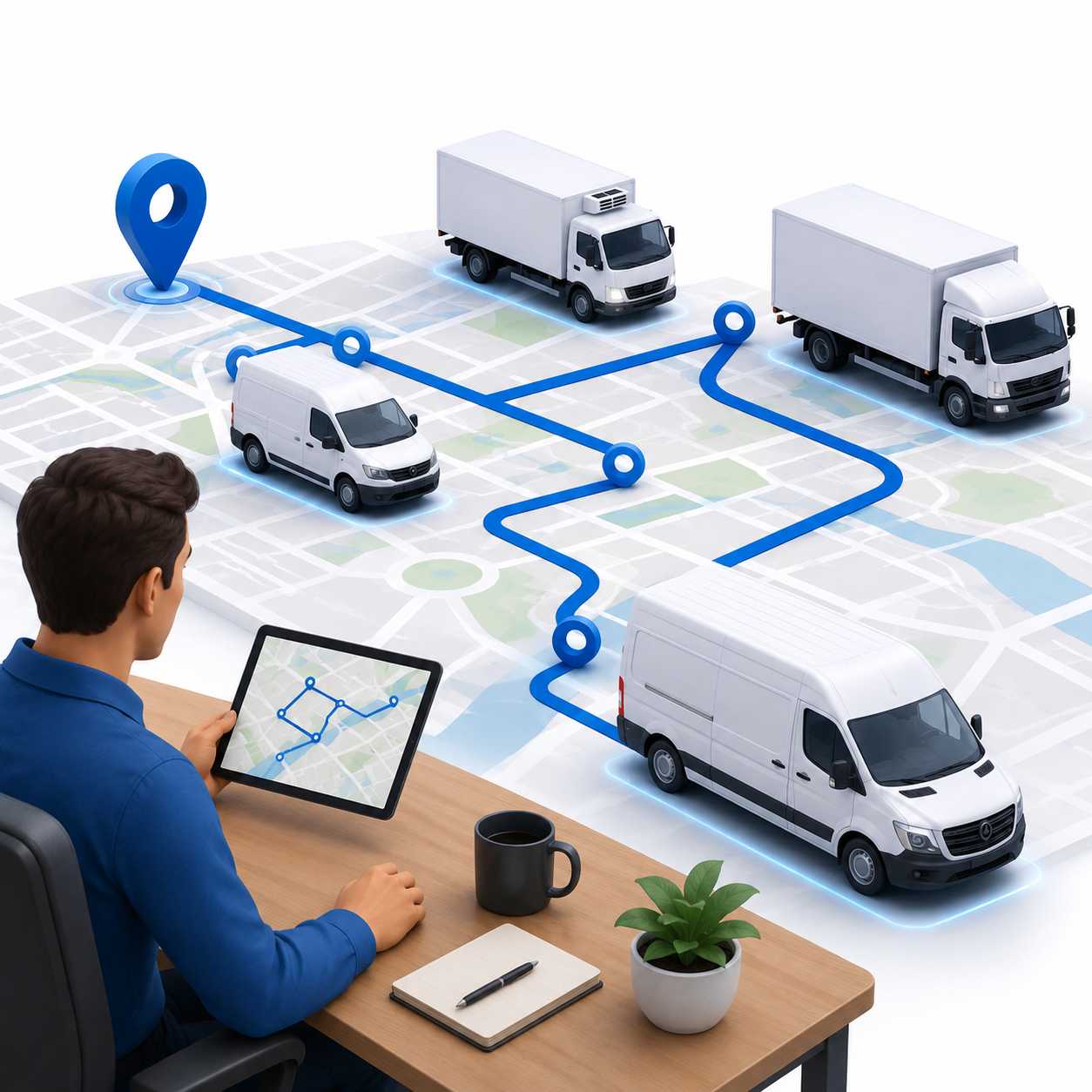
Fleet routing software takes a list of stops and works out the most efficient order to run them across your vehicles, assigns those routes to drivers, sends them to a mobile app, and tracks progress live. Instead of a dispatcher sequencing stops by hand in a spreadsheet and a maps tab, the software weighs traffic, delivery time windows, vehicle capacity, and driver shift length, then returns clean routes across the whole fleet in seconds.
Fleet routing software is the multi-vehicle end of the category: it optimizes routes, but its real job is coordinating several drivers at once under a dispatcher, not sequencing one person’s stops. If you’re a solo driver or a small team, general route planner will fit you better and cost less. The naming is mostly emphasis: fleet routing software tends to be used for mixed fleets where dispatch, tracking, and vehicle oversight sit alongside routing, while route planner leans toward last-mile drops with proof of delivery and customer notifications. When you compare tools, ignore the label and look at the four things that actually differ: pricing model, stop limits, setup time, and how usable the driver app is. This guide is built around exactly those four. If you want the product itself rather than a comparison, start with Bodha’s route planner and run a real day of stops through it.
What Separates Good Fleet Routing Software From the Rest
Before the platform list, here’s the checklist we’d use. Six things decide whether fleet routing software works out or gets abandoned in month three.
1. Does it cap your stops? Plenty of platforms meter you per stop or per task. It looks cheap during evaluation and gets expensive exactly when business is good. Flat pricing with unlimited stops means a strong December doesn’t produce a surprise invoice.
2. How fast can you actually go live? Some platforms need hardware fitted to every vehicle and a six-week integration. Others import a spreadsheet and dispatch the same afternoon. This gap is the single biggest predictor of whether a rollout succeeds, because momentum dies during long implementations.
3. Is the driver app any good? Your dispatcher uses the platform half an hour a day. Your driver lives in it for nine. If closing a stop takes six taps or the app falls over when signal drops, adoption fails regardless of how clever the optimizer is.
4. Can it prove the delivery happened? Signature, photo, timestamp, captured in the app. Without it you’re relying on a driver’s memory in every customer dispute.
5. Does it tell customers anything? Automated notifications with live ETAs typically cut “where is my delivery” calls by more than half. That’s a support cost, not a nice-to-have.
6. What happens when you double in size? The tool that’s cheapest at eight drivers is often the most expensive at thirty. Model year two before you sign anything.
Bodha was built against that list specifically. Here’s how it works.
The 8 Best Fleet Routing Software Tools
1. Bodha: Best Fleet Routing Software for Growing Delivery and Service Fleets
Any fleet size, from one driver to enterprise · $29.99/driver/month · unlimited stops · live in under an hour · 7-day free trial
Bodha exists because of a gap we kept hitting. Growing fleets get served badly by this market. They’re past what a solo-driver app handles, but they don’t want enterprise telematics with hardware installs and a three-year term either. So they end up underserved, overcharged, or both in sequence.
We do routing, dispatch, tracking, and proof of delivery properly. We deliberately don’t do engine diagnostics.
How a day runs on Bodha
Morning, 7:04am. Your dispatcher drops today’s stops in from Excel or CSV, or they’ve already synced through the API from Shopify, WooCommerce, or your order system. Bodha validates and geocodes every address as it lands, so bad data surfaces immediately rather than at 11am when a driver’s standing in the wrong street.
7:06am. Route optimization runs. The algorithm weighs traffic patterns, delivery time windows, vehicle capacity, and driver schedules, then returns clean routes across every driver. If your dispatcher knows something the algorithm doesn’t, like a customer who needs the back gate or a dock that jams after 3pm, they drag and drop to fix it. Two minutes, not two hours.
7:10am. Routes dispatch to the driver app on iOS and Android. Every driver gets turn-by-turn navigation, their full manifest, and per-stop notes. Loaders work from the vehicle loading plan, so parcels go in reverse delivery order and nobody’s digging through the van at stop 14.
Through the day. Your dispatcher watches live GPS positions with predictive ETAs. Customers get SMS and email updates automatically as their delivery approaches, with a live tracking link, so the phone stops ringing. Drivers scan parcels using the phone camera instead of a separate handheld unit.
At each stop. Proof of delivery captured in-app: signature, photo, notes, timestamped and synced to the cloud. When a customer disputes a delivery six weeks later, it takes ten seconds to settle.
End of day. Route analytics show you driver performance, route efficiency, and delivery time trends. You find out which routes are quietly bleeding miles before the fuel card statement does it for you.
What makes Bodha different
Unlimited stops on every paid plan. No per-stop meter. No task tier you slip out of in December. One rate per driver, whatever volume you push through it. Fleets switching off per-stop pricing usually notice within a month, because their bill stops moving.
Live inside an hour. No hardware. No professional services engagement. No implementation fee. Most teams import their addresses and dispatch a real optimized route the same morning they sign up.
No hardware to buy, fit, or replace. Location comes from the driver’s phone. That removes an install cost per vehicle, a support contract, and the awkward conversation about fitting devices to vehicles you lease.
The scanner is in the app. If your drivers currently carry a phone for the route and a handheld scanner for parcels, that’s two devices doing one job. Bodha’s package scanner uses the camera they already have.
Everything’s included, not tiered. Proof of delivery, notifications, tracking, and analytics aren’t locked behind an upgrade. The price you evaluate on is the price you operate on.
It scales without a migration. Bodha Drive covers individual drivers. Bodha Fleet runs multi-driver dispatch. White label puts your brand and domain on top of our engine with full API access. Growing from one to the next doesn’t mean rebuilding.
Who Bodha suits
Delivery, courier, field service, waste, pharmacy, and trade fleets of any size, from a single driver through to enterprise operations running several thousand stops a day. Particularly strong for fleets with seasonal volume swings, because flat pricing absorbs them, and for anyone scaling fast enough that a per-stop bill would become a problem.
Where we’re honest about not being the answer: if you need ELD and Hours-of-Service compliance or engine fault codes, that’s a telematics job and you’ll want Geotab or Verizon Connect, possibly with routing alongside.
2. Routific
Free up to 100 orders/month · $150/month up to 1,000 orders · per-order fees above that · one to two weeks to set up
Routific handles local delivery routing with a focus on route quality over feature breadth. It produces tidy, well-separated routes and handles time windows competently. Fine for urban and suburban work.
The billing model is the thing to understand. Routific moved off per-vehicle pricing in mid-2024, so there are no per-driver or per-dispatcher fees at all, and unlimited drivers are included. Instead you pay by order volume: free to 100 orders a month, a flat $150 up to 1,000, then per-order charges on top that start around $0.15 and decline as volume rises. For a fleet with genuinely flat volume that can work out well. For a fleet with a peak season it means your software bill rises exactly when you’re busiest.
SMS notifications are a paid add-on rather than included. Rural and long-distance routing gets less attention than urban work, and the fleet management layer underneath is lighter than platforms built for larger operations.
Against Bodha: unlimited drivers is a real advantage if you run a large part-time roster on low volume. Past roughly 1,000 orders a month the order-based fees start compounding, while Bodha stays flat at $29.99 per driver with unlimited stops and SMS included rather than added on.
3. OptimoRoute
Lite $35.10/driver/month, Pro $44.10 (annual billing) · order caps per tier · 30-day trial · two to three weeks to set up
Built for appointment-based field service rather than delivery. Handles time windows, skills-based technician assignment, and multi-day planning for jobs that span a week, and it does that part well.
Two things the headline price hides. First, both paid tiers cap how many orders you can plan at once: Lite tops out at 700, Pro at 1,000. If your volume runs above that you’re on a custom quote. Second, proof of delivery isn’t in the entry plan. Neither is real-time order tracking, geofencing, or customer feedback. Those sit in Pro at $44.10 per driver, so the tier most delivery operations actually need costs about 47 percent more than the advertised rate.
Monthly billing runs closer to $39 per driver, with the $35.10 figure applying only if you pay a year upfront. Setup is real work too, because you’re modelling a service catalogue rather than uploading addresses.
Against Bodha: OptimoRoute goes deeper on appointment scheduling and offers a longer 30-day trial. But Bodha includes proof of delivery, tracking, and notifications at the entry rate rather than gating them a tier up, has no order ceiling at any level, and deploys in an hour rather than weeks. For field service fleets that need routing more than a scheduling engine, that’s a meaningful gap.
4. Spoke Dispatch (formerly Circuit for Teams)
Solo app around $20/month · team plans from $100/month for 500 stops · overage fees per extra stop · same-day setup
Worth clearing up the naming first, because plenty of comparison posts still get it wrong. Circuit for Teams was rebranded as Spoke Dispatch in October 2025, and the solo Circuit Route Planner became Spoke Route Planner. Same product and team, new name. If you’re evaluating “Circuit” today, you’re evaluating Spoke.
It grew out of a consumer driver app and it’s still the simplest tool here to hand to someone with no interest in software. For one person with a van, the solo plan at roughly $20 a month is a sensible purchase.
Team pricing is where it gets expensive. Plans are sold as stop packages starting around $100/month for 500 stops, rising through published tiers toward $750 to $1,000/month at higher volumes, and every stop beyond your allowance carries an overage fee of roughly $0.04 to $0.07. So your bill moves with your busiest month, not your headcount. Manager-side features lag too: proof of delivery and analytics sit on higher tiers, and route editing after dispatch is a recurring complaint in user reviews.
Against Bodha: cheaper for a genuine solo driver. For a team it inverts quickly. Three drivers on Bodha is $89.97 a month with unlimited stops; the equivalent Spoke tier is $100 for 500 stops before any overage. Every stop you add moves the comparison further in Bodha’s favour.
5. Route4Me
Reported at $60 to $349 per user/month depending on source · five-user minimum · add-on marketplace on top · three to six weeks to set up
Route4Me is genuinely capable, and if your routing requirement is unusual it can probably model it. Territory management is among the strongest available anywhere and the API is solid.
Pricing is the problem, starting with the fact that nobody can tell you what it is. Route4Me doesn’t publish rates on its own site, and third-party sources disagree sharply. Treat any single figure you read, including ours, as unverified until you have a quote.
What’s consistent across sources is more useful than the number. There’s a five-user minimum, so a three-person team still pays for five seats. Drivers count as billed users. The entry plan reportedly doesn’t include the optimization engine at all, meaning you need the tier above it to get the actual routing. And a large marketplace of add-ons covers things most competitors bundle, including SMS notifications, geofencing, voice navigation, and curbside routing, mostly without published prices. Route4Me also removed its 7-day free trial in early 2026, so evaluating it now means a sales call.
Against Bodha: Route4Me handles genuinely unusual constraints that we don’t. For a typical delivery or service fleet, you’re assembling a configuration of uncertain cost, with a five-seat floor and paid add-ons, to reach roughly what Bodha includes at $29.99 per driver with published pricing you can read before talking to anyone.
6. Onfleet
Launch from roughly $599 to $619/month for about 2,500 tasks · Scale around $1,299 to $1,349 · Enterprise from about $2,999 · two to four weeks, often with API work
Aimed at very high-volume last mile. Auto-dispatch assigns tasks dynamically as orders arrive rather than locking in a morning plan, which genuinely suits on-demand delivery, and the API is the best on this list if you’re embedding routing inside your own product. Unlimited users are included on every plan.
Billing is by completed task, not by driver, which cuts both ways. It’s fine if you’re a small team pushing enormous volume. It’s punishing if you have a lot of vehicles doing moderate stop counts, because a 60-truck operation doing six large drops each is paying into a model designed around 600 small ones.
Watch the extras. SMS and voice bill separately per segment on top of the plan. Barcode scanning, ID verification, and auto-dispatch sit above the entry tier, so most courier operations end up on Scale rather than Launch. Published reports also show the entry price moving upward through 2026, so confirm current rates rather than trusting any figure in a comparison post.
Against Bodha: at the entry tier Onfleet is roughly $599 to $619 for about 2,500 tasks before SMS. A 20-driver Bodha fleet is $599.80 with unlimited stops, notifications, and scanning included. For last-mile operations below enterprise scale, the maths rarely favours per-task pricing.
7. Geotab
100+ vehicles · custom pricing plus hardware · several weeks including installs
A telematics platform first. Routing is one capability inside a much larger system built around engine diagnostics, driver behaviour scoring, preventive maintenance, and DOT or ELD compliance.
Every vehicle needs a GO device bought and fitted, which is real money upfront and a real deployment timeline. Multi-year contracts are standard. Routing optimization isn’t where it competes hardest, and the feature surface overwhelms smaller teams without dedicated IT.
Against Bodha: different category. If you need compliance and vehicle health data, Geotab does things we don’t. If you need routing, you’d be buying a lot of platform and hardware to get it. Many Geotab customers run a dedicated routing tool alongside for exactly this reason.
8. Verizon Connect
100+ vehicles · custom quote · several weeks to deploy
Routing inside a broad fleet management suite covering GPS tracking, compliance, driver safety, and dashcams, running on Verizon’s network.
Pricing is opaque and comes via a sales cycle. Contracts often run three years, which is a long commitment for software you haven’t lived with. Dashcams and compliance modules are add-ons on top.
Against Bodha: worth it if you’re already in the Verizon ecosystem and want one vendor. For a fleet whose actual problem is routing, it’s considerably more platform, more contract, and more cost than the job requires.
Side by Side Comparison
Matching Fleet Routing Software to Your Fleet Size
1 to 5 vehicles. Cost and simplicity are all that matter. Ignore telematics, API access, and advanced analytics. Bodha Drive or Spoke’s solo plan both work. Expect 15 to 25 percent off your mileage versus manual planning and roughly an hour a day back.
5 to 25 vehicles. Where manual planning properly breaks and most fleets buy their first real fleet routing software. This is also the point where teams start searching for route planner software by name. You need a dispatcher view, driver accountability, and proof of delivery, which rules out most of the cheap tier. Bodha Fleet is built for exactly this band: everything included, flat pricing, live the same day. Realistic gain is 20 to 30 percent mileage reduction plus one to two dispatcher hours daily.
25 to 100 vehicles. Integration starts mattering, and your reporting has to survive contact with a finance team. Bodha handles both through the API and route analytics, with the same flat per-driver rate you started on. Route4Me and OptimoRoute are the alternatives worth a look. Watch total cost of ownership rather than sticker price, because add-ons and implementation fees are where budgets go wrong.
100+ vehicles and enterprise. Procurement and change management dominate at this scale. If you need ELD compliance and engine diagnostics, that’s Geotab or Verizon Connect territory. If you need routing, Bodha Enterprise handles it without the hardware rollout: unlimited stops, advanced analytics, custom branding and white-labelling, full API access, priority 24/7 support, and a dedicated account manager. No GO devices to fit, no three-year term, and deployment measured in weeks rather than quarters.
Best Fleet Routing Software by Industry
Courier and parcel. High stop density and constant delivery disputes. You want in-app scanning, timestamped photo POD, and customer notifications. Load sequencing matters more than fleets expect, because a route optimized without reverse-order loading has drivers digging through the van at every stop.
Food and beverage. Time-critical, constantly re-planned as late orders land. Dynamic re-optimization is essential and ETA accuracy drives satisfaction more directly than in any other vertical.
Field service, HVAC, and trades. Appointment windows and job durations vary enormously. Any system assuming uniform stop time produces a schedule that collapses by mid-afternoon. Also covers HVAC and plumbing, pest control, lawn care, and cleaning fleets.
Waste collection. Fixed recurring routes and heavy vehicles. Week-to-week stability beats daily optimization, and a timestamped photo proving collection settles most disputes before they start.
Trucking and freight. Weight and height restrictions, bridge limits, HOS. Consumer mapping engines will cheerfully send a 13’6″ truck under a 12’8″ bridge, so commercial vehicle routing data is non-negotiable.
Pharmacy and medical. Chain of custody, signature capture, audit trails. Encryption standards outrank optimization speed. Bodha runs 256-bit encryption with SOC 2 and GDPR compliance.
The Pricing Trap Nobody Warns You About
Four billing models dominate this category, and they produce wildly different bills at identical volume.
Per driver. Flat rate per seat. Predictable, immune to seasonal spikes, scales with headcount rather than success. Bodha and OptimoRoute.
Per stop. You pay per delivery. Cheap while you’re small, punishing when you’re not, and it penalises exactly the growth you’re chasing. Spoke team plans.
Per task. Tiered bands of monthly tasks. Fine inside a band, painful when you straddle one. Onfleet, and Routific by order volume.
Per vehicle plus hardware. Monthly rate plus device cost and installation upfront, usually with a multi-year contract. Geotab and Verizon Connect.
Run the numbers on your own fleet
Twenty drivers, 9,000 stops a month:
- Bodha at $29.99 per driver: $599.80. Flat. Still $599.80 when December spikes to 14,000 stops.
- Per stop at $0.05: $450 in a normal month, $700 in December, and rising every time you grow.
- Per task at a 10,000-task tier: roughly $1,299, and December tips you into the next band.
Same fleet, three very different annual totals. Model twelve months rather than one, use your peak volume rather than your average, and count the separately billed items like SMS. An hour with a spreadsheet saves more than any negotiation will.
What Bodha Pays Back
Vendors quote savings percentages. Here’s how to check them against your own numbers.
Fuel. Twenty vehicles at 120 miles a day over 22 days is 52,800 miles a month. At 12 mpg and $3.80 a gallon that’s roughly $16,720. Cut 22 percent and you’ve saved about $3,680.
Labour. Two hours of daily planning down to fifteen minutes returns about 38 hours a month. At a $28 loaded rate, roughly $1,064.
Capacity. Usually the biggest number and the one most fleets forget. Shorter routes mean more stops per driver. Twenty drivers each fitting in four more stops at $6 contribution margin is about $10,560 a month in extra capacity without hiring anyone.
Support. Automated delivery notifications typically cut “where’s my delivery” calls by 50 to 70 percent.
Set all that against $599.80 a month and payback lands inside the first month. Our customers report around 30 percent lower fuel costs, 25 percent more daily deliveries, and 70 percent fewer support calls within the first month. You can read how they measured it in our customer stories.
Switching From Another Platform
Most fleets arriving at Bodha are leaving something else, usually per-stop pricing or a spreadsheet. Here’s how that goes.
Your data comes with you. Export your stop list, customer records, and driver roster from your current tool as CSV. Import it straight in. If you’re connected through an order system, the API or webhooks handle it and nobody re-keys anything.
Run both for a week. Keep your existing platform live and put two or three drivers on Bodha in parallel. Compare planned miles on the same stops. This is the only comparison that settles the question, and it protects you if something needs configuring.
Expect messy addresses. Nearly every fleet finds 5 to 15 percent of their address data is wrong, incomplete, or ambiguous. Geocoding failures at import are normal. Fix them in the source system or you’ll be doing it again next quarter.
Bring your drivers in early. Someone who’s run a territory for six years knows things the optimizer doesn’t. Which dock jams after 3pm. Which customer needs the back gate. Let them flag problem stops and visibly act on it. Treat routes as suggestions for the first fortnight. Trust first, adoption follows.
Record your baseline before you switch. Current miles per stop, stops per driver per day, on-time percentage, planning hours. Route analytics handle the after-picture, but the before-picture is on you, and without it you can’t prove the ROI later.
Typical timeline for a 25-vehicle fleet: an hour to import and configure, a week piloting, two weeks to full rollout.
Common Mistakes
Buying telematics to fix a routing problem. The most expensive error in this category. If mileage and planning time are the pain, buy routing. Telematics can come later.
Comparing feature lists instead of route quality. Everyone lists “route optimization.” The gap between implementations runs 8 to 15 percent of your fuel bill. Test with real data.
Ignoring the driver app. Six taps to close a stop, or an app that dies without signal, and adoption fails no matter how good the optimizer is.
Under-modelling year two. The cheapest tool at eight drivers is frequently the most expensive at thirty.
Signing long before you’ve lived with it. Multi-year terms make sense for hardware-dependent telematics. For software routing, insist on something you can walk away from.
Quick Decision Path
- Any multi-driver fleet wanting routing done properly goes to Bodha Fleet
- Enterprise scale without a hardware rollout goes to Bodha Enterprise
- Seasonal volume swings go to Bodha, because flat pricing absorbs them
- Appointment-heavy field service goes to Bodha or OptimoRoute
- Very high task volume, technical team goes to Bodha last mile or Onfleet
- Reselling logistics under your own brand goes to Bodha White Label
- ELD/HOS compliance and engine diagnostics goes to Geotab or Verizon Connect
Start With Your Own Data, Not a Demo
Fleet routing software is one of the few operational purchases where payback is fast and measurable. The question isn’t which platform is best in the abstract. It’s which one fits your fleet, your volume, and your timeline.
If your problem is genuinely routing, meaning too many miles, too much planning time, no idea where drivers are, arguments about whether a delivery happened, then Bodha handles all of it in one platform at one flat per-driver rate, with unlimited stops and setup measured in hours.
Import yesterday’s stop list into a free trial. Compare our optimized mileage against what your drivers actually drove. If the gap doesn’t cover the subscription, don’t buy it.
Start your 7-day free trial · No credit card required · Cancel anytime. Book a 30-minute demo and we’ll run your real stop list on the call.
Frequently Asked Questions