Here’s something most delivery advice skips right past: a hot meal is a depreciating asset. The second that lid clicks shut, a countdown starts, and every minute it spends in a bag on a back seat pulls it further from what left the kitchen. A parcel doesn’t care if it arrives at 1pm or 3pm. A biryani does. Fries do. That soup absolutely does.
So food delivery isn’t really a delivery problem. It’s a race against cooling, and the finish line is a customer who either becomes a regular or never orders again. That’s the whole game, and it’s exactly the game food delivery route optimization software is built to win, by sequencing every stop around real drive time and order readiness so meals reach the door in the state they left the pass.
This guide takes a slightly different route than most. Before any features or feature lists, we’ll settle an honest question a lot of vendors won’t ask you: do you even need this? Then we’ll get into which food businesses it genuinely helps, where your minutes leak away, and how the right food delivery route optimization software buys them back. Let’s start the clock.
The Clock Starts the Moment the Lid Closes
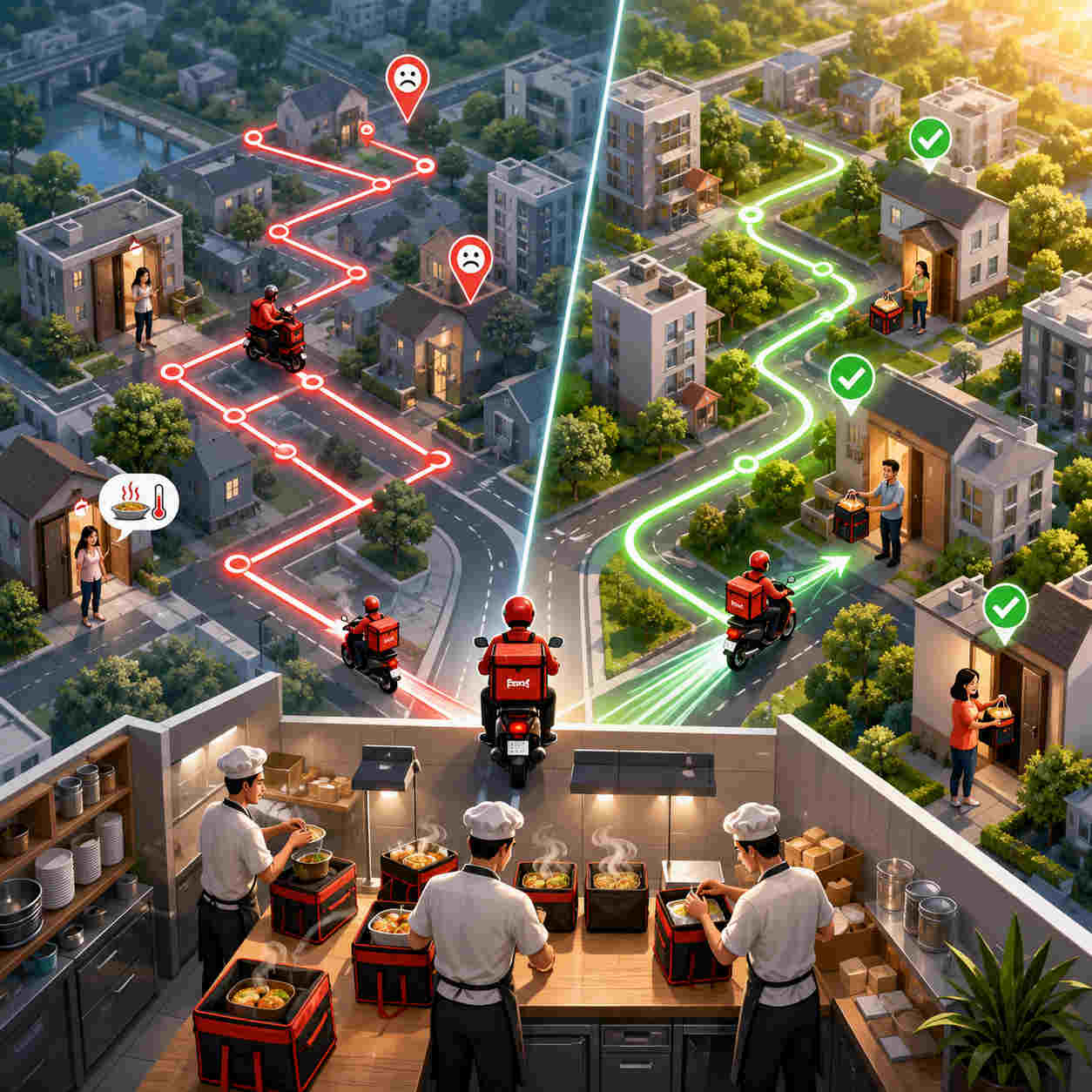
Picture the last order of a busy lunch rush. It’s bagged, it’s sitting on the counter, and it’s perfect. Now it waits four minutes for a driver. Then it rides along while that driver drops two other orders that happened to get bagged first. By the time it lands, it’s twenty-five minutes older and a good bit colder, and the customer has no idea it was ever perfect. They just know their lunch was lukewarm.
Nothing in that story was a cooking failure. It was a routing failure. The food was fine; the sequence was wrong. And that’s the quiet truth about this whole category: the biggest lever on food quality at the door isn’t the kitchen, it’s the order in which drivers hit their stops and how long each meal waits before it’s even picked up.
Food delivery route optimization software is the tool that takes that decision away from guesswork. Instead of a dispatcher dragging pins around a maps app, or a driver deciding on the fly, it works out the fastest, most sensible order to run a batch of stops, weighing drive time, delivery windows, and how fresh each order is. Think of it as a heat-management system that happens to look like a route planner. Keep the total time-in-bag low and you keep the food hot. It really is that simple, and that hard.
An Honest Question: Do You Even Need This?
Now the part most articles won’t tell you, because it doesn’t sell software to everyone. Not every food business needs route optimization. If you run a restaurant doing on-demand delivery, where an order comes in and one driver runs it straight to a single address, there’s nothing to optimize. A route with one stop is just a trip. Dropping money on a multi-stop food delivery app for that is like buying a forklift to carry a sandwich.
Route optimization earns its keep at one specific moment: when a single driver leaves with a batch of stops, roughly five, ten, or more, that all have to be sequenced. That’s when the number of possible routes explodes and no human orders them perfectly by hand. One driver, one drop, back to base? Skip it. One driver, twelve drops across a zone, all cooling by the minute? Now food delivery route optimization software is the difference between hot and sorry.
So here’s the simple test, and it’s worth putting on the wall: if your driver leaves the kitchen with a list, you need routing. If orders trickle out one at a time, you don’t. The businesses in the next section are the ones that leave with a list every single day. If you see yourself there, keep reading. If you don’t, you just saved yourself a subscription.
Who This Is Really For
The sweet spot for food delivery route optimization software isn’t the on-demand crowd. It’s planned, recurring, high-density delivery. Same drivers, batches of stops, tight windows, and product that won’t wait. Here’s where it genuinely pays off. See if one of these is you.
- Subscription tiffin & meal-prep. Fixed daily or weekly subscriber lists, the same customers every cycle, and dense routes packed into a lunch or dinner window. About as close to a textbook fit as it gets, since every driver rolls out with a full, known list.
- Milk & dairy rounds. The original recurring route. Same doorsteps, same order, every morning, with product that has to land before the day warms up. A classic case for a multi-stop food delivery app built for routine drops.
- Grocery delivery. Batches of orders assigned per driver against tight afternoon and evening windows, with chilled and frozen items that punish any backtracking. High-density routing is the whole ballgame here.
- Bakery supply. Pre-dawn drops to cafés, shops, restaurants, and hotels that all need their bread and pastries before they open. Miss the window and you didn’t just deliver late, you missed the entire selling day for that account.
- Beverage & bottled-water delivery. Recurring runs to homes, offices, and retail: water coolers, soft drinks, the office coffee supply. Often with a return leg for empties, which makes clean sequencing even more valuable.
- Produce, CSA & farm-box delivery. Weekly box subscribers strung across a region on one route. Freshness is the promise, so time-in-transit is the number that matters most.
- Meal-kit delivery. Scheduled batches going out to a subscriber base, where the whole brand rests on boxes arriving cold-chain intact and on the right day.
- Multi-drop catering. Not the single big wedding, but the runs that hit several offices, venues, or events in one go. The moment a catering driver has more than a couple of drops, a restaurant delivery route planner starts saving real time.
- Coffee & office-pantry supply. Recurring restocking across dozens of business accounts, where reliability and a predictable arrival window keep the contract renewed.
One more you might be wondering about: full B2B food distribution, meaning wholesale produce, dairy, frozen, restaurant and grocery supply, the 30-to-50-stops-a-run operations. That’s a bigger, more specialized beast with cold-chain compliance layered on top, so we gave it its own deep-dive rather than cramming it in here. If that’s your world, read our guide to route optimization software for food distributors instead, since it’s written for exactly that scale.
Notice the thread running through all of these: recurring customers, batched stops, and food that’s fighting the clock. That’s the profile. If it’s yours, the rest of this guide is for you.
What About Restaurants and Cloud Kitchens?
Fair question, since the words “food delivery” make almost everyone picture a restaurant. Here’s the nuance. A single-location restaurant running the occasional on-demand order still doesn’t need a restaurant delivery route planner: one order, one driver, one address, nothing to sequence. But plenty of restaurants have quietly turned into batched-delivery operations without ever calling it that, and those absolutely do.
The moment a restaurant runs its own drivers and sends them out with several orders at once, whether that’s a lunch push to nearby offices or a dinner cluster spread across a few neighborhoods, it’s playing the exact same game as everyone else on this list. A restaurant delivery route planner sequences those batched orders so the food stays hot and the driver stops doubling back across town. That’s real food delivery route optimization software work, restaurant badge or not.
Cloud kitchens are the sharpest version of this. One kitchen, often several brands, firing dozens of orders into the same rush from a single address. That’s not on-demand. That’s high-volume batched delivery, and cloud kitchen delivery routing is what makes it survivable. Without smart cloud kitchen delivery routing, a busy hour becomes a pile of cold, late orders and a wave of refunds. With it, a lean fleet clears the volume and the food still arrives worth eating. So the honest rule holds: on-demand restaurant, probably not; a restaurant or cloud kitchen running batched runs, definitely. The same last mile food delivery software logic applies either way.
Where the Minutes Disappear
If time-in-bag is the enemy of hot food, it helps to know exactly where those minutes vanish, because that leak map is precisely what food delivery route optimization software is built to read. And they rarely disappear in one dramatic chunk. They leak, a few at a time, in places nobody’s watching. Here’s where a delivery day quietly bleeds time.
The zig-zag route. A driver sent across a zone and back again because the stops were never properly ordered. It looks like driving. It’s actually just cooling food in motion. This single problem is the one food delivery route optimization software was invented to kill.
Dispatching before the food’s ready. A driver arrives to collect an order that isn’t up yet, so they stand around, or worse, they leave with what’s ready and the late order waits for the next run. Either way, minutes gone. Good planning stages pickups around when orders are actually ready, not just when a driver’s free.
One driver drowning while another idles. Without something balancing the load, one driver ends up with fifteen stops and a cold sweat while another finishes early and scrolls their phone. Uneven routes mean some customers always wait too long. A proper last mile food delivery software spreads the work so no single route becomes the slow one.
The customer with no idea where their food is. No live ETA means the customer starts calling, the office starts chasing the driver, and everyone’s stressed before the food’s even close. The information gap doesn’t cool the food, but it torches the experience just as badly.
No proof it ever arrived. “It never came.” Without a timestamp and a photo, that’s your word against theirs, and you usually eat the cost, literally and figuratively. Disputes are their own kind of leak, costing you money, time, and trust.
Add these up across a full service and you’re not losing one minute, you’re losing dozens, spread invisibly across every route. The fix isn’t making drivers hurry. It’s closing the leaks so the minutes never escape in the first place.
How Route Optimization Buys the Minutes Back
So how does food delivery route optimization software actually claw back all that lost time? Not with one trick, but with a handful of them working together, each one plugging a leak from the section above.
It sequences around drive time and readiness. The core move: instead of running orders in the sequence they came in, the software orders stops by real road drive time, so drivers stop zig-zagging and start flowing neighborhood to neighborhood. Bodha’s route optimization plans on actual road speeds, not straight lines, so the plan holds up on the street. Factor in your prep and service times and a driver isn’t sent to grab a meal that’s still on the pass.
It batches smartly, then assigns the right driver. Good last mile food delivery software groups nearby stops into sensible runs and hands each batch to the driver who can clear it fastest from where they already are. That’s how you get more stops per driver without any single order sitting too long.
It re-plans when the rush shifts. Orders don’t stop coming just because the routes are built. A capable multi-stop food delivery app re-optimizes as new orders land mid-service, folding them into the nearest active route instead of forcing a rebuild. The route stays a living thing, not a list you’re locked into.
It puts the route on the driver’s phone. An optimized sequence is useless on a dispatcher’s screen. A real driver app delivers turn-by-turn navigation, the stop order, and delivery notes, so drivers move without calling in.
It keeps the customer in the loop automatically. Live tracking plus automatic ETA texts and a tracking link mean the customer watches their food approach instead of phoning to ask. For a restaurant delivery route planner, that’s the feature that quietly kills the “where’s my order?” calls. Bodha customers routinely see those drop by around 70% in the first month.
It captures proof at the door. A timestamped, photo-backed proof of delivery at each stop ends the “it never arrived” arguments in seconds. One lookup, dispute settled.
Put those together and food delivery route optimization software stops being a planning chore and becomes the thing that keeps your food hot, your drivers efficient, and your customers off the phone.
The Batching Decision: More Stops Without Colder Food
Here’s the tension at the heart of food delivery, and it deserves its own moment. Batching more stops onto one driver saves you money: fewer trips, less fuel, better use of the people you’ve got. But batch carelessly and you get exactly what you were trying to avoid, cold food, because the first order sat in the bag while the driver ran four more.
This is the real skill, and it’s where cheap tools and serious food delivery route optimization software part ways. A good one doesn’t just cram stops together to look efficient. It weighs the trade-off: how many orders can share a run before the earliest one crosses the line from hot to sad? It groups by proximity, respects each order’s freshness window, and can push the most heat-sensitive drops to the front of the sequence. You get the cost savings of batching and keep the food acceptable at every door.
For a cloud kitchen delivery routing setup especially, where one location might pump out dozens of orders across several brands in a single rush, getting this balance right is the entire operation. Batch well and a cloud kitchen scales beautifully on a handful of drivers. Batch badly and every extra order just means more lukewarm complaints. Smart cloud kitchen delivery routing is what lets you say yes to volume without saying goodbye to quality, and it’s a big part of why a purpose-built multi-stop food delivery app beats a generic maps app the moment your order count climbs.
What to Look For (and What to Ignore)
When you go shopping for food delivery route optimization software, the feature lists all start to blur together. So here’s a shorter way to think about it: judge everything by whether it keeps food hot, drivers efficient, and customers informed. These are the things that actually do that.
True multi-stop optimization across your fleet. Not single-route planning that just hands the balancing act back to your dispatcher. You want the whole batch sequenced and shared across drivers in one pass. This is the beating heart of any real restaurant delivery route planner.
Real road drive times. Straight-line estimates produce routes that look tidy and drive terribly. Insist on live, road-aware timing.
Fast mid-service re-optimization. Rushes are chaos. Adding an order and reslotting the route should take seconds, or the tool has failed at the one moment that counts.
A driver app people actually use. Navigation, stop order, notes, one-tap status. If your drivers fight the app, none of the routing matters.
Live tracking, ETAs, and proof of delivery. The trio that handles the customer side: visibility going out, and a clean record coming back.
Easy import and recurring routes. If you run the same subscribers weekly, you shouldn’t re-type them. Look for spreadsheet import and a customer CRM that remembers your regulars, plus route analytics so you can tighten things over time.
And now for the part nobody says out loud. What to ignore: if you’re a batched-delivery food business, you probably don’t need a heavyweight platform bolted onto full POS, accounting, and inventory just to route drivers. That’s a different, pricier tool for a different job. A focused last mile food delivery software that nails routing, tracking, and proof, and plays nicely alongside the ordering system you already use, is usually the faster, cheaper, better fit. In other words, the right multi-stop food delivery app solves the one problem that actually cools your food; it doesn’t try to run your entire business. Don’t pay enterprise prices to solve a routing problem.
Getting Hot Food Out the Door With Bodha
If your operation looks like the ones earlier in this guide (batches of stops, recurring customers, food racing the clock), this is where Bodha fits. It’s software-first, so there’s no hardware and no drawn-out setup. Most teams import their stops and customers from a spreadsheet, optimize their first routes, and dispatch to drivers inside an hour.
From there, the day runs itself more than you’d expect. Drivers follow optimized routes on the Bodha app and capture proof at each door. Dispatch watches the whole fleet live and reslots on the fly when the rush spikes. Customers get automatic ETAs and a tracking link. And every route feeds analytics you can use to keep tightening. Food businesses that switch from manual planning typically see up to 30% lower fuel costs, around 25% more deliveries per driver, and that 70% drop in “where’s my order?” calls, all of which, not coincidentally, add up to hotter food landing on time.
The honest framing: Bodha is a food delivery route planner, not an all-in-one restaurant OS. It doesn’t run your menu, your billing, or your kitchen. It runs your routes, and it slots in alongside the ordering tools you already have. That focus is the point. You get serious food delivery route optimization software, real-time tracking, notifications, and proof of delivery, without paying for a bloated platform you’d half-use. You can see exactly what it costs on the pricing page before spending a rupee or a dollar. Whether you’re running subscription tiffin, a grocery round, or cloud kitchen delivery routing across several brands, the same food delivery route optimization software does the heavy lifting. If your meals are showing up a little colder and a little later than they should, tightening your routes is the most direct fix there is, and you could be running a hotter, faster operation by tomorrow’s rush.
Frequently asked questions