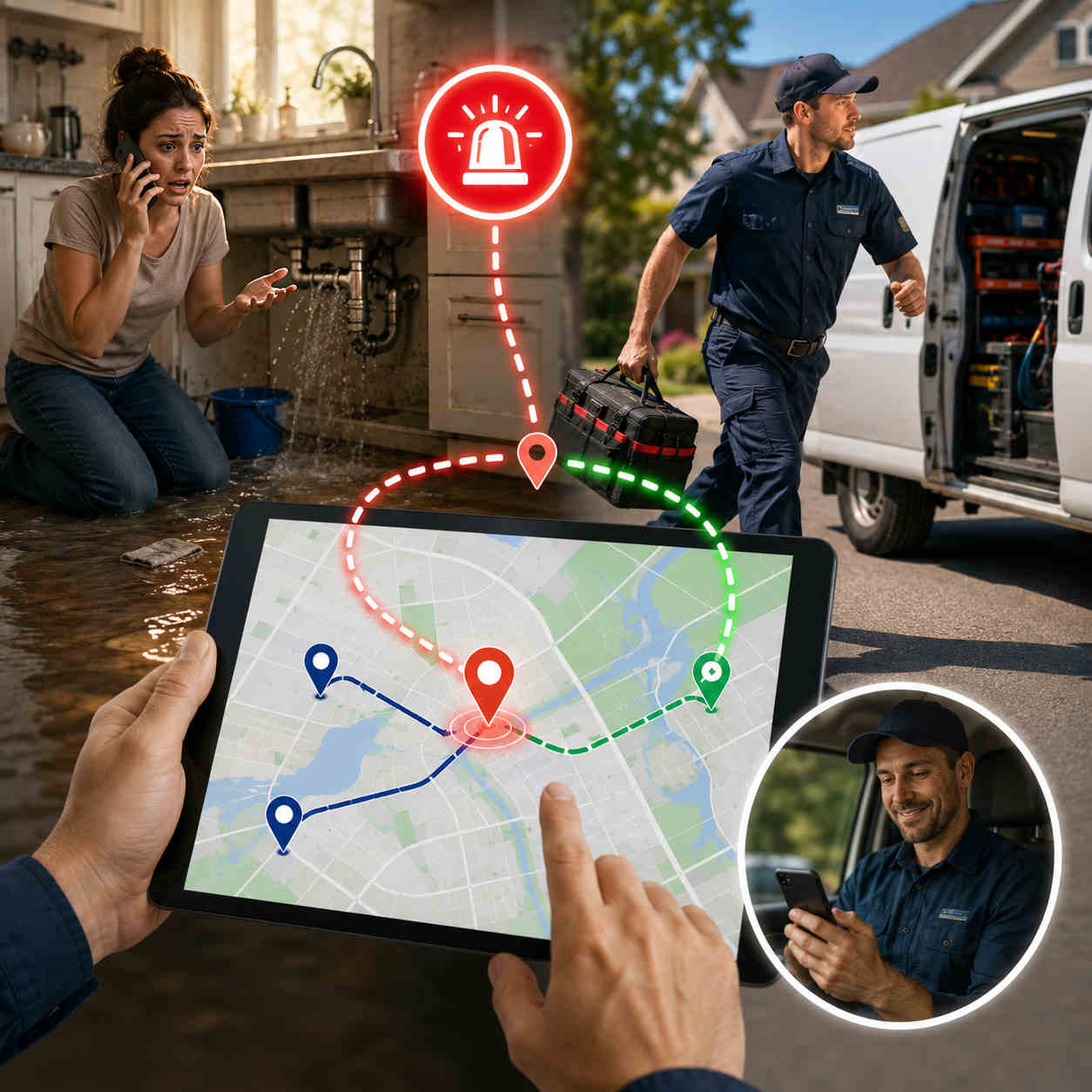
Three o’clock. Hottest day of the year. The phone rings and it’s a family whose AC just quit, there’s a baby in the house, and they need somebody now. Your dispatcher’s face does that little thing it does, and then the scramble starts. Who’s closest? Nobody’s totally sure. One tech gets pinged, turns out he’s halfway across town. Another’s elbow-deep in a job and can’t leave. Twenty minutes go by. The customer’s still sweating. And somewhere in the back of their mind, a one-star review is already writing itself.
You know that scene. Every shop does. But look closely and it isn’t really a people problem. Your dispatcher is good. The problem is that they’re flying blind, because you can’t route what you can’t see. When the whereabouts of your crew live in someone’s head instead of on a screen, every urgent call becomes a guess. That’s the whole reason HVAC emergency dispatch software exists. It tells you who’s genuinely closest and free, drops the urgent job into the day without knocking everything else over, and gets the right person moving in minutes, not twenty.
So let’s get into it. What HVAC emergency dispatch software actually does, why the manual way falls apart at the exact moment you need it most, how the urgent call routing HVAC and plumbing crews depend on really works under the hood, and what to look for so your next 3pm disaster is a two-tap reassignment instead of a fire drill. Burst pipe or dead furnace, the job’s the same: get the right person there fast, and don’t torch the rest of the day doing it.
What Is HVAC Emergency Dispatch Software?
Plainly put, it’s the tool that gets the right tech to an urgent job fast, on its own, instead of your dispatcher working three phones at once. A same-day call comes in. The software shows you every tech’s live location and what they’re in the middle of, helps you send the nearest one who can actually break away, reshuffles that tech’s route to fit the new job, and drops the change onto their phone. The customer gets an ETA without anyone lifting a receiver. And your office quits firefighting.
Worth drawing a clear line here, because the trades software aisle is a confusing place. A full field service platform runs the paperwork: job records, invoicing, parts, memberships. An answering service makes sure somebody picks up at 2am. HVAC emergency dispatch software is the bit in between, the part that turns a logged panic call into a truck actually pointed at the problem. Same story for plumbing emergency dispatch, by the way. A pipe letting go at 4pm is the same puzzle as a furnace dying at midnight: someone needs help this minute, and you need your closest capable person there without wrecking five other appointments.
Here’s what trips people up, though. You don’t have to throw out what you’ve already got. Decent same-day service dispatch software doesn’t fight your stack, it slides in next to it. Already running an FSM or an answering service? Emergency dispatch adds the live eyes and the instant rerouting those tools usually don’t have. Still working off a whiteboard and a cell phone? Then honestly, this is the one upgrade that’ll change your ugliest days the most. Either way the pitch is the same: quicker urgent call routing HVAC and plumbing operators can lean on, minus the chaos.
Why Manual Emergency Dispatch Falls Apart Under Pressure
On a slow day, a sharp dispatcher with a whiteboard and a phone looks like a wizard. Problem is, emergencies don’t book themselves for slow days. They land on the days you’re already slammed, and that’s precisely when the manual way buckles. Here’s where the cracks show.
You’re guessing who’s closest. No live tracking means “who can grab this?” gets answered from memory, off a mental map that went stale an hour ago. That tech you pictured nearby? He wrapped up and drove clear across town twenty minutes back. Guess wrong on an emergency and a fifteen-minute response becomes forty. This, right here, is the daily headache behind urgent call routing HVAC teams keep losing sleep over.
Double-books and dropped balls. Mid-scramble, two techs get aimed at the same job while a third request slips off the whiteboard entirely. One move, and you’ve burned a truck and lost a customer. Manual plumbing emergency dispatch punishes this hardest, because water doesn’t wait around politely while you untangle the mix-up. It’s soaking the drywall the whole time.
One emergency, whole day gone. Wedge an urgent call onto a tech by hand and watch his next three appointments wobble, then slide, then collapse. Those customers ring in irritated. The afternoon dominoes. You spend the back half of the day saying sorry. Without same-day service dispatch software to reslot things cleanly, a single emergency taxes everything downstream of it.
It all lives in one head. When “who’s where and what’s on fire” exists only in your dispatcher’s memory, the whole operation stops the second they take lunch. That’s a shaky way to run the part of the business your reputation hangs on.
And the reputation hit keeps on giving. A slow emergency isn’t one bad afternoon and done. It’s a one-star review parked on your profile for years, quietly waving the next customer toward the competition. In this trade, how you handle the emergency is the story people tell, at the cookout, in the neighborhood Facebook group, in the review that pops up when somebody Googles you at midnight with a flooded basement. Get it right and it sells for you for years. Get it wrong and it costs you just as long. Field service dispatch software is how you make sure it’s the good version.
Tally it up and manual emergency handling isn’t just stressful, it’s a slow bleed. Every laggy response, every double-book, every blown schedule leaks money and goodwill out the same hole. HVAC emergency dispatch software patches it by swapping the guesswork for a live picture you can actually act on.
How Emergency Dispatch Software Routes Urgent Calls to the Right Tech
Cut through the sales speak and good HVAC emergency dispatch software really does five plain things the instant an urgent call hits. Each one lifts a task off your dispatcher’s plate at the worst possible moment. Here’s the sequence, front to back.
First, it shows you who’s actually closest. Live GPS tracking puts the whole crew on one map, updating in real time, so “who’s nearest?” stops being a hunch. You see where everyone is and what they’re doing, and you pick the tech who can truly get there quickest, not the one you half-remember being in that zip code. That’s the bedrock of any real urgent call routing HVAC and plumbing shops can trust.
Then it slots the job in and re-optimizes on the spot. Adding an emergency shouldn’t mean rebuilding the whole day from zero. Solid route planning reshuffles that tech’s remaining stops around the new urgent job in seconds, and lets you grab it and drag it yourself when you’d rather override the machine. This is the line between same-day service dispatch software and a glorified calendar: the day flexes to swallow the emergency instead of snapping under it.
Next, the new route lands on the tech’s phone. The updated stop shows up in the technician’s mobile app right away, navigation, notes, gate codes and all. No phone call, no “okay so from where you are, head back toward Elm.” He just sees it and goes.
Meanwhile, the customer gets a heads-up automatically. The second a tech is assigned and rolling, an ETA text and a tracking link go out on their own. For a panicked homeowner watching their kitchen flood, “help is 15 minutes out” is the whole difference between a grateful review and a furious one. Just as true for plumbing emergency dispatch as for a no-cool call in August.
And finally, it captures proof. Timestamped, photo-backed proof of service logs exactly when the truck showed and what got done. Anybody ever argues the response time or the work, you’ve got the receipt. Quiet insurance a paper job sheet could never give you.
String those five together and the urgent call routing HVAC and plumbing teams used to dread stops being a scramble. Call comes in, you spot who’s closest, the job drops in, the tech rolls, the customer’s already been texted, all in less time than it used to take just to find somebody.
Balancing Emergencies With the Planned Day
Here’s what makes trades dispatch genuinely tricky, and it’s worth sitting with. Your day is never all emergencies or all planned work. It’s both, braided together. A tech’s got a tidy morning of tune-ups, and then 2pm rolls around and a no-cool call lands that flat-out can’t wait. The whole craft of dispatch is soaking up the urgent without ditching the planned, and protecting that balance is really what HVAC emergency dispatch software is for.
It comes down to the re-optimization. Add an emergency and the software doesn’t just staple it to the end of somebody’s day and let the rest topple. It weighs the whole board: who can take the urgent job with the least damage, whose leftover stops can shift, how to keep the most appointments on time. Good same-day service dispatch software treats the emergency as one more thing to solve around, not a grenade rolled under the schedule.
That balancing act guards your recurring money, too. The maintenance agreements and seasonal tune-ups that actually pay your rent don’t get sacrificed every single time an urgent call jumps the line, because the system reslots with some sense instead of bumping whatever’s easiest to bump. Tie that to a client CRM holding every site’s history and access notes, and even a last-minute fill-in tech rolls up knowing where the shutoff is and which dog bites. That’s where field service dispatch software quietly pays for itself, not on the dramatic rescue, but on keeping the ordinary day whole while it pulls off the dramatic one.
What to Look For in HVAC & Plumbing Emergency Dispatch Software
Plenty of tools wear the “dispatch software” label without being built for the speed a real emergency demands. So when you’re weighing up HVAC emergency dispatch software, these are the things that actually earn their money at 3pm on the worst afternoon of the summer.
Live GPS, not “last check-in.” You need every tech’s true, current spot on one map, or you can’t send the genuinely closest person. Any field service dispatch software worth a dime treats this as the whole point, not a bolt-on.
Re-optimization that’s actually instant. Dropping in an urgent job and resequencing the affected route should take seconds. If it’s twenty minutes of manual dragging, the tool just failed the one exam that counted. This is the beating heart of same-day service dispatch software.
An app your techs won’t hate. The slickest reassignment on earth is useless if it never reaches the truck cleanly. You want a fast app, real navigation, job notes, and one-tap status updates flowing back to dispatch.
Customer texts that fire on their own. An ETA and a tracking link the moment a tech’s en route. For plumbing emergency dispatch especially, that little bit of reassurance flips a frightened caller into a loyal customer.
Proof of service. Timestamped, photo-backed, arrival to sign-off, so response times and finished work are never a “well, he said he showed up” situation.
It plays nice with what you already run. The best HVAC emergency dispatch software rides alongside your FSM, your scheduler, your answering service, instead of demanding you rip everything out. Import the jobs, dispatch, reroute, keep the invoicing and booking you already trust.
Setup measured in minutes. Emergencies won’t hold for a three-month rollout. Look for something you can load from a spreadsheet and run inside an hour.
Reports you’ll actually open. Analytics on response times and completed jobs tell you whether your urgent call routing HVAC and plumbing process is getting better or just feels like it is, and where to aim next.
Check most of those boxes and you’ve got emergency dispatch that holds up when the pressure’s on, not one more screen to glare at while the phone won’t stop.
What Faster Emergency Response Actually Delivers
Easy to talk about all this in the abstract, so let’s put it in dollars and reviews. The obvious win is speed. Shaving an emergency from forty minutes to fifteen is the kind of thing customers don’t forget, and not forgetting is exactly what turns a one-time panic call into a regular and a glowing review. Your emergency response is your reputation, and your reputation fills next month’s calendar.
Then there’s the leak you plug. Fewer double-books means fewer wasted truck rolls. Cleaner rerouting means the planned jobs you’d otherwise bump stay on the books, so you protect the day’s revenue instead of robbing one job to pay another. And because good field service dispatch software banks proof of every response, the callback squabbles that used to swallow an afternoon get settled in about ten seconds. There’s a softer payoff too: your dispatcher climbs out of permanent fight-or-flight. When the map does the finding and the software does the reslotting, the person running your board gets to manage the day instead of just surviving it. Calmer office, faster trucks, better reviews. That’s the quiet compounding you get from nailing the urgent call routing HVAC and plumbing teams live or die by.
Where Emergency Dispatch Fits: Software vs. FSM vs. Answering Service
People tie themselves in knots here, so let’s untangle it. These tools overlap, but they fix different things, and knowing which you actually need keeps you from overpaying for the rest.
An answering service makes sure the call gets caught, day or night. Necessary, but it taps out at “we’ve logged your emergency.” A field service management platform runs the back office, records, invoices, parts, memberships. Also worth having, but heavy, and not built for split-second rerouting. HVAC emergency dispatch software is the connective tissue between them, the thing that turns a logged urgent call into a truck physically closing in on the problem, and keeps the rest of the day standing while it happens.
So the real answer is they work best shoulder to shoulder, not instead of each other. Answering service catches the call. Your same-day service dispatch software finds the nearest tech, reslots the route, gets them moving. Your FSM cuts the invoice after. Loads of shops run good field service dispatch software right next to the tools they already own and let each one do the job it’s actually good at. That’s exactly how Bodha’s built, tight routing, dispatch, tracking, and proof that tucks into your setup instead of bulldozing it.
Getting Started With Bodha
Best part for anyone drowning in emergency chaos? How fast this flips. Because Bodha is software-first and runs off the tech’s app, most shops are dispatching live inside an hour. Pull your jobs and customer list in from a spreadsheet, get the crew on the app, and you’re ready before the next urgent call even rings. No hardware, no drawn-out onboarding.
After that, emergencies get almost boring, which is the whole idea. Call lands, you glance at the live map in Bodha Fleet, spot who’s closest, drop the job in, and the route re-optimizes and pushes itself to the tech’s phone. Customer gets an ETA. Proof of service closes it out. Shops that switch usually see quicker response times, fewer blown schedules, and a real dent in the “where’s my technician?” calls that used to eat the front desk alive, on top of the up-to-30% fuel savings that come with tighter routing across the board.
Bodha’s HVAC and plumbing route planner keeps its focus narrow on purpose: live tracking, instant re-optimization, proof of service, automatic customer texts, all riding alongside the FSM and answering service you already run. Poke around the pricing page before you spend a nickel. If urgent calls keep turning your afternoons into fire drills, HVAC emergency dispatch software is the shortest path out, and you could be handling the next one calmly by this afternoon. (Want the wider picture on tightening every route, not just the 3pm scrambles? Start with our guide to HVAC and plumbing route planning software.)
Frequently asked questions