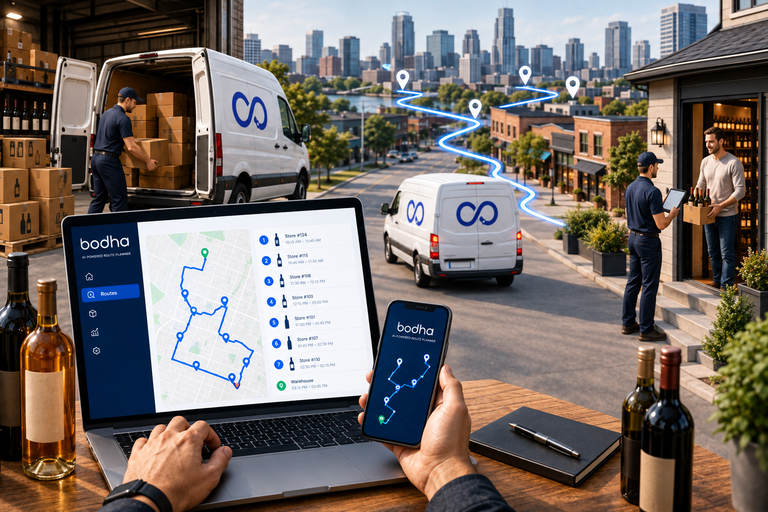
Running an alcohol delivery operation without a liquor delivery route planner is a bit like navigating a city blindfolded. You might eventually get where you’re going, but the wasted fuel, blown time windows, and frustrated customers along the way will cost you far more than the detour ever would.
Here’s the reality. The US alcohol e-commerce market is projected to surpass $36 billion by 2028. Customers expect speed. They expect reliability. And they’re not shy about switching to a competitor when you fall short. Whether you run a neighborhood liquor store with two drivers or you’re managing a regional distribution fleet, the way you plan your delivery routes has a direct impact on how much profit sticks around at the end of the day.
This guide covers everything you need to know about choosing and using a liquor delivery route planner. We’ll walk through how alcohol delivery software fits into the bigger picture, and break down the specific strategies that top-performing delivery operations are using to stay ahead in 2026.
What Is a Liquor Delivery Route Planner?
A liquor delivery route planner is a specialized tool that figures out the most efficient sequence of stops for your delivery drivers. Instead of plotting addresses on a map by hand or leaning on basic GPS navigation, a route planner weighs multiple variables at the same time: delivery time windows, live traffic conditions, driver availability, vehicle load capacity, and customer priorities.
But here’s the important part. A general-purpose route planner wasn’t built for alcohol delivery. The liquor industry comes with constraints that generic tools just can’t handle. Think state-by-state delivery hour restrictions, mandatory age verification at the door, dry county boundaries, and product-specific load limits. All of that requires a planning system that actually understands the alcohol delivery landscape.
When a liquor delivery route planner accounts for these variables, you don’t just get routes that minimize distance. You get routes that minimize cost, maximize compliance, and keep your business safe from regulatory violations that could put your license on the line.
How It Differs from Standard Routing Tools
Google Maps and Apple Maps do a fine job getting a single driver from point A to point B. But they fall apart the moment your operation involves multiple drivers, dozens of daily stops, or delivery windows that change based on what each customer prefers.
A dedicated liquor delivery route planner handles complexity that standard tools were never designed for. It can chew through hundreds of delivery addresses at once, distribute stops across your available drivers based on proximity and workload balance, and adjust routes on the fly when last-minute orders come in or a customer reschedules.
And it doesn’t work in isolation. It connects with the platforms your business already runs on, like Shopify or WooCommerce for orders and your billing software for invoicing. That creates a smooth workflow from the moment an order lands to the second a signature gets captured at the door.
Want to see this in action?
Bodha Fleet optimizes multi-driver routes in seconds, handles time windows and capacity constraints automatically, and gives your dispatch team full visibility from a single dashboard. Start your free 7-day trial →
Why Alcohol Delivery Operations Need Specialized Software
Alcohol delivery isn’t like delivering packages or groceries. Every single order comes wrapped in regulatory complexity that other industries simply don’t face. And ignoring that complexity doesn’t just hurt efficiency. It can shut your doors.
Regulatory Compliance Is Non-Negotiable
Every state in the US enforces its own rules around alcohol delivery. Many municipalities pile on additional restrictions. Texas permits alcohol delivery until midnight on weekdays but pushes the cutoff to 1 AM on weekends. California draws a hard line at 2 AM for beer and wine, yet prohibits hard liquor delivery after midnight. Pennsylvania? They restrict all alcohol deliveries to licensed retailers only.
A capable alcohol delivery software platform bakes these rules right into its routing logic. When a driver’s route crosses multiple jurisdictions, the software makes sure each delivery falls within the legal time window for that specific location. No guesswork. No flipping through compliance calendars by hand. No accidental violations that come back to bite you.
Age Verification at Every Stop
With standard package delivery, a driver can drop a box at the door and move on. Alcohol delivery doesn’t work that way. Every handoff needs face-to-face age verification, and that adds real time to each stop. Your route calculations need to account for it.
Modern alcohol delivery software puts ID scanning right inside the driver’s mobile app. The driver scans the recipient’s government-issued ID, the system checks the date of birth automatically, and the verification record gets stored as part of the digital proof of delivery. That protects you during audits and takes human error out of the equation.
Load Capacity and Product Handling
Alcohol is heavy. It’s fragile. And it’s often temperature-sensitive. A case of wine runs about 40 pounds. A keg of craft beer? That can top 160 pounds. Your liquor delivery route planner needs to factor in vehicle weight limits, stacking constraints, and how many units each van can physically carry without issues.
On top of that, several states cap how much alcohol a single driver can transport in one trip. Go over the limit, even by accident, and you’re looking at fines or license suspension. The right alcohol delivery software tracks load capacity in real time and splits orders across vehicles when things get tight. Bodha Fleet’s vehicle loading plan takes this a step further by generating reverse-sequence load orders that match each driver’s optimized route.
Core Features to Look for in a Liquor Delivery Route Planner
Not every route planning tool is built the same. The gap between a tool that shaves twenty minutes off your morning and one that genuinely transforms your operation comes down to a handful of features.
Multi-Stop Route Optimization
This is the foundation of everything. Your liquor delivery route planner should accept hundreds of stops at once, whether they’re imported from a spreadsheet, pulled from your order system, or punched in manually. And it should spit out the most efficient route sequence in seconds.
The best tools go well beyond simple shortest-distance math. They factor in traffic patterns for the specific time of day, known construction zones, road restrictions for commercial vehicles, and the delivery windows your customers actually requested. What you get is a route that hits every stop on time while covering the fewest possible miles.
Dynamic Re-Routing
Deliveries almost never go exactly as planned. A customer calls to push their window back. A driver runs into a road closure nobody saw coming. A rush order drops in that absolutely needs same-day fulfillment.
Your alcohol delivery software should handle these curveballs without forcing a dispatcher to tear up the whole route and start over. Dynamic re-routing recalculates remaining stops in real time, shifts work to other available drivers if needed, and pushes fresh turn-by-turn directions straight to the driver’s mobile app.
GPS Fleet Tracking
Knowing where your drivers are at any given moment isn’t a nice-to-have. It’s an operational necessity. Live GPS tracking lets dispatchers see progress across the entire fleet, spot drivers who are falling behind, and proactively update ETAs for customers who are waiting.
For alcohol delivery specifically, GPS tracking also creates a timestamped record of every single stop. That data becomes your best friend during compliance audits, proving deliveries were made within legal hours and at verified locations.
Proof of Delivery Collection
Every alcohol delivery should leave behind a digital paper trail. The strongest liquor delivery route planner platforms capture multiple forms of evidence at each stop: e-signatures, photos of delivered products, scanned ID verification results, and GPS-stamped timestamps.
Why does this matter? Three reasons. It shields you from false “I never received it” claims. It satisfies the regulatory requirements around age verification documentation. And it shows your customers that their order was handled with care from start to finish.
Customer Notifications and ETA Updates
Your customers want to know when their order is showing up. Automated delivery notifications triggered at key milestones like dispatch, approaching delivery, and completion cut down on inbound calls and make the whole experience feel professional.
Better alcohol delivery software sends dynamic ETAs that update based on the driver’s actual position, not some static guess from three hours earlier. Some platforms even offer branded tracking pages where customers watch their delivery approach on a live map. That’s the kind of experience that gets people ordering again.
Driver Scheduling and Workload Balancing
Burnt-out drivers make mistakes. In alcohol delivery, those mistakes carry legal consequences. Your liquor delivery route planner should spread stops evenly across your team based on working hours, break requirements, and geographic assignments.
This keeps workloads manageable, trims overtime expenses, and makes sure no single driver ends up with an unsafe pile of time-pressured deliveries. Healthier teams perform better. It’s that straightforward.
All of this, one platform. Bodha Fleet brings route optimization, live tracking, proof of delivery, customer notifications, and driver management together in a single dashboard. Book a free demo →
How Alcohol Delivery Software Reduces Costs Across Your Operation
Investing in alcohol delivery software isn’t just about making life easier. The financial impact shows up on multiple lines of your P&L, and the savings compound fast as you scale. We’ve broken down the math in more detail in our guide to reducing delivery costs.
Fuel and Mileage Savings:
Inefficient routes burn fuel. Every unnecessary mile your drivers cover is money straight out of your margin. A properly configured liquor delivery route planner typically cuts total fleet mileage by 20 to 30 percent compared to routes planned by hand.
If you’re running five vehicles six days a week, that reduction adds up to thousands of dollars in fuel savings alone over a year. Throw in the reduced wear and tear on tires, brakes, and oil, and the total savings grow even more.
Reduced Labor and Overtime Costs:
Optimized routes mean drivers finish their stops faster. Fewer overtime hours. Less reliance on temp drivers during busy seasons. More deliveries completed within regular working hours.
Your alcohol delivery software also kills the hours your dispatchers currently spend building routes every morning. What used to be a 45-minute daily grind turns into a 3-minute task. That frees up your operations team to focus on growing the business instead of wrestling with logistics spreadsheets.
Fewer Failed Deliveries:
A failed delivery hits you twice. You pay for the driver’s time and fuel on the attempt, then pay again when the order gets rescheduled and re-routed. In alcohol delivery, failed attempts happen more often than in other industries because recipients must be home and old enough to accept the order.
A liquor delivery route planner that respects customer time windows and sends proactive ETA notifications cuts failed delivery rates significantly. When people know exactly when to expect their order, they’re far more likely to actually be at the door.
Lower Risk of Compliance Penalties:
Regulatory violations in alcohol delivery carry steep price tags. Fines for delivering outside legal hours, selling to minors, or exceeding transport limits can run from a few hundred dollars to tens of thousands. In bad cases, you lose your delivery license entirely.
Alcohol delivery software that enforces compliance automatically acts as a financial safety net for your whole business. It blocks routes that would result in after-hours deliveries, requires ID verification before a stop can be marked complete, and flags loads that are approaching legal limits.
Integrations That Make Your Alcohol Delivery Software Work Harder
A liquor delivery route planner doesn’t operate in isolation. It delivers its real value when it’s connected to the platforms your business already depends on. Here are the integrations that matter most for alcohol delivery operations.
Shopify Integration
If you sell through a Shopify store, your alcohol delivery software should pull incoming orders directly into the routing queue without any manual steps. Every new order, complete with customer address, product details, and delivery notes, shows up as a stop ready to be optimized. No copying and pasting between tabs. No transcription mistakes slowing down dispatch. Your online storefront and your delivery operation stay in sync automatically.
WooCommerce Integration
For liquor stores running their e-commerce on WooCommerce, the same principle applies. Orders placed on your website flow straight into your liquor delivery route planner the moment they’re confirmed. That means your dispatch team isn’t toggling between your WordPress dashboard and a separate routing tool. Everything lives in one place, and routes get built from real orders in real time.
Billing Software Integration
Delivery operations generate a lot of invoicing activity, and doing it by hand eats up hours every week. When your alcohol delivery software connects with your billing software, every completed delivery can auto-generate an invoice record. Payments, mileage data, and delivery summaries flow into your books without anyone re-entering numbers. End-of-month reconciliation stops being a headache.
Customer Management Software Integration
Keeping track of who ordered what, when they prefer their deliveries, and how to reach them shouldn’t require a separate spreadsheet. Connecting your customer management software to your liquor delivery route planner means customer profiles, order history, and contact details stay in sync across both systems. Your dispatch team gets the full picture for every stop, and your customers get a more personal delivery experience without anyone doing extra data entry.
Setting Up Your Liquor Delivery Route Planner: A Step-by-Step Approach
Getting a new routing system up and running doesn’t have to be complicated. Most alcohol delivery software platforms are designed for quick deployment. But a structured rollout helps you capture the full value right away. We’ve got a more detailed walkthrough in our guide to planning delivery routes.
Step 1: Audit Your Current Routes
Before you optimize anything, get a clear picture of where you stand today. Pull data on total miles driven, average stops per driver, delivery success rates, and customer complaint patterns. That baseline is what you’ll measure improvements against.
Step 2: Define Your Delivery Zones
Break your service area into logical zones based on geographic density, delivery hour regulations, and driver coverage. Your liquor delivery route planner uses these zones to assign stops efficiently and prevent drivers from crisscrossing between areas that are miles apart.
Step 3: Import Your Customer Data
Upload your customer database into the alcohol delivery software: addresses, preferred delivery windows, special instructions, order frequency. Clean data produces accurate routes, so spend a few minutes verifying addresses and weeding out duplicates before import. Bodha Fleet lets you import stops from Excel and CSV files in seconds.
Step 4: Configure Compliance Rules
Program the regulatory parameters for every jurisdiction you serve. Delivery hour windows, age verification requirements, quantity limits, driver certification rules. All of it should be locked in before your first optimized route goes live.
Step 5: Run a Pilot Zone
Don’t flip the switch for your entire operation on day one. Pick one delivery zone or a single day’s worth of routes to test the new liquor delivery route planner. Compare the results (time per route, fuel use, on-time rate) against the baseline you captured in Step 1.
Step 6: Train Your Drivers
The best routing software on the planet delivers nothing if your drivers don’t use it properly. Walk your team through the mobile app, the ID scanning flow, proof of delivery capture, and how to flag issues from the road. Get them comfortable before you scale.
Step 7: Scale and Optimize Continuously
Once your pilot zone shows clear gains, expand to more zones and more drivers. Check your route analytics every week to catch recurring bottlenecks. Adjust zone boundaries when demand patterns shift. Fine-tune time window settings using actual delivery data, not guesses.
Most teams go live in under an hour. Bodha Fleet is built for fast setup. Upload stops, assign drivers, generate optimized routes on day one. No credit card needed. Start free for 7 days →
Choosing the Right Alcohol Delivery Software for Your Business Size
Alcohol delivery operations come in very different sizes, and the right software pick depends on where you are now and where you’re headed. For a pricing overview, take a look at our fleet management software cost breakdown.
Small Operations: 1 to 5 Drivers
If you’re running a local liquor store with a small delivery crew, simplicity is everything. Find a liquor delivery route planner with easy stop import, one-click optimization, and a mobile app your drivers can figure out without a training manual. Stay away from platforms that need dedicated IT support or a two-week onboarding process.
At this scale, the biggest wins come from ditching manual route planning and making sure every delivery includes proper age verification records. Even a basic alcohol delivery software setup can slash daily planning time by 80 percent and trim mileage by 20 percent or more.
Mid-Size Operations: 5 to 25 Drivers
Coordination becomes the real headache at this level. Multiple drivers covering overlapping zones, order volumes that bounce around from day to day, and the need for live visibility across your fleet all call for a sturdier alcohol delivery software platform.
Look for tools with automated driver assignment, live GPS tracking dashboards, and solid integrations with platforms like Shopify and WooCommerce alongside your billing and customer management software. The ability to re-optimize routes mid-shift, say when a driver calls in sick or a big catering order drops at 10 AM, becomes critical here.
Large Operations: 25+ Drivers
Enterprise-scale alcohol delivery needs a liquor delivery route planner that was built for serious volume and complexity. Multi-depot routing, territory management, analytics with profitability-per-route breakdowns, and seamless connections to your e-commerce, billing, and customer management platforms aren’t optional at this stage.
Your alcohol delivery software should support role-based access too. Dispatchers, fleet managers, and leadership each need to see the data that’s relevant to their decisions. And compliance reporting that rolls up age verification records, delivery timestamps, and driver certification status across the entire fleet will save you hours when audit season hits.
Common Mistakes to Avoid with Your Liquor Delivery Route Planner
Even with great tools in place, a few operational slip-ups can undercut your results. Keep an eye out for these.
Ignoring Real-Time Traffic Data
A route that looks perfect at 6 AM can turn into a mess by 10 AM if it sends drivers through a school zone or past a highway construction project. Make sure your liquor delivery route planner pulls in live traffic feeds, not just historical averages.
Over-Packing Driver Schedules
Squeezing too many stops into a single shift leads to rushed handoffs, skipped age checks, and tired drivers who are far more likely to make costly mistakes. Your alcohol delivery software should enforce maximum stop counts and mandatory break periods. Cutting corners on this is how compliance violations happen.
Neglecting Return Trip Planning
A lot of operations optimize the outbound route but completely forget about the drive back to the depot. A driver who finishes their last delivery 45 minutes from base is burning fuel and time that smarter planning could have avoided.
Failing to Review Analytics
Your liquor delivery route planner generates useful performance data every single day. Completion rates, average time per stop, fuel consumption per route, customer satisfaction scores. All of it points to opportunities for improvement. Make it a habit to review these numbers weekly, not once a quarter when problems have already piled up.
Skipping Driver Feedback
Drivers see things that no dashboard can capture. Tricky road conditions, parking headaches at certain addresses, customer preferences that never made it into the system. Build a regular feedback loop between your drivers and dispatch team. The insights they share make your future routes sharper.
The Future of Alcohol Delivery Software in 2026 and Beyond
The alcohol delivery landscape is shifting fast, and the technology behind it is keeping pace.
AI-Powered Predictive Routing:
The next wave of liquor delivery route planner tools won’t just optimize based on today’s orders. They’ll forecast tomorrow’s demand using historical sales data, weather patterns, local event calendars, and seasonal trends. That lets you pre-position inventory and pre-schedule drivers before orders even come in.
Autonomous Delivery Integration:
Fully autonomous alcohol delivery faces some real hurdles, especially around age verification at the door. But hybrid models are starting to take shape. Autonomous vehicles could handle the transportation leg while a human agent manages the final handoff and compliance check. Forward-looking alcohol delivery software platforms are already building the APIs to support that shift.
Sustainability-Driven Routing:
Environmental impact is climbing the priority list for both consumers and regulators. Future liquor delivery route planner tools will optimize for carbon emissions per delivery, not just time and cost. Electric vehicle range limits, charging station locations, and emission zone regulations will all become standard routing variables.
Deeper Integration with E-Commerce Platforms:
More and more liquor stores are building direct-to-consumer online channels through platforms like Shopify and WooCommerce. The connection between storefront and delivery operation needs to be tight. Next-generation alcohol delivery software will deepen these integrations further, enabling live inventory visibility, automatic order-to-route conversion, and customer-facing delivery scheduling right at checkout.
Frequently Asked Questions
Start Building a Smarter Delivery Operation Today
Every mile your drivers waste on a bad route is profit walking out the door. Every delivery made outside legal hours puts your license at risk. Every customer left guessing where their order is becomes a customer who orders from someone else next time.
A purpose-built liquor delivery route planner fixes these problems at the root. Pair it with solid alcohol delivery software, and you’ve got the operational backbone to scale your business, stay compliant in every jurisdiction, and deliver the kind of speed and reliability that turns one-time buyers into regulars.
The tools are here. The competitive edge is real. The only question left is how soon you put them to work.
Try Bodha Fleet free for 7 days, no credit card required. Or book a demo to see how it works for alcohol delivery operations.