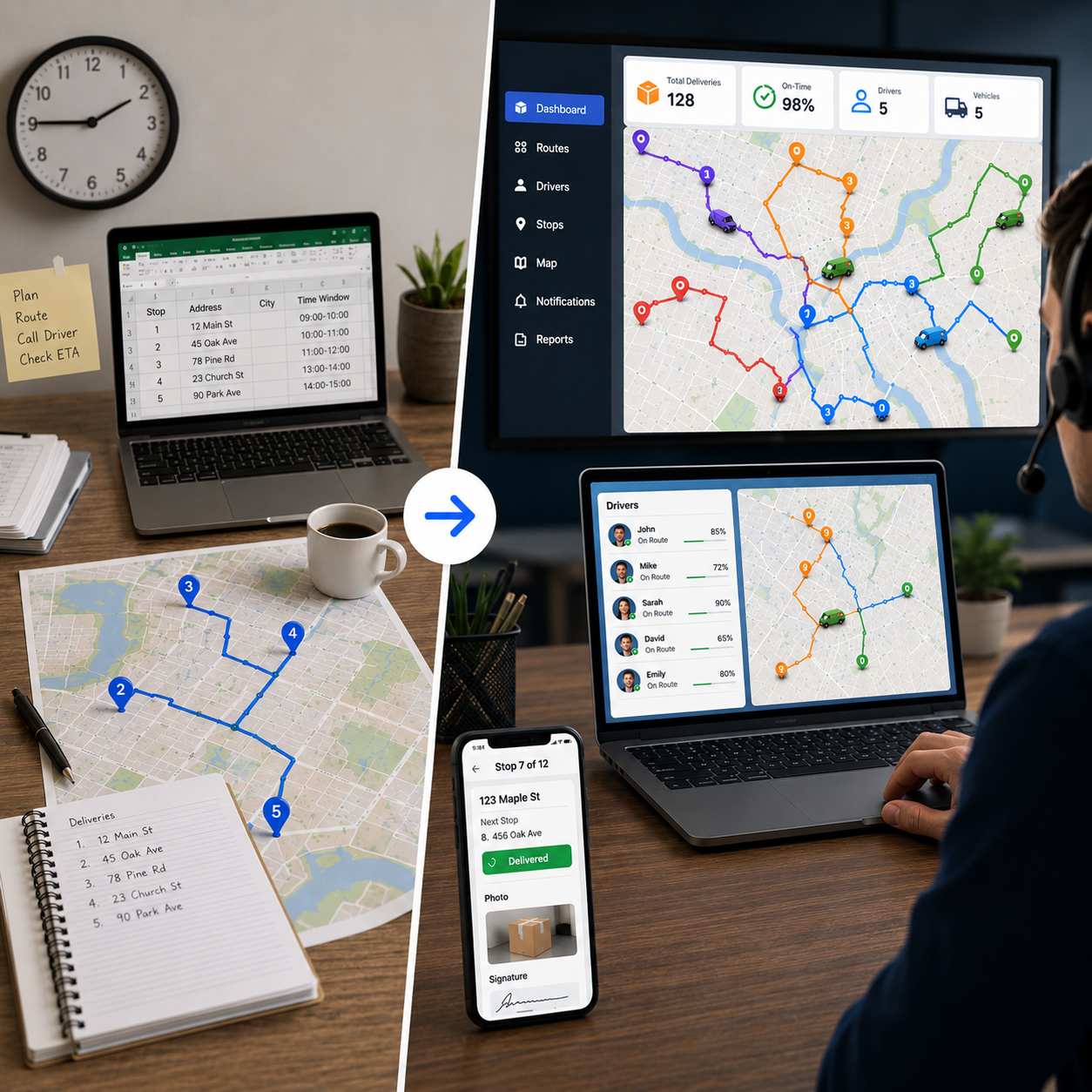
When you run a business with drivers, “free route planner” means something very different than it does for someone planning a weekend of errands. You are not just trying to order a few stops. You need to assign routes to several drivers, see where everyone is during the day, capture proof of delivery, and keep customers updated, all without the morning planning swallowing an hour. That is the difference between a basic planner and real route planner software.
This guide compares the best free route planner software for delivery teams in 2026. We will be straight about what is genuinely free versus what is a trial in disguise, which features actually matter once you have a fleet, and the point where free stops being enough. This one is squarely for the business side, the operations running drivers, rather than the solo errand-runner.
What Counts as Route Planner Software, Not Just a Planner
A map app or a single-route tool gets one person from stop to stop. Route planner software runs an operation. The line between the two is worth drawing, because a lot of “free route planner software” you will find online is really a consumer tool with a business label stuck on it.
Proper route planning software for a delivery team does several things a basic planner never will:
- Plans across multiple drivers at once, balancing stops by area, vehicle, and shift instead of one route at a time.
- Gives a dispatcher a live view, so someone in the office can see progress and step in when a driver falls behind.
- Captures proof of delivery, photos, signatures, or notes, tied to each stop.
- Keeps customers informed automatically with arrival notifications, which cuts the “where is my order” calls.
- Connects to the rest of your stack, pulling orders in from a spreadsheet, an order system, or an ecommerce platform rather than retyping them.
If a tool cannot do most of that, it is a route planner, not route planner software. Keep that distinction in mind as you read, because it is the fastest way to separate the genuine business tools from the rest.
What to Look for in Free Route Planner Software
Once you are choosing for a team rather than yourself, the checklist changes. Here is what actually matters in free route planning software for a business:
- Multi-driver dispatch. Can you plan and assign routes for several drivers from one place, or are you stuck planning one route at a time?
- Real-time tracking. Can a dispatcher see live driver locations and progress, or are you back to phoning drivers to ask where they are?
- Proof of delivery. Photo, signature, or note capture at each stop, with a clean digital record afterward.
- Customer notifications. Automatic SMS or email as a delivery approaches, which is one of the biggest cuts to support calls you can make.
- Bulk import and integrations. CSV and Excel upload at minimum, ideally an API or connectors for Shopify, WooCommerce, or your order system.
- A driver mobile app. Turn-by-turn navigation and the delivery list in the driver’s hand, on both iOS and Android.
A consumer tool might tick one or two of these. Business-grade route planner software ticks most of them. The catch, as we will get to, is that very little of it is permanently free.
The Honest Catch With "Free" Route Planning Software
Here is the part the listicles skim over. Truly free route planner software that does all of the above for a whole fleet, forever, does not really exist. The reason is the same one that applies to any free tool: mapping, optimization, and tracking cost the provider real money, and they cannot give that away to a business running hundreds of paid deliveries a day.
So in practice, “free” route planning software comes in three flavours, and it pays to know which one you are looking at:
- Genuinely free, but limited. A real free tier that caps stops (usually 10 to 30 per route) and leaves out team features. Great for getting started or for a solo driver.
- Free trial of a paid platform. Full features for a week or two, then a subscription. This is most “free” business route planner software, and it is fine, as long as you know the clock is running.
- Free for one driver, paid for a team. Some tools are free at single-driver scale and charge the moment you add dispatch and tracking.
None of these is a trick, as long as the tool is honest about which one it is. The smart way to shop is to get the most generous genuinely-free tier for everyday use, and lean on a no-card trial to test the full platform on your real routes before paying.
What Free Route Planning Software Usually Leaves Out
Free tiers are generous in the places that demo well and quiet about the places that matter once you are running a business. Before you settle on any route planning software free of charge, check what is missing, not just what is included:
- Multiple drivers. Most free plans optimize one route at a time. The moment you have a second driver, you are either upgrading or planning each route by hand.
- A live view of the day. Tracking and ETAs are almost always paid, so on a free plan the dispatcher is back to phoning drivers to ask where they are.
- Data you can take with you. Some free tools limit exports or how long routes are stored, which gets awkward when you need records for a customer dispute.
- Support when it breaks. Free usually means a help forum, not someone who answers when a route will not load at 6am.
None of these make free route planning software useless. They just mark the line where free was always going to end for a growing operation.
Will Free Route Planner Software Fit the Tools You Already Use?
A route planner does not live on its own in a delivery business. Orders come from somewhere, an online store, an order system, a CRM, and the addresses have to get into your planner without someone retyping them every morning. This is where a lot of free route planner software quietly falls short.
At the basic level, look for CSV and Excel import so you can drop a full delivery list straight in. A step up is direct connectors or an API that pull orders from Shopify, WooCommerce, or your order management system automatically, so the route builds itself as orders land. The more your route planning software free tier can ingest without manual entry, the less time the morning takes and the fewer addresses get fat-fingered. If integrations matter to you, check them early, because they are the feature most often missing from a free plan and the hardest to work around by hand.
Best Free Route Planner Software Compared (2026)
Here is how the main business-focused options stack up. These reflect each provider’s published free tier at the time of writing, so confirm the current limits before you rely on one.
A quick read of that table: only a few tools give a business anything genuinely free, and the team features almost always sit on paid plans or trials. Below is the honest detail on each.
Bodha
Bodha’s free tool optimizes up to 30 stops per route with unlimited routes, no signup and no card, running the same engine as its paid platform. For a solo driver or a small operation that is plenty. The team features, multi-driver dispatch, live tracking, proof of delivery, and automatic customer notifications, sit in the app and Bodha Fleet on a 7-day free trial. So you start genuinely free, then test the full platform on your own routes before paying.
Best for: delivery teams that want a real free starting point and a clear, no-card path to full software.
Routific
Routific is built for local delivery businesses and is one of the more generous free tiers, with planning free up to around 100 stops a month, unlimited routes, and a free driver app. Optimization and multi-route planning are solid, and proof of delivery and the heavier features come on paid plans.
Best for: small delivery businesses that want multi-driver planning without paying on day one.
RouteXL
RouteXL optimizes up to 20 stops per route for free with unlimited routes and spreadsheet import. The trade-off is that it is web only, with no driver app and no tracking or proof of delivery, so it suits planning at a desk and navigating elsewhere.
Best for: solo planners doing desk-based route building on a budget.
Circuit (Spoke)
Circuit, now under Spoke, is a polished app with a free tier of around 10 stops a day. The team features, dispatch and tracking, live on its paid Teams plans.
Best for: solo drivers with light, occasional routes who want a clean mobile app.
Route4Me, OptimoRoute, and Onfleet
These three are capable enterprise platforms rather than free tools. Route4Me’s trial requires a card, OptimoRoute and Onfleet are trial-based with no real free plan, and all three put dispatch, tracking, and proof of delivery on paid tiers. They are strong software once you are paying, but they are not where a budget-conscious business starts.
Best for: larger operations with a budget and a need for advanced fleet features.
Track-POD
Track-POD is a commercial delivery platform with strong proof-of-delivery tooling, offered on a free trial rather than a free plan. It suits established fleets, and like the enterprise tools above, the real features are paid.
Best for: commercial fleets that want heavy proof-of-delivery features and will pay for them.
Which Free Route Planning Software Is Right for Your Business?
The right pick depends less on the feature list and more on your size and how you deliver.
- Solo driver or owner-operator (up to ~30 stops a day). Start with a genuinely free tool. Bodha’s free route planner software gives you AI optimization, vehicle-aware routing, and spreadsheet import with no card, which covers a solo day comfortably.
- Small team (2 to 10 drivers). Now you need multi-driver dispatch and a live view of the day. Routific’s free tier or a no-card trial of a full platform like Bodha lets you test team planning before committing.
- Growing operation (10+ drivers, hundreds of stops). You have outgrown free. The question becomes which paid platform fits, and a trial is the way to compare them on your real routes. If you are in a specialised vertical like food distribution or pharmacy, this is also where niche tools matter, since cold-chain timing, compliance records, and capacity rules are needs that general software tends to ignore.
Knowing how the optimization itself works, and why it consistently beats manual planning, helps you judge any tool on this list rather than taking the marketing at face value.
What Route Planner Software Costs Once You Outgrow Free
Since most team features sit behind paid plans, it helps to know roughly what you are walking toward before you start. Pricing for route planner software usually works one of two ways, per driver per month or per vehicle, sometimes with tiers based on how many stops or routes you run. For a small fleet, that often lands at a modest monthly cost per driver, which is easy to justify the moment the software saves each driver an hour a day in planning and backtracking.
The point of starting on free route planner software is not to dodge paying forever. It is to prove the value on your own routes first, so that when you do upgrade, it is a decision backed by your own numbers rather than a leap of faith. A genuine free tier paired with a no-card trial lets you reach that decision without spending a thing, which is the whole reason free route planning software is worth taking seriously even for a business that will eventually pay.
Questions to Ask Before You Commit to Route Planner Software
Choosing route planner software for a team is a purchase, not just a download, so it is worth a few minutes of due diligence. Run any tool, free or paid, past these:
- Does it plan for all my drivers at once, or one route at a time?
- Can a dispatcher see live progress, and reassign a stop mid-day if someone falls behind?
- How does it handle proof of delivery, and can I get those records out easily?
- Will it import from my order system or ecommerce platform, or am I retyping addresses?
- What does it cost the day I outgrow free, and is the jump reasonable?
- Can I test it on my real routes first, ideally without a credit card?
That last one matters most. The best free route planner software lets you prove the value on your own deliveries before any money changes hands, which is exactly why a genuine free tier paired with a no-card trial beats a feature list every time.
How Bodha Works as Free Route Planner Software
Getting started takes a few minutes, with no card for the free tool:
- Open the free route planner software and set your start point and time.
- Add stops by typing or pasting them, or import your delivery list from a CSV or Excel file. Bodha geocodes every address and flags any it cannot read.
- Pick the vehicle and click Optimize. The AI engine sequences the route in seconds.
- Review it on the map, drag any stop you want to adjust, and send it to your phone or print the run sheet.
- When you need a team view, move into the app and Fleet on a 7-day free trial to add multi-driver dispatch, live tracking, proof of delivery, and customer notifications.
Same engine for the free single routes and the full platform, so nothing changes when you scale up except the features you unlock.
Free Route Planner Software FAQs