For years, the morning looked the same at most delivery businesses. A spreadsheet full of addresses. Google Maps open in another tab. A dispatcher with a coffee going cold, dragging stops around the list until the order looked about right.
It worked. Sort of.
In 2026, that routine is finally dying off, the way the fax machine did before it. And it has nothing to do with chasing shiny tech. It is about money. A modern AI route planner does in a few seconds what used to swallow the first hour of someone’s day, and the route it produces is better than the one a person would have pieced together by hand. Route optimization software cuts the wasted miles, hands back the planning time, and catches the lazy backtracking that nobody spots until the fuel bill lands. Better still, you can test the whole idea on a genuinely free route planner before paying anyone a cent.
So here is the plan for this piece: how AI route planning actually works, why route optimization software leaves the spreadsheet habit behind, what you get free versus paid, and how to switch without blocking out a whole week for it. Whether you run one van or a small fleet, an AI route planner 2026 buyers now treat as basic kit puts real optimization within reach, usually free to start.
The Old Way: Spreadsheets, Google Maps, and the Cost Nobody Adds Up
Picture a small delivery outfit, a few drivers, a couple hundred stops a day. The morning goes roughly like this:
- Orders trickle in by phone, email, and the website, and somebody keys them into a spreadsheet.
- The dispatcher sorts them by postcode. It feels organised. It is really just a guess.
- Then comes Google Maps, address by address, until the 10-stop wall hits and the whole thing splinters into three or four mini-routes per driver.
- Drivers get their lists over WhatsApp, by text, or on a printed page.
- A stop gets skipped or traffic backs up, and since nobody has a live view, the dispatcher just rings the driver to ask what is going on.
- Customers wondering where their order is get handled one call at a time.
Add it up and that is forty-five minutes to a couple of hours gone every single morning, before a van has even moved. Pay someone for that time, five days a week, week after week, and “free” planning turns out to be one of the more expensive things you do. That is before the extra fuel from routes that were never really optimized in the first place. Closing that gap is the whole job of route optimization software.
What Route Optimization Software (and AI Route Planning) Really Means
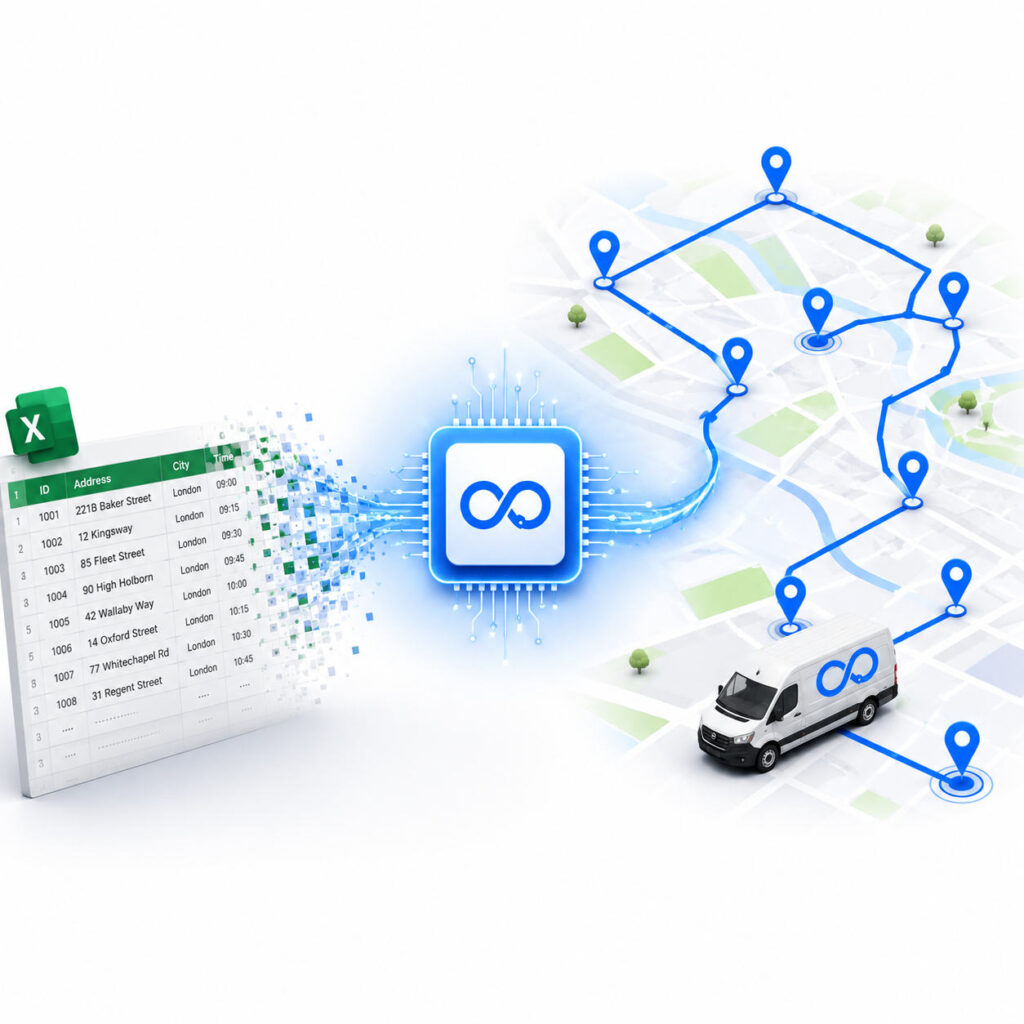
Strip the jargon away and route optimization software does one job: it works out the smartest order to hit a list of stops, for one driver or a whole fleet. You hand it the addresses, it builds the sequence, and it weighs distance, real roads, drive times, delivery windows, and vehicle type all at once, instead of leaving you to eyeball it.
AI route planning takes that further. A basic tool sorts stops by which one is nearest. An AI route planner weighs thousands of possible orderings at the same time and lands on the one that saves the most time and distance while still keeping your rules. That is the gap between sorting and optimizing, and on a busy day it is worth a real slice of your mileage. It is also why “route optimization software” and “route planner software” are the same thing described from two angles, and why a solid free route planner software comparison is worth a read before you marry any one platform. The best free route planner software gives you that optimization without a paywall blocking the door.
How an AI Route Planner Actually Works
Underneath, route optimization software is wrestling with a famous maths problem, the Travelling Salesman Problem, and its messier cousin the Vehicle Routing Problem. In plain English: given all these stops and all these rules, what order should I drive them in? An AI route planner juggles several things at once to answer that:
- Distance and drive time, which stop being the same number the moment traffic shows up
- Time windows on individual stops
- Priority or VIP drops that have to come early
- How much the vehicle can actually carry
- Driver hours and shift limits
A dispatcher is sharp, but holding hundreds of stops against all of those rules at once is not a human strength. Most of us can keep maybe seven things straight at a time. An algorithm checks every stop against every rule in a blink. That is the whole pitch behind AI route planning.
Traffic, Time Windows, and What the Van Can Carry
A decent AI route planner pulls live traffic and adjusts on the fly. Build a route at 7am and it can plan around the 8:30 crawl and the clearer roads after ten, steering drivers clear of the worst of it. Time windows are where it really earns its keep. A delivery promised between nine and eleven gets slotted in early even if it sits dead in the middle of the map, because the software is balancing geography against the promise you made. Capacity rules stop anyone rolling out with more than the van holds.
Why the Software Beats Doing It by Hand
In practice, an optimized route usually comes in noticeably shorter than the hand-built version of the same stops, somewhere around a fifth to a third less driving. The honest answer is that it depends on your city, how tightly your stops cluster, and what you drive, so take any single percentage with a pinch of salt. What does not change is the direction. The more stops you have, the more slack there is to cut, so the gap between a spreadsheet and a real AI route planner only widens as you grow.
What "Good" Route Optimization Actually Looks Like
Not all route optimization software is built the same, and the difference shows up on the road, not in the report. The cheaper logic chases shortest distance and nothing else, and it hands drivers what the trade calls “spaghetti routes,” paths that loop over the same streets and send you doubling back on yourself. On paper it looks tidy. In the cab it is maddening, and it costs you in wrong turns, lost minutes, and drivers who quietly start eyeing the exit.
Good route optimization software trades a little raw efficiency for a route a human can actually follow. It keeps each driver in their own patch, stops sending people back over ground they already covered, and produces an order that makes sense from the driver’s seat. The better an AI route planner is, the more it leans on real drive times rather than straight-line distance, so a route that looks a touch longer on the map can be the faster one once one-way streets and traffic are in the picture. When you trial something, judge the route you would actually have to drive, not the number on the summary screen.
What to Look For in Route Optimization Software
Before you commit to anything, it helps to know what matters day to day. Run any route optimization software past this list:
- Real optimization, not a glorified sort. Make sure it rebuilds the order, not just lists your stops nearest-first. That rebuild is where the savings live.
- Genuinely free access. A free route planner should let you plan a real route with no card and no bait-and-switch. Be suspicious of “free” that turns out to be a seven-day countdown.
- A fair stop cap and unlimited routes. Check how many stops you get per route for nothing, and whether you can make as many routes as you like.
- Spreadsheet import. CSV and Excel upload with automatic geocoding stops being optional past twenty stops, and the tool should flag a dud address rather than swallow it.
- Time windows and priorities. If you make promises on timing, the software has to honour them, not just sort by geography.
- Vehicle awareness. Car, bike, scooter, or truck should change the route and the ETAs, because in real life it does.
- A clean handoff to the driver. Turn-by-turn or a printable run sheet, plus the option to fire each stop into Google Maps, Waze, or Apple Maps.
- Somewhere to grow into. When solo planning stops being enough, the same tool should add multi-driver dispatch, tracking, and proof of delivery without making you start over.
Work down that list and the real route optimization software separates itself from the basic stop-sorters wearing the same badge pretty fast. If you would rather have it done for you across the main tools, our free route planner software comparison lays them out side by side.
Free vs Paid AI Route Planners: What You Actually Get
You do not have to pay to find out whether this works. Here is how a free route planner stacks up against a paid plan, using Bodha as the example:
Short version: the free route planner hands you the real AI engine for up to 30 stops a route, unlimited routes, no signup, no card. When the days get bigger than that, or you need several drivers, tracking, and proof of delivery, the app and Bodha Fleet pick up the slack on a 7-day free trial. Want the wider lay of the land first? The free route planner software comparison covers it.
Which Businesses Get the Most From an AI Route Planner
Just about anyone sending a vehicle to more than a few addresses a day will get something back, but a handful of operations feel it most:
- E-commerce and last-mile: volumes lurch from a sleepy Tuesday to a Saturday in peak season, and AI route planning soaks that up without anyone re-planning by hand.
- Food and grocery: tight windows and stock that goes off mean the order has to be right first time, which is squarely what route optimization software is for.
- Pharmacy and medical: time-critical drops, where an item has to land inside a strict window, lean hard on time-window optimization.
- Couriers and parcels: counts that leap from thirty to three hundred stops need software that scales, not a spreadsheet that falls over.
- Field service and maintenance: techs scattered across a region, jobs that run long or short, customer windows all over the place. Smart sequencing earns its keep.
- Florists and gifting: Valentine’s and Mother’s Day turn an ordinary round into a stress test that manual planning rarely survives.
- Property and inspections: agents and surveyors running eight to twenty viewings a day claw back real time from a better order.
The thread tying them together is volume and change. The more you run, and the more it shifts day to day, the harder an AI route planner works for you. And since you can start on a free route planner, there is no need to take any of this on faith. Run your own route through it and watch.
5 Signs You Need an AI Route Planner
If more than one of these rings true, you already know the answer:
- Your dispatcher burns more than half an hour every morning building routes.
- Drivers keep missing windows, or doubling back for a stop they drove past an hour ago.
- Customers ring up asking where their delivery is and you have nothing live to tell them.
- Fuel is climbing faster than your order count, which nearly always means wasted miles.
- You added drivers to grow and found deliveries per dollar barely moved.
Any one of these and route optimization software pays for itself in short order. All five, and you are handing ground to competitors who already made the jump.
How to Move From Spreadsheets to a Free AI Route Planner
This is not the IT project people brace for. Most teams are running by end of day:
- Export your address list from wherever it lives now, a spreadsheet, an order system, or a CRM, as a CSV.
- Open the free route planner. No signup, no card for the free web tool.
- Drop in your CSV. Bodha places every address and flags anything it cannot read before you move on.
- Hit Optimize. Look over the route on the map and drag a stop if a special case needs it.
- Push each stop to Google Maps, Waze, or Apple Maps, or print the run sheet for the dash.
- Need several drivers, live tracking, and proof of delivery? Move the same flow into the Bodha app and Fleet on a 7-day free trial.
Most outfits feel the difference inside a week, which is the whole reason to start free instead of committing blind.
FAQs About AI Route Planning and Route Optimization Software
1. Is there a free AI route planner?
Yes. Bodha’s free route planner runs the full AI engine for up to 30 stops a route, with unlimited routes, no signup, and no card. Need unlimited stops, several drivers, and tracking? The app adds a 7-day free trial.
2. What is the best route optimization software in 2026?
There is no single winner. It comes down to your size and how you deliver. Solo drivers and small businesses do well on a free route planner with real AI optimization, while bigger fleets need multi-driver dispatch, tracking, and proof of delivery. Our free route planner software comparison weighs up the trade-offs.
3. How is an AI route planner different from Google Maps?
Google Maps stops you at 10 waypoints and drives them in the order you typed, with no optimization at all. An AI route planner 2026 buyers would look at takes the whole list and rebuilds it into the fastest sensible sequence, factoring in traffic, time windows, and the vehicle.
4. How much does route optimization software cost?
Anywhere from free to enterprise money. A free route planner like Bodha’s covers up to 30 stops a route with unlimited routes at no cost, and paid plans pile on unlimited stops, multiple drivers, tracking, and proof of delivery. What you need comes down to volume, so starting free and upgrading later is the low-risk way in.
5. Can an AI route planner re-optimize during the day?
On paid and fleet plans, yes. A driver runs late, a fresh order lands, traffic turns, and the software rebuilds what is left of the route on the spot rather than leaving the morning’s plan frozen. That live re-optimization is one of the biggest things an AI route planner has over a static spreadsheet.