Ask any dispatcher what their morning looks like and you’ll hear some version of the same story. Stops coming in from three places, drivers texting to ask where they’re headed, a spreadsheet that made sense yesterday and doesn’t today, and the quiet knowledge that at least one route is going to fall apart before lunch. Fleet dispatch software exists to take that whole scramble off their plate.
The catch is that “dispatch software” now covers a huge range of tools. Some are last-mile delivery platforms that assign and sequence stops across a team of drivers. Some are heavy telematics systems built around hardware, engine data, and compliance, with dispatch bolted on top. Some are trucking tools built for loads and freight rather than doorsteps. They all call themselves dispatch software, and they are not remotely the same purchase.
This guide compares the ten best fleet dispatch software tools for 2026, what each one is actually good at, who it fits, and roughly what it costs, so you can match a tool to your operation instead of guessing from a feature list. We lead with the ones built for last-mile and multi-driver delivery, then cover the enterprise and trucking-focused platforms.
What is fleet dispatch software?
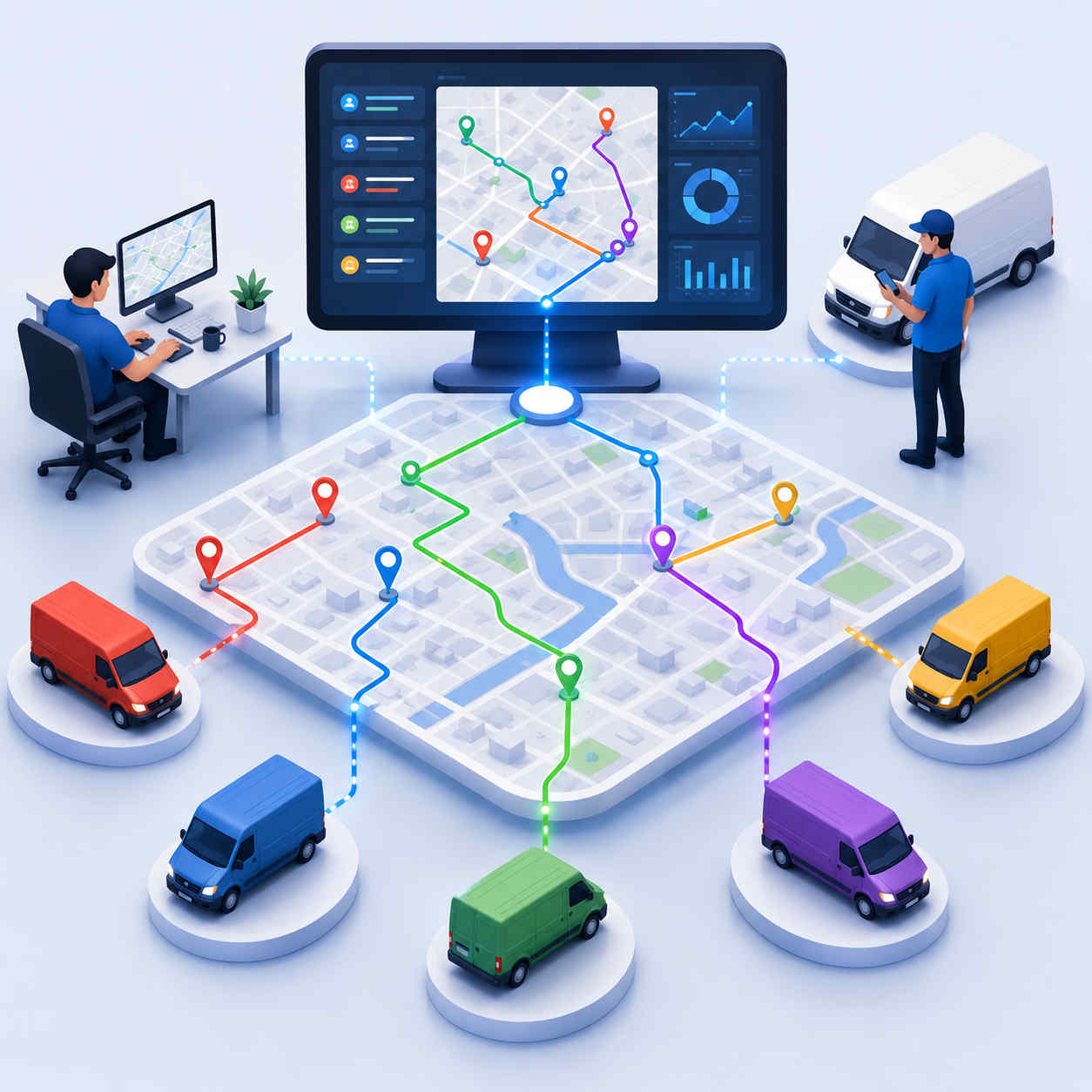
Fleet dispatch software is a tool that lets you assign work to drivers, send them optimized routes, track them in real time, and keep customers updated, all from one dashboard. Instead of a dispatcher hand-building routes and phoning drivers, the software takes the day’s stops, splits them across the available drivers, sequences each route for the fewest miles, and pushes everything to a driver app. Good dispatch software also adjusts live when the day changes, reassigning stops when a driver drops out or a rush order lands.
The difference between plain route optimization and true fleet dispatch software is the team layer. Route optimization sequences one driver’s stops. Dispatch software decides which driver gets which stops in the first place, balances the load across everyone, and gives you a control room to run the whole day from. If you manage more than a couple of drivers, that team layer is where the real time savings live.
You’ll also see the terms fleet dispatch software and fleet dispatching software used interchangeably, and for practical purposes they mean the same thing. Whether a vendor labels it fleet dispatch or fleet dispatching, what you’re buying is a system that turns a pile of orders into assigned, sequenced, trackable routes.
How fleet dispatching works, step by step
Under the buzzwords, fleet dispatching follows a simple sequence, and understanding it makes the tool choices below much clearer. Modern fleet dispatch software runs this entire loop automatically, where a manual operation runs it by hand and pays for the difference in time and mistakes.
It starts with intake. Orders arrive from wherever you take them: a spreadsheet, a CSV export, or a live API feed from your order or e-commerce system. From there, the fleet dispatching software validates and geocodes each address, so every stop lands in the right place on the map.
Next comes assignment, the step that defines fleet dispatch. The software looks at who’s working, what each vehicle can carry, and where every driver starts, then splits the day’s stops across the team so the workload is balanced rather than dumped on whoever the dispatcher trusts most. This is the part manual fleet dispatching gets wrong most often.
Then sequencing. For each driver, the fleet dispatching software orders the stops for the fewest miles and the best chance of hitting every time window, factoring in real roads and live traffic rather than straight-line distance.
Fourth is dispatch to the driver. Finished routes land in a driver mobile app with turn-by-turn navigation, delivery notes, and the day’s stops in order, so nobody’s working from a printed sheet or a group text.
Fifth is live tracking and re-dispatch. As drivers work, the dispatcher watches progress on a live map, and when the day shifts, whether that’s a cancellation, a rush order, or a driver out sick, the fleet dispatch software re-dispatches on the spot instead of forcing a rebuild. Customers stay informed through automatic delivery notifications the whole time.
Finally, proof and reporting. Each drop is confirmed with a photo, signature, or GPS-stamped time, and once the day wraps, route analytics turn it into planned-versus-actual numbers you can act on. That closed loop, from intake to insight, is what good fleet dispatching software delivers, and a whiteboard never will.
What to look for in fleet dispatch software
Before the list, here’s the short version of what separates a tool that runs your day from one that just draws lines on a map.
The biggest one is multi-driver assignment. Plenty of tools marketed as dispatch software really only plan a single route at a time. If you still have to decide who takes what before the software runs, you haven’t automated the expensive part. Real fleet dispatch software splits the whole day across your drivers on its own.
Then there’s live re-dispatching. A plan built at 6 a.m. is wrong by 10. The dispatch software worth paying for absorbs new orders, reacts to a driver running behind, and reshuffles when someone calls in sick, without you rebuilding from scratch.
After that it’s the practical stuff: whether the tool respects real constraints like time windows, vehicle capacity, and driver shifts; whether it captures proof of delivery and sends customer notifications; how fast you can get started; and, increasingly, whether it demands hardware. Older dispatch software wanted a tracker wired into every vehicle. The modern baseline is live tracking through the driver’s phone with nothing to install.
Keep those in mind as you read. Now the list.
Why fleets are moving to dispatch software in 2026
The pull toward fleet dispatching software isn’t really about technology for its own sake. It’s about money that’s been leaking out of manual fleet dispatch for years, now that the tools to stop it are cheap and quick to deploy.
Start with fuel and miles. When a human splits routes by hand, they can’t hold enough variables in their head to find the tightest plan, so drivers backtrack, overlap, and cover ground nobody needed to. Fleet dispatch software that runs proper route optimization across the whole team routinely trims 20 to 30 percent off the miles, and the fuel bill follows the miles down. On a fleet of any size, that alone tends to cover the subscription several times over.
Then there’s the dispatcher’s time. The two hours every morning spent building routes, plus the constant firefighting through the day, is expensive labor doing work software now does in seconds. Move that to dispatch software and the dispatcher shifts from building plans to supervising exceptions, which is both cheaper and more useful. Most teams get ten to twenty hours a week back.
The quieter savings matter just as much. Balanced assignment means less overtime and fewer burned-out drivers, which shows up in retention, since replacing a driver is never cheap. Window-aware routing means more first-try deliveries, so you pay to attempt fewer stops twice. And automatic customer notifications mean fewer “where’s my order” calls tying up the office. Delivery teams commonly report support calls dropping by 40 percent or more once dispatch software is sending ETAs on its own.
There’s also a customer-expectation shift underneath all of this. People now expect a national-carrier tracking experience even from a local delivery: a morning ETA, a live link, a photo at the door. You simply can’t produce that by hand, and the dispatch software that assigns your routes is the same system generating those updates. So the operational win and the customer-experience win arrive together.
Add it up and 2026 is the year the math stopped being close. When the hardware barrier is gone and setup takes an hour, sticking with a whiteboard is the expensive option. With that context, here’s how the leading tools compare.
1. Bodha: Best overall fleet dispatch software for last-mile teams
Bodha is dispatch software built specifically for last-mile and multi-stop delivery fleets, and it’s the tool we’d point most delivery operators to first. You import the day’s stops from a spreadsheet or through the API, and Bodha assigns them across every driver and sequences each route in under thirty seconds, with delivery windows, vehicle capacity, and driver availability built into the plan rather than bolted on afterward.
What makes it stand out as fleet dispatch software is the control room. Dispatchers work the whole day from one live map, drag stops between drivers mid-shift, and reassign a sick driver’s entire route in two clicks while the system rebalances everyone else. Its live tracking runs on the GPS already in drivers’ phones, so there’s no hardware to buy and no per-vehicle box, and every customer gets a branded tracking link with automatic ETAs.
Best for: Courier, food and beverage, waste, pharmacy, and field-service fleets that want proper dispatch software without a hardware rollout.
Pricing: From around $29.99 per driver per month with unlimited stops (see plans); notifications, proof of delivery, and scanning included rather than gated a tier up.
Watch for: It’s focused on last-mile delivery dispatch, not heavy telematics like engine diagnostics or DOT/ELD compliance, so long-haul trucking fleets that need those will want a telematics platform alongside it.
2. Onfleet: Best for high-volume last-mile delivery dispatch
Onfleet is a well-known last-mile delivery management platform with strong dispatch software features: route optimization, driver tracking, customer notifications, and proof of delivery in a clean interface. It’s a popular choice for e-commerce and food delivery operations that push a lot of volume through a warehouse or kitchen.
As fleet dispatch software it’s capable and mature, but the pricing model tends toward enterprise. It’s billed by tasks rather than drivers, so costs scale with delivery volume, and SMS is charged separately on top. For a busy mid-market operation that’s fine; for a smaller fleet it can get expensive fast.
Best for: Mid-market e-commerce and food delivery with high daily volume.
Pricing: Roughly $599–$619 per month for about 2,500 tasks, before SMS.
Watch for: Task-based pricing means your bill climbs with volume; smaller fleets often find per-driver dispatch software cheaper.
3. OptimoRoute: Best for planning-heavy dispatch and field service
OptimoRoute leans toward the planning and scheduling side of dispatch software. It’s strong on scheduling recurring work, spreading jobs evenly across a crew, and mapping whole days or weeks in advance, which makes it a good fit for field service as well as delivery. Capacity-aware optimization and solid reporting round it out.
It works well as fleet dispatching software for teams that plan ahead, though the entry tier caps order volume and there’s no permanent free plan, so it’s more of a commitment than a quick trial.
Best for: Delivery and field-service teams scheduling recurring work across a crew.
Pricing: Around $35.10 per driver per month on annual billing; entry tier caps you near 700 orders.
Watch for: The order cap on the base plan, and no free tier to test on real routes long-term.
4. Route4Me: Best mature, broad-market dispatch platform
Route4Me is one of the longest-running names in this category, with dispatch software covering everything from solo drivers up to enterprise teams. It has deep route optimization, a wide integration library, and a lot of configurability, which is both its strength and its learning curve.
If you want a feature-rich platform with a long track record and don’t mind investing time to set it up, Route4Me delivers. The trade-off is that it can feel heavier and less modern than newer dispatch software, and it doesn’t publish standard pricing.
Best for: Businesses wanting a mature, highly configurable dispatch platform.
Pricing: Not publicly listed; quote-based by tier.
Watch for: Configurability comes with complexity, and the lack of transparent pricing makes budgeting harder.
5. Spoke Dispatch: Best for small delivery teams
Worth clearing up the name first, because a lot of comparison posts still get it wrong: Circuit for Teams was rebranded as Spoke Dispatch in late 2025, and the solo Circuit Route Planner became Spoke Route Planner. Same product and team, new name. If you’re evaluating “Circuit” today, you’re looking at Spoke.
As dispatch software it’s clean, modern, and easy for small teams to pick up, with good multi-stop optimization, a dispatcher view, driver tracking, and proof of delivery. It’s a strong pick for teams of a handful of drivers who want something simple.
Best for: Small delivery teams that want straightforward fleet dispatch software.
Pricing: Around $100 per month for 500 stops, with overage fees beyond that.
Watch for: Stop-package pricing with overages can bite in a busy month; heavier fleets outgrow the entry tier.
6. Samsara: Best for large mixed fleets needing telematics plus dispatch
Samsara is a telematics platform first, with dispatch software as one capability inside a much larger system built around vehicle diagnostics, driver-behavior scoring, cameras, and compliance. For a big mixed fleet that wants hardware-level visibility into vehicles and a way to dispatch them, it’s a serious contender.
The trade-off is that you’re buying a telematics ecosystem, not a lightweight dispatch tool. That means per-vehicle hardware, longer rollouts, and custom pricing. The dispatch and routing layer is capable but isn’t the product’s center of gravity the way it is for a dedicated last-mile tool.
Best for: Large mixed fleets that need telematics and dispatch in one system.
Pricing: Custom, plus per-vehicle hardware.
Watch for: Hardware installs and multi-year contracts; overkill if you only need last-mile dispatch software.
7. Motive: Best for trucking and freight dispatch with compliance
Motive (formerly KeepTruckin) is built around trucking: ELD compliance, hours-of-service, driver safety, and fleet management, with dispatch software geared toward loads and long-haul rather than doorstep deliveries. If your operation is freight and your dispatch problem is which truck hauls which load while staying compliant, Motive is designed for exactly that world.
It’s less suited to dense last-mile delivery, where the problem is sequencing sixty stops across a van rather than assigning a single load to a rig. Like other telematics-first platforms, it involves hardware and custom pricing.
Best for: Trucking and freight fleets that need dispatch plus ELD/HOS compliance.
Pricing: Custom, plus hardware.
Watch for: It’s freight-oriented dispatch software; last-mile delivery teams are a poor fit.
8. Verizon Connect: Best for enterprise fleet tracking with dispatch
Verizon Connect is an enterprise fleet management and telematics platform with dispatch software and routing among its many modules. It offers deep GPS tracking, vehicle diagnostics, and reporting at scale, aimed at larger organizations that want one vendor across the whole fleet.
As with the other telematics giants, dispatch is a feature within a broad suite rather than the core focus, and it comes with hardware and enterprise pricing. Smaller last-mile operations tend to find it heavier and pricier than they need.
Best for: Enterprises wanting telematics and dispatch from a single large vendor.
Pricing: Custom, plus per-vehicle hardware.
Watch for: Enterprise sales cycles, hardware, and contracts; not built for quick last-mile setup.
9. Geotab: Best for telematics-first fleets adding dispatch
Geotab is a telematics powerhouse, and its dispatch software capability comes largely through MyGeotab plus its Marketplace of integrated routing and dispatch add-ons like Route4Me, Elite EXTRA, and others. If you’re already running Geotab hardware for tracking and compliance, layering dispatch on through the Marketplace is a natural extension.
The flip side is that dispatch isn’t native in the way it is for a dedicated tool, so you’re often stitching together the telematics core with a third-party routing add-on. That’s powerful for a hardware-committed fleet and unnecessarily complex for a small delivery team.
Best for: Fleets already invested in Geotab telematics who want to add dispatch.
Pricing: Custom, plus per-vehicle hardware; add-on costs vary by Marketplace partner.
Watch for: Dispatch via add-ons rather than native; more moving parts to manage.
10. Elite EXTRA: Best for dispatch with delivery management add-ons
Elite EXTRA handles live fleet dispatch and delivery management side by side, letting teams build and optimize routes, push them out to drivers, and follow progress as the day runs. On the delivery side it layers in the record-keeping extras, like signature and photo capture at the door plus barcode scanning, so your proof and your fleet dispatching sit in one place. It also connects to telematics platforms, Geotab among them.
It’s a solid dispatch tool, though it’s more of a traditional enterprise, quote-based product than a self-serve one, so expect a sales conversation rather than an instant signup.
Best for: Delivery operations wanting dispatch plus signature, photo, and barcode capture.
Pricing: Custom/quote-based.
Watch for: Quote-based onboarding; less self-serve than newer dispatch software.
Fleet dispatch software by industry
Fleet dispatching looks different depending on what you move, and the best fit often depends on your vertical more than your size. Courier and parcel operations need dense multi-stop sequencing and proof of delivery, which is the core of last-mile fleet dispatch software; Bodha’s courier dispatch setup is built around exactly that. Food and beverage fleets add tight time windows and temperature-sensitive loads, so the fleet dispatching software has to respect capacity and freshness, not just distance. Waste and recycling haulers care most about service verification and route adherence. Pharmacy and medical delivery needs airtight proof and scheduled windows. Field service teams, like HVAC, plumbing, pest control, and cleaning, need fleet dispatch that handles job durations and skills alongside geography. And trucking fleets lean toward load-based dispatch and compliance. The takeaway: match the fleet dispatching software to the shape of your work, because a tool built for one of these rarely fits another cleanly.
How to choose the right fleet dispatch software
Strip away the branding and the choice usually comes down to one question: are you dispatching deliveries or dispatching vehicles?
If your day is about getting stops to doors (courier, food, pharmacy, waste, field service), you want dedicated last-mile fleet dispatch software that assigns and sequences stops across drivers, tracks through the phone, and gets you live the same day. Bodha, Onfleet, OptimoRoute, and Spoke all live in this camp, with Bodha the strongest all-round fit for fleets that want full dispatch without a hardware project.
If your day is about managing trucks and compliance across a large or long-haul fleet, the telematics-first platforms (Samsara, Motive, Verizon Connect, Geotab) give you hardware-level vehicle data with dispatch as one piece of a bigger system. They cost more, take longer to roll out, and are overkill if all you actually need is to route a team of drivers.
A few practical habits make any rollout smoother. Start with a pilot route rather than flipping the whole operation overnight, decide upfront what success looks like (miles cut, windows hit, planning time saved), and measure against your current numbers before you scale. The same step-by-step approach works whether you’re routing couriers or field techs. Train dispatchers and drivers separately, because they need different things from the fleet dispatching software. And confirm current pricing directly with each vendor, since rates in this category shift through the year and any figure in a comparison post is a starting point, not a quote.
Get the match right and fleet dispatch software stops being software you bought and starts being the thing that quietly runs your day. If you want to see it on your own routes, you can start a free trial of Bodha and dispatch a real day’s stops within the hour.
Frequently Asked Questions