Amazon Flex driver holding smartphone with optimized delivery route map next to car trunk loaded with packages at warehouse station

Amazon Flex Route Planner: How to Optimize Your Blocks and Finish Faster (2026)

user profile

Ruchita Purohit

August 10, 2026

Table Of Content

Amazon delivers over ten million packages a day. Ten million. And they do it faster, cheaper, and more reliably than anyone else in the game. FedEx has been at this for fifty years. UPS even longer. Yet Amazon; a company that started selling books out of a garage, overtook both of them in US delivery volume and hasn’t looked back.

The secret isn’t more trucks. It isn’t more warehouses. It’s route optimization.

Every branded Amazon van on the road right now is running a route that’s been calculated down to the turn. Their DSP drivers carry a device called the Rabbit that accounts for traffic, road closures, weather, and delivery speed in real time. The system recalculates as the driver moves. It shaves minutes off every stop, miles off every route, and dollars off every delivery. Multiply that by ten million packages and you start to understand how a “Day One” company became worth two trillion dollars.

Here’s the irony. Amazon Flex drivers are part of that same delivery machine. Delivering the same packages, to the same customers, under the same brand name; but they don’t get the Rabbit. They get a simplified version of the routing through the Flex app, and that version is built to protect Amazon’s costs, not the driver’s paycheck.

That routing gap is costing you real money on every single block. But the gap also has a fix. It’s called an Amazon Flex route planner, and experienced drivers across the country are using one to reorder their stops before they leave the station. The result is 30 to 60 fewer minutes on the road, 20 to 30 percent less fuel burned, and blocks that finish close to home instead of in some random neighborhood across town.

This guide breaks down how Amazon Flex routing works behind the curtain, why it keeps falling short for drivers, and how to use a route planner for Amazon Flex to close that gap yourself.

How Amazon Flex Routes Actually Work (And Where They Fall Short)

Amazon Flex designs routes using an algorithm that factors in package count, delivery addresses, historical traffic, and weather data. The system builds a route that fits the estimated block time shown in the offer you accepted. When it works well, you finish with time to spare.

But here’s what most new drivers don’t realize. The Amazon Flex route planner built into the app is optimized for Amazon’s delivery cost, not for your total day. Amazon cares about getting all forty-three packages delivered within the block window. It does not care that your last stop is forty minutes from your apartment. It does not care that you drove past three future stops on your way to the first one. And it definitely does not care about how much gas you burned getting it all done.

DSP drivers, the ones in branded Amazon vans get the proprietary Rabbit device with real-time recalculation. Flex drivers get a simpler version. It works well enough for Amazon’s purposes, but “well enough for Amazon” and “efficient for you” are two very different things.

That gap is exactly where a third-party Amazon Flex route planner earns its place on your phone.

The Three Route Problems That Cost You Real Money

Talk to any driver who’s been doing Flex for more than a couple of months and you’ll hear the same complaints. The specifics change, but the pattern is always the same.

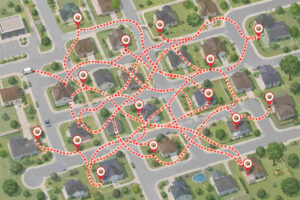
Aerial view of suburban neighborhood with chaotic zigzag delivery route line showing inefficient Amazon Flex stop order

Zigzagging Across Your Delivery Zone

The Flex app sends you to one side of your zone, pulls you across to the other side, then back to a street you already passed. You’re covering the same ground two or three times in a single block. The Flex algorithm is working with constraints you can’t see – package priority tiers, customer delivery promises, route-level balancing across all drivers leaving the station at the same time. The result is a route that looks logical in Amazon’s database but feels chaotic in your car. Drivers who use an Amazon Flex route planner report that eliminating this zigzagging cuts 15 to 20 percent of their total driving distance per block.

Your Last Stop Is Nowhere Near Home

Amazon doesn’t know where you live. The algorithm finishes your route wherever its math says the last delivery should go. Run five blocks a week and each one ends twenty minutes farther from home than it needs to an hour and forty minutes of unpaid driving every week. A good Amazon Flex route planner lets you set your home as the end location, so your last few deliveries naturally pull you toward your house instead of away from it. This single feature is the number one reason experienced drivers started using route planners in the first place.

No Time to Manually Reorder at the Station

You’ve got forty-plus stops and maybe five minutes before you need to be moving. Scrolling through addresses on your phone and trying to mentally figure out the best sequence isn’t happening. This is why speed of input matters so much in an Amazon Flex route planner. The planners that work for Flex drivers let you import stops instantly by pasting a list, uploading a screenshot, or scanning addresses from your manifest. If a planner asks you to type each address one by one, it’s not built for this job.

The Five-Minute Workflow: Station to Optimized Route

This is the part that matters most. The actual, repeatable workflow you can use starting on your very next block. By your third block, you’ll have it under five minutes.

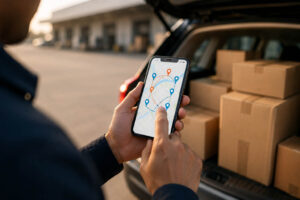
Close-up of delivery driver hands holding smartphone with route planner app showing multiple delivery stops at Amazon Flex station

Step 1:
Show up and load
Arrive at the station five to ten minutes early. Scan packages, load your car, and organize packages roughly by delivery zone. Same-area packages near each other.

Step 2:
Capture your stop list
Before you leave the station, get your stops into your Amazon Flex route planner. With Bodha Route Planner, you can bulk upload, scan addresses with your phone camera, or add stops using voice input. The goal is getting all forty stops into the planner in under three minutes.

Step 3: 
Set your start and end location
Start point is the station. End point is your home. This is the single most important setting in any Amazon Flex route planner. It’s what prevents the “last stop is forty minutes from home” problem.

Step 4:
Hit optimize
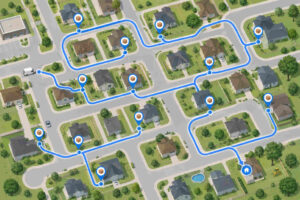
One tap. The route planner reorders your stops for minimum driving distance, ending near your home. Look at the route line. If it eliminates obvious backtracking (and it almost always will), follow it.

Step 5:
Drive the optimized sequence

Follow the route planner’s stop order for which delivery to do next. Still use the Flex app to mark each delivery complete and take your delivery photo. For turn-by-turn navigation, tap a stop in Bodha and it opens directly in Google Maps, Waze, or Apple Maps.

That’s the workflow. Five steps. Five minutes at the station. And you’ll feel the difference before you’re halfway through your first optimized block.


Aerial view of suburban neighborhood with clean optimized delivery route loop showing efficient stop order from an Amazon Flex route planner

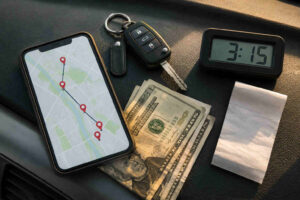
Let’s put a number on the impact. A 4-hour block pays $84. Finish in 4 hours and you made $21 an hour gross. Finish in 3 hours and 15 minutes instead? That’s $25.85 an hour. Same pay. Same deliveries. Less driving. The only difference is you reordered your stops before leaving the station.

How to Choose an Amazon Flex Route Planner That Actually Works

Not every route planner is built for the Flex driver workflow. A lot of them were designed for sales reps doing eight appointments a day. The stop counts are lower, the time pressure is lighter, and the user isn’t standing in a warehouse parking lot trying to get moving before their block clock starts ticking.

Here’s what actually matters for Flex:

Fast import – If you can’t get forty addresses into the app in under three minutes, the planner is costing you time instead of saving it. Photo scan, paste, voice input, or CSV upload all work at station speed. Manual typing is a dealbreaker.

Custom start and end points – Non-negotiable. Any Amazon Flex route planner that can’t set your home as the end location is missing the feature Flex drivers need most.

Handles real stop counts without a paywall – A standard Flex logistics block has thirty to fifty stops. If a planner caps you at ten or twenty stops on the free tier, you’ll hit that wall on your first real block. Google Maps only handles ten stops and doesn’t optimize the order at all. Circuit’s free tier is ten stops. Routerra caps at twenty free stops. Bodha Route Planner offers unlimited stops on the free tier, so you can run full Flex blocks on the free plan from day one.

Works offline – You’re going to lose signal during your block in parking garages, rural areas, and apartment stairwells. The planner needs to hold your optimized stop list without a live connection.

Simple, driver-friendly interface – You’re glancing at this at red lights and in parking lots. Big buttons, clear “next stop” cards, one-tap navigation to each address.

For drivers who also work DoorDash, Instacart, or courier gigs, Bodha handles all of it from one app. You’re not switching between a Flex planner, a DoorDash planner, and a separate app for your afternoon route. One Amazon Flex route planner for everything you deliver.

Why Flex Drivers Are Switching to Bodha Route Planner

Split image showing frustrated delivery driver with messy route on left and confident driver with clean optimized route on right using Bodha route planner

Most route planners were built for dispatchers and fleet managers. Bodha Drive was built for the driver standing in the station parking lot with forty packages and five minutes to get moving.

Here’s what makes it different for Amazon Flex. You add stops using scan, voice, or bulk upload without typing addresses one by one. You set your home as the end point, tap optimize, and your entire block gets resequenced in seconds. The route eliminates backtracking, clusters apartment stops together, and flows toward your house so your last delivery is minutes from your front door. While you drive, one tap opens each stop in Google Maps, Waze, or Apple Maps. No learning curve. No switching between three different apps.

The free tier gives you unlimited daily stops. Not ten. Not twenty. Unlimited. That means you can run full Flex logistics blocks without paying a cent. If you also deliver for DoorDash, Instacart, or run your own courier jobs, Bodha handles all of it from the same app. And because it includes proof of delivery with photo and signature capture, you’ve got a record of every drop if a customer ever disputes one.

Try Bodha Route Planner Free →

Pro Tips: What the Highest-Earning Flex Drivers Do Differently

Route optimization gets you most of the way there. But these three habits separate a $21-an-hour driver from a $28-an-hour one.

Pick your blocks strategically
Not every block is worth taking. Avoid anything under base rate unless you need activity points for Level 2. Watch for surge pricing during holidays, bad weather, and early mornings. Skip stations more than twenty minutes from your home unless the pay compensates for the deadhead drive. The math on a $92 block from a station ten minutes away is very different from the math on a $92 block from a station forty minutes away.

Flat lay on car dashboard showing smartphone with route map, car keys, dollar bills, and gas receipt representing Amazon Flex driver earnings and fuel savings

Track every single mile
This is the biggest money leak for drivers who skip it. The IRS standard mileage rate for 2026 is between $0.67 and $0.76 per mile. A typical Flex driver logs 15,000 to 25,000 miles a year, which adds up to $10,000 to $19,000 in potential tax deductions you’ll lose without records. Use Everlance, Stride, or MileIQ. Track from the moment you leave home until you get back. Deadhead miles to the station and the drive home both count.

Organize your car before you leave
Three minutes grouping packages by delivery zone saves you from digging through forty packages at every stop. Experienced drivers lose less than twenty seconds per stop on package retrieval. New drivers lose two to three minutes. Over forty stops, that difference adds up to over an hour.

The Bottom Line

Amazon built the most efficient delivery network on the planet using route optimization. That same principle, finding the fastest path through a set of stops, is available to every Flex driver right now, for free.

The Flex app gives you a route. An Amazon Flex route planner gives you a better one. The difference is thirty to sixty minutes of your time, a few dollars in gas, and potentially hundreds of dollars a month in recaptured earnings.

You don’t need to be a tech person. You don’t need twenty minutes to set it up. You need five minutes at the station, a route planner that handles your stop count without charging you, and the willingness to follow a smarter sequence instead of whatever the Flex app threw at you.

Bodha Route Planner is free to start, runs on your phone, and optimizes unlimited stops from your very first block. Download it, load your next Flex block into it, and see the difference for yourself.

Your blocks are already assigned. Your packages are already in the car. The only variable left is the order you deliver them in. Make it a good one.

Start Free with Bodha Route Planner →

Frequently Asked Questions

Yes. Most experienced Flex drivers run a route planner alongside the Flex app. You follow the planner's optimized stop order for sequencing but still use the Flex app to mark deliveries complete and take delivery photos. Using an external Amazon Flex route planner does not violate Amazon's terms as long as you complete every assigned delivery within your block.

Drivers consistently report saving 20 to 60 minutes per block by switching to an optimized stop order. On average, eliminating backtracking and zigzagging cuts 15 to 20 percent of total driving distance. On a 4-hour block paying $84, finishing in 3 hours raises your effective hourly rate from $21 to $28

The Flex app provides a suggested stop order, but it optimizes for Amazon's delivery cost — not the individual driver's total day. It doesn't consider where you live, your personal knowledge of the area, or your preferred end location. A dedicated Amazon Flex route planner usually produces a more driver-friendly sequence.

Bodha Route Planner offers unlimited daily stops on the free tier, mobile apps for iOS and Android, multiple input methods including scan and voice, and custom start/end locations so your block finishes near home. Most competing planners cap their free tier at 10 to 20 stops, which isn't enough for a standard Flex block.

Yes — this is the most popular feature among Flex drivers using an Amazon Flex route planner. By setting your home as the end location, the planner reorders stops so your final deliveries pull you toward your house instead of away from it. Instead of finishing thirty to forty minutes from home and driving back unpaid, you finish a few minutes from your front door.

Stop driving 40 extra minutes per block

Bodha Route Planner reorders your Flex stops in seconds — so you finish faster, burn less gas, and drive home instead of across town. Unlimited stops. Free forever.

Related blogs

How to Plan Delivery Routes: A Practical Guide for Operators

How to Plan Delivery Routes: A Practical Guide for Operators

Back Table Of Content Something every experienced dispatcher knows: the difference between a good day and a chaotic…


Reduce Delivery Costs: 10 Proven Strategies That Actually Work

Reduce Delivery Costs: 10 Proven Strategies That Actually Work

Back Table Of Content Last-mile delivery is the most expensive part of the logistics chain. It accounts for…
Best Route Optimization Software for Food Distributors in 2026: Features, Pricing & Top Picks

Best Route Optimization Software for Food Distributors in 2026: Features,…

Back Table Of Content In food distribution, the clock runs everything. You’re moving perishable stock through narrow receiving…

.